Last updated: 12 October 2026
TL;DR: Travel between one work assignment and another counts as working time for the minimum wage. Travel between home and work does not, unless the person works while travelling, and that is true even where there is no fixed workplace. Time spent training counts too. Mileage and pay are separate questions.
An RVN is asked to start at the main surgery, drive to the branch at eleven for two consults, and come back for the afternoon. She is paid for the hours she is at each site. The 35 minutes each way in her own car is unpaid, and the practice has never thought about it. That travel time is working time, and it may be taking her below the minimum wage.
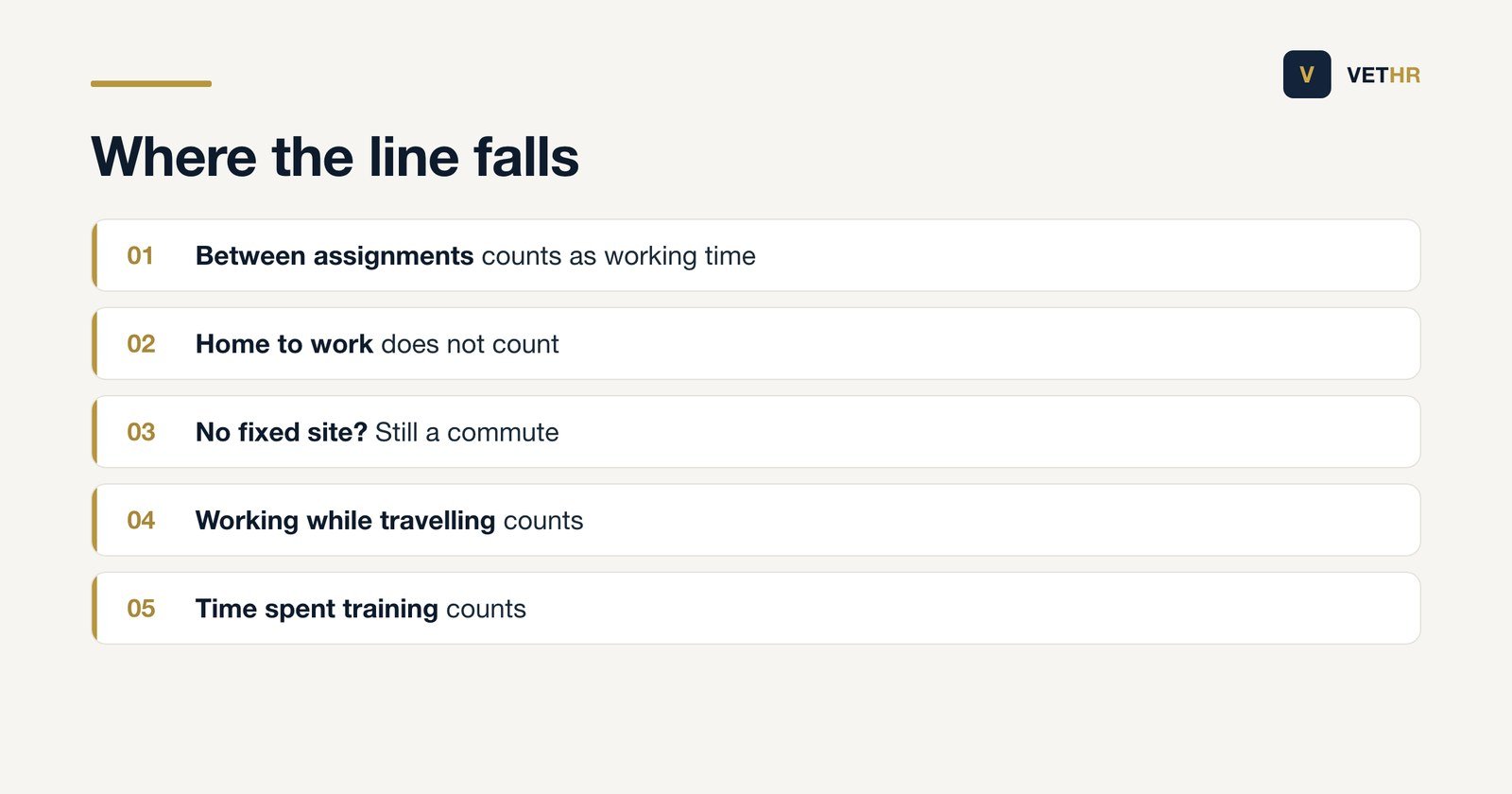
GOV.UK guidance on which hours count for the minimum wage includes travelling from one work assignment to another, giving the example of a care worker driving from one client to another between appointments.
The same guidance excludes travelling between home and work, unless the worker works whilst travelling, and says that exclusion applies regardless of whether the worker has a fixed place of work.
That second half matters in this profession, because plenty of veterinary staff do not really have one workplace. Not having a fixed site does not turn a commute into paid travel time.
Apply the assignment to assignment test and the answers become clear.
The training point is worth noting separately. A nurse sent on a course for the day is working, and the hours count, which changes the arithmetic for anyone near the minimum wage. Our note on training cost agreements covers the money side of CPD.
The journey from home to the first place of work, and the journey home at the end, unless the person is working during it. A vet who lives forty minutes from the practice is commuting, not accruing travel time.
The same is true where the first appointment of the day is a home visit and the vet goes straight there. That first journey is to work rather than between assignments.
Being on call and travelling to an emergency is a different question again, and it turns on the terms of the on-call arrangement. Our guide to on-call pay for veterinary staff deals with that separately.
There is a knock on for holiday pay. Where travel regularly forms part of someone’s working hours, it is part of their normal remuneration, and holiday pay calculated on contracted hours alone will understate what they are owed. Our note on holiday pay for irregular hours covers how the reference period works.
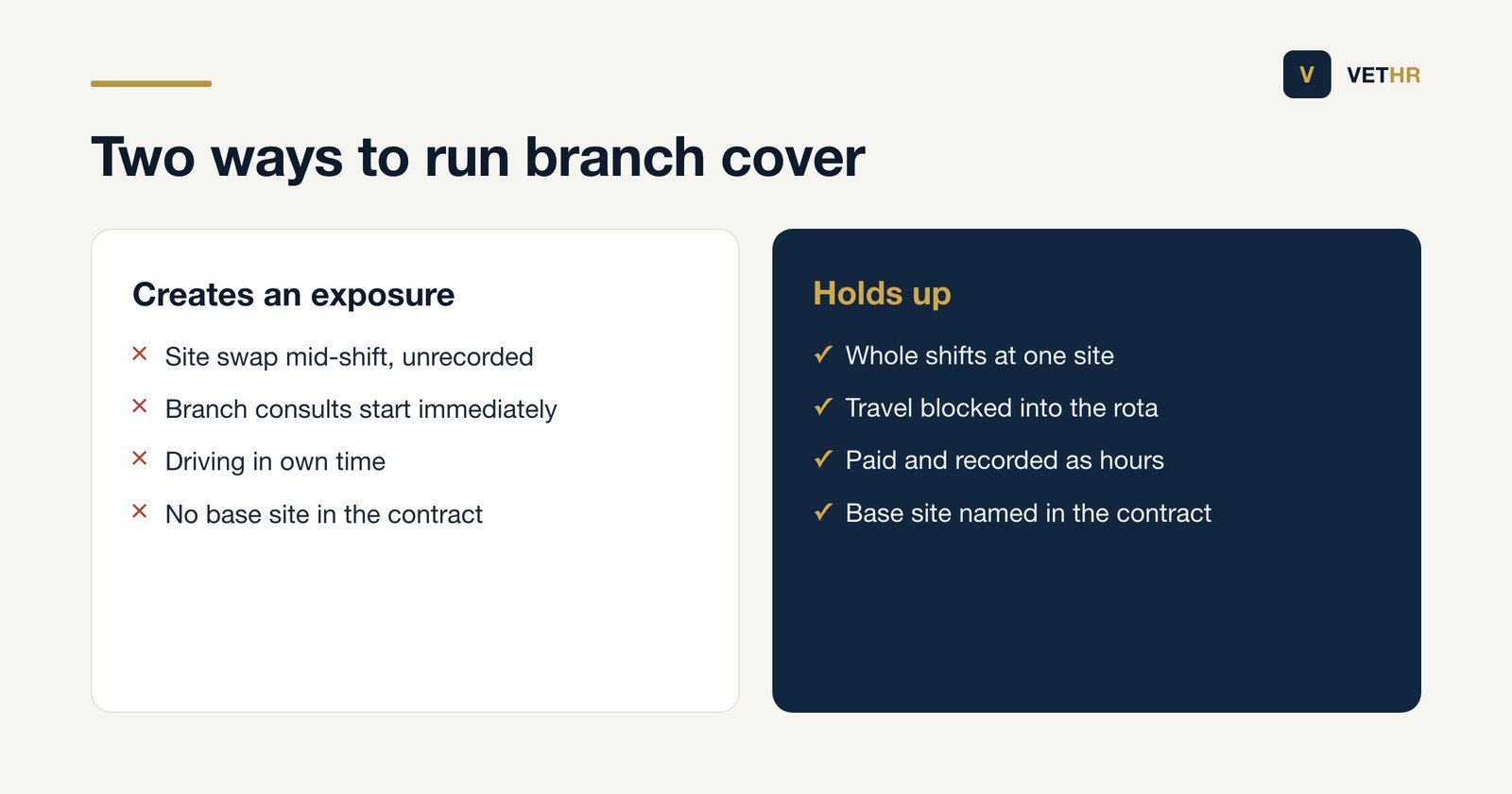
This is where most practices are exposed. A rota that moves people between sites mid-shift generates paid travel time every time it does so, and almost no small group records it.
Two fixes, and the first is better. Build the rota so people do whole shifts at one site wherever possible, which removes the issue and is also better for continuity of care.
Where mid-shift movement is unavoidable, put the travel in the rota as a paid block with a realistic duration, rather than pretending the consult at the branch starts the moment the previous one ends. Our note on HR for multi-site veterinary practices covers the wider rota design.
Say in the contract which site is the person’s base. Without that, the line between commuting and travel time between assignments is very hard to draw.
Tell people the position rather than leaving them to work it out. Staff who suspect they are driving for nothing rarely raise it, and the suspicion does more damage to goodwill than the money involved.
Once the working day has started, movement between calls is travel time. A vet who leaves the surgery at ten, does three home visits and returns at one has been working for three hours, driving included.
For mixed and farm practice this adds up fast, and the honest position is that a round is one long assignment rather than a series of unpaid gaps.
Watch the working time position as well as the pay. Long rounds plus travel time can push someone over daily limits or into inadequate rest, which is a separate duty. Our guide to working time rules for veterinary practices covers the limits.
Insurance is the detail practices forget. A member of staff driving between sites or out to visits in their own car needs business use on their policy, and social, domestic and pleasure cover will not extend to it. Ask for confirmation once a year, record the date, and say in the handbook who is responsible for arranging it.
Ask people what the journeys actually take, rather than what the map says. A twenty minute drive between two surgeries is thirty five minutes at five o’clock, and a rota built on the optimistic figure produces late consults every single week.
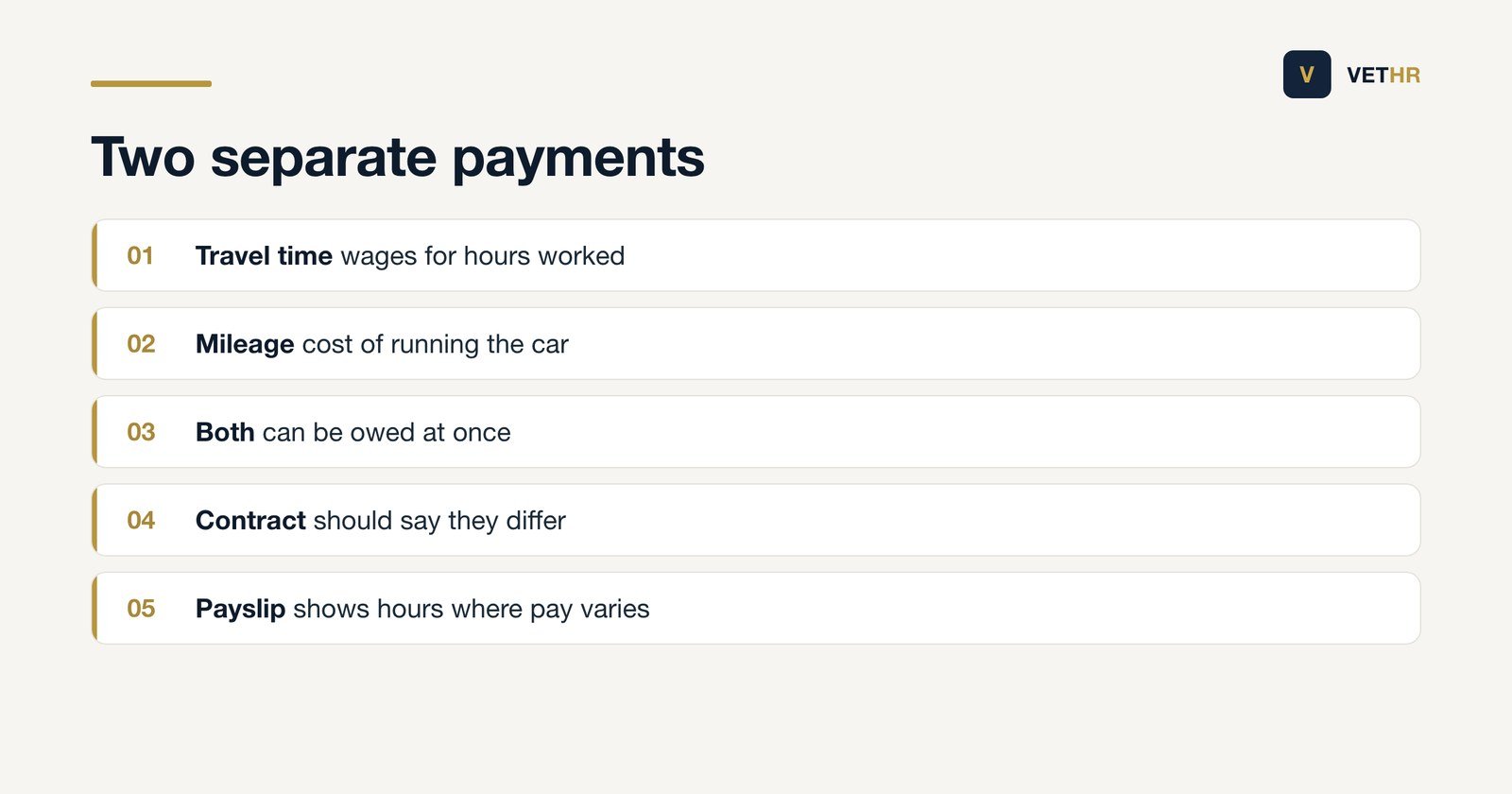
Paying mileage is not the same as paying for travel time. Mileage reimburses the cost of running a car. Travel time is wages for hours worked. A practice can owe both, and paying one does not discharge the other.
Say so explicitly in the contract and the handbook, because the confusion runs in both directions. Staff assume a mileage rate covers their time, and practices assume paying mileage settles the question.
Set the rate, say who claims what and by when, and keep it consistent across roles. Our note on staff benefits in a veterinary practice covers where allowances like this sit.
Be consistent across roles. A practice that pays a vet for driving to a farm call but not a nurse for driving to the branch is applying two different rules to the same legal test, and the person on the lower salary is the one losing out.
You cannot pay what you do not record. Get travel between sites and between visits into the same system as everything else, so it appears in worked hours rather than in somebody’s memory.
Then make sure it reaches the payslip. GOV.UK requires payslips to show the number of hours worked where pay varies depending on time worked, so travel time on a variable pay arrangement has to be visible.
Our clock in and out system records it against the shift, and the rota system lets you build the travel block in when you publish. Book a free 30-minute HR health check if you want us to look at a multi-site rota.
No. GOV.UK guidance excludes travelling between home and work from the hours that count for the minimum wage, unless the worker works whilst travelling, and that applies whether or not the person has a fixed place of work.
Yes, where it is travel from one work assignment to another during the working day. Moving someone from the main surgery to a branch mid-shift creates paid travel time in both directions.
Different rates can be agreed contractually, but the total pay for the total hours must still meet the National Minimum Wage. Check the arithmetic across the whole pay reference period rather than shift by shift.
No. Mileage reimburses the cost of using a vehicle. Travel time is pay for hours worked. A practice can owe both at once, and the contract should say clearly that they are separate.
Time spent training counts as working hours for minimum wage purposes. The journey is treated on the usual basis, so travel from the practice to a course during the day is different from going straight there from home.
The cheapest answer to travel time is a rota that does not move people mid-shift. Where the practice genuinely needs the movement, put it in the rota, pay it, and show it on the payslip.
We review multi-site rotas and the contracts behind them for independent practices, through HR consultancy for veterinary practices and the Vet HR staff systems.
The Vet HR Team provides HR consultancy and white-labelled staff systems exclusively to UK veterinary practices.
Contracts, rotas, holiday, a difficult conversation. Tell us what you are dealing with and we will come back within one working day. Nothing to sign up to.
Got it. We will come back to you within one working day. If you do not see a reply, please check your spam folder.
