Last updated: 30 October 2026
TL;DR: Where a risk assessment shows a risk of exposure to biological agents and effective vaccines exist, the vaccine should be offered to staff who are not already immunised. The employer pays. Staff must be told the advantages, disadvantages and limitations, they can decline, and occupational health records need updating.
A new nurse asks on day two whether the practice covers her tetanus booster, and whether she needs anything else for the work. Nobody can answer. There is no list of who has had what, no line in the budget, and the last conversation about staff vaccinations happened with a different practice manager in a different building.
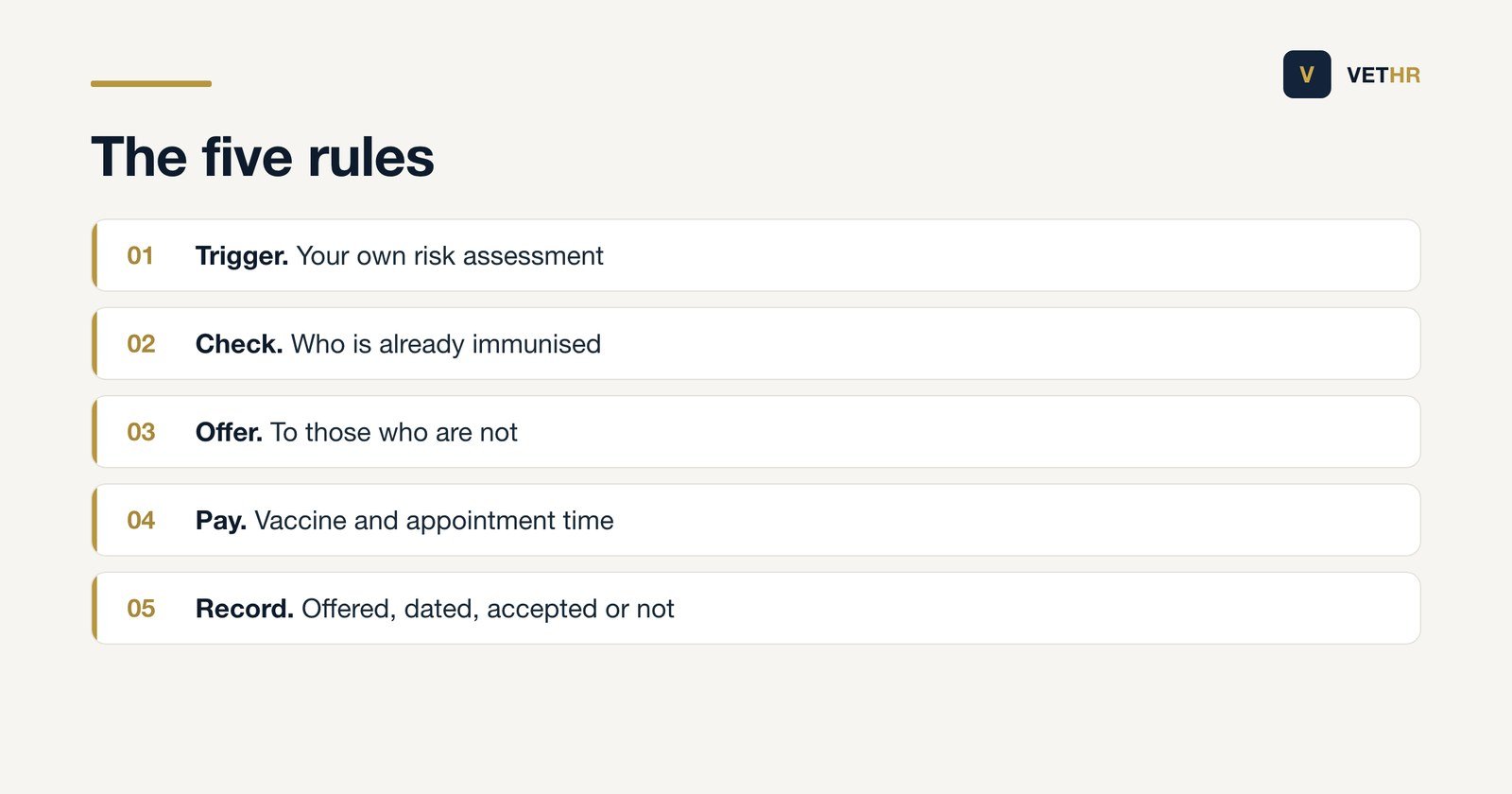
Your own risk assessment. HSE states that if a risk assessment shows there is a risk of exposure to biological agents, and effective vaccines exist, you should have arrangements in place to determine whether an employee is already immunised, and the vaccine should be offered to those who are not.
Two duties on staff vaccinations sit inside that sentence and practices usually do neither. Find out what people already have, and offer the vaccine to those who do not.
The trigger is the assessment rather than the job title, which means the answer can differ between a small animal nurse, a farm vet and a receptionist. Our guide to the zoonoses risk assessment is where that work starts.
The employer pays for staff vaccinations, without exception. HSE states that under the Health and Safety at Work Act, employers must pay for protective measures such as immunisation.
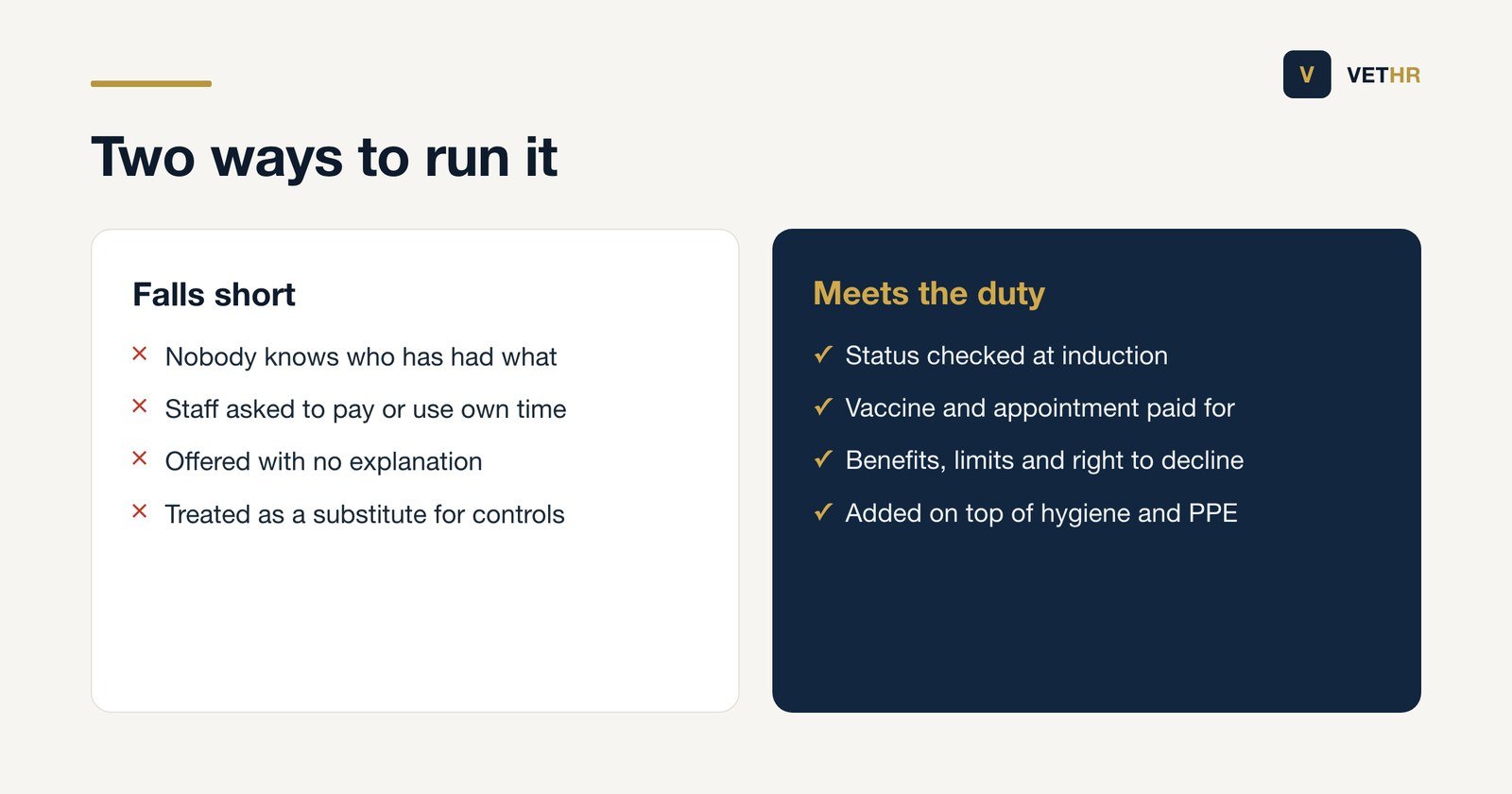
That includes the appointment as well as the vaccine itself. Asking someone to use their own time and money for a protective measure the assessment requires is not a cost saving, it is a failure of the duty.
Budget for it annually rather than treating each request as an exception. A line in the budget stops the answer depending on who happens to be asked, and on what sort of week the practice is having.
Staff vaccinations do not replace the controls. The legal framework sits in COSHH, and HSE sets out that employers must carry out a risk assessment and prevent or adequately control exposure to hazardous substances, with COSHH applying to incidental exposure to biological agents during work activities as well as to deliberate work with them.
Staff vaccinations sit on top of that, not instead of it. Hand washing, PPE, safe sharps handling, isolation procedures and a sensible approach to unvaccinated or imported animals all still have to be there.
A practice that answers an exposure risk with a vaccine and nothing else has skipped the part that actually protects people. Our notes on COSHH assessments and needlestick injuries cover the controls that come first.
Watch for the gap between a booster that is genuinely a work requirement and one the person would have had anyway. Practices sometimes decline to fund a tetanus booster on the basis that everybody should have one, which misses the point: if the assessment identifies the risk as arising from the work, staff vaccinations are a protective measure the employer owes.
Time it sensibly too. A course that needs several appointments over months is easier to complete if it starts during induction than if it starts in the middle of a busy autumn, and the person is far more likely to finish it.
An offer of staff vaccinations is not an instruction. HSE says that in providing vaccines, employers should ensure employees are made aware of the advantages and disadvantages of immunisation and its limitations, and it acknowledges that some workers prone to exposure may choose not to have the immunisation.
So the conversation has three parts: what the vaccine protects against, what it does not, and that declining is allowed. Record that the offer was made and what was decided, without recording clinical detail you have no business holding.
Someone who declines is not a problem to be managed. Revisit the other controls for that person, note that you did, and leave the door open if they change their mind.
Pregnancy changes the conversation and should trigger a fresh look at the assessment rather than a decision made at the desk. Our guide to the pregnancy risk assessment covers it.
HSE says employers should keep occupational health records updated regarding any immunisation courses carried out.
What the practice needs to record about staff vaccinations is narrow: who was offered what, on what date, and whether it was accepted or declined. That is enough to evidence the duty and it is not a medical record.
Keep it in the confidential health file rather than the personnel file, because vaccination status is health data. Our notes on health surveillance and GDPR and staff records cover the split between a health record and a medical record.
Bank staff, students and freelance vet cover need including in the question. They are exposed to the same hazards on the days they work, and they are the group most likely to fall outside a scheme that was set up once for the permanent team.
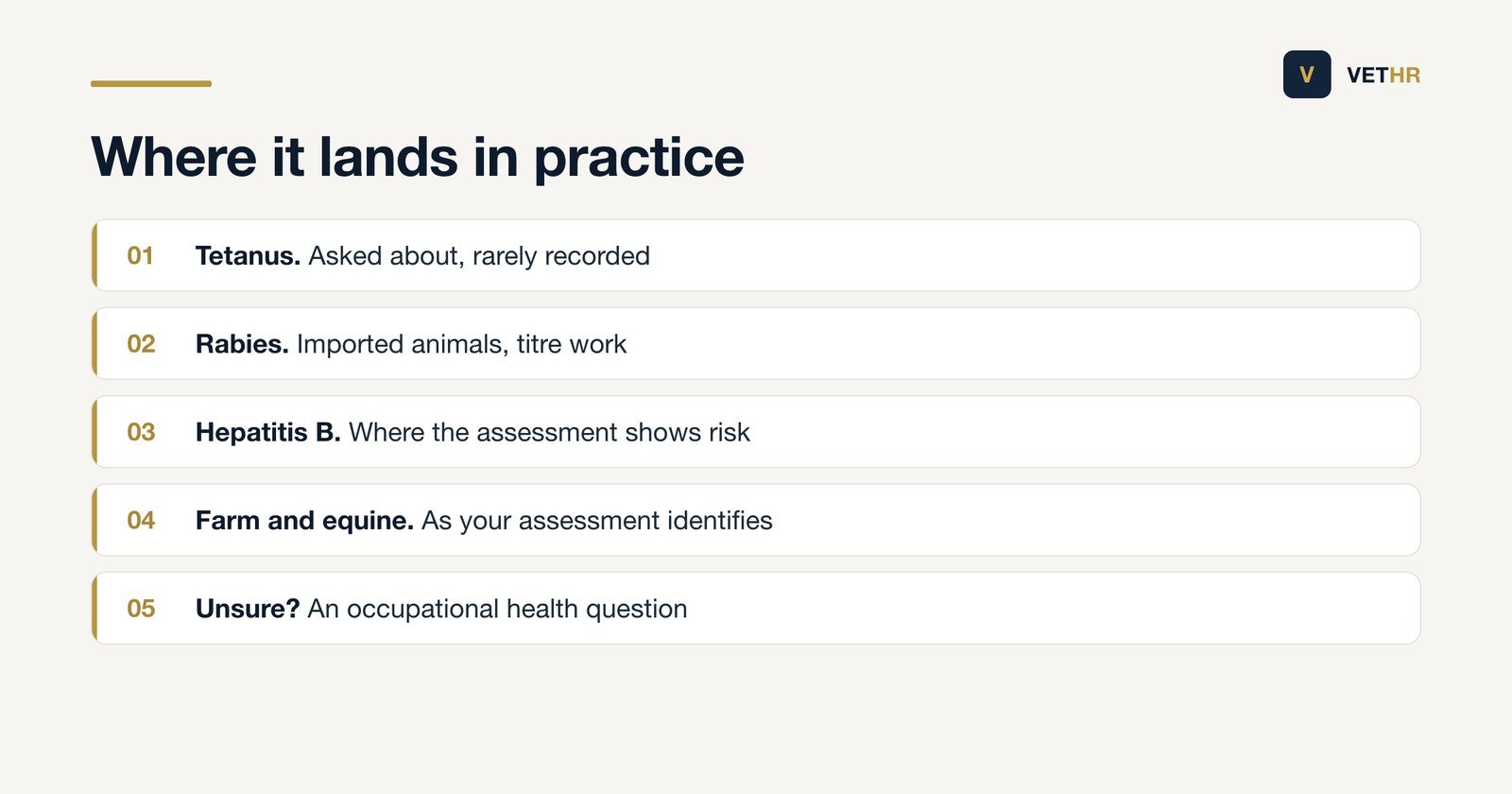
Work from your assessment rather than a list from the internet, because the right answer depends on the work your practice actually does.
Where the assessment is genuinely uncertain, that is an occupational health question rather than a practice manager question. Our note on occupational health in a veterinary practice covers setting up that relationship.
Review the list when the work changes. A practice that starts seeing imported rescue dogs, takes on farm work or opens an isolation ward has changed its exposure profile, and the staff vaccinations question should be asked again rather than assumed to be settled.
Five lines, in the health and safety section rather than a separate document.
Add the status check to the new starter checklist so it happens on day two rather than never. Our new starter checklist covers the rest of that week, and a free 30-minute HR health check will tell you whether your assessments actually say anything about this.
Yes, where the risk assessment calls for them. HSE states that under the Health and Safety at Work Act, employers must pay for protective measures such as immunisation. That covers the appointment time as well as the vaccine.
The duty is to offer, not to compel, and HSE acknowledges that some workers prone to exposure may choose not to have the immunisation. Where someone declines, revisit the other controls for that person and record that you did.
No. COSHH still requires a risk assessment and prevention or adequate control of exposure. Hand hygiene, PPE, sharps handling and isolation procedures remain in place regardless of who is immunised.
Who was offered what, when, and whether it was accepted or declined. HSE expects occupational health records to be kept updated regarding immunisation courses. Keep clinical detail out of the personnel file.
Your risk assessment, informed by occupational health advice where the position is not obvious. The work the practice actually does decides it, so a small animal practice and a mixed practice will reach different answers.
The nurse asking about her tetanus booster deserves an answer that does not depend on which manager is in. Check status at induction, offer what the assessment requires, pay for it, and keep one line per person.
We build health and safety document sets for independent practices through HR consultancy for veterinary practices and the policy document set.
The Vet HR Team provides HR consultancy and white-labelled staff systems exclusively to UK veterinary practices.
Contracts, rotas, holiday, a difficult conversation. Tell us what you are dealing with and we will come back within one working day. Nothing to sign up to.
Got it. We will come back to you within one working day. If you do not see a reply, please check your spam folder.
