TL;DR: Short-time working cuts hours and a lay-off sends staff home when there is not enough work. GOV.UK says an employer can do either only if the contract allows it, and that without a contract term staff are normally entitled to full pay. If staff are unpaid, guarantee pay is up to £41 a day for 5 days in any 3 months, a maximum of £205. After 4 weeks in a row, or 6 in 13, employees can claim redundancy.
Last updated: 5 November 2026

A branch is closed for six weeks while a new floor is laid. A hospital loses its night cover for a month because the out-of-hours partner has gone. A practice has a flood and half the consulting rooms are unusable. There is less work than staff, and the owner asks whether the nurses can be sent home without pay.
The honest answer is: only if the contract allows it, and even then there is a minimum payment. This guide explains lay-offs and short-time working in a veterinary practice, what GOV.UK says about guarantee pay and redundancy rights, and what to try before you reduce anyone’s hours. It is general information and not legal advice.
A lay-off means being sent home or kept off work, unpaid or otherwise, for at least one working day. Short-time working means hours are reduced. GOV.UK says an employer can ask an employee to do either if there is not enough work, and that there is no maximum period.
The gov.uk page on lay-offs and short-time working defines both terms. For employer guidance, its page on making staff redundant: lay-offs and short-time working says short-time working means reduced hours or pay of less than half a week’s pay.
They are not ordinary reductions in hours agreed by both sides. They are temporary measures when work has dried up, imposed by the employer. In a veterinary practice the triggers are usually closures, building works, loss of a service, loss of a vet or a sudden fall in demand. They are rare, which is why practices often meet the rules for the first time during a crisis.
Only if the contract allows it. GOV.UK says an employer can lay off an employee as long as the employment contract allows this, and that staff should normally get full pay unless the contract allows unpaid or reduced-pay lay-offs. The arrangement must be agreed first, through the contract, a collective agreement or long-standing accepted practice.
The employer page says any lay-off or short-time arrangement must be agreed with staff first, and that national and collective agreements can only be enforced if they are in the employee’s employment contract. In plain terms, check the contract, then the handbook, then any agreement the contract points to.
If there is no clause, you cannot simply send people home and stop paying them. Doing so is a breach of contract. Acas warns that imposing a change without agreement can lead employees to work under protest, bring claims or resign and claim constructive dismissal. Our guide to employment contracts for veterinary staff explains what the clause should say.
Guarantee pay is the minimum statutory payment an employee gets for a day without work, if they are laid off and not paid in full. The maximum is £41 a day for 5 days in any 3-month period, so £205. Employees who usually earn less than £41 a day get their normal daily rate.
From GOV.UK’s page on guarantee pay: the maximum you can get is £41 a day for 5 days in any 3-month period. To qualify, an employee must have been employed continuously for 1 month, which includes part-time workers, must reasonably make sure they are available for work, must not refuse any reasonable alternative work, including work not in the contract, and must not have been laid off because of industrial action.
Part-time entitlement is worked out proportionally. You cannot claim guarantee pay for any day that you do some work. An employer may have its own guarantee pay scheme, which cannot be less than the statutory arrangements, and if the employee is paid under it they do not also get statutory pay.

One caution on figures. The employer-facing GOV.UK page on lay-offs still shows an older £31 a day and £155 limit. The guarantee pay page shows £41 and £205, which is the current figure, so check the rate on the guarantee pay page or with your payroll provider before you pay.
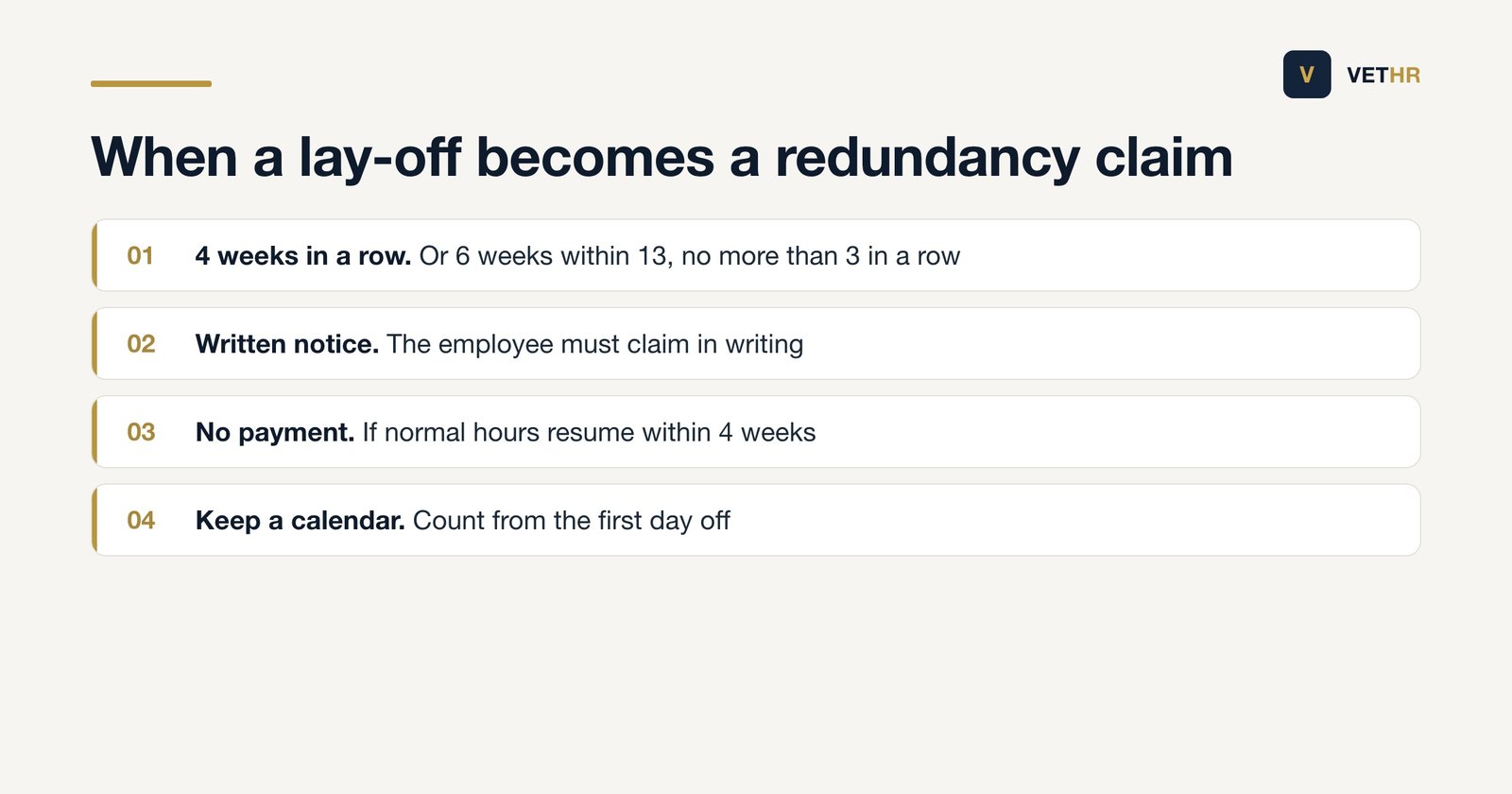
If a lay-off or short-time working lasts 4 or more weeks in a row, or 6 or more weeks in a 13-week period with no more than 3 of those weeks in a row, the employee can claim a redundancy payment. They must give written notice first, and no payment is due if normal hours resume within 4 weeks.
GOV.UK’s employer page sets out those thresholds, and its overview says there is no maximum length of a lay-off but that employees may claim redundancy after 4 weeks in a row or 6 weeks within a 13-week period. For a practice, this means a plan to lay staff off for two months is really a plan that may end in redundancy claims.
Count carefully. A six-week closure with staff off throughout crosses the line. A pattern of two weeks off, one week on, repeated, may cross the 6 in 13 test. Keep a calendar. Our guide to redundancy in a veterinary practice explains the redundancy process and the pay.
Try the options that keep people paid and in the job: agree a temporary reduction, offer annual leave or time off in lieu, redeploy staff to another site or task, use the quiet period for training, or agree unpaid leave for those who want it. Each avoids guarantee pay disputes and redundancy rights.
Our guides to time off in lieu and annual leave records cover those routes. If none of them work, take advice before you reduce hours without agreement.
You cannot lawfully impose unpaid lay-off or reduced hours. You can ask for agreement, offer something in return, or in extreme cases consider dismissal and re-engagement, which is risky now and will be restricted. Imposing the change anyway is a breach of contract.
Acas says imposing a contract change without agreement is a breach of contract, and that fire and rehire is a last resort that needs a fair reason, a fair process, correct notice and a right of appeal. The Employment Rights Act 2025 will make it automatically unfair to dismiss employees for refusing certain core changes, including changes to total hours, unless a narrow financial difficulty exemption is met. Our guide to fire and rehire explains the current law and the changes.
The safer route is to ask. Explain the problem, show the figures, offer a time limit and a review date, and give people the choice. Many staff will accept a short, clear, fair arrangement. The ones who will not may have other reasons, and it is better to learn them in conversation.
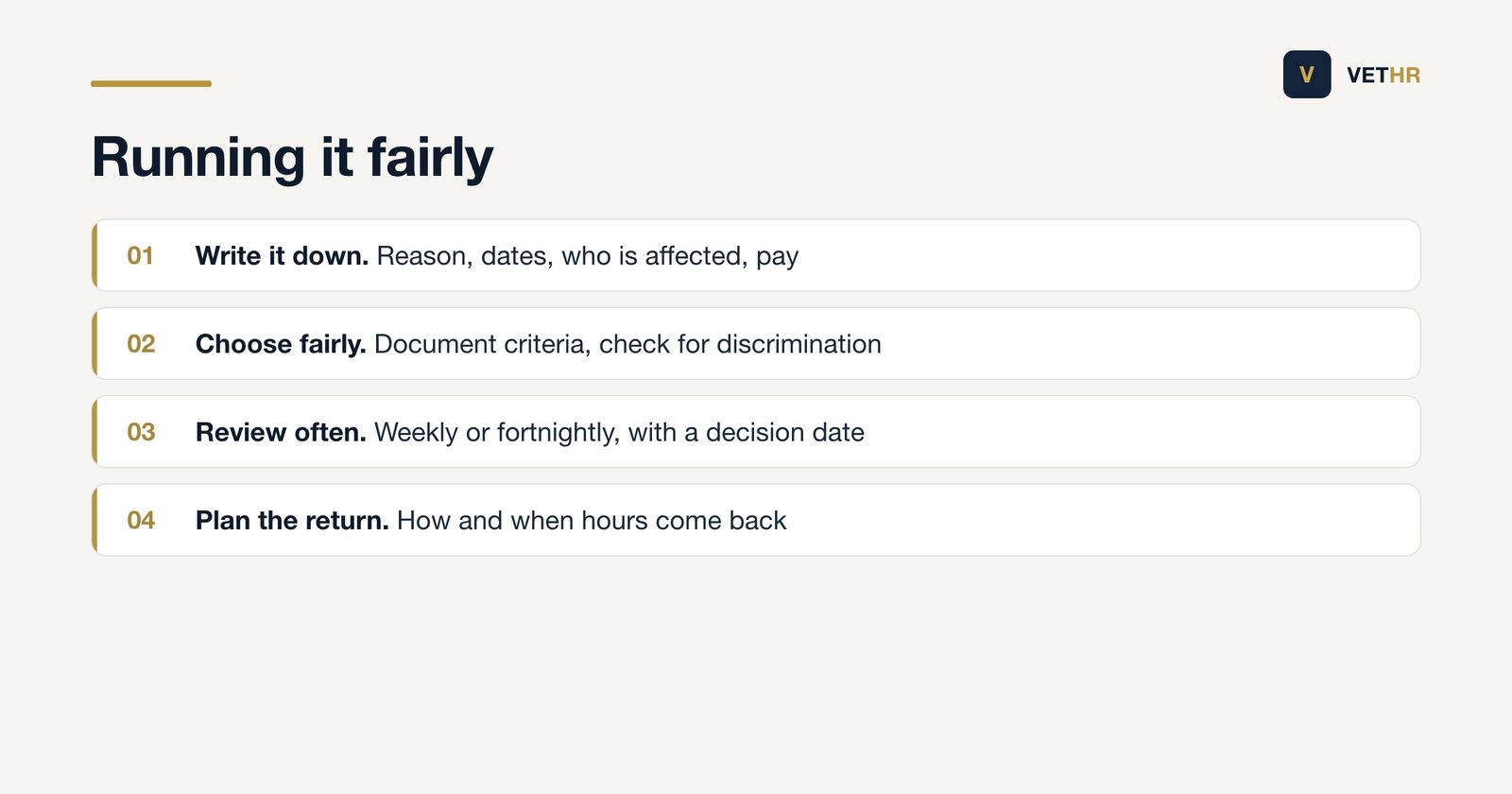
Write down the reason, the dates and the review points, tell everyone at once, apply the rules consistently, pay what is due and keep records. Put the agreement in writing. Check in during the period, and say clearly how and when normal working will resume.
Discrimination is a particular risk when choosing who is laid off. Pregnant staff, staff on family leave, part-timers and those with a disability are all protected, and a selection that disadvantages them can lead to claims. Take advice and document the criteria.
If you are facing a closure or a fall in work and want to talk it through before you decide, book a free 30-minute HR health check at our contact page. We can check your contracts for a lay-off clause and plan the alternatives.
If there is genuinely no work for a day, and the contract allows lay-off, pay guarantee pay unless a better contractual payment applies. If the contract does not allow lay-off, pay full pay. Do not ask staff to take unpaid time off to avoid paying. Consider whether closing a branch really means redundancy instead.
Where a branch closes permanently or a service ends, short-time working is not the answer. The right route is the redundancy process, with consultation and notice. Our guide to restructuring a veterinary practice explains how to run it, and the guide to short staffing covers the opposite problem.
For most practices the temporary nature of the problem decides the route. A short, defined closure is a candidate for agreed alternatives. A permanent change is a redundancy.
The rules apply to every employee who has completed a month of continuous service, but the practical picture differs by role. Nurses, reception staff, kennel assistants and vets are all covered in the same way, and part-timers are covered pro rata. Zero-hours and agency arrangements raise separate questions, so take advice before assuming the same route applies.
A closure of consulting rooms may leave vets with theatre or inpatient work while reception has little to do. That is a reason to review who is genuinely without work rather than sending a whole team home. Redeploying people to the work that remains is usually cheaper and fairer than paying guarantee pay to some and full pay to others.
Salaried staff on fixed hours are affected as much as hourly staff. A salary does not remove the need for a contract term. If a salaried nurse is told not to come in and the contract has no clause, the full salary is still due.
Keep the contract clause you relied on, the date and wording of every notice, each person’s days off and days worked, the guarantee pay calculation, the review notes and the date normal hours resumed. These records answer the two questions that matter later: was the arrangement allowed, and did anyone cross the 4 or 6 in 13 week lines.
A simple table works. One row per employee, one column per week, a mark for each week off and a running total. Check it at every review. Payroll needs the same dates to apply guarantee pay correctly, so share the table with whoever runs payroll.
If a claim does arrive, the records also show what you offered instead. A practice that can show it tried redeployment, leave and agreed reductions before laying anyone off is in a far better position than one that went straight to sending people home.
Tell staff first and in person where you can, then confirm in writing the same day. Explain the reason, the dates, the pay and the review date, and invite questions. People cope better with a hard message that is clear than with rumours about one.
For clients, say only what they need: which services are affected, for how long and where to go instead. Do not discuss individual staff arrangements. A closed branch or reduced out-of-hours cover is a service message, not an HR one.
Keep the tone steady. Staff watch how the owner handles a crisis, and a fair, well-explained arrangement protects morale and retention long after the quiet period ends.
The common mistakes are sending staff home without checking the contract, not paying guarantee pay, using the old figure, losing count of the weeks, picking people unfairly and keeping no records. Each can turn a temporary problem into a claim.
Only if the contract, a collective agreement or accepted practice allows it. Otherwise staff are normally entitled to full pay. Even where it is allowed, statutory guarantee pay applies, up to £41 a day for 5 days in any 3 months.
GOV.UK says the maximum is £41 a day for 5 days in any 3-month period, so £205. Employees who usually earn less than £41 a day get their usual daily rate, and part-timers are paid proportionally.
After 4 or more weeks in a row, or 6 or more weeks in a 13-week period with no more than 3 in a row. They must give written notice first, and no payment is due if normal hours resume within 4 weeks.
Not safely. Imposing a change without agreement is a breach of contract. Consult, explain, offer something in return and agree in writing. Dismissal and re-engagement is a last resort and is being restricted for changes to total hours.
No. GOV.UK says you cannot claim guarantee pay for any day that you do some work.
If work is falling or a closure is coming, book a free 30-minute HR health check through our contact page and we will review your contracts and options. See also our HR consultancy for veterinary practices and employment contracts.
Sources: GOV.UK: lay-offs and short-time working, GOV.UK: guarantee pay, GOV.UK: making staff redundant, lay-offs and short-time working.
Contracts, rotas, holiday, a difficult conversation. Tell us what you are dealing with and we will come back within one working day. Nothing to sign up to.
Got it. We will come back to you within one working day. If you do not see a reply, please check your spam folder.
