Last updated: 9 November 2026
TL;DR: A second job matters to the practice for three reasons: combined working hours must not exceed 48 a week on average, fatigue is a clinical safety issue, and there may be a genuine conflict of interest. GOV.UK is clear that combined working hours across jobs should not be more than 48 hours a week on average.
An RVN mentions she has picked up weekend shifts at another practice. She is contracted to you for 37 hours, the weekend work is another 16, and she is on your out of hours rota once a fortnight. Nobody has written anything down, and the first time anyone does the arithmetic is after a drug error on a Monday morning.
Usually yes, unless the contract restricts it. There is no general rule preventing a second job, and a blanket ban is both hard to justify and unpopular in a profession where people top up income with freelance vet cover.
What a practice can reasonably require is notification. A clause asking staff to tell you about a second job, so you can check the hours and any conflict, is proportionate and almost never resented.
A clause requiring your permission is stronger and needs to be exercised reasonably. If you have one, refuse only for a real reason, in writing, and say what it is.
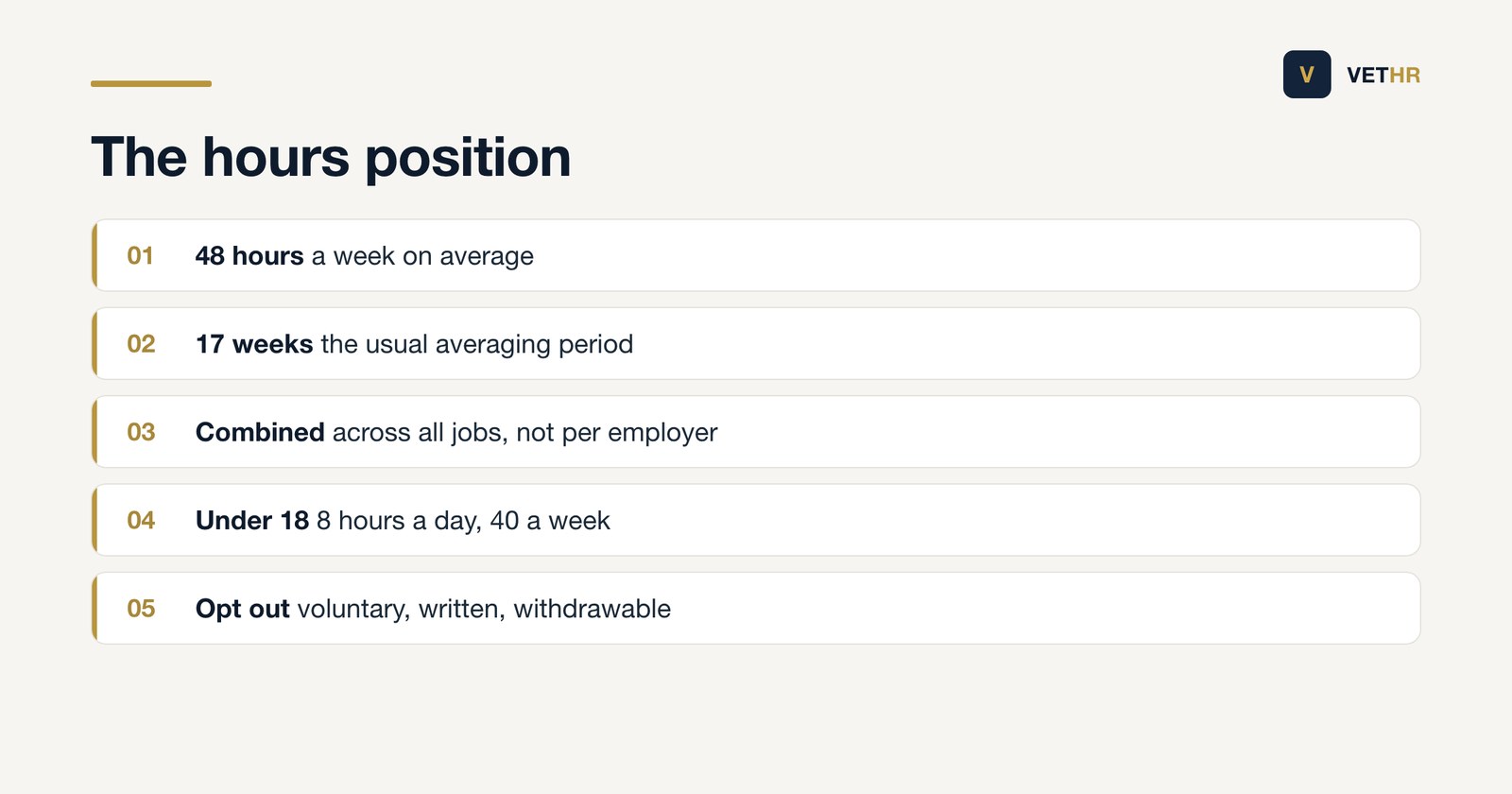
This is the part of the second job question most practices do not know. GOV.UK states that you cannot work more than 48 hours a week on average, normally averaged over 17 weeks, and that if you are under 18 you cannot work more than 8 hours a day or 40 hours a week.
Crucially, the limit is not per employer. GOV.UK says that where someone has more than one job, their combined working hours should not be more than 48 hours a week on average.
So the nurse on 37 hours plus 16 hours plus on-call is over the limit unless she has opted out. You cannot know that without asking, which is the whole argument for a notification clause.
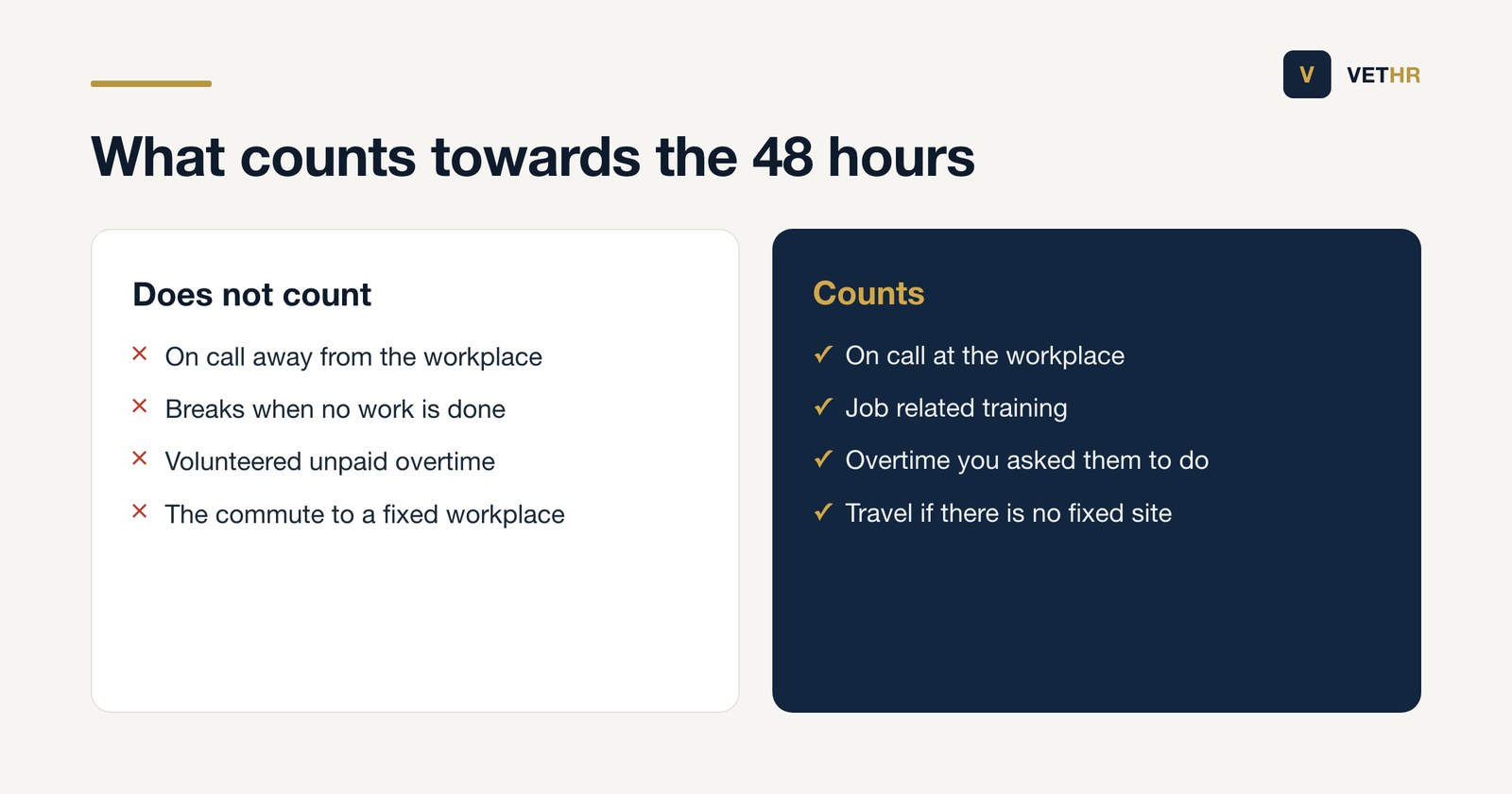
Worth knowing precisely, because the second job arithmetic changes depending on what goes in. GOV.UK includes job related training, time spent travelling if you travel as part of your job, working lunches, paid overtime, unpaid overtime you are asked to do, and time spent on call at the workplace.
It also includes travel between home and work at the start and end of the day where the person does not have a fixed place of work, which matters for anyone doing visits or covering several sites.
Excluded are time on call away from the workplace, breaks when no work is done, travelling outside normal working hours, unpaid overtime volunteered for, holiday, and the ordinary commute where there is a fixed workplace. Our guides to working time rules and on-call pay cover how those land on a veterinary rota.
Students and apprentices need a closer look. Someone studying alongside a job has study hours that are not working time but still consume the same week, and a rota built as though they were available like anyone else will show up as missed deadlines rather than as a working time breach.
Someone can choose to work more than 48 hours by opting out. The word choose is doing the work in that sentence.
An opt out has to be voluntary, individual and in writing, and it can be withdrawn. Putting it in the contract as a condition of employment, or presenting it as a form everyone signs at induction, undermines the voluntariness that makes it valid.
Keep the opt outs somewhere you can find them, with the date each was signed. A practice that believes everyone has opted out but cannot produce the paperwork has no opt outs at all.
An opt out also does not remove the rest of the working time rules, and it does not remove the practice’s duty of care.
Ask about a second job at induction rather than waiting for it to come up. A new starter asked openly in week one will usually tell you, whereas somebody who takes work on in month eight and has never been asked will assume the practice would rather not know.
Keep the record simple. One line per person on the personnel file saying where else they work and roughly how many hours, reviewed once a year, is all you need to answer the question properly if it ever matters.
The legal limit is a proxy for the thing that actually matters. A nurse doing 53 hours across two practices, with an out of hours shift in the middle, is a clinical risk long before she is a compliance problem.
So the second job conversation is not really about the contract. It is about which days she is working elsewhere, whether they sit either side of your nights, and whether the rota can be arranged so they do not.
Have that conversation as a rota planning exercise rather than a disciplinary one. Our notes on night workers and managing burnout cover the wider picture.
Some second job situations are a real problem, and it is worth being precise about which. Working for a competing practice nearby, taking client contact details, or using your protocols elsewhere are legitimate concerns.
Bar work, a family business, tutoring or a Saturday in a shop are not. A practice that treats all outside work as a threat loses goodwill and gains nothing.
Where the concern is genuinely about competition, that is a restrictive covenant question rather than a moonlighting one, and covenants have to be reasonable to be enforceable. Our note on restrictive covenants covers the limits.
Four lines, and none of them needs to be heavy handed.
Then actually ask, at induction and at the annual review, rather than waiting to hear about it in the staff room. Our notes on employment contracts and one to one meetings cover where both belong.
Book a free 30-minute HR health check if your contracts are silent on this and you would like the clause drafted.

A blanket ban is hard to justify and unpopular. A notification clause is proportionate and gets you what you actually need, which is the information to check hours and conflicts. A permission clause must be exercised reasonably.
Yes. GOV.UK states that where someone has more than one job, their combined working hours should not be more than 48 hours a week on average, normally averaged over 17 weeks. The limit is not per employer.
No. Opting out is a choice the individual makes, in writing, and it can be withdrawn. Making it a condition of employment or a form everyone signs at induction undermines exactly the voluntariness that makes it valid.
Time spent on call at the workplace counts as working time. Time on call away from the workplace does not. That distinction matters a great deal on a veterinary rota, and it should be clear in the contract.
Treat it as a rota and safety conversation, not a disciplinary one. Look at which days the other work falls on and whether it sits either side of your out of hours shifts, then adjust the rota if you can.
The nurse picking up weekend shifts is not doing anything wrong. She is doing what a lot of the profession does, and the only real problem is that nobody knew, so nobody could plan around it.
Add the second job notification clause, ask at induction and at review, and treat the answer as rota information rather than a conduct issue. We draft these clauses for independent practices through employment contract drafting and HR consultancy.
The Vet HR Team provides HR consultancy and white-labelled staff systems exclusively to UK veterinary practices.
Contracts, rotas, holiday, a difficult conversation. Tell us what you are dealing with and we will come back within one working day. Nothing to sign up to.
Got it. We will come back to you within one working day. If you do not see a reply, please check your spam folder.
