Last updated: 4 November 2026
TL;DR: The approved mileage rate for cars and vans is 55p from 6 April 2026, having been 45p before that, dropping to 25p above 10,000 business miles. Motorcycles are 24p and bicycles 20p. The 10,000 mile step applies to tax but not to National Insurance, which is the trap that catches practices with a busy farm or visiting vet.
A vet doing farm visits has claimed 14,000 business miles this year. The practice pays a flat rate per mile for all of them, payroll has never mentioned it, and nobody has looked at the figure since the rate changed in April. There is a National Insurance issue sitting in those numbers that almost nobody spots.
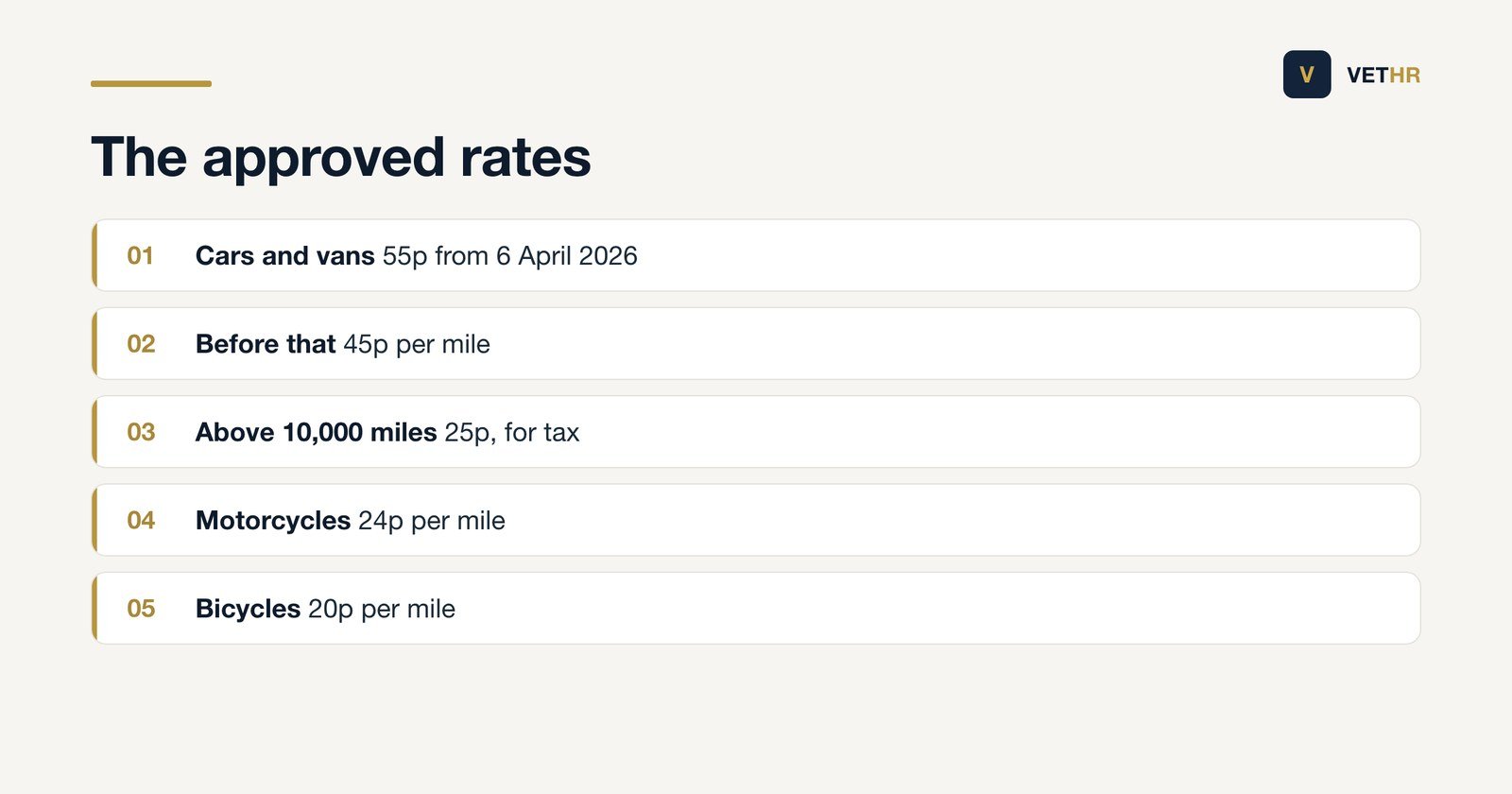
HMRC publishes approved rates, and they changed this year. GOV.UK gives the rate for cars and vans as 55p from 6 April 2026, having been 45p before 6 April 2026, with 25p for each business mile above 10,000. Motorcycles are 24p and bicycles 20p.
If your practice still pays 45p, that is now below the approved amount. It is not unlawful, but it costs your staff money and it has a consequence set out below.
Check the figure in your expenses policy against the current rate, because a number typed into a claim form in 2023 does not update itself, and neither does the spreadsheet somebody built around it.
You can, and it creates reporting. GOV.UK states that where you pay above the approved amount you must report it on form P11D, and add anything above the approved amount to the employee’s pay, deducting and paying tax as normal.
So a generous rate is not free. It is taxable pay above the threshold, and the paperwork is the practice’s rather than the employee’s.
Most independent practices are better off paying exactly the approved amount and being clear about it. It is simple, it is tax free to the employee, and it needs no P11D entry.
Paying below the approved rate is allowed and quite common. GOV.UK says the employee can then get tax relief on the unused balance, known as Mileage Allowance Relief.
Tell people that. A nurse driving between branches at 30p a mile is entitled to claim relief on the difference, and most staff have never heard of it. A line in the expenses policy pointing them to it costs the practice nothing and is genuinely useful.
It is not a substitute for a fair rate. Relief returns tax on the gap, not the gap itself, so a low mileage rate still leaves the person out of pocket.
This is the one worth reading twice. For National Insurance, GOV.UK sets the qualifying amount by multiplying business miles by the NI rate per mile, which for cars and vans is 55p from 6 April 2026, having been 45p before, with motorcycles at 24p and bikes at 20p.
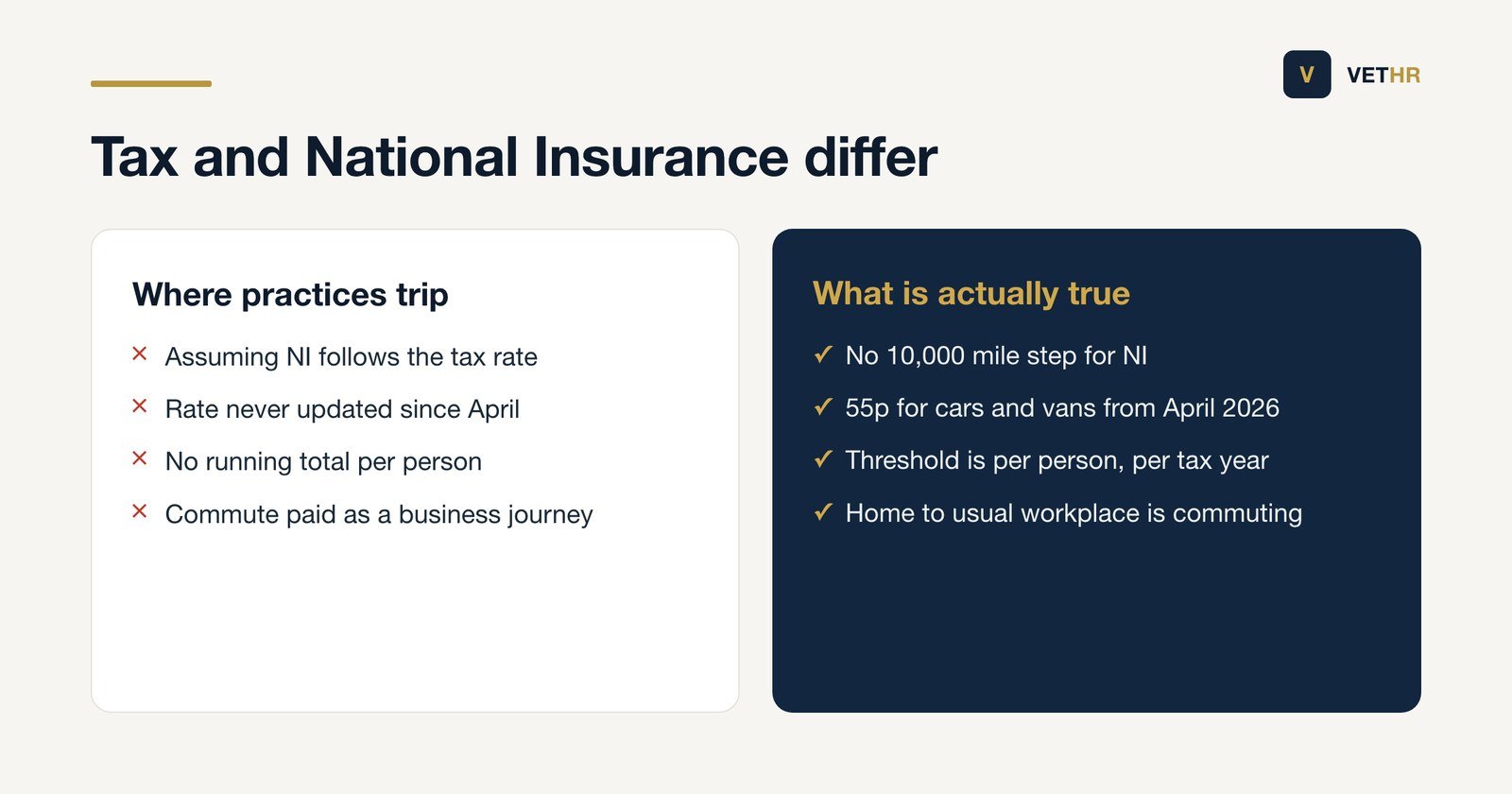
The crucial difference is that the 10,000 mile step does not apply for National Insurance. The same per mile rate applies regardless of how many miles are driven.
So the vet on 14,000 miles has a tax rate that drops to 25p after 10,000 and a National Insurance rate that stays at 55p throughout. GOV.UK also notes that there is no Mileage Allowance Relief for National Insurance, and that amounts cannot be carried forward between earnings periods.
Where payments exceed the qualifying amount, the excess is added to other earnings for Class 1 National Insurance for that period. Our note on veterinary payroll covers where that calculation belongs.
Passenger payments are worth knowing about separately. Where a colleague travels in the same car on the same business journey, HMRC operates a separate arrangement for carrying passengers, and it is one of the few genuinely free things a practice can offer a team that car shares to a CPD day.
Decide what happens with practice vehicles too. A car or van owned by the practice sits under completely different rules from an employee using their own vehicle, and a policy that covers only mileage claims leaves the other half unanswered.
Business journeys, not commuting. The drive from home to the usual place of work is not a business journey, and paying mileage for it creates a taxable benefit rather than an expense.
In a practice the genuine ones are clear enough: home visits, farm and equine rounds, travel between the main surgery and a branch during a shift, and a journey to a course or a supplier.
Remember that paying mileage is not the same as paying for the time spent driving, which is a separate question with its own rules. Our guide to travel time for veterinary staff covers when those hours must be paid.
Watch the on-call journey. A vet called out at two in the morning is making a business journey rather than a commute, and practices that reimburse those trips inconsistently tend to do it because nobody ever wrote down which category they fall into. Our note on on-call pay covers the money side of the same shift.
Anyone claiming mileage in their own car needs business use on their policy. Social, domestic and pleasure cover does not extend to driving between sites or out to visits.
Ask for confirmation once a year, record the date, and say in the policy that it is the individual’s responsibility to hold the right cover and the practice’s responsibility to check.
While you are asking, check the driving licence too. One annual email covers both and takes a morning. Our note on HR for multi-site veterinary practices covers the rest of the branch travel question.
Apply the same rate to everybody. A practice paying a vet 55p and a nurse 40p for the same branch journey has created a fairness problem that will surface the first time the two of them compare notes, and there is no tax reason for the difference.
Five lines and one form. The policy says the rate, which journeys qualify, the deadline for claiming, who authorises, and the insurance requirement.
The form needs the date, the journey, the reason and the miles. Running totals matter more than most practices realise, because the 10,000 mile threshold is per employee per tax year and nobody notices it being crossed unless something is counting.
Set a claim deadline of one month and hold to it. A stack of six month old claims landing in March is how a year end goes wrong, and it is unfair on whoever has to reconstruct the journeys. Our note on payslips covers how the payment should appear.
If nobody has looked at your rate since April, book a free 30-minute HR health check and we will go through it with you.

For cars and vans GOV.UK gives 55p from 6 April 2026, having been 45p before that date, then 25p for each business mile above 10,000 in the tax year. Motorcycles are 24p and bicycles 20p.
Yes, but anything above the approved amount must be reported on a P11D and added to the employee’s pay with tax deducted as normal. Most independent practices are better off paying exactly the approved amount.
Because the 10,000 mile step does not apply for National Insurance. The same rate per mile is used regardless of volume, so a high mileage vet has a tax rate that drops and an NI rate that does not.
No. Home to the usual place of work is commuting, and paying mileage for it creates a taxable benefit rather than a reimbursed expense. Home visits, farm rounds and mid-shift branch travel are the genuine ones.
Yes, if they drive their own car for work. Social, domestic and pleasure cover does not extend to it. Ask for confirmation annually, record the date, and check the driving licence in the same email.
The vet on 14,000 miles is not a payroll problem until nobody is counting. Update the rate, run a total per person per tax year, and know that the National Insurance calculation does not follow the tax one.
We write expenses policies and check them against contracts for independent practices through HR consultancy for veterinary practices and employment contract drafting.
The Vet HR Team provides HR consultancy and white-labelled staff systems exclusively to UK veterinary practices.
Contracts, rotas, holiday, a difficult conversation. Tell us what you are dealing with and we will come back within one working day. Nothing to sign up to.
Got it. We will come back to you within one working day. If you do not see a reply, please check your spam folder.
