TL;DR: EMS placements are the practical weeks veterinary students must complete outside the vet school. RCVS says students need a minimum of 30 weeks, at least 20 of them clinical, and expects providers to assess risk, brief students, carry suitable professional indemnity cover, assign a contact and give feedback. GOV.UK says students on a required placement of up to a year are exempt from the minimum wage, and shadowing is not covered by it at all.
Last updated: 10 November 2026

Every practice gets the request: a second-year student wants a week of seeing practice, or a final-year student needs two weeks of clinical time before graduating. The practice says yes because it remembers being the student, and then spends the first morning discovering that nobody knows who is looking after them, whether they are insured or what they are allowed to touch.
This guide covers EMS placements in a veterinary practice: what RCVS expects of a provider, how to handle insurance, pay and supervision, and a checklist that makes hosting vet students easier. It is general information and not legal advice.
EMS stands for extra-mural studies. They are practical placements that veterinary students complete outside the vet school, in practices, farms, referral centres and other animal settings. RCVS says students must dedicate a minimum of 30 weeks to extra-mural studies, and that at least 20 of those weeks should be clinical.
RCVS’s guidance for providers on information for EMS providers also encourages at least six weeks of clinical EMS each year during the clinical years, and requires at least 10 weeks of animal husbandry EMS, usually in the early years. Individual vet schools can set higher figures and split the weeks differently, so do not assume the number from one school applies to another.
The requirements also depend on when the student started their degree. RCVS says students who started after August 2024 are covered by the 2024 EMS policy and earlier starters by the 2023 policy. Ask the student which policy and which school they follow, and which forms the school expects you to complete.
Students bring energy and questions, and good EMS placements is one of the best recruitment tools a practice has. Many practices meet their next graduate vet or nurse this way. Hosting also strengthens the team’s own teaching and standards, because explaining why you do something makes you check you are doing it well.
EMS placements cost time. A student who is poorly organised is a drag on a busy consult room, and a student who is well organised is an extra pair of hands who leaves with a good reference and an interest in your area. The difference is almost entirely planning, which is why this guide is mostly about the first hour of the first day.
RCVS also runs a free National Booking Database where providers can advertise placements and students and schools can find them. Joining it can reduce the stream of ad hoc email requests, because students book against the slots you offer. Contact details for being listed are on the RCVS provider page.
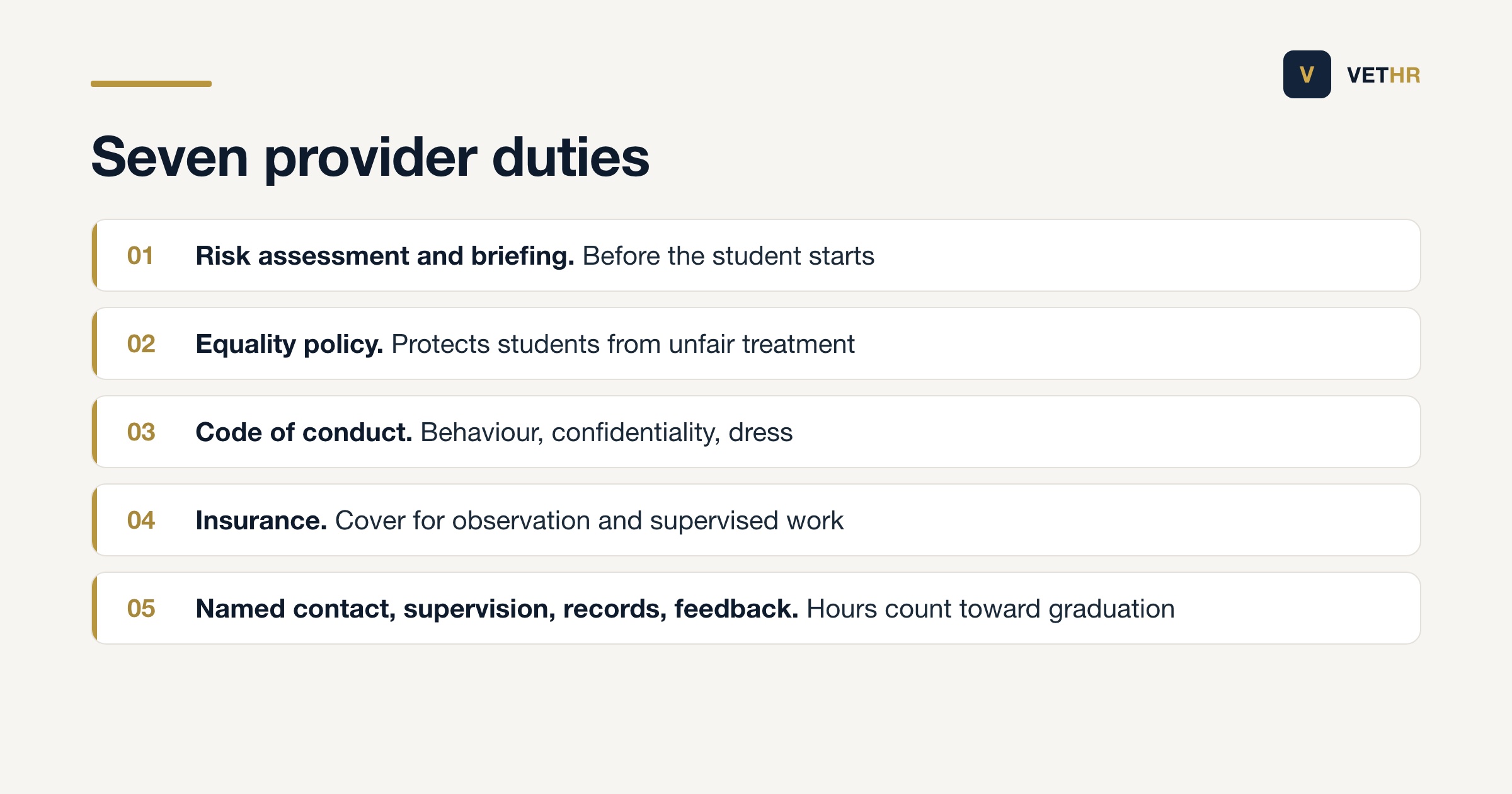
RCVS asks providers to follow health and safety law, carry out risk assessments, put safety protocols in place and brief students before they start. It also asks for anti-discrimination policies in line with the Equality Act 2010, clear professional expectations, a named contact, appropriate supervision, accurate attendance records and constructive feedback.
The RCVS page on the role of the EMS provider lists these duties. Turn them into a short internal procedure:
RCVS says students may examine animals, run diagnostic tests and give treatment under supervision, and that surgery must be under the direct and continuous supervision of a registered veterinary surgeon. It also asks providers to tailor supervision to each student, progressing from observation to supervised participation.
RCVS says students should follow the Veterinary Surgeons (Practice by Students) (Amendments) Regulations 1993. In practice, agree on day one what the student may do, who supervises each task and what they must never do alone. Ask the student what they have done before and what they want to learn, because a final-year student on their fourth placement needs a different programme from a first-year on their first.
Match tasks to confidence on EMS placements. Early on, let the student watch, then perform part of a procedure under direct supervision, then more. Say clearly that asking is always welcome and that stopping when unsure is a strength. A student who is afraid to say they are lost is the one who makes a mistake.
Our guide to lone working matters here. A student should not be left alone with animals or clients, in the building or on a visit, unless the school and your risk assessment say otherwise.
RCVS says students are covered by BVA student membership for personal accident and personal liability, but not professional liability. It asks providers to ensure their professional indemnity insurance, or equivalent, covers observations, supervised practical activities and educational activities during the placement. Do not assume. Check.
The RCVS page on health and safety on EMS placements says providers have a legal obligation to communicate their health and safety policies to students, and that safety is shared between the vet school, the provider and the student. It says the school confirms cover, and students are advised to have their own insurance too.
Email your insurer and ask a direct question: does my cover extend to EMS students observing and carrying out supervised tasks? Keep the reply on file. Employers’ liability and public liability are separate policies, so ask about those too. If the answer is no or unclear, fix it before the student arrives.
Generally no, if the placement is a required part of their course and lasts no more than a year. GOV.UK says students doing work experience that is a required part of a UK further or higher education course are exempt from the minimum wage, provided the placement does not exceed one year. Shadowing is not covered by minimum wage law at all.
GOV.UK’s guidance on minimum wage, work experience and internships says the exemption does not cover work unrelated to the course, such as part-time work to fund studies. It also says that intern has no legal status, that entitlement depends on the actual arrangement and that a promise of paid work or a future contract can make someone a worker.
That last point matters in a practice. If you offer an EMS student a paid summer job as a clinical assistant, or a paid job on the side, that work is not part of the placement, and it is paid work with employment rights. Keep EMS placements and paid work clearly separate, in writing. Our guide to minimum wage in a veterinary practice covers the rates.
Many practices choose to cover lunch and travel or to offer a small contribution. GOV.UK says reasonable out-of-pocket expenses can be repaid to a genuine volunteer without creating worker status, but you should check your arrangement against that page, and take advice if you plan to give anything beyond expenses. The RCVS provider pages do not cover pay or expenses, so the position comes from the employment rules.

Before EMS placements begin, send the code of conduct, the day-one timetable, parking and dress details and the name of their contact. On the day, brief them on safety, introduce the team and agree what they may do. At the end of each day, spend five minutes on what went well and what they want to see next.

A one-page welcome pack works well:
Confidentiality needs a particular mention. Students see client records and staff conversations. Tell them what they may not repeat or photograph, and keep them away from systems they do not need. Our guides to GDPR and staff records and the staff privacy notice explain how to handle personal data properly.
RCVS asks providers to keep accurate attendance records because placement hours count toward graduation, and to complete the required feedback forms with detailed comments. It asks for feedback that is specific, encouraging and constructive, backed by concrete examples. It also encourages students to give honest feedback on your placement.
Sign hours off daily or weekly while the details are fresh. Write the feedback with examples: the student took a clear history, handled a nervous dog well, needs to work on confidence with injections. Vague words such as good or fine do the student no favours and the school cannot use them.
If a student is not meeting standards, tell them early and tell the school. A problem raised on day two can be fixed. A problem raised on the last day is a surprise. If there is a concern about safety or conduct, follow the school’s procedure and your own, and take advice.
Tell the team before a student arrives, not on the morning. Nurses and receptionists often teach students more than vets do, and they need to know the student’s level and what they may do. Ask the team to speak up if they see a student out of their depth.
Tell clients that a student is present and ask permission before a student is in the consulting room. Most owners are happy, but some are not, and a refusal must be respected without comment. A short sign at reception or a line on the booking confirmation does the job.
Look after your own people too. Hosting EMS placements adds to a busy week, and the supervising vet loses time. Agree who covers what, protect the contact’s diary, and recognise the effort in appraisals. Practices that treat teaching as extra work done in spare minutes burn out the people who are best at it.
Finally, keep a simple log of the students you have hosted, their dates, their school and the person who supervised them. It helps with references, with RCVS or school queries and with spotting good future recruits.
The usual mistakes with EMS placements are no named contact, no briefing, assuming insurance covers students, leaving students unsupervised, blurring placement and paid work, and late or vague feedback. All are cheap to fix with a one-page procedure and ten minutes of planning.
RCVS says a minimum of 30 weeks, with at least 20 clinical. Vet schools can set higher or differently split figures, and the policy depends on when the student started their degree, so ask the student’s school.
GOV.UK says students on work experience that is a required part of a UK further or higher education course are exempt from the minimum wage if the placement does not exceed one year. Shadowing is not covered. Paid work outside the placement carries employment rights.
RCVS asks providers to ensure their professional indemnity cover extends to observations, supervised practical activities and educational activities. Ask your insurer in writing and keep the reply.
RCVS says students may examine animals, run diagnostic tests and give treatment under supervision, and that surgery must be under the direct and continuous supervision of a registered veterinary surgeon.
RCVS runs a free National Booking Database. Contact details for being listed are on the RCVS provider page.
If you want a ready-made procedure for EMS placements, welcome pack and code of conduct, book a free 30-minute HR health check through our contact page. Our policies and handbook system includes templates you can adapt, and our HR consultancy can help with insurance and employment questions.
Sources: RCVS: information for EMS providers, RCVS: the role of the EMS provider, RCVS: health and safety on EMS placements, GOV.UK: minimum wage, work experience and internships.
Contracts, rotas, holiday, a difficult conversation. Tell us what you are dealing with and we will come back within one working day. Nothing to sign up to.
Got it. We will come back to you within one working day. If you do not see a reply, please check your spam folder.
