Last updated: 20 November 2026
TL;DR: Workers have the right to one uninterrupted 20 minute rest break during their working day if they work more than 6 hours a day, 11 hours rest between working days, and either 24 hours without work each week or 48 hours each fortnight. The break does not have to be paid. Uninterrupted is the word practices fall over.

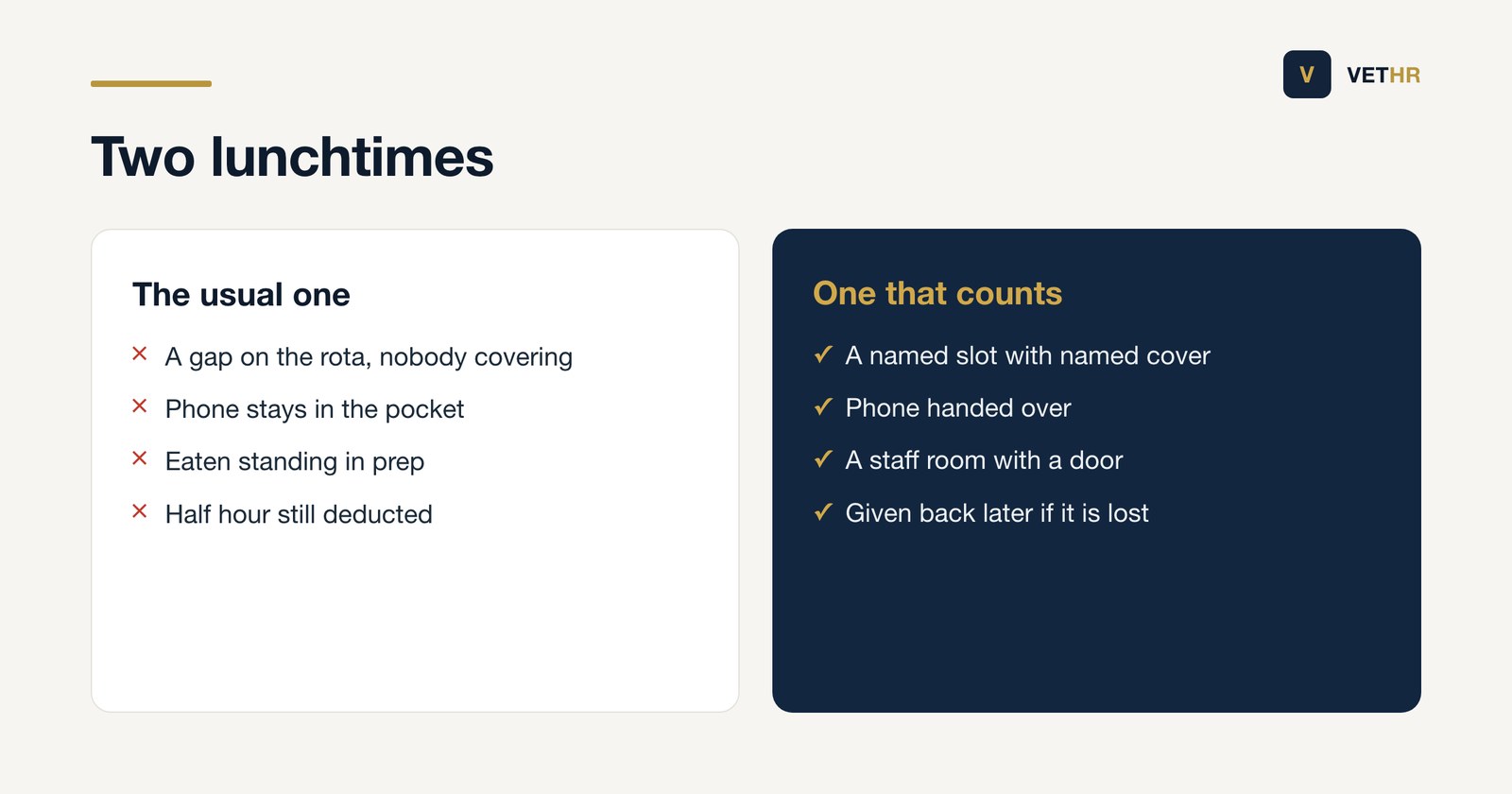
Every practice has a version of the same lunchtime. A nurse sits down at one, the door goes at five past, and she eats standing at the prep bench at ten to two. Nobody did anything wrong and the practice has still not given a legal rest break.
GOV.UK splits rest breaks at work into three separate rights, and it helps to keep them apart because practices tend to think only about the first. Two of the three are not really breaks at all, they are gaps between shifts, which is why rest breaks get missed on a rota that only plans the working day.
Twenty minutes is a floor, not a target. Most practice contracts promise a half hour or an hour, and a contractual promise is enforceable on top of the statutory minimum.
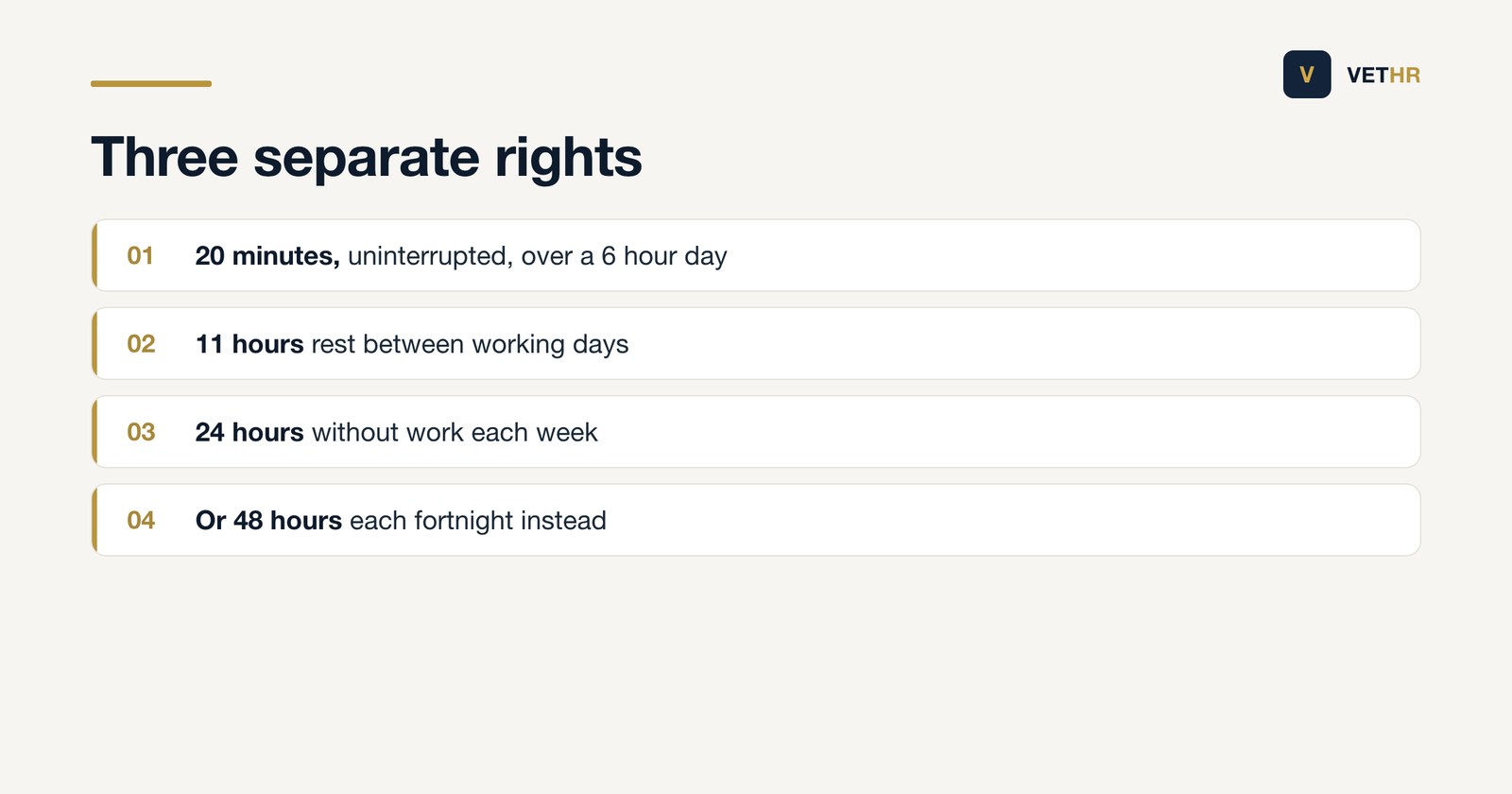
One uninterrupted twenty minutes. Not four fives. Not twenty minutes with a phone in your pocket. Not a sandwich in the prep room with the door open and a dog crashing next door. Rest breaks that are technically taken and practically interrupted are the normal state of a busy practice.
In a practice the interruption is almost never deliberate. It is a walk-in, a phone call reception cannot hold, a recovery that goes wrong. But the break still did not happen, and if it never happens then the right is not being honoured.
The honest question for a practice owner is not whether rest breaks are scheduled. It is whether anybody in the building has actually had one this week. Ask, and be ready for the answer.
GOV.UK is clear that the break does not have to be paid, and that it depends on the employment contract.
So whether rest breaks are paid is your decision, and it needs to be the same decision for everybody. The common practice model is an unpaid half hour deducted from the shift, which is fine, as long as the half hour genuinely happens.
Where it goes wrong is deducting unpaid rest breaks that were worked. That is unpaid work, and over a year it is a meaningful sum for somebody on a nurse’s salary. If the break is routinely lost, either protect it or stop deducting it. Our notes on deductions from wages and overtime cover the pay side.
The second of the three rest breaks entitlements, eleven hours between working days, is the one that catches out a practice running its own out of hours.
Finish at eight, back on at nine the next morning, and the gap is thirteen hours. Finish a late at ten and open at eight, and it is ten. That is the sort of rota that looks fine on a spreadsheet and fails the rule by an hour.
It matters most around on-call. A vet called out at three in the morning has had their daily rest broken, and simply carrying on into a full consulting day is the pattern behind most of the tired, clinically risky shifts we hear about. Our guides to on-call pay, night workers and the working time rules cover the surrounding law.
Either an uninterrupted 24 hours without any work each week, or an uninterrupted 48 hours without any work each fortnight. The choice is the employer’s, and it should be stated rather than assumed.
Without any work is the phrase to notice. A Sunday spent at home carrying the on-call phone is not an uninterrupted 24 hours without any work in any ordinary sense, even if nothing rings.
Practices running a one in three or one in four weekend usually satisfy this comfortably. Practices where the same two people cover everything usually do not, and nobody notices until one of them resigns. Weekly rest is the quietest of the three rest breaks rules and the one most often broken for months at a time.
There is a line in HSE’s guidance on fatigue at work that settles most arguments about rest breaks in a practice. The legal duty is on employers to manage risks from fatigue, irrespective of any individual’s willingness to work extra hours.
That matters because veterinary teams volunteer. They skip rest breaks, stay late and pick up the extra list, and they do it willingly. Their willingness does not move the duty.
HSE describes what fatigue actually does: slower reactions, reduced ability to process information, memory lapses, absent-mindedness, decreased awareness, lack of attention, underestimation of risk, reduced coordination. Read that list again and think about anaesthetic monitoring, drug calculations and a scalpel.
It also says the incidence of accidents and injuries has been found to be higher on night shifts, after a succession of shifts, when shifts are long and when there are inadequate breaks. That is a fair description of a bad week in a practice running its own out of hours, and it is why rest breaks are a clinical governance point as much as an HR one.
Anyone above school leaving age and under 18 sits under a different and more generous set of rules, and a practice with a school leaver in kennels or an apprentice needs to know that before writing the rota.
Treat the adult minimums as a starting point that does not apply to them. Our note on young workers in a veterinary practice sets out what changes.
GOV.UK also says an employer should give enough breaks to make sure health and safety is not at risk where the work is monotonous. Little of veterinary work is monotonous, but a long stint of data entry or kennel cleaning can be.
Rest breaks are a rota problem long before they are a legal one, and the fixes are practical rather than legal.
Our guides to building a veterinary rota, shift patterns and running short staffed cover the mechanics. Book a free 30-minute HR health check if your rota and your contracts currently promise different things.

One uninterrupted 20 minute rest break during the working day, where the worker works more than 6 hours a day. Many veterinary contracts promise more than that, and a contractual promise is enforceable on top of the statutory minimum.
No. GOV.UK says the break does not have to be paid and that it depends on the employment contract. What you cannot do is deduct an unpaid break that the person actually worked through.
The entitlement is to one uninterrupted 20 minute break, so two tens do not satisfy it. Splitting it may suit the day better, but it is not the same as the legal minimum and should not be recorded as though it were.
Workers have the right to 11 hours rest between working days. A late finish followed by an early start is the usual way a veterinary rota breaches this, often by an hour, and usually without anybody checking.
Either an uninterrupted 24 hours without any work each week or an uninterrupted 48 hours without any work each fortnight. Decide which your practice operates and write it into the rota policy rather than leaving it to chance.
The rules are short and the compliance question is shorter. Twenty uninterrupted minutes, eleven hours between shifts, and a full day off each week.
Put the rest breaks on the rota with cover attached, and audit them the way you would audit anything else. We write the rota policy and the contract wording that match through HR consultancy for veterinary practices and the policy document set.
The Vet HR Team provides HR consultancy and white-labelled staff systems exclusively to UK veterinary practices.
Contracts, rotas, holiday, a difficult conversation. Tell us what you are dealing with and we will come back within one working day. Nothing to sign up to.
Got it. We will come back to you within one working day. If you do not see a reply, please check your spam folder.
