Last updated: 5 September 2026
TL;DR: Appraisals happen once a year and catch almost nothing. One to one meetings, held monthly for twenty minutes, catch the small problems while they are still small. Most veterinary resignations are not sudden. They are the visible end of something that had been true for months and had nowhere to be said.
They rarely are. By the time someone resigns they have usually been unhappy for months, applied elsewhere, been interviewed and accepted an offer. The resignation is the last step of a process nobody at the practice saw.
What makes it feel sudden is that the practice had no routine place for the earlier steps to surface. There was the annual appraisal, which is too formal and too far apart, and there was the corridor, which is too public. Between those two, nothing.
One to one meetings are the thing that fills that gap. They are not appraisals, they are not performance management, and they are not a chat. They are a scheduled, private, predictable twenty minutes where the honest answer to “how is it going” has somewhere to go.
Frequency, formality and purpose. An appraisal looks backwards and produces a record. One to one meetings look at the next few weeks and produce actions.
The mistake practices make is running one to one meetings as mini appraisals. The moment they feel like assessment, people start managing their answers, and the whole value evaporates.
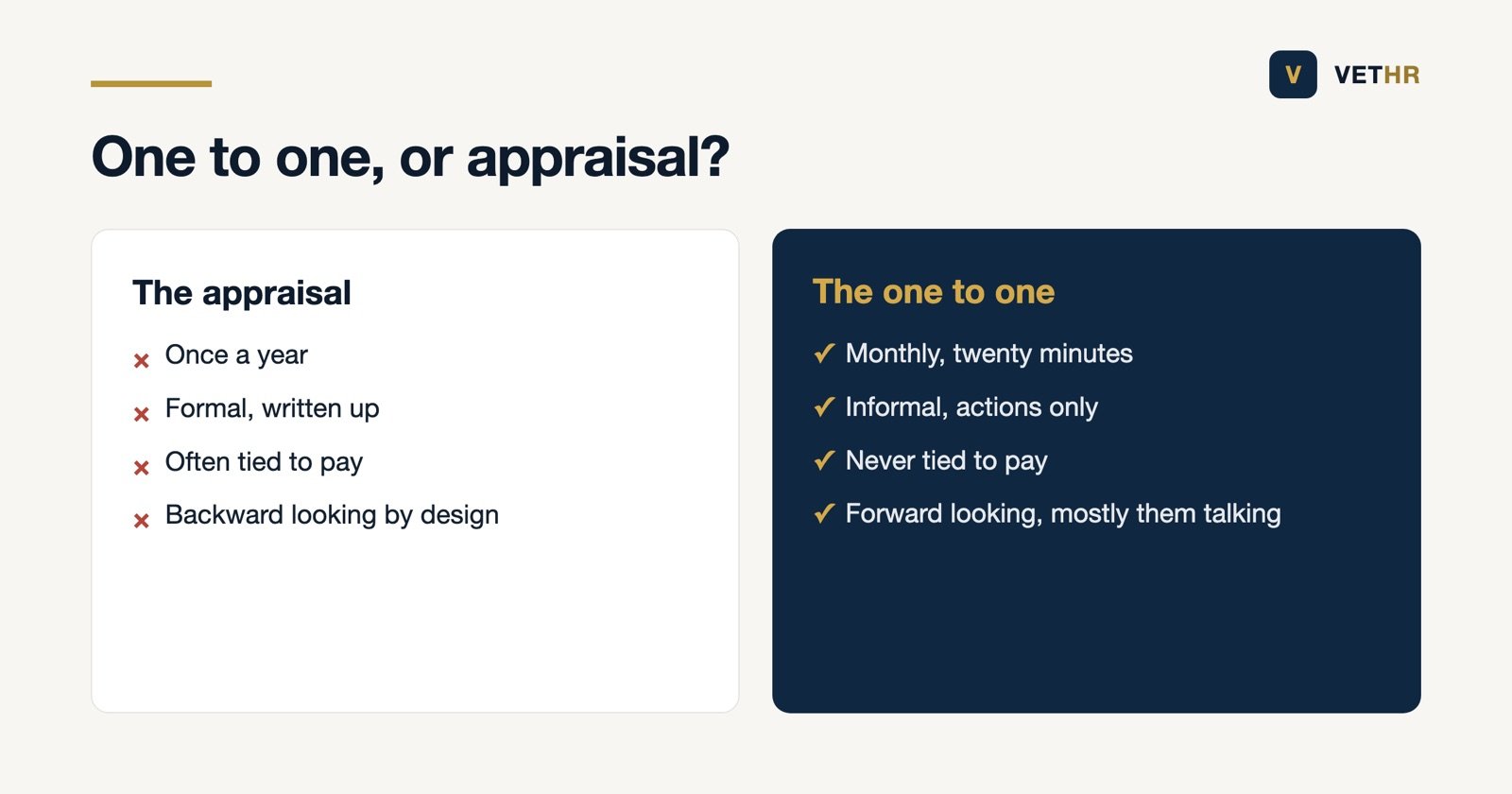
Monthly, twenty minutes, in the diary, with the same person each time. Every part of that sentence is doing work.
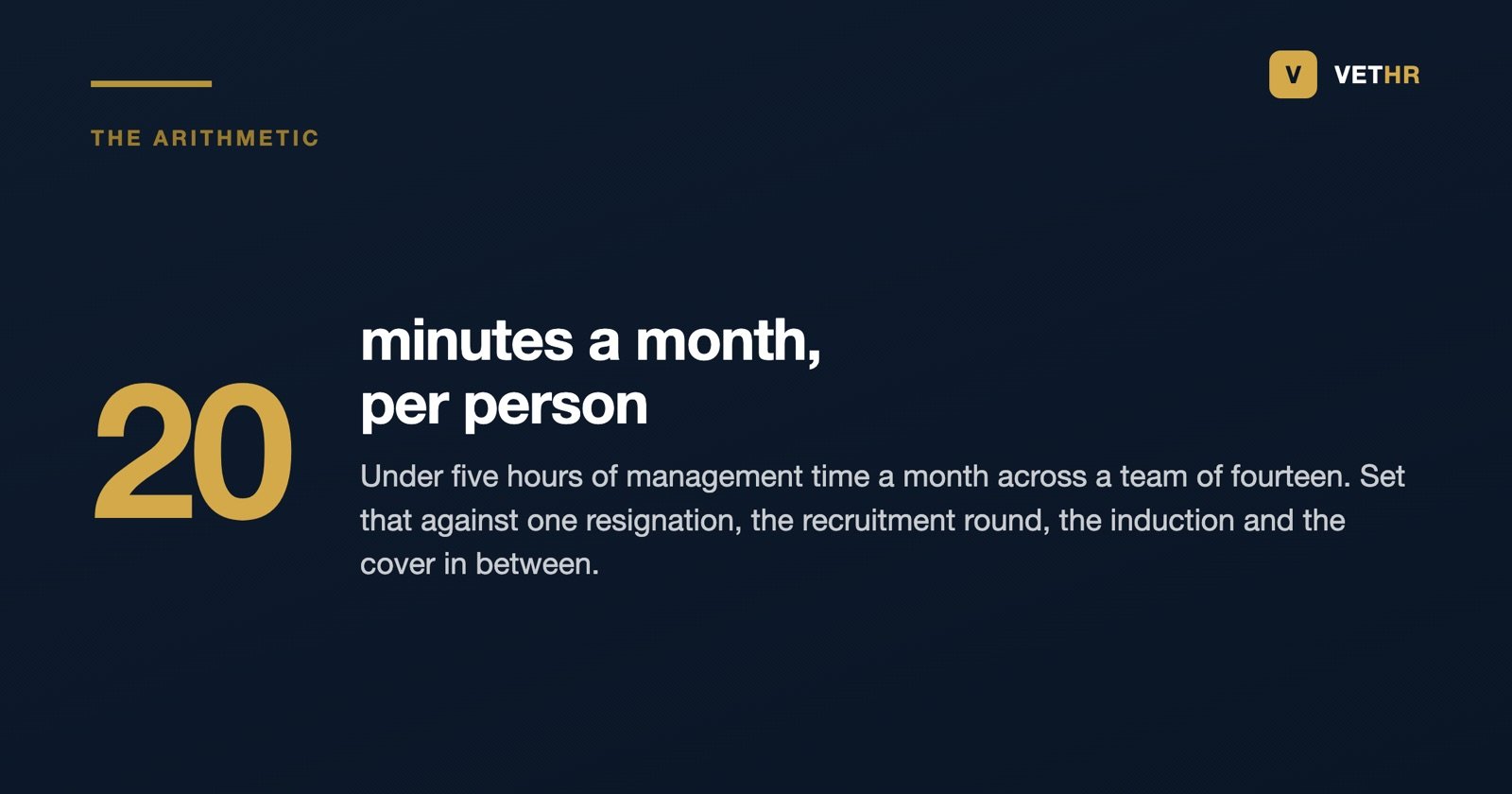
For a practice of fourteen people that is about five hours a month spread across whoever line manages. It is genuinely cheaper than one resignation.
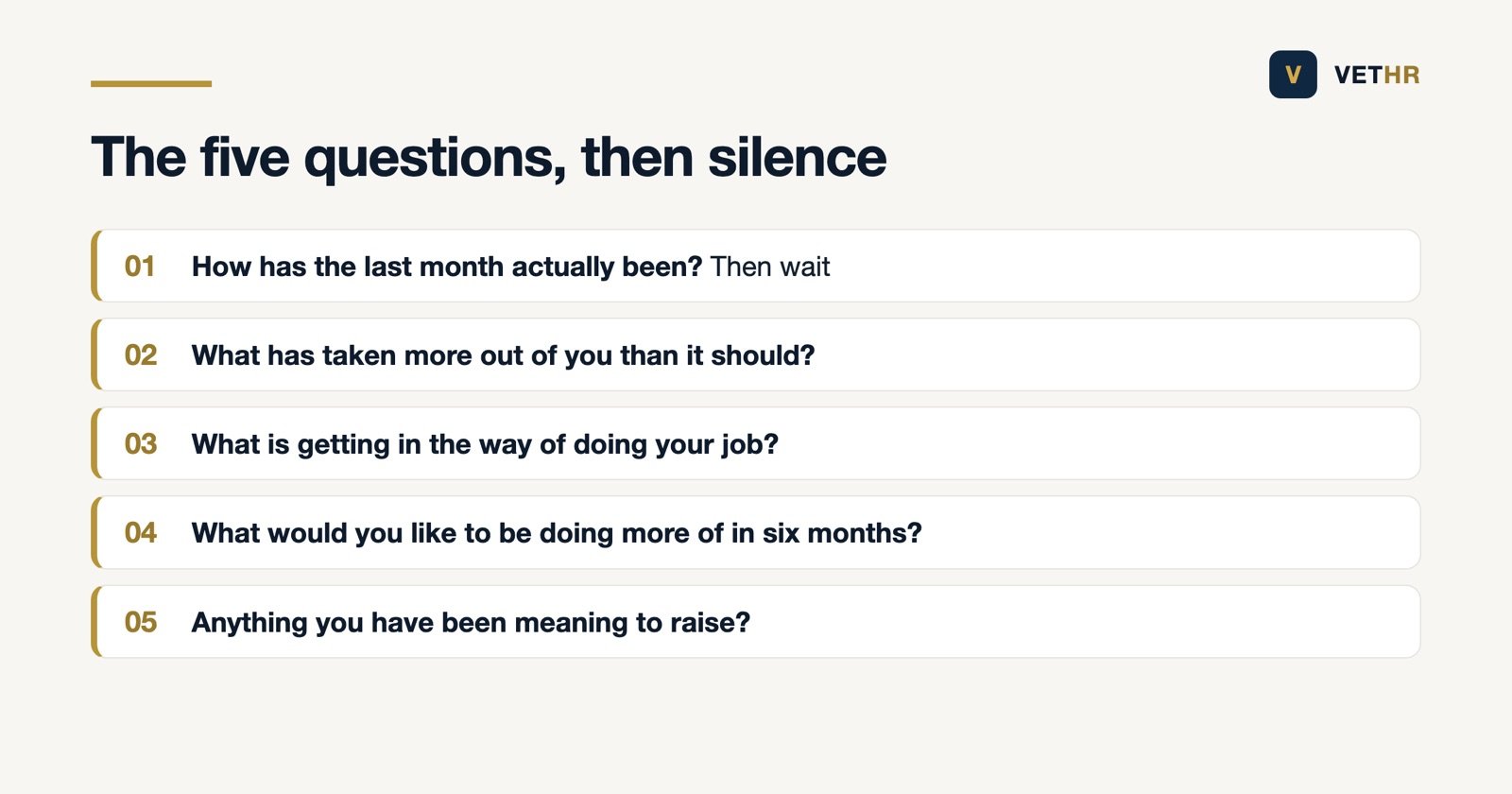
Fewer questions than you think, and then silence. The most common failure in one to one meetings is a manager who fills every pause.
Notice there is no question about performance. If there is a performance issue it needs its own conversation, and burying it in a one to one poisons the format permanently.
This is where most practices lose it. People will tell you things once. If nothing visibly happens, they will not tell you twice, and the meeting becomes theatre.
Three rules cover it. Write down only the actions, not the conversation. Do one thing before the next meeting, however small, and say at the start of that meeting that you did it. Where the answer is no, say no with a reason rather than letting it disappear.
The point is not that every request is granted. It is that everything raised gets a visible response, which is the difference between being heard and being listened to.
It is worth doing this arithmetic honestly, because “we are too busy” is the reason one to one meetings never start, and it does not survive the comparison.
Twenty minutes a month, per person, across fourteen staff is under five hours of management time a month. Set against that, losing one RVN costs the advertising, the manager’s time through a recruitment round, the induction period before they are productive, and the freelance vet cover or overtime that fills the gap in between. It also costs the rota strain that lands on everyone who stayed, which is the part that quietly produces the next resignation.
You do not need a precise figure to see which side is larger. Our guide to the cost of a bad rota works through the same maths on the scheduling side.
All three are failures of discipline rather than of the format. If one to one meetings have been tried before at your practice and fizzled out, it will almost certainly have been one of these rather than the idea itself.
Three things come up in practice one to one meetings that would not in an office, and it is worth being ready for them.
Where something raised is a formal matter, move it into the formal process rather than handling it in the meeting. Acas guidance on discipline and grievance sets out where that line sits.
In a practice that has never had one to one meetings, the announcement lands badly if it is not explained. People assume performance management, because that is the only time anyone has ever been asked for a private meeting.
Say three things when you introduce them. Everyone is getting one, not just you. They are not about performance and nothing goes on your file. And if you have nothing to raise, we finish in five minutes and that is a good outcome, not a wasted meeting.
Then hold the first round exactly as promised, including finishing early where there is nothing to say. The format is established by what you do in month one, not by what you announced.
Whoever the person actually reports to day to day, which in a practice is often the head nurse or the practice manager rather than a partner. Split them so nobody holds more than about eight.
Keep actions, not minutes. A short note of what was agreed and by when is useful and reassuring. A transcript of what somebody confided is neither, and it changes what people are willing to say.
They need them more, not less, because they are in the building less and hear less. Hold them at the same frequency even if it means catching someone on their working day rather than yours.
No. They make appraisals easier and much less dramatic, because nothing in the appraisal is a surprise by then. Keep both, and keep them clearly separate.
Keep holding them. Some people take four or five before they use the space, and the ones who take longest are frequently the ones with most to say. Consistency is what earns it.
Recruitment in this profession is slow, expensive and uncertain, and freelance vet cover in the gap costs more than either. Against that, twenty minutes a month per person is not a soft investment, it is the cheapest retention tool available.
Put the first round in the diary this week. If you want a structure for what to ask and how to record it without turning it into a performance review, our free HR health check covers it, and you keep the written summary either way.
Contracts, rotas, holiday, a difficult conversation. Tell us what you are dealing with and we will come back within one working day. Nothing to sign up to.
Got it. We will come back to you within one working day. If you do not see a reply, please check your spam folder.
