Last updated: 5 September 2026
TL;DR: Practices hiring recent graduates must offer the Veterinary Graduate Development Programme. Approval requires at least one VetGDP Adviser with a minimum of three years’ experience who has completed the online training, protected time each week for both the graduate and the adviser, and a practice declaration through MyRCVS. The RCVS expects it to take around a year.
A practice offers a new graduate a job in March, and everyone is delighted. Then somebody asks in June who the adviser is, whether they have done the training, and where the weekly hour is going to sit in a rota that is already tight. That sequence is common and entirely avoidable.
The Veterinary Graduate Development Programme, run by the RCVS for vets entering practice. Veterinary practices and workplaces hiring recent graduates, as well as some returning or overseas qualified vets, must offer it.
It is a structured support programme rather than an exam. The graduate works through entrustable professional activities with an experienced colleague, building evidence and confidence over the first period in practice.
On duration, the RCVS states it expects the programme to take around one year but it may take more or less time than this, with graduates having up to 18 months and extensions possible on request.
The obligation to offer it sits with the employer. A practice that hires a new graduate without approval in place has created a problem for the graduate, not just for itself.
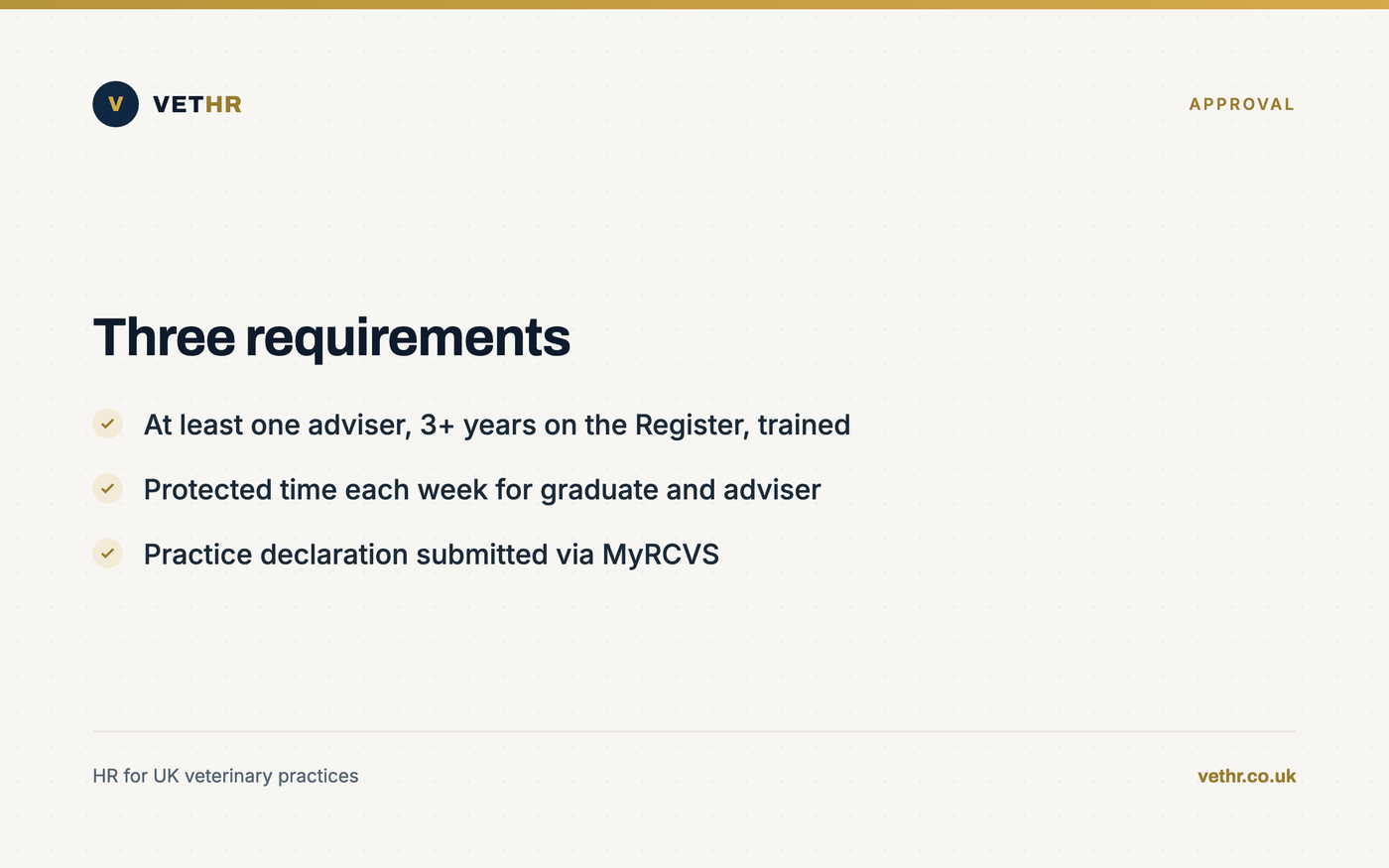
Three requirements, all of which take time to arrange. The RCVS sets out that a workplace must have at least one VetGDP Adviser on the team, allow protected time for the graduate and adviser each week, and submit the practice declaration through MyRCVS.
Start this in the autumn if you plan to recruit for the summer. Advisers need to complete training, and a practice discovering in July that nobody has done it has left itself very little room.
Treat approval as a recruitment asset rather than an administrative hurdle. Graduates compare practices on exactly this, alongside rota and CPD, as our guide to the veterinary job advert covers.
A vet with at least three years on the UK Register who has completed the training and has employer support. The RCVS also requires advisers to complete a refresher course every five years to maintain their status.
Employer support is a stated requirement rather than a courtesy, including agreement to provide protected time for both the adviser and the graduate. An adviser without that agreement cannot do the role properly.
The RCVS publishes the detail for advisers and graduates separately on its VetGDP pages, which is worth reading before you nominate anyone rather than after.
Choose carefully rather than defaulting to whoever is most senior. The best adviser is usually someone who remembers being new, is present on the same shifts and is genuinely willing, which is not always the same person as the clinical director.
Train two if you can. A single adviser means the programme stalls entirely when that person is on holiday, off sick or leaves, and the graduate carries the consequence.
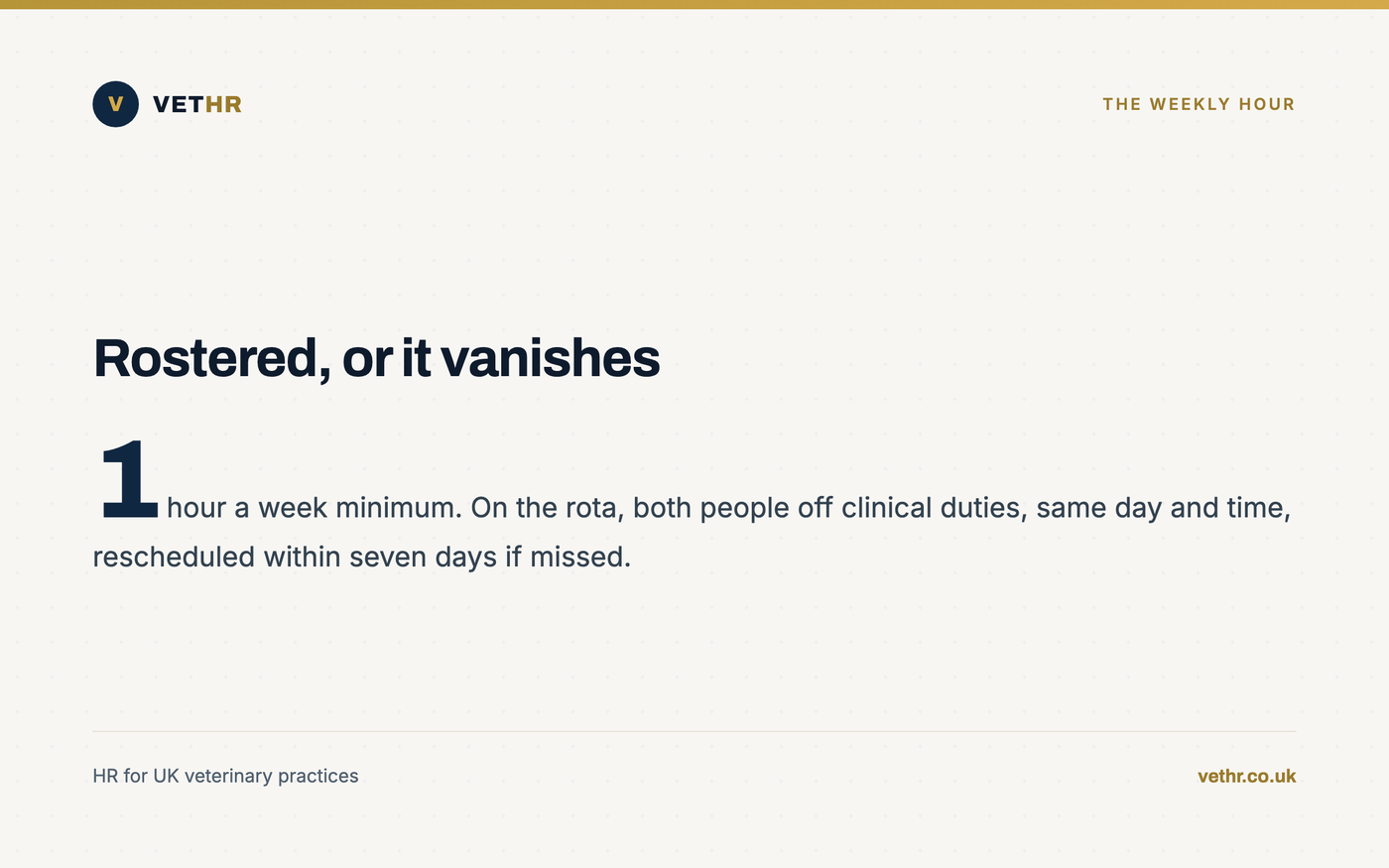
Rostered, non-clinical time that survives a busy week. The RCVS states that advisers agree to support the graduate for at least one hour per week, and that employers must allow protected time for both.
One hour a week sounds trivial and disappears immediately unless it is on the rota. The pattern is familiar: it happens for three weeks, then a Wednesday overruns, and by November nobody can remember the last session.
Treat it exactly as you would a CPD day or annual leave, as our guide to CPD requirements argues for study time generally.
By planning the graduate’s first months as a distinct shape, not as a standard vet slot with a meeting attached. The programme assumes graduated exposure, and the rota either supports that or quietly undermines it.
Point three is where practices create genuine risk. A new graduate on sole charge before they are ready is both a welfare issue and a clinical one, and it sits alongside your lone working arrangements rather than separately from them.
Brief the wider team as well as the adviser. Nurses and receptionists are the people a new graduate actually asks in the moment, and a team that knows someone is in their first year handles the awkward questions very differently from one that assumes any vet is a finished article.
Publish the rota far enough ahead that the graduate can see the shape coming, as our guide to building a veterinary rota sets out.
Planning to recruit a new graduate next year? A free 30-minute HR health check will get the structure ready. Book your HR health check.
It is the clearest signal a practice sends about what kind of employer it is. A graduate whose protected hour happens every week concludes something quite different from one whose adviser has cancelled four times.
The first eighteen months set the pattern for a career. Practices that support that period well tend to keep people, and the ones that treat a new graduate as a cheap pair of hands generally get eighteen months and a resignation.
The replacement cost is the argument for taking it seriously. Recruiting a vet in a tight market absorbs advertising, cover and months of reduced capacity, as our analysis of what staff turnover costs sets out.
Ask the graduate directly how it is going at three months, and separately from the adviser. Someone struggling will rarely raise it with the person supervising them, and a short conversation with the practice manager catches problems while they are still fixable.
Support the adviser too. Being an adviser is real work on top of a clinical role, and a practice that provides the time but never acknowledges the load ends up without an adviser at all.
Yes, where you are hiring recent graduates, and it also applies to some returning and overseas qualified vets. Practices and workplaces employing them must offer the programme, which means having an approved adviser and the protected time arranged before the person starts.
A veterinary surgeon who has been on the UK Register for at least three years, has completed the online training, has employer support including agreement to provide protected time, and has submitted their declaration. Advisers complete a refresher course every five years.
Advisers agree to support the graduate for at least one hour per week, with protected time for both. In practice the informal support alongside that matters just as much, which is why rostering the adviser onto the same shifts early on is worth doing.
The RCVS expects it to take around one year, though it may take more or less time. Graduates have up to 18 months to complete it, with extensions possible on request to the VetGDP team.
The graduate needs another approved adviser, which is why training two is sensible. A practice with a single adviser loses its capacity to support a graduate the moment that person resigns, goes on long term absence or takes maternity leave.
VetGDP is a regulatory requirement wearing the clothes of a development programme, and practices that treat it as paperwork tend to get the worst of both. Done properly it is the cheapest retention investment available to a practice hiring at graduate level.
Get an adviser trained early, train a second, roster the protected hour like annual leave and phase sole charge and out of hours deliberately. Our rota system and HR consultancy handle the structure around it, and the free HR health check is where to start.
The Vet HR Team provides HR consultancy and white-labelled staff systems exclusively to UK veterinary practices. Check current RCVS guidance for the definitive VetGDP requirements.
Contracts, rotas, holiday, a difficult conversation. Tell us what you are dealing with and we will come back within one working day. Nothing to sign up to.
Got it. We will come back to you within one working day. If you do not see a reply, please check your spam folder.
