Last updated: 5 September 2026
TL;DR: Staff who regularly work at least 3 hours during the night period, normally 11pm to 6am, are night workers. They must not work more than an average of 8 hours in 24, usually averaged over 17 weeks, and nobody can opt out of that limit. They are entitled to a free health assessment, and stricter rules apply to hazardous or strenuous work.
Most practices talk about out of hours in terms of who is on call and what it pays. The working time rules ask a different set of questions, and a practice that has never applied them to its overnight in-patient cover is usually breaching at least one of them without realising.
Night workers are anyone who regularly works at least three hours during the night period. GOV.UK states that staff who regularly work at least 3 hours during the night period are night workers, and that the night period is normally 11pm to 6am unless a different period is agreed.
The word regularly does a lot of work. A one-off overnight does not make someone a night worker, but a nurse doing two overnight in-patient shifts most weeks almost certainly is one, whatever the contract calls it.
The last one is the grey area in veterinary work. Where being on call reliably produces hours of actual work between 11pm and 6am, the position needs assessing rather than assuming, as our guide to on-call pay discusses.
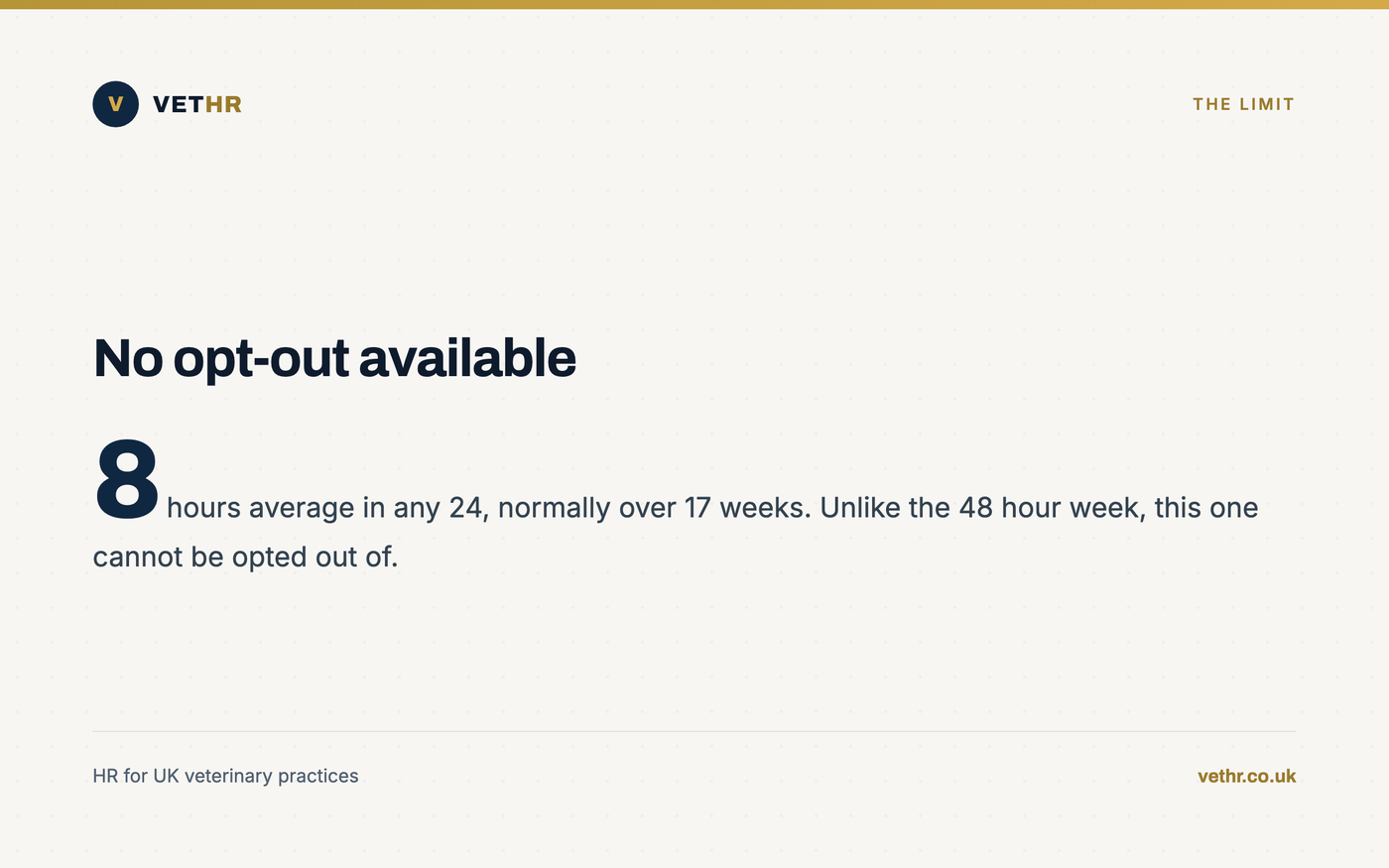
Night workers are limited to an average of eight hours in each 24 hour period. GOV.UK is explicit that night workers must not work more than an average of 8 hours in a 24-hour period, usually calculated over 17 weeks, or up to 52 weeks by agreement.
There is no opt-out. This is the point most practices miss, because the familiar 48 hour weekly limit can be opted out of and this one cannot. An agreement signed by the employee makes no difference.
Regular overtime counts towards the average. A twelve hour overnight shift is not automatically unlawful, because the figure is an average, but a pattern of long nights with little in between will breach it.
Include travel to a second site in the calculation where it happens during a shift. Practices with branch surgeries sometimes move night workers between buildings for a callout, and that time is working time rather than commuting.
Measure it rather than estimating. Working out the average across 17 weeks by hand for four people is the kind of task a clock in system should own, which is part of the case for our clock in and out system.
An assessment the employer must offer night workers, free of charge, before someone starts night work and at regular intervals afterwards. It is a legal entitlement rather than a courtesy, and the employee can decline it.
It does not have to be a full medical. A questionnaire reviewed by a suitably qualified person is the usual approach, looking at sleep, existing health conditions and whether night work is safe for that individual.
Keep the outcome, not the detail. The assessment produces health information, which is special category data, so store it appropriately and share only what the rota owner needs to know, as our guide to GDPR and staff records sets out.
Offer it in writing to every one of your night workers and record the response. A practice that offered nothing and a practice whose staff declined look identical from the outside unless somebody wrote the offer down.
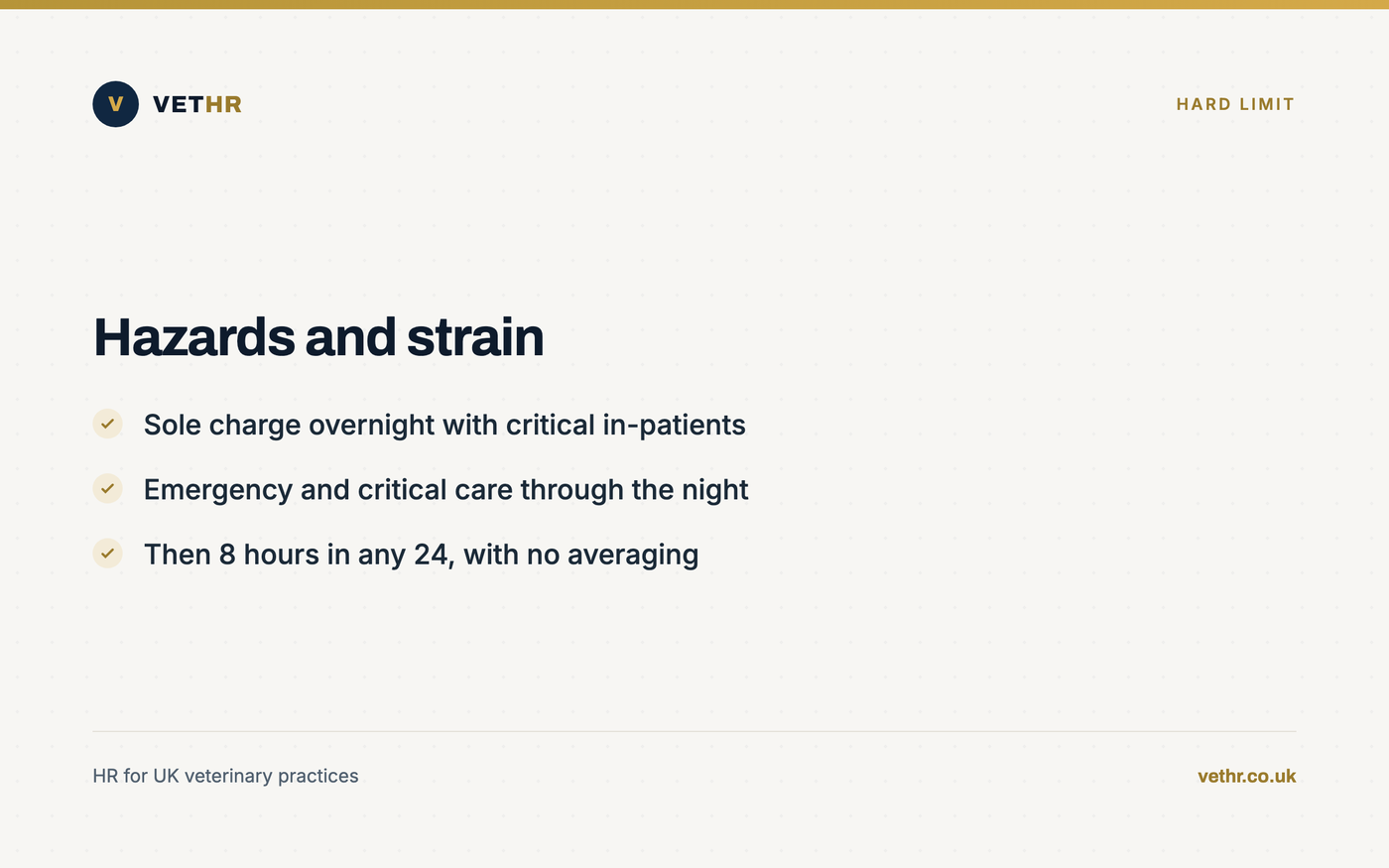
A hard limit replaces the average for some night workers. GOV.UK states that night workers who deal with special hazards, or whose work involves mental or physical strain, cannot work longer than 8 hours in any 24 hour period, with no averaging at all.
Employers must risk assess to identify where this applies. That is the practice’s job, and in veterinary work the candidates are obvious once you look for them.
If the assessment concludes that a shift involves that level of strain, a twelve hour overnight is not lawful regardless of what the rest of the fortnight looks like. That is a rota design question rather than a paperwork one, and it needs answering before it is tested.
The normal rest rules apply to night workers and they bite hardest around nights. GOV.UK confirms workers are entitled to 11 hours rest between working days, plus an uninterrupted 24 hours without work each week or 48 hours each fortnight.
Eleven hours is the number that catches practices out. A nurse who finishes an overnight at 8am cannot start again until 7pm, which rules out the tempting arrangement where she covers a late afternoon clinic on the same day.
The 20 minute break rule applies too, for anyone working more than six hours. On a night shift with one person in the building, that break is theoretical unless the practice has decided in advance how it happens.
Read this alongside your lone working controls, because an overnight nurse is usually both a night worker and a lone worker, as our guide to lone working covers.
Overnight cover never assessed against the working time rules? A free 30-minute HR health check will check it. Book your HR health check.
Around recovery rather than around coverage. A rota that covers every night and destroys the people covering them solves this month at the cost of next year’s staffing.
Ask the people doing it what would help. Night workers usually have a short and specific list, such as a proper bed rather than a chair, food that does not require leaving the building, and knowing which named person will answer the phone at 3am.
Point seven quietly drives turnover. Where nights land on whoever is least able to refuse them, the practice re-recruits that role every eighteen months, which our analysis of what staff turnover costs puts a figure against.
No. Unlike the 48 hour weekly limit, the average of 8 hours in 24 for night workers cannot be opted out of. An agreement signed by the employee does not make longer average hours lawful, which is the single most common misunderstanding in this area.
Potentially, because the 8 hour figure is an average normally calculated over 17 weeks. A twelve hour shift can be balanced by shorter or non-working periods. But where the work involves special hazards or significant mental or physical strain, 8 hours in any 24 becomes a hard limit with no averaging.
Yes. The assessment must be offered free of charge to the worker, before night work starts and at regular intervals afterwards. The employee can decline it, but the offer must be made, and the practice should keep a written record that it was.
It depends on what actually happens. Availability at home is treated differently from working, but where callouts routinely produce three or more hours of work in the night period on a regular basis, the person may well be a night worker. Assess the real pattern rather than the label.
Eleven hours of rest between working days. A shift finishing at 8am means no work until 7pm at the earliest. Practices frequently breach this by asking an overnight nurse to cover an evening clinic on the same calendar day.
Overnight care is part of good veterinary medicine and it is not going away. What is optional is whether the practice designs it deliberately, with the health assessments offered, the averages tracked and the eleven hours protected.
Identify your night workers, offer the assessment in writing, risk assess for strain and track the average automatically. Our rota system and HR consultancy cover the mechanics, and the free HR health check will tell you where your overnight cover currently sits.
The Vet HR Team provides HR consultancy and white-labelled staff systems exclusively to UK veterinary practices. Check current GOV.UK guidance before changing working patterns.
Read next: Annualised Hours in a Veterinary Practice.
Contracts, rotas, holiday, a difficult conversation. Tell us what you are dealing with and we will come back within one working day. Nothing to sign up to.
Got it. We will come back to you within one working day. If you do not see a reply, please check your spam folder.
