Last updated: 5 September 2026
TL;DR: Since 26 October 2024 employers have a legal duty to take reasonable steps to prevent sexual harassment before it happens. Acas is clear that employers must take steps to prevent sexual harassment happening in the first place, and the duty covers third parties such as clients. A tribunal can uplift compensation by up to 25 per cent where the duty has been breached.
Most practice owners read this topic and think of a serious incident between colleagues. The duty is broader and quieter than that. It covers the comment at the Christmas party, the client who will only be seen by the male vet, and the running joke in the prep room that one person has stopped finding funny.
A positive obligation to prevent sexual harassment before anything happens. Acas states that employers must take steps to prevent sexual harassment happening in the first place, introduced by the Worker Protection (Amendment of Equality Act 2010) Act 2023 and in force from 26 October 2024.
That is a change in kind, not degree. Previously an employer responded to complaints; now the absence of preventative work is itself a failure, whether or not anything has ever been reported in your practice.
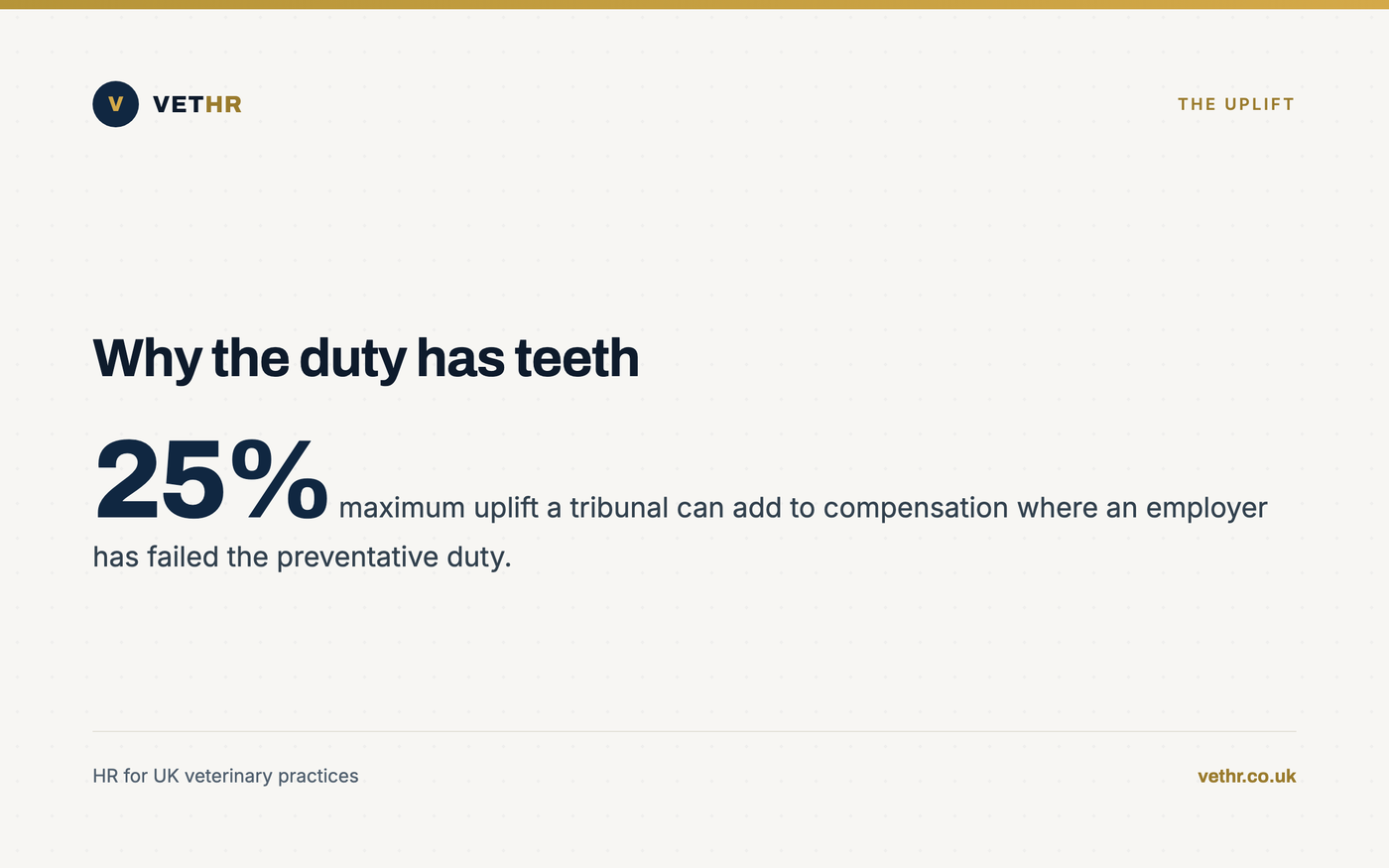
The consequences are financial as well as reputational. Where a tribunal finds an employer liable, it can consider whether the preventative duty was met and order an uplift in compensation of up to 25 per cent.
The government confirmed the change when the new protections came into force. There is no small employer exemption, so a six person branch surgery carries the same duty as a thirty person hospital.
Sexual harassment is unwanted behaviour of a sexual nature that either violates someone’s dignity or creates an intimidating, hostile, degrading, humiliating or offensive environment. Acas is explicit that intent is irrelevant, so behaviour counts whether or not it was meant that way.
The intent point is the one managers argue with, and it is not arguable. “He did not mean anything by it” describes the sender, and the legal test looks at the effect on the person receiving it.
Practice group chats deserve particular attention here. What gets posted in a shift cover group is workplace conduct, and it is disclosable, as our guide to the social media policy covers.
Yes, and for veterinary practices third party sexual harassment is the most significant part of the duty. Acas confirms that harassment can come from third parties, for example customers, clients and members of the public, and preventative steps must take that into account.
Think about where your staff are exposed. A receptionist alone at a desk, a nurse in a consult room with a client and a closed door, a vet on a farm or home visit, and anyone working an evening shift with reduced cover.
The practical response is unglamorous. Make it explicit that staff may end a consultation, refuse to see a specific client, or ask a colleague to join them, and that they never need to justify that decision afterwards.
Then act on it. A client who is flagged twice should be spoken to or discharged, and leaving that decision to the individual member of staff is precisely the failure the duty is aimed at. Our guide to lone working covers the overlapping safety controls.
Like any other risk assessment, in writing and specific to your practice. Acas asks employers to consider the risks of sexual harassment happening in their organisation, the steps that could reduce those risks, and which of those steps are reasonable for them to take.
Write the sexual harassment assessment down and date it. An assessment that exists only as a conversation between two partners is indistinguishable, from the outside, from having done nothing at all.
Include students and apprentices explicitly. A student veterinary nurse on placement is junior to everyone, dependent on the practice for a sign-off, and least likely to report sexual harassment, which is exactly the combination the assessment should be looking for.
The practice social calendar belongs in the sexual harassment assessment. Acas specifically flags higher risk situations including events involving alcohol, and the December party is where a large share of workplace complaints originate.
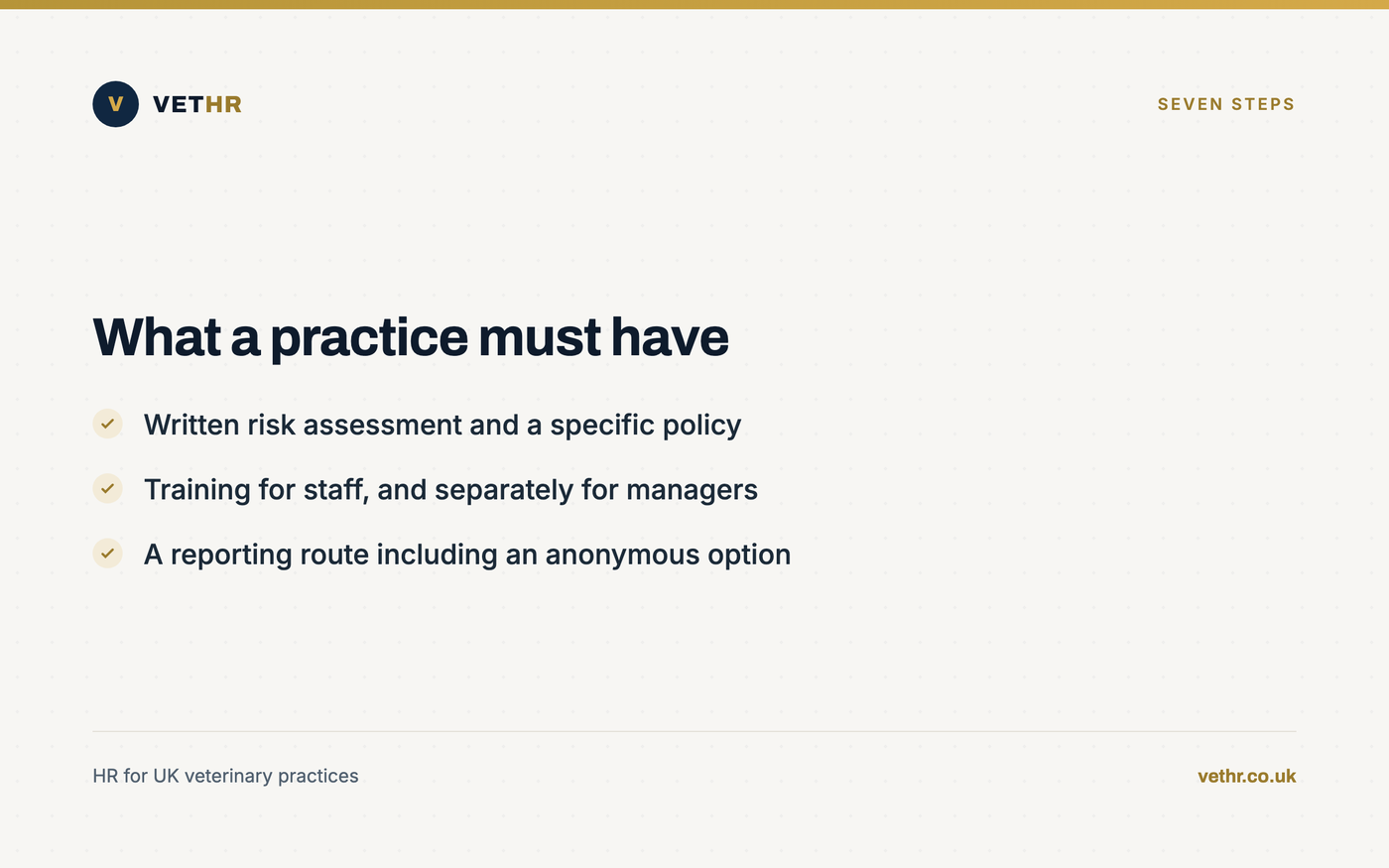
These follow the Acas steps for employers on sexual harassment, translated into practice terms. None of them is expensive, and the whole set can be in place within a month.
Step six is where small practices struggle, because in a team of twelve the obvious reporting route may be the person concerned or their close colleague. Name an external route as well, and say so in the policy.
Keep the policy with the rest of your people documents so it is issued and acknowledged like everything else, as our guide to the staff handbook sets out.
No written risk assessment yet? A free 30-minute HR health check will tell you exactly what is missing. Book your HR health check.
You follow a proper procedure, promptly, and you protect the person who spoke up. How the first report is handled determines whether anyone else in the practice ever reports anything again.
Acas expects procedures to follow the Code of Practice on disciplinary and grievance procedures. That means investigating properly, keeping the process confidential and deciding on evidence rather than on who is more senior.
Take a report of sexual harassment seriously even when it arrives informally. A comment at the end of an appraisal or a remark on a return to work form still puts the practice on notice, and treating it as a chat rather than a report is how a manageable situation becomes a claim.
Separate the parties while you investigate where you can, and be careful that the separation does not penalise the complainant. Moving the person who reported to a different site, or off the good shifts, reads as a consequence of reporting.
Note also that whistleblowing protections for disclosures about sexual harassment commence on 6 April 2026 and apply to conduct occurring before that date, which raises the cost of handling a report badly. Our guides to handling a grievance and whistleblowing cover the mechanics.
Yes. There is no exemption based on headcount. What is reasonable will differ between a six person branch and a large hospital, but every employer must consider the risks, take reasonable steps and be able to show what those steps were.
Yes. Acas confirms harassment can come from third parties including customers, clients and members of the public, and preventative steps should reflect how often your staff deal with the public. For a veterinary practice that is constantly, which makes it a core part of your assessment rather than a footnote.
Intent does not determine the outcome. Acas is clear that behaviour counts whether it was intended to have the effect or simply had it. The test looks at whether dignity was violated or an intimidating, hostile, degrading, humiliating or offensive environment was created.
Up to 25 per cent. Where a tribunal has found an employer liable for sexual harassment it can consider whether the preventative duty was breached and uplift the compensation accordingly, with the amount reflecting the extent of the failure.
No. A policy nobody has been trained on, with no risk assessment behind it and no working reporting route, is unlikely to count as taking reasonable steps. Acas expects a specific policy, training for staff and managers, a clear reporting route and a record kept of complaints.
Veterinary practices are small, close teams that work long hours in confined spaces with the public constantly present. That combination is exactly why the preventative duty matters here, and why most practices have more risk than they would guess before writing the assessment.
Write the assessment, publish a specific policy, train the team and the managers separately, and give people a route that does not run through the person they are worried about. Our policy library and HR consultancy cover all four, and the free HR health check is where to start.
The Vet HR Team provides HR consultancy and white-labelled staff systems exclusively to UK veterinary practices. This is HR guidance, not legal advice; take advice from a solicitor on any live complaint.
Contracts, rotas, holiday, a difficult conversation. Tell us what you are dealing with and we will come back within one working day. Nothing to sign up to.
Got it. We will come back to you within one working day. If you do not see a reply, please check your spam folder.
