Last updated: 5 September 2026
TL;DR: Veterinary payroll rarely goes wrong on tax. It goes wrong on hours: unrecorded overtime, on-call that was never agreed, lieu that nobody tracked and holiday pay calculated by hand. Payslips must be given on or before payday and must show hours worked where pay varies with time worked.
Veterinary payroll is the one process in a practice where a small error becomes personal immediately. A nurse who is paid twelve pounds short does not think about a system fault, she thinks about whether anyone noticed her staying late in the first place. That is why the checks matter more than the software.
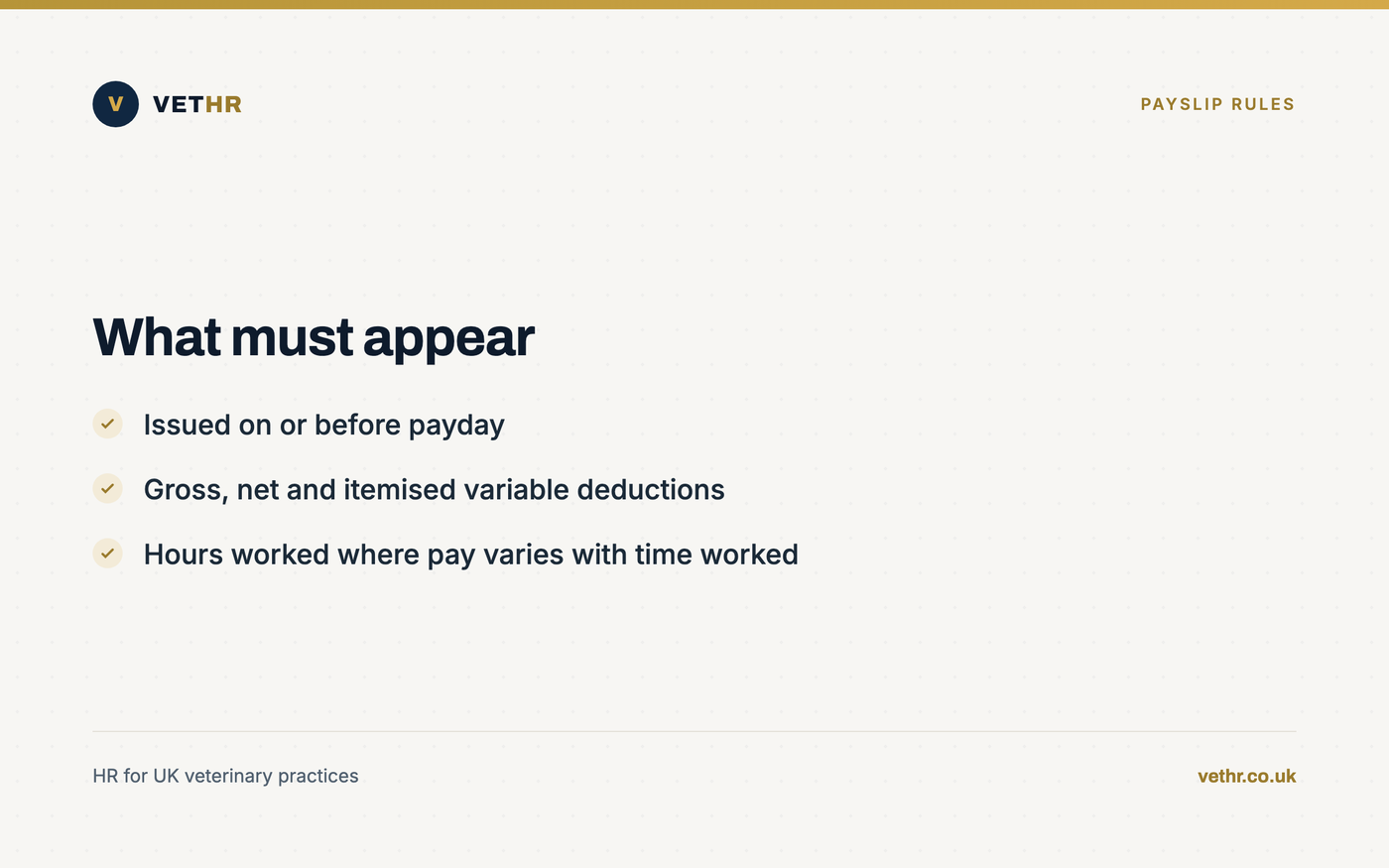
A veterinary payroll payslip must show more than a net figure. GOV.UK sets out that employers must provide a payslip on or before payday, showing gross and net earnings with deductions itemised, variable deduction amounts such as tax and National Insurance, and the number of hours worked where pay varies depending on time worked.
That hours requirement is the one veterinary payroll most often misses. A bank nurse paid for what she works must be able to see the hours she was paid for, not just a total.
Fixed deductions can be handled through a separate written statement rather than itemised each month, provided it is issued before the first payslip and updated annually. Electronic payslips are acceptable.
Where you use rolled-up holiday pay for irregular hours staff, it must appear as its own line, as our guide to rolled-up holiday pay explains.
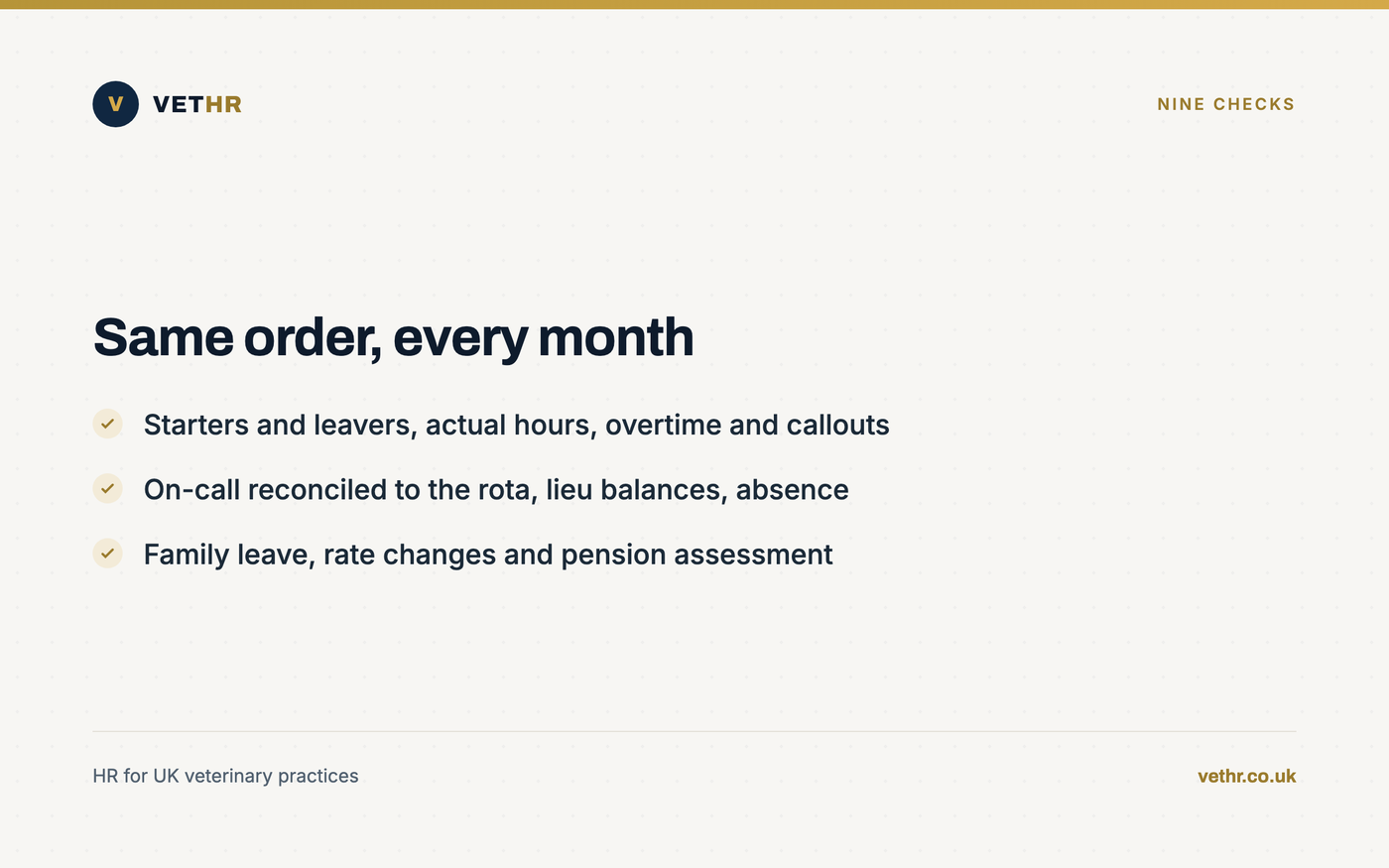
The same nine, in the same order, every month. A veterinary payroll run that changes shape each month is one where something gets missed in a busy week.
Run the checks against the rota rather than against last month’s veterinary payroll file. Copying forward is how a leaver stays on the payroll for an extra month and how a rate change agreed in a review meeting never actually reaches anyone’s bank account.
Check four is the most commonly missed. On-call sits on the rota rather than in the payroll file, so unless somebody reconciles the two every month, the payment silently depends on memory.
Pension is check nine for a reason. Auto enrolment obligations apply where someone is aged between 22 and State Pension age and earns at least £10,000 a year, with minimum contributions of 8 per cent of qualifying earnings, of which at least 3 per cent comes from the employer.
Because tax is automated and hours are not. Payroll software calculates PAYE and National Insurance reliably. What it cannot do is know that a nurse stayed forty minutes past the end of her shift on three days last week.
Two consequences follow. The person is underpaid, and where they are paid near the legal floor the effective rate can fall below the minimum wage, which turns a goodwill problem into a compliance one.
The fix is measurement rather than policy. Our clock in and out system exists so that the hours feeding veterinary payroll are recorded rather than remembered.
With three written veterinary payroll rules that exist before the month starts. Almost every payroll dispute in a practice traces back to a rate that was agreed verbally and remembered differently by two people.
Lieu with no expiry is a liability that grows quietly. A practice carrying eleven days of untracked lieu across four nurses will discover it during a resignation, at which point it becomes a payment, as our guide to time off in lieu sets out.
Publish the veterinary payroll rates where staff can see them. A rate that only the practice manager knows will be questioned in every difficult month, and the questioning takes longer than the transparency would have.
Fix it fast, communicate first, and never let the person chase you. Speed and honesty are what determine whether an error is forgotten in a week or repeated in an exit interview a year later.
Keep a short log of veterinary payroll corrections across the year. Three errors traced to the same missing check is a system fault worth fixing, whereas three unrelated ones are simply a busy year, and you cannot tell the difference without the log.
Point four matters legally as well as practically. Recovering an overpayment without agreement risks an unlawful deduction claim, and the amounts involved are usually far smaller than the damage caused by taking money back without a conversation.
Payroll running on memory and a spreadsheet? A free 30-minute HR health check will show you where the gaps are. Book your HR health check.
Everything in veterinary payroll that is arithmetic, and nothing that is judgement. Veterinary payroll is a chain of small calculations feeding one another, and the calculations are exactly where a person adds no value and plenty of risk.
Holiday is the highest value thing to automate. Manual holiday calculations for part-time and irregular hours staff are slow, error prone and impossible to audit, which is why our holiday calculations system exists.
Whatever you automate, keep one named owner for the monthly veterinary payroll run. Systems reduce errors; they do not decide who is accountable when February’s numbers look odd.
Yes, where pay varies depending on time worked. GOV.UK requires the payslip to show the number of hours in that case, alongside gross and net earnings and itemised variable deductions. For bank and hourly paid staff in a practice, that means the hours must be visible on the payslip itself.
Not unilaterally. Discuss it, agree a repayment approach and confirm it in writing. Deducting without agreement risks an unlawful deduction claim, and in a small team it damages trust well beyond the individual concerned. Take advice if the sum is large or the employee disputes it.
Under automatic enrolment the minimum total contribution is 8 per cent of qualifying earnings, with at least 3 per cent from the employer. Qualifying earnings sit between £6,240 and £50,270 a year, and enrolment applies to workers aged 22 to State Pension age earning at least £10,000.
Often yes for the tax calculation, but it does not remove your risk. A payroll bureau processes what you send it, so if hours, on-call and lieu are wrong when they leave the practice, they will be wrong on the payslip. The upstream data is the part that has to be right.
Long enough to evidence pay, hours and statutory payments if challenged, and no longer than you can justify under data protection principles. Set a written retention period, apply it consistently and store records securely, because payroll data is among the most sensitive you hold.
Veterinary payroll is a trust process wearing an accounting costume. Staff read the payslip as a statement about whether their extra hours were seen, and a practice that gets it right every month buys goodwill that no wellbeing initiative can match.
Run the same nine checks, capture hours properly, write down your on-call and lieu rules and fix errors before anyone has to ask. Our clock in and out and holiday calculations systems handle the arithmetic, and the free HR health check will show you which check keeps failing.
The Vet HR Team provides HR consultancy and white-labelled staff systems exclusively to UK veterinary practices. We are not tax advisers; check PAYE and pension obligations with your accountant.
Contracts, rotas, holiday, a difficult conversation. Tell us what you are dealing with and we will come back within one working day. Nothing to sign up to.
Got it. We will come back to you within one working day. If you do not see a reply, please check your spam folder.
