Last updated: 5 September 2026
TL;DR: Annualised hours contract someone to a total number of hours across the year rather than a fixed weekly pattern, with pay spread evenly each month. They suit practices with genuine seasonal swings, but they only work with accurate hour tracking, a written balance rule and working time compliance, since the 48 hour limit is normally averaged over 17 weeks.

Most practices are not equally busy all year. Summer brings foreign travel paperwork and grass seeds, autumn brings vaccination reminders, January is quiet and February fills up again. Staffing every week for the busiest week is expensive, and staffing for the average leaves people drowning twice a year.
A contract for a total number of hours over a twelve month period rather than a fixed number each week. The employee works more in busy periods and fewer in quiet ones, and their pay is spread evenly across the year so their income does not swing.
The usual arithmetic starts from a full-time equivalent. Thirty seven and a half hours a week across fifty two weeks is 1,950 hours, less holiday, which gives a contracted annual figure with a defined proportion rostered in advance and the remainder held as a reserve.
That reserve is the point. It is a planned, paid, contractually agreed mechanism for covering peaks, rather than the informal alternative most practices use, which is asking the same reliable nurse to stay late again.
Annualised hours are a contractual variation, so they cannot be imposed on existing staff. New contracts or agreed changes only, and the agreement should be in writing before the first month begins.
Those with a real, predictable seasonal pattern and the systems to track hours precisely. Without both, the arrangement becomes an untracked promise that quietly turns into unpaid overtime.
The last one is not a joke. Annualised hours require a running balance that both sides can see at any point, and a practice that cannot currently tell a nurse how much holiday she has left will not manage an hours ledger across twelve months.
Consider whether a different arrangement solves the same problem. Our guides to the four day week and to casual workers cover two alternatives that need far less machinery.
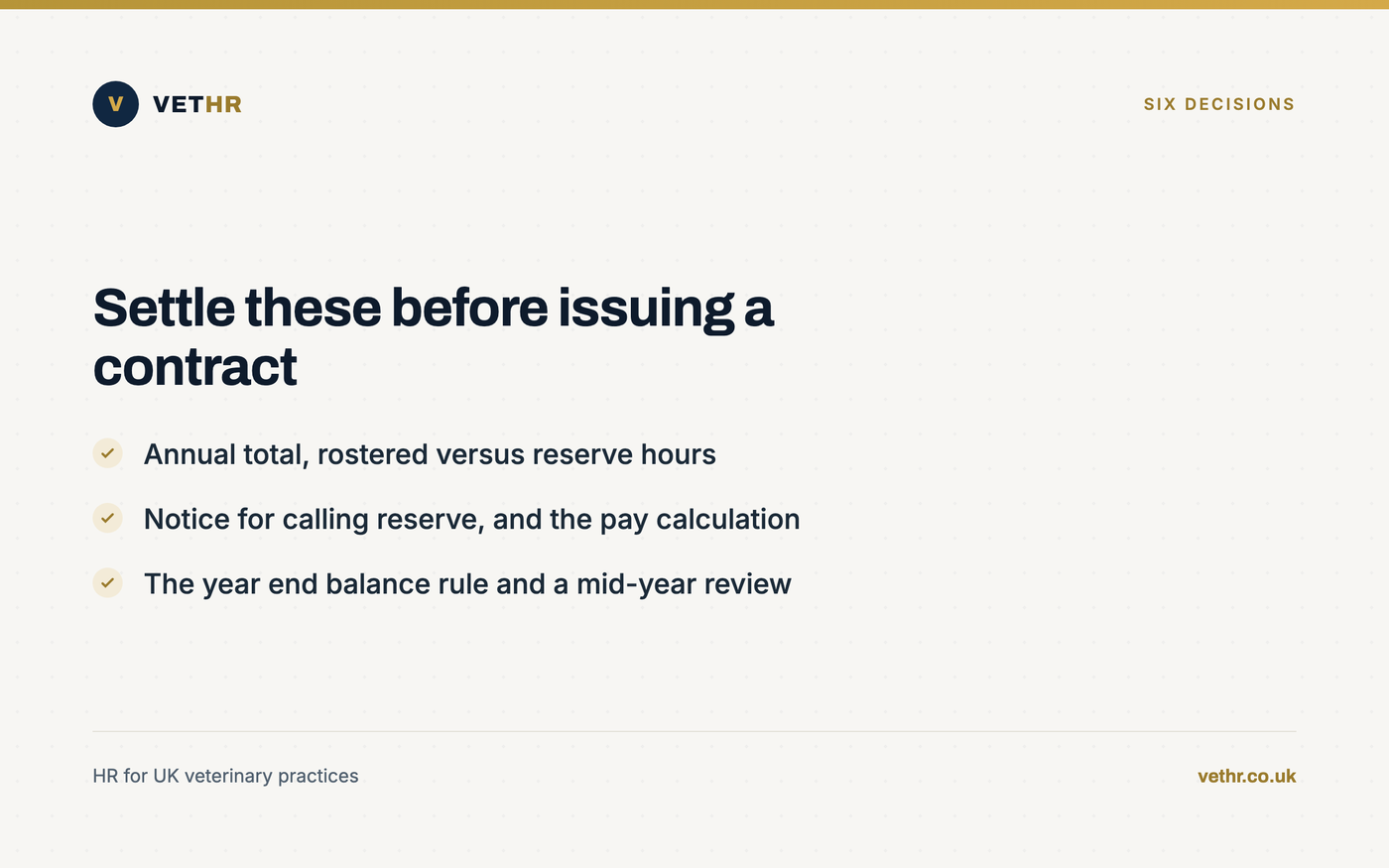
Six decisions, all made before the first contract is issued. The failures in these arrangements are almost always design failures rather than operational ones.
Notice is the one staff care about most. An arrangement that lets the practice call reserve hours with two days’ notice is not flexible working, it is on-call with a different name, and it will be resented within a season.
Track the hours in the same system as the rota. Our clock in and out system and rota system exist so that a running balance is a screen rather than a monthly spreadsheet exercise.
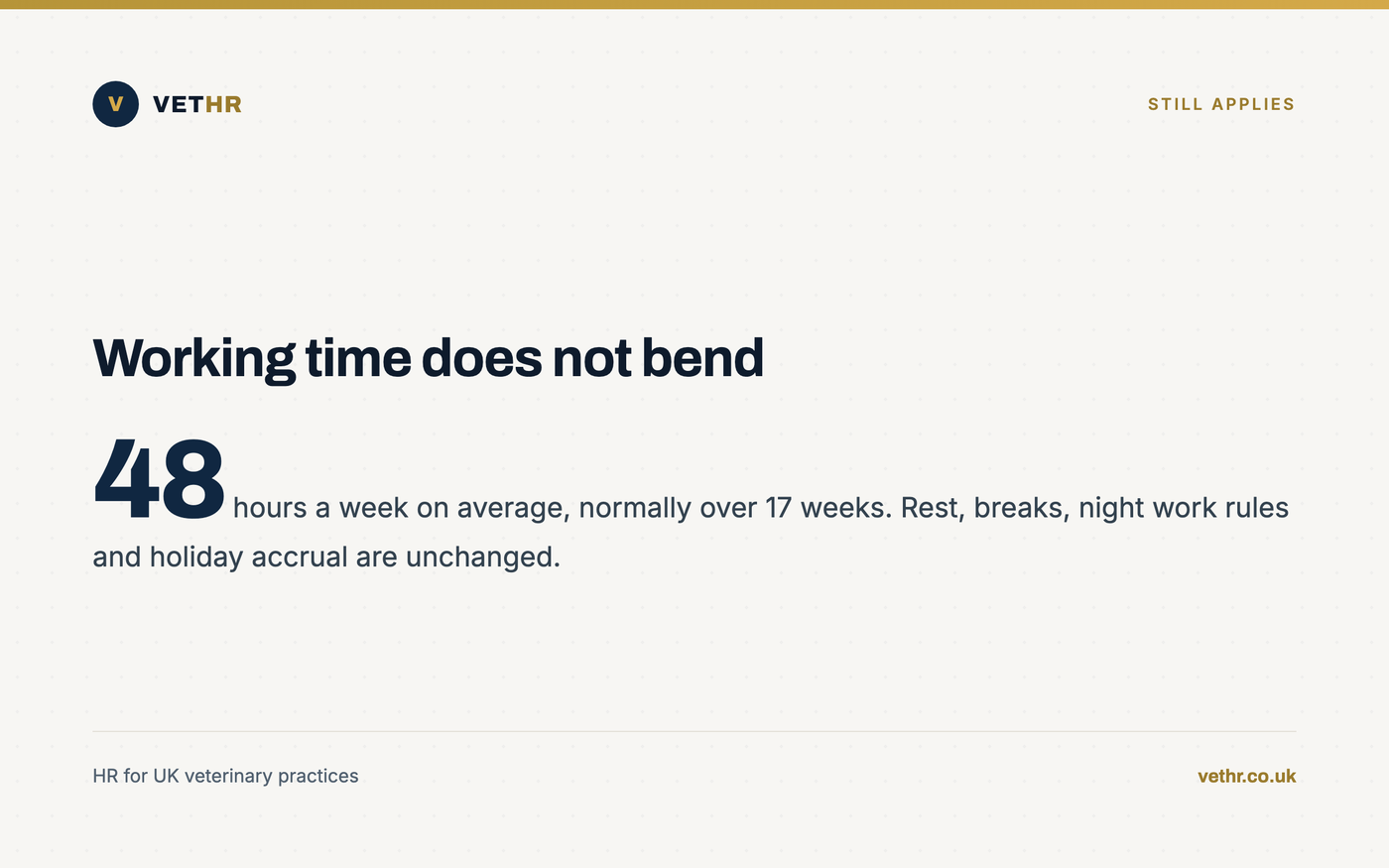
The same as for any other arrangement, and this is where annualised hours are misunderstood. GOV.UK states you cannot work more than 48 hours a week on average, normally averaged over 17 weeks.
Averaging over 17 weeks helps, because a heavy lambing fortnight can be balanced by a quieter period inside the same reference window. It does not licence a whole quarter above the limit on the basis that the year will average out.
Daily and weekly rest, night work rules and break entitlements are unaffected by the contract type. So are the minimum wage checks, which must be applied to the pay reference period rather than to the annual figure.
Payslips matter more under this model than most. GOV.UK requires a payslip to show the number of hours worked where pay varies depending on time worked, and even where the monthly figure is fixed, showing hours worked against the annual total is what keeps the arrangement transparent.
Holiday still accrues at 5.6 weeks. Decide at the outset whether holiday sits inside or outside the annual hours total, and write it down, because that single ambiguity produces most annualised hours disputes. Our guide to working time rules for veterinary practices covers the rest.
Whatever the contract says, which is why the contract has to say something specific. This is the question that arrives in month eleven when nobody has looked at the ledger since March.
The leaver case is the one that goes wrong. A nurse who worked heavily through a busy summer and resigns in September has been paid a twelfth of an annual salary each month while working well above the average, and the reconciliation must be capable of paying her the difference.
Review the balance formally twice a year, not once. A single mid-year check catches drift, but a second review at around month nine gives the practice time to offer hours or agree a carry forward before the year end forces a decision that suits nobody.
Deductions from final pay need an express written term and considerable care. Take advice before recovering anything, because an unlawful deduction claim is a cheap and easy claim for an employee to bring.
Thinking about annualised hours for a seasonal practice? A free 30-minute HR health check will tell you if it fits. Book your HR health check.
Three, and for most small animal practices one of them is a better answer. Annualised hours are powerful and heavy, and plenty of seasonal problems are solved with something lighter.
Option one is the most common good answer. Where those staff have genuinely irregular hours, rolled-up holiday pay removes much of the administration that pushes practices towards annualisation in the first place.
Option three fails without discipline. Untracked lieu is the default state of most practices already, and it is exactly the problem that annualised hours are supposed to replace, as our guide to time off in lieu explains.
Only by agreement. Changing the hours structure is a contractual variation, so it requires consultation and written consent rather than an announcement. Most practices introduce it for new roles first and offer it to existing staff as a genuine choice with a trial period.
Yes. GOV.UK confirms the limit is an average, normally calculated over 17 weeks. A busy fortnight can be offset by a quiet one inside that window, but an entire season above the limit is not made lawful by a quiet January, and daily and weekly rest requirements are unchanged.
Statutory entitlement of 5.6 weeks applies as normal. Decide explicitly whether holiday hours sit inside or outside the annual total and state it in the contract. Leaving it ambiguous is the single most common cause of disagreement at the end of the first year.
Set a written minimum and stick to it. Two or three weeks works in most practices; two days does not, because it converts the arrangement into unpaid on-call in the eyes of the team. If genuine short notice cover is needed, pay for it as on-call rather than drawing on reserve hours.
They should be paid the difference, and the contract should say how that is calculated. Reconcile hours actually worked against pay actually received. The reverse case, where someone has been paid for hours not yet worked, needs an express written term and legal advice before any deduction.
Annualised hours are a good answer to a specific problem: genuine seasonal swing, in a practice that already tracks hours accurately. They give staff steady pay and give the practice a planned way to cover peaks without improvising.
For everyone else, a properly run bank and a disciplined lieu system get most of the benefit for a fraction of the administration. Our HR consultancy and contract service will tell you which one fits, and the free HR health check is the place to start.
The Vet HR Team provides HR consultancy and white-labelled staff systems exclusively to UK veterinary practices. Contract variations and pay deductions are legal matters; take advice before making changes.
Contracts, rotas, holiday, a difficult conversation. Tell us what you are dealing with and we will come back within one working day. Nothing to sign up to.
Got it. We will come back to you within one working day. If you do not see a reply, please check your spam folder.
