Last updated: 14 June 2026
TL;DR: A four day week can work in a veterinary practice, but only if you separate the idea from the slogan. A compressed week keeps full hours in four longer days; reduced hours cuts the week to around 32 hours, with pay as agreed. Requests arrive through flexible working law, with a 2 month decision window and eight lawful refusal grounds. Trial it first, in writing, with the rota maths done honestly.

The idea gets pitched to practice owners as either a retention miracle or an operational impossibility. It is neither. This guide walks through what a request actually means in law, the rota arithmetic, how to trial a new pattern honestly, and how to say no properly when a small clinical team genuinely cannot absorb it.
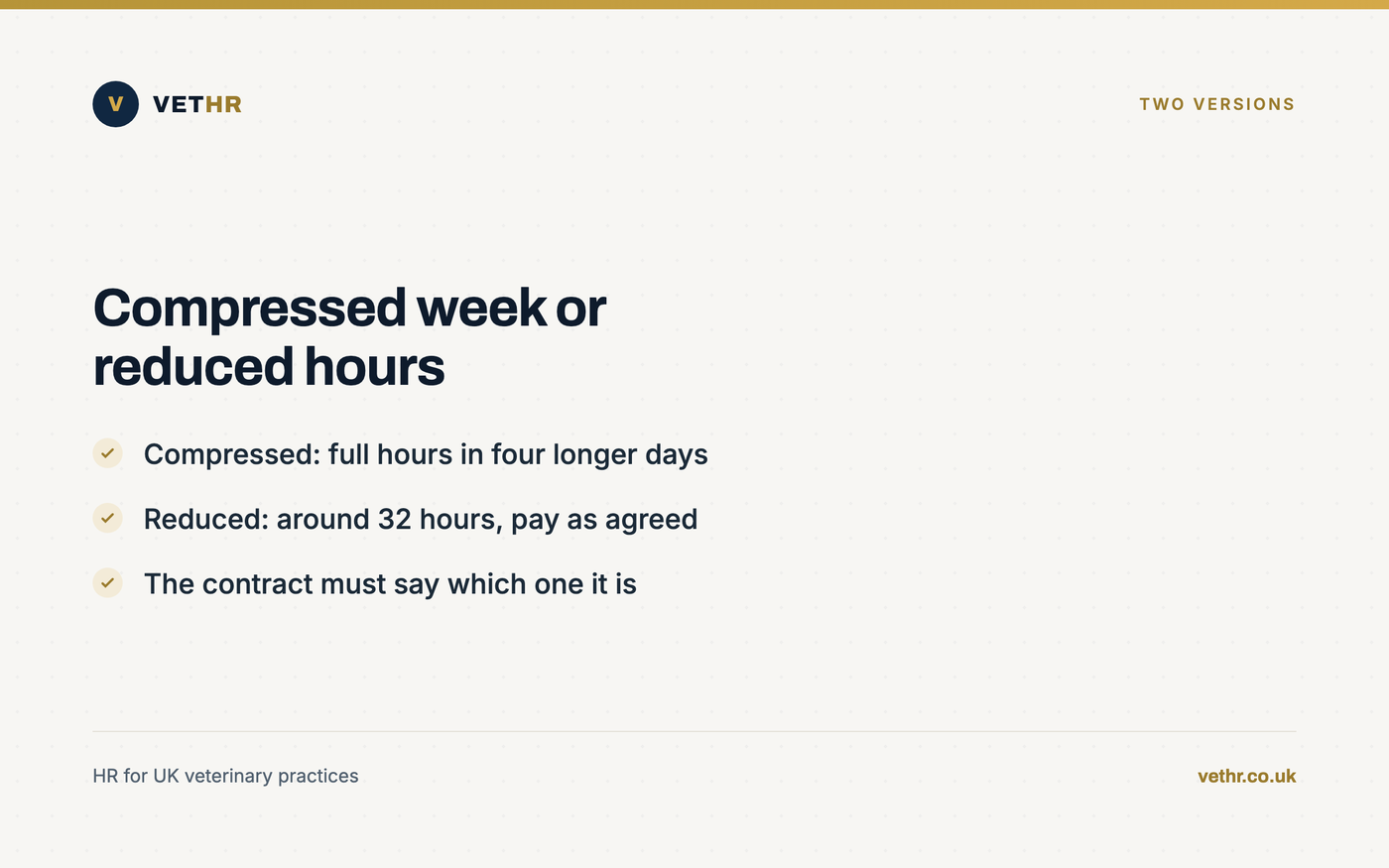
One of two very different things. A compressed week keeps full time hours but fits them into four longer days, so pay is unchanged. Reduced hours drops the week to around 32 hours over four days, and pay either drops with it or stays, depending entirely on what you agree. The contract must say which.
The distinction drives everything else. A vet moving from five 8 hour days to four 10 hour days still works 40 hours: the practice loses a day of presence but no capacity. A vet dropping to 32 hours at full pay is a 20% capacity cut funded by the practice. A vet dropping to 32 hours at 80% pay is part time working under a fashionable name.
Whichever version is on the table, be precise in writing before anyone starts: the new days, the new hours, what happens to pay, whether the change is permanent or a trial, and the date it takes effect. Vague goodwill now is a dispute later.
Usually as a statutory flexible working request. Every employee has the legal right to request flexible working from their first day in the job, and a request can propose changes to days, hours and times. Employees can make 2 applications in any 12 month period, and you must decide within 2 months.
The right is broad but belongs to employees. GOV.UK guidance on flexible working confirms all employees have the legal right to request it from their first day in a job. Acas adds that the statutory right applies to anyone with the legal status of employee, which most bank and casual arrangements are not, in its guidance on the right to request.
The request itself must be written and dated, state that it is a statutory request, describe the change wanted and when it should start, and mention any previous application. Employees can make 2 applications for flexible working in any 12 month period, per GOV.UK guidance on applying for flexible working.
Your side of the process has hard edges. You must discuss the request with the employee before refusing it, and you must make the final decision, including any appeal, within 2 months of the request unless the employee agrees to longer. We cover the full process in our guide to flexible working requests in a veterinary practice.
Sometimes. The maths is unforgiving: a practice open six days needs the same clinical cover from someone who is present one day fewer. Compressed patterns can genuinely help, because longer days span more of the opening day. Reduced hours means reorganising, recruiting or shrinking the diary. Run the numbers before you answer anyone.
Take a practice open 8am to 7pm. A five day vet on 8 hour shifts never covers a full opening day alone; a four day vet on 10 hour shifts nearly does. A compressed pattern can cut handovers within the day even as it adds a day of absence. Whether that trade works depends on your consult demand by day of the week, not on principle.
The pressure points are predictable: Saturdays, school holidays, the days your sole surgical vet or certificate holder is off, and any OOH obligations built around weekday presence. Map a real four week rota with the proposed pattern in place before you respond to a request. Our rota system lets you model a pattern change before anyone commits to it.
And be honest about scale. In a two or three vet practice, one person’s fifth day is a large share of total clinical cover. If that day cannot be reorganised among the rest of the team and you cannot recruit for a single day a week, that is not meanness. It is arithmetic, and the law recognises it, as the refusal grounds below show.
Agree a fixed trial with a written start date, end date and review date, and name the measures that will decide it: consult capacity, appointment waiting times, sickness, complaints and the load on the remaining days. Acas suggests discussing whether a trial period could help test out a change before either side commits.
The trial idea has official backing. Acas guidance on making a decision on a flexible working request says consultation means talking and listening to the employee to make a fully informed decision, and raises accepting part of a request or testing a change through a trial period as options on the table.
Put the temporary nature in writing. The trial letter should say the change is a trial, when it ends, and that the previous pattern resumes unless both sides agree otherwise. Without that line, a trial that drifts on can harden into the new normal by conduct rather than decision.
Judge it on numbers you already record: consults booked, appointment lead times, sickness absence, overtime in the remaining team. Run it long enough to include at least one busy period, not just a quiet fortnight. A trial judged on recorded numbers ends in a decision. A trial judged on vibes ends in a grievance.
Weighing up a request right now, or expecting one? Book a free HR health check. In 30 minutes we will look at the pattern being proposed, your rota cover and your contracts, and tell you plainly whether it can work in a practice your size, and how to respond either way.
The statutory entitlement stays 5.6 weeks a year, but a week now means the new pattern. GOV.UK’s own example: someone working 3 days a week must get at least 16.8 days of leave. On four days that formula gives 22.4 days. Recalculate from the change date and confirm it in writing.
The 5.6 weeks minimum comes from GOV.UK guidance on holiday entitlement, which shows the entitlement scaling with days worked: 3 days a week means at least 16.8 days of paid leave, because 3 times 5.6 is 16.8. Apply the same sum to four days and the answer is 22.4.
Compressed hours produce a neat result if you count in hours. Five 8 hour days give 5.6 weeks of 40 hours, which is 224 hours of leave. Four 10 hour days give the same 224 hours, taken as 22.4 longer days, and each booked day now burns 10 hours rather than 8. Track leave in hours or the sums quietly go wrong. Our holiday calculations system recalculates entitlement when a pattern changes, so nobody argues in December about what was agreed in June.
A pattern change is also a paperwork trigger. Hours and days of work sit in the written statement of employment particulars, and GOV.UK guidance on the written statement says staff must be told of changes in writing within one month. Fold the confirmation into the same letter that records the new pattern.
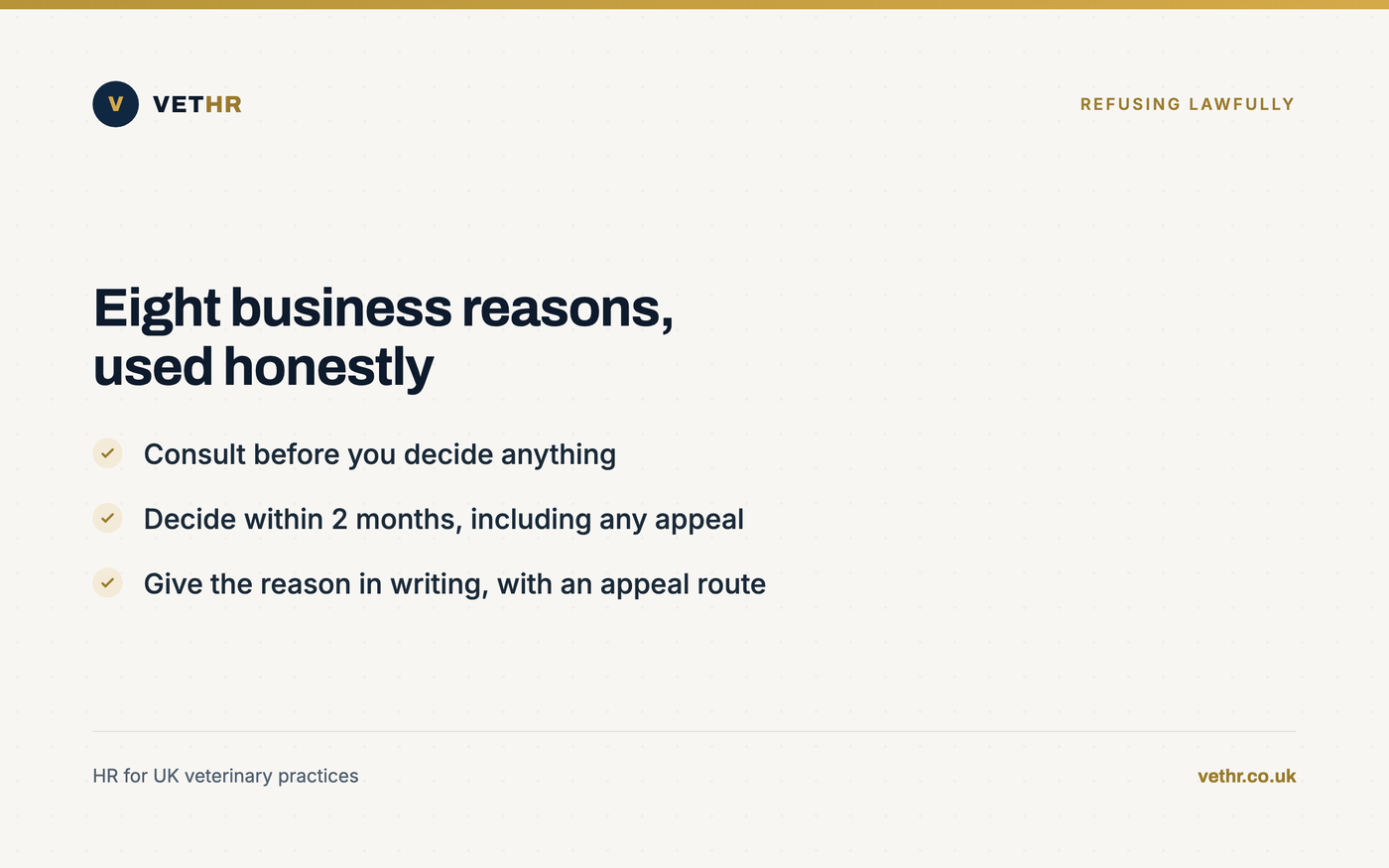
When one of the eight statutory business reasons genuinely applies and you can show your working. They include the burden of extra costs, inability to reorganise work among existing staff, inability to recruit, and effects on quality, performance or meeting customer demand. You must discuss the request first and respond within 2 months.
GOV.UK guidance on handling the application lists the reasons an employer can rely on: extra costs that will damage the business, the work cannot be reorganised among other staff, people cannot be recruited to do the work, flexible working will affect quality, flexible working will affect performance, the business will not be able to meet customer demand, a lack of work during the proposed working times, and planned changes to the workforce.
For a small clinical team, several of those are frequently real: a three vet rota that cannot lose a day of cover, a diary that cannot be reorganised across two colleagues already at capacity, a part time recruitment market with nobody in it. The point is not to reach for the list reflexively. It is that when the arithmetic genuinely fails, saying so, with the rota model attached, is a lawful and defensible answer.
Refuse well. Consult first, consider a counter offer such as a different day, a compressed rather than reduced pattern, or a later start date. Give the business reason in writing, offer an appeal, and keep the paperwork. A refusal that shows honest consideration rarely comes back to bite. A one line no often does.
No. Compressed hours keep full time hours in four longer days, with pay unchanged. A reduced hours version cuts the working week, usually to around 32 hours, with pay either reduced pro rata or maintained by agreement. The two have completely different effects on capacity, cost and the rota, so name which one you mean.
No. The statutory scheme is a right to request, not a right to have. Employees can apply from day one and make 2 applications in any 12 month period, and the employer must consult and decide within 2 months, but can refuse for any of the eight statutory business reasons, given in writing.
The statutory minimum is 5.6 weeks of the pattern actually worked. Following GOV.UK’s formula, four days a week gives at least 22.4 days of paid leave, the same sum that gives a 3 day worker 16.8 days. Compressed full timers keep the same total hours of leave, taken in longer days.
There is no statutory length, so agree one that covers at least a full rota cycle and one genuinely busy period. Put the start date, end date and review date in writing, state that the old pattern resumes unless both sides agree otherwise, and judge the trial on measures you already record.
The statutory right belongs to employees: Acas notes it applies to anyone with the legal status of employee, which most bank and casual arrangements are not. Nothing stops a practice agreeing a pattern voluntarily with anyone, but the formal request process, deadlines and refusal grounds apply to employees.
A four day week is neither a miracle nor an impossibility. Compressed patterns can fit a long opening day surprisingly well. Reduced hours can work in larger teams and genuinely cannot in some small ones. The law asks only that you take the request seriously, do the sums honestly, decide within 2 months and give real reasons.
Whichever way you are leaning, do it with the numbers in front of you. Model the pattern in our rota system before you commit, let the holiday calculations system handle the recalculation, or book a free HR health check and we will talk through the request sitting on your desk.
The Vet HR Team provides HR consultancy and white-labelled staff systems exclusively to UK veterinary practices.
Read next: Best Veterinary Rota Software UK (2026) and Self Rostering in a Veterinary Practice.
Contracts, rotas, holiday, a difficult conversation. Tell us what you are dealing with and we will come back within one working day. Nothing to sign up to.
Got it. We will come back to you within one working day. If you do not see a reply, please check your spam folder.
