Last updated: 5 September 2026
TL;DR: UK law recognises employees, workers, the self-employed and contractors, directors and office holders, and each has different rights. Employment status is decided by the reality of the working arrangement, not by the label on the invoice, and a person can have one status for employment law and another for tax.
A vet invoices you monthly and calls herself self-employed. A nurse on the bank picks up shifts most weeks and has done for three years. Neither arrangement is unusual, and in both cases the label everyone has agreed on may not be the one a tribunal would apply. That gap is where practices get caught.
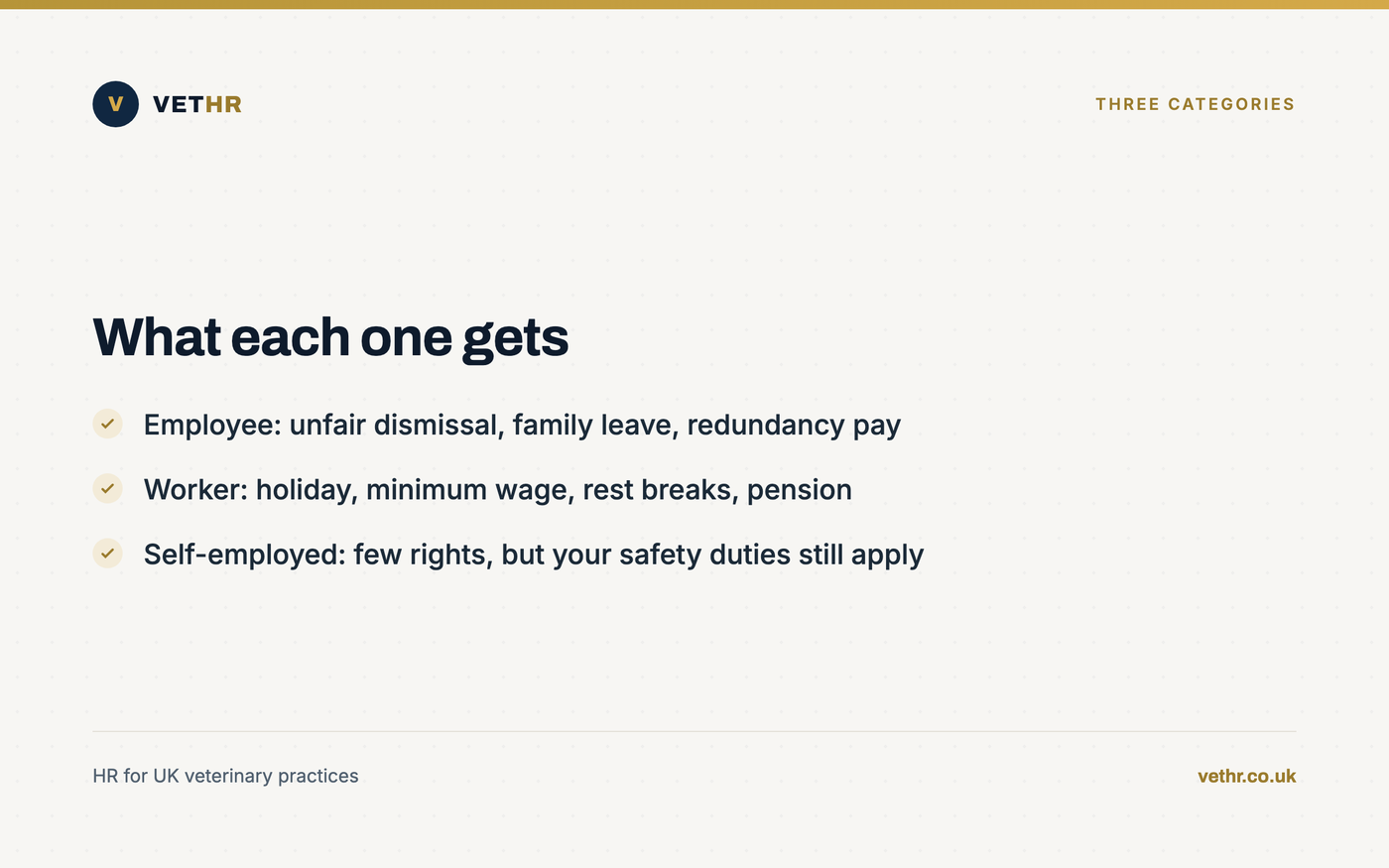
GOV.UK sets out that the main types of employment status are: worker, employee, self-employed and contractor, director, office holder. Each category carries a different set of rights and a different set of employer responsibilities.
Worker status is the one most practices underestimate. It is not a halfway house nobody uses; it is the category most bank and casual staff actually sit in, and it carries the holiday and minimum wage obligations that cost real money.
GOV.UK also warns that a person may have a different employment status in tax law, so a vet treated as self-employed by HMRC may still be a worker for employment rights. The two questions are answered separately.
Because it decides what you owe, and the liability builds quietly over years. A misclassified worker has been accruing holiday all along, and unpaid holiday claims do not politely limit themselves to the current leave year.
The minimum wage figure is not optional. GOV.UK confirms the National Living Wage for those aged 21 and over is £12.71 an hour from 1 April 2026, with £10.85 for 18 to 20 year olds and £8.00 for under 18s and eligible apprentices.
There is a reputational cost as well as a financial one. Practices compete for nurses in a tight market, and a reputation for arrangements that quietly deny people holiday pay travels through a local professional network faster than any recruitment advert.
Courts and tribunals make the final decision on employment status, so a practice cannot settle the question by writing a confident sentence into a contract.
Sometimes, and less often than practices assume. A vet who covers three different practices, sets her own rates, sends her own invoices, carries her own indemnity and can send a suitably qualified substitute has a strong claim to be self-employed.
A vet who covers only your practice, works the shifts you allocate on the rota you publish, uses your equipment, follows your protocols and has done so every week for two years looks very different, whatever the invoice says.
Three questions get you most of the way. Can they refuse work without consequence? Can they send someone else in their place? Are they genuinely in business on their own account, with other clients and their own commercial risk?
If the answers are no, no and not really, take advice. The financial exposure is covered in our piece on what freelance vet cover costs a practice, and the employment status question sits directly on top of it.
Almost always workers, and sometimes employees. Very few bank staff in veterinary practice are genuinely self-employed, because they are personally providing a service under your direction, using your premises and equipment.
That means holiday pay, minimum wage, rest breaks and, where earnings and age thresholds are met, auto enrolment into a workplace pension. None of that goes away because the person is on a zero hours arrangement.
Watch for status drift. A bank nurse who has worked the same three shifts every week for two years, and who is expected to turn up, may by then have become an employee with unfair dismissal protection. Our guide to casual workers in a veterinary practice covers how that happens.
Once you have classified someone as a worker, the holiday mechanics follow. For genuinely irregular hours staff, rolled-up holiday pay may be the simplest lawful route.
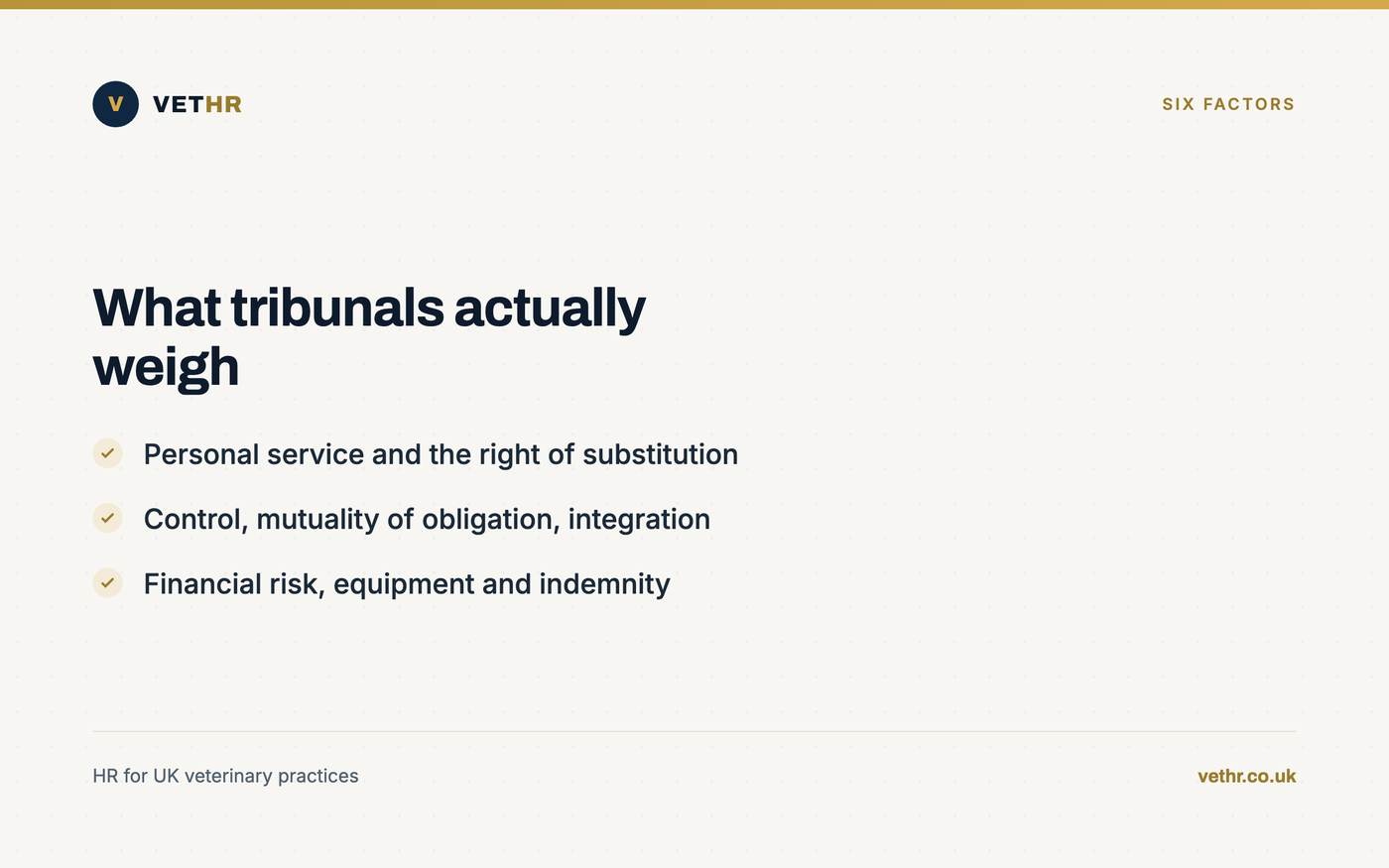
The reality of the arrangement, weighed as a whole. No single factor is decisive, which frustrates practices looking for a rule, but the pattern of answers is usually clear once you write them down honestly.
Beware the arrangement that has drifted. Most misclassification in veterinary practice is not deliberate; it starts as a genuine one-off engagement and slowly becomes a fixed part of the rota without anyone revisiting the paperwork that was written for a very different arrangement.
Review each arrangement at least annually, and always when someone’s pattern of work changes materially. A vet who moves from one day a month to three days a week has changed the facts, and the classification should be checked against the new reality rather than the old contract.
Write the answers down for each arrangement rather than for the group. Two vets doing what looks like the same freelance work can land in different categories, and a single practice-wide assumption will be wrong for at least one of them.
Unsure how your bank staff and freelance cover should be classified? A free 30-minute HR health check will map it. Book your HR health check.
Carefully, in writing and with advice, because the correction has a backward-looking element that needs handling properly. The instinct to quietly change the paperwork going forward is the one to resist.
Expect some pushback from the individuals concerned. A freelance vet may prefer the tax treatment of self-employment and a bank nurse may worry about losing flexibility, so explain that worker status does not oblige anyone to accept shifts, it simply attaches holiday pay and minimum wage protections to the ones they do accept.
Do it before you sell, merge or take on investment. Buyers ask about employment status early in diligence, and unresolved classification questions reduce price or delay completion, as our guide to HR due diligence when buying a practice sets out.
No. Employment status is determined by the reality of the working arrangement, and courts and tribunals make the final decision. A label that contradicts how the relationship actually operates carries very little weight, and it does not protect the practice from holiday pay or minimum wage claims.
No. Zero hours describes how work is offered, not employment status. Most zero hours staff in veterinary practice are workers, which means paid holiday, the national minimum wage and rest breaks apply, and some become employees over time through a settled pattern of work.
Yes. GOV.UK notes that a person may have a different employment status in tax law. The two systems ask different questions, so an HMRC position on tax does not settle whether the person is entitled to holiday pay or the minimum wage.
Yes. Whatever their status, people working on your premises are covered by your health and safety arrangements, including risk assessments, incident reporting and lone working controls. Status affects employment rights, not your duty to keep people safe in the building.
Further than most practices expect, which is why misclassification is expensive rather than merely untidy. The limits are a legal question and depend on the circumstances, so take advice on the historic exposure before deciding how to correct a long-standing arrangement.
Employment status is not paperwork, it is the question that decides what every other piece of paperwork means. Get it right and holiday, pension and pay all follow logically. Get it wrong and you are accruing a liability that nobody will notice until someone leaves unhappy.
Map your arrangements, apply the factors person by person, and correct what needs correcting rather than hoping. Our HR consultancy and contract service handle exactly this work, and the free HR health check will tell you where your risk sits in half an hour.
The Vet HR Team provides HR consultancy and white-labelled staff systems exclusively to UK veterinary practices. Status disputes are legal matters; take advice from a solicitor where the position is unclear.
Read next: The RVN Employment Contract.
Contracts, rotas, holiday, a difficult conversation. Tell us what you are dealing with and we will come back within one working day. Nothing to sign up to.
Got it. We will come back to you within one working day. If you do not see a reply, please check your spam folder.
