Last updated: 5 September 2026
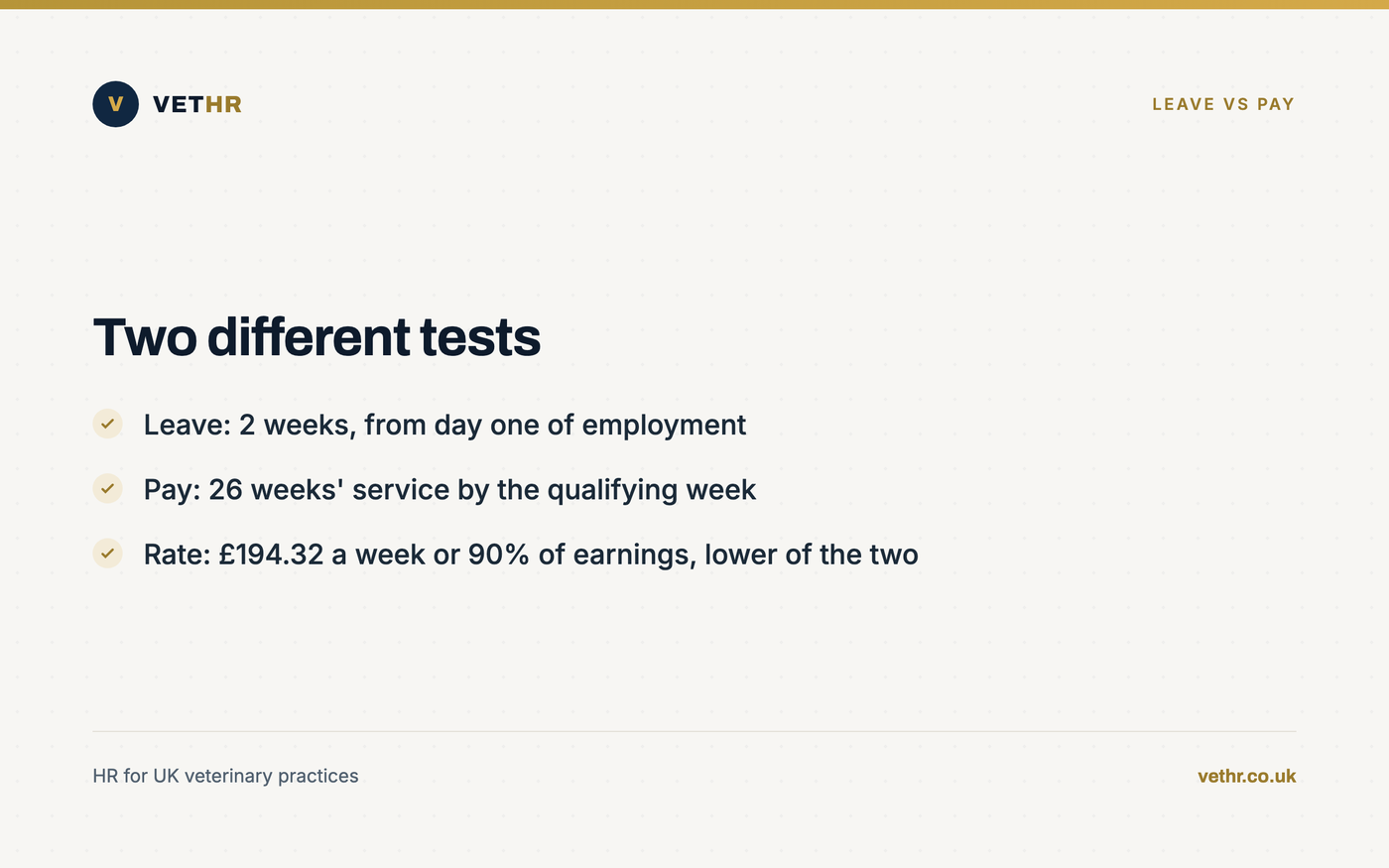
TL;DR: Paternity leave is two weeks, and the right to the leave itself starts on day one of employment. Statutory Paternity Pay is different: it needs 26 weeks of continuous service by the qualifying week and is paid at £194.32 a week or 90 per cent of average weekly earnings, whichever is lower. Notice is 28 days before the leave starts.
A vet tells you in March that his partner is due in July. You are pleased for him, and then you start doing arithmetic about consults, out of hours and the two nurses already booked off that fortnight. Handled early, this is a fortnight of planned cover. Handled late, it is a scramble and an awkward conversation about money.
Paternity leave is up to two weeks of time off for the partner of someone giving birth or adopting. GOV.UK confirms the entitlement is 2 weeks’ Paternity Leave, and eligibility for the leave itself begins from the first day of employment.
That day one point matters in veterinary practice, where a new graduate vet or a newly recruited RVN may join weeks before a baby arrives. You cannot make paternity leave conditional on length of service, and you cannot fold it into annual leave.
The leave is available to the child’s father, or the partner of the person giving birth, including a same sex partner. It applies to adoption as well as birth. The two weeks must be taken as whole weeks, not odd days scattered through a rota to suit consulting patterns.
Keep the leave right and the pay right separate in your head. Everyone employed by you can take the leave. Not everyone will qualify to be paid for it, and confusing the two is where most practice disputes begin.
The statutory weekly rate is £194.32, or 90 per cent of average weekly earnings, whichever is lower. For most vets and qualified nurses the flat rate will apply, because 90 per cent of their earnings is well above it.
Eligibility for pay is stricter than for leave. GOV.UK requires the employee to have been continuously employed for at least 26 weeks up to the end of the qualifying week, which is the fifteenth week before the baby is due.
So a vet who started in May, with a baby due in July, gets the two weeks off but not the statutory payment. Say that clearly and in writing at the point of the request. Discovering it on a payslip is how goodwill evaporates.
Many practices choose to enhance paternity leave pay, most often to full pay for the fortnight. That is a business decision, not a legal one, but if you offer it, write down the rule and apply it to everyone. An enhancement handed out case by case looks like favouritism from the treatment room.
Two deadlines apply. The employee must tell you the due date at least 15 weeks before the baby is expected, and give at least 28 days’ notice of when they want the leave to start and whether they are taking one week or two.
Twenty eight days is a workable amount of notice for a practice rota, which is the point of the rule. It is long enough to move a surgery list, arrange freelance vet cover or shuffle a branch clinic without paying premium rates in a panic.
Babies do not respect notice periods, so build flexibility into how you record it. The start date can move, and a practice that treats the original date as fixed will end up in a dispute about a fortnight that was always going to be unpredictable.
Log the notice in the staff record on the day it is given. Our guide to digital staff records covers how to keep that evidence without a paper file that lives in someone’s drawer.
By planning it in the month you are told, not the week it starts. Two weeks is short enough that most practices try to absorb it and long enough that absorbing it badly burns out whoever is left holding the consult list.
External cover is the expensive option and often the one chosen last, at the worst rate. Our analysis of what freelance vet cover really costs sets out why late booking is where the margin goes.
The cheapest cover is usually internal, agreed in advance, and paid for properly. A nurse taking on extra shifts should know the rate before the fortnight, not argue about it afterwards, and any time off in lieu should be banked with an expiry date attached rather than left floating.
Where a practice runs branches, decide which site absorbs the gap. Spreading a fortnight thinly across three sites usually means three unhappy teams rather than one managed one.

Short, specific and honest about money. The policy exists so that a stressed practice manager and an expectant father reach the same answer without negotiating it, and so nobody has to guess what the practice does.
Put it in the handbook rather than the contract. Statutory rates change every April, and a figure written into a contract has to be varied while a figure in a policy can simply be updated. Our policy library is built that way for the same reason.
Expect the follow up question. A significant number of new fathers ask about compressed hours or a shorter day within a year of the birth, so read the policy alongside your approach to flexible working requests.
Not sure your family leave paperwork is current? A free 30-minute HR health check will tell you in one call. Book your HR health check.
Four, and all of them are administrative rather than clinical. None of them are expensive to avoid, and each one is a familiar story in small practices where the rota is tight and HR is somebody’s fifth job.
The refusal one is the most serious. A practice that declines paternity leave on service grounds has denied a statutory entitlement, and the employee does not need two years of service to complain about it. It is also the mistake that spreads fastest through a small team.
There is a fifth, softer one. Practices congratulate the vet and then never ask how the return went. A five minute conversation in week one back catches the sleep deprivation, the childcare gap and the quiet resignation you would otherwise get in November.
No. Where the employee qualifies and has given the correct notice, the leave is an entitlement rather than a request you can decline. What you can do is discuss the timing within the permitted window and plan cover early, which is far more effective than refusing.
They get the leave but usually not Statutory Paternity Pay. GOV.UK requires at least 26 weeks of continuous employment up to the end of the qualifying week, the fifteenth week before the due date. Say this in writing as soon as the request is made so nobody plans around money that will not arrive.
Yes. Statutory annual leave continues to accrue while an employee is on family leave, so the two weeks do not reduce their holiday entitlement for the year. Your holiday system should treat the period as paid absence rather than as booked annual leave.
Ask the employee what they need and check the current GOV.UK guidance before confirming, because the rules on splitting the entitlement and on how soon after the birth it must be used have been reformed in recent years. Practices should confirm the arrangement in writing once agreed.
There is no automatic requirement to mirror maternity enhancement, but the comparison is now a live one and it is worth taking advice before setting different rates. Whatever you decide, apply it consistently and write the reasoning down.
Paternity leave is two weeks. It is the smallest piece of family leave law you will deal with and, handled badly, it does damage out of all proportion to its length, because it lands at the exact moment someone is deciding what kind of employer you are.
Write the policy, confirm the pay position in writing, and book the cover the month you are told rather than the week it starts. If your family leave paperwork has not been reviewed since the last set of reforms, our HR consultancy and the free HR health check are the fastest way to find out what is missing.
The Vet HR Team provides HR consultancy and white-labelled staff systems exclusively to UK veterinary practices. Statutory rates change each April, so check current GOV.UK figures before confirming pay.
Contracts, rotas, holiday, a difficult conversation. Tell us what you are dealing with and we will come back within one working day. Nothing to sign up to.
Got it. We will come back to you within one working day. If you do not see a reply, please check your spam folder.
