Last updated: 22 October 2026
TL;DR: There is no legal right to paid time off for IVF appointments, and Acas says employers should treat them like any other medical appointment. A full cycle takes around 3 to 6 weeks. From the embryo transfer stage the worker has the same rights as a pregnant worker, and protection continues for 2 weeks if treatment is unsuccessful.
An RVN asks for three short-notice mornings off over the next fortnight and will not say why. She has never done this before. The rota is tight, the practice manager is irritated, and the reason is fertility treatment that the nurse is not ready to discuss with anyone. How that fortnight is handled decides whether she is still at the practice in a year.
Narrower than most people assume until a specific point, then much stronger. Acas states that there is no legal right to paid time off for IVF appointments, and that an employer should treat those appointments the same as any other medical appointment.
So the starting position on fertility treatment is your ordinary medical appointment practice, whatever that is. If you routinely allow paid time for a dentist or a physiotherapy appointment, the same should apply here.
What changes the position is the stage the treatment reaches, which is why a practice needs to understand the shape of a cycle rather than just the request in front of it.
Acas says a full cycle of IVF takes around 3 to 6 weeks to complete, and that someone might need more than one cycle to become pregnant.
Within those weeks, fertility treatment appointments are frequent, often early in the morning, and frequently confirmed at short notice because they follow scan results rather than a plan. That is the part that collides with a veterinary rota, and it is not something the person can control.
Two practical answers work. Agree a standing arrangement for the cycle rather than negotiating each request, and identify who can cover a morning at a few days’ notice before you need them. Our note on being short staffed in a veterinary practice covers building that list.
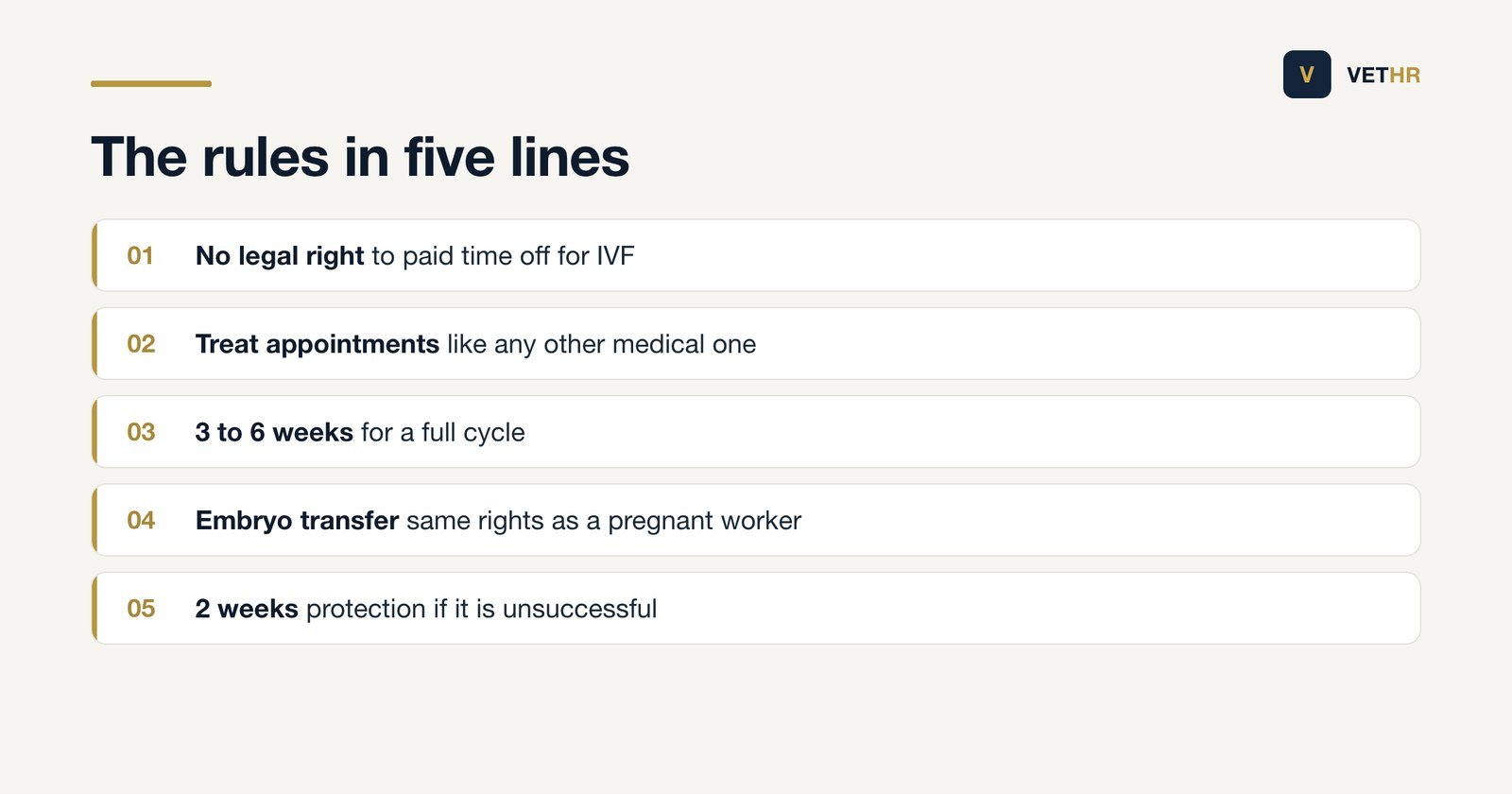
This is the point in fertility treatment every manager should know. Acas states that when a worker reaches the embryo transfer stage, they have the same rights as a pregnant worker.
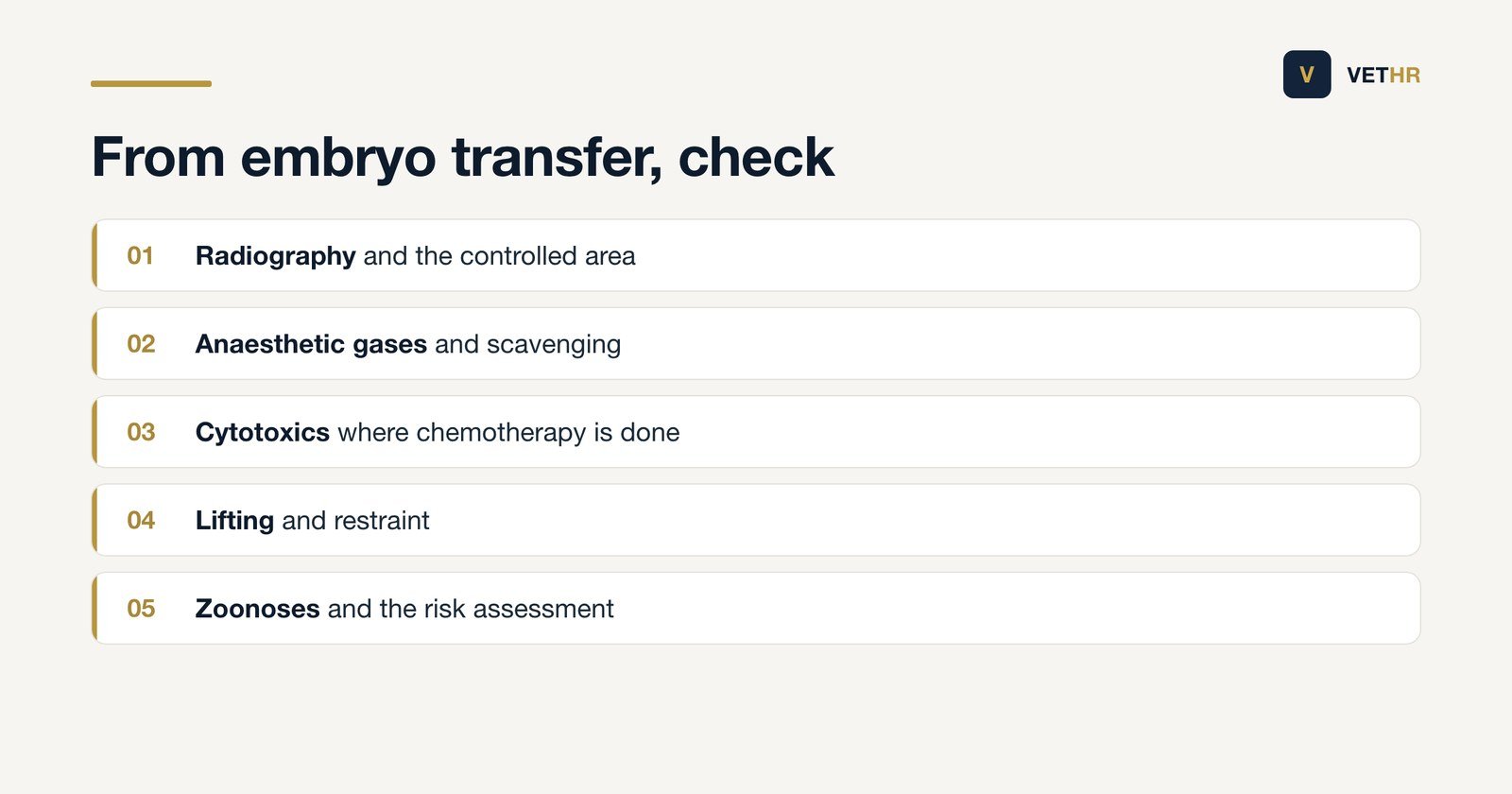
That brings protection from pregnancy and maternity discrimination, the right to paid time off for antenatal appointments once pregnancy is confirmed, and the health and safety duties that follow. In a veterinary practice those duties are not abstract: radiography, anaesthetic gases, cytotoxics, heavy lifting and zoonotic risk all need looking at.
Acas also notes the worker does not have to tell their employer at that stage, though they might find it helpful because the employer can then offer support. So you may not know, which is an argument for having a risk assessment process that is triggered by a conversation rather than by an announcement. Our guide to the pregnancy risk assessment covers it.
If treatment is unsuccessful, Acas says the worker remains protected against pregnancy discrimination for 2 weeks after finding out.
Acas advice is to treat sickness related to fertility treatment the same as any other sickness. That sounds neutral and it has a sharp edge in practices that run absence trigger points.
A cycle can produce several short absences in a few weeks. A trigger system that counts occasions will fire, and a formal absence meeting landing in the middle of a cycle is exactly the wrong outcome for everybody.
Build discretion into the trigger policy so a manager can pause the count where there is an underlying medical course of treatment, and record that they did. Our note on absence trigger points covers how to write that discretion in without losing the point of the system.
Note too that once someone reaches the embryo transfer stage, pregnancy related sickness is treated differently again, and should be recorded separately from ordinary absence.
Remember that fertility treatment is not only something women in the practice go through. Partners attend appointments too, and a male vet asking for a morning off may be dealing with exactly the same fortnight. A policy written as though it applies to one half of the team will be read that way.
Train the managers who will hear it first. The response in the first thirty seconds, whether that is a sigh about the rota or a straightforward yes, is the part the person will remember and repeat.
Almost nobody. One named manager needs enough information to arrange cover and apply the policy. Health information is special category data, so it should not travel round the practice in a rota note or a group chat.
Agree with the person what colleagues will be told, in their words. Most people are content with something like a series of medical appointments, and that is enough for a team to work with.
Our notes on GDPR and staff records and the staff privacy notice cover where health information belongs and who may see it.
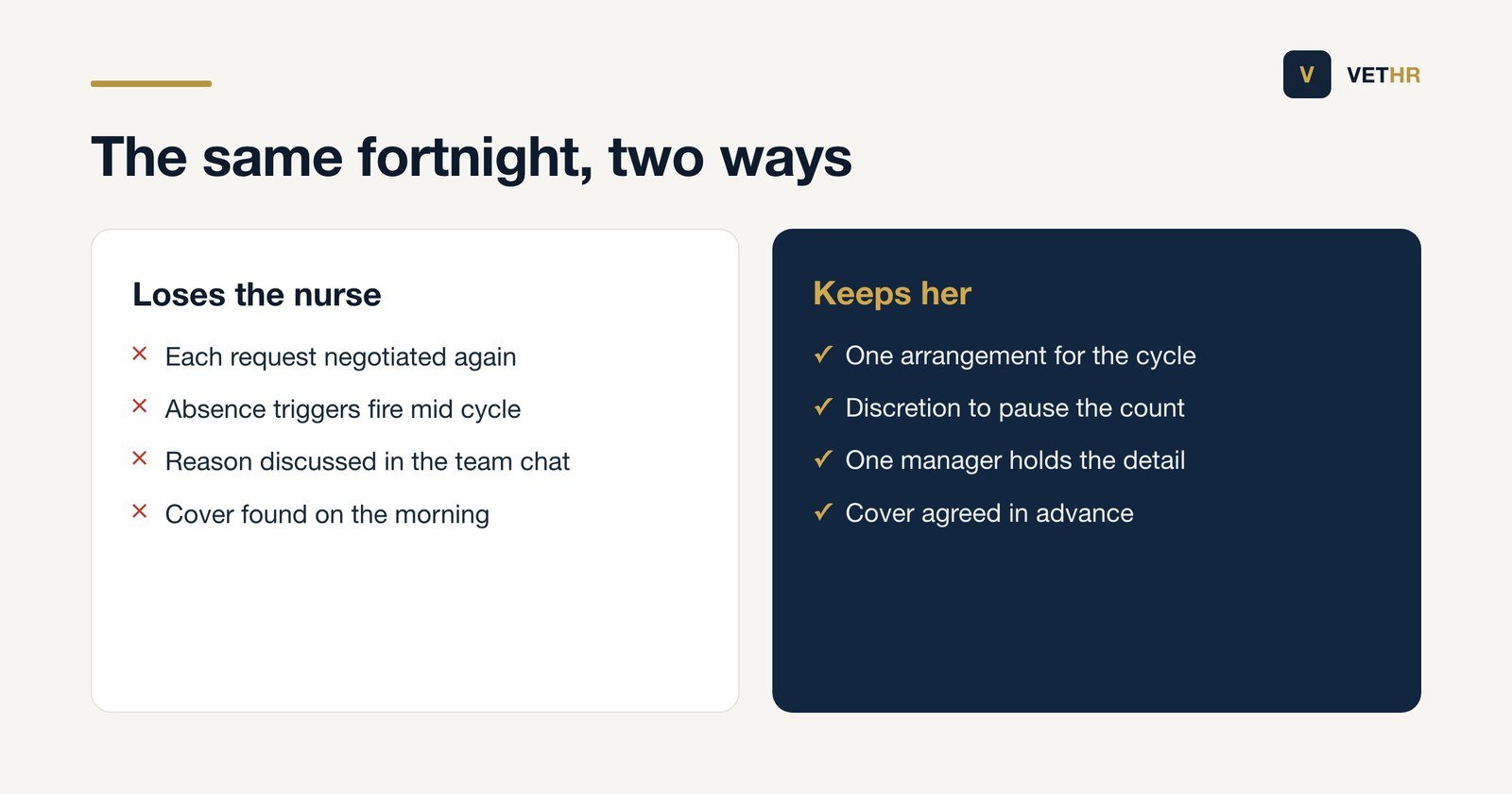
Be straight about the cost, because pretending there is none is how resentment builds in a small team. A cycle means some short-notice cover over a few weeks, usually mornings.
Set against that, the alternative is a resignation from someone experienced at the point she most needs a job that works. Fertility treatment is one of the clearest cases where a few weeks of flexibility buys years of retention.
Handle the cover without explaining why it is needed. Our rota system lets a manager record an approved absence without the reason being visible to the whole team.
Put it next to the family leave entries rather than in a wellbeing document. It belongs with maternity, adoption and parental leave, which is where people look. Our page on policies for veterinary practices shows the set.
Worth diarising: the government’s Employment Rights Act implementation timeline lists bereavement leave, including for pregnancy loss, among the 2027 measures. Our note on bereavement leave tracks it.
Book a free 30-minute HR health check if you want this added to your handbook before somebody needs it.
There is no legal right to paid time off for IVF appointments. Acas says to treat them the same as any other medical appointment, so the answer depends on what your practice already does for medical appointments generally.
Acas says a full cycle of IVF takes around 3 to 6 weeks, and someone might need more than one cycle. Appointments within that period are frequent and often confirmed at short notice, which is what affects the rota.
At the embryo transfer stage. Acas states that from that point the worker has the same rights as a pregnant worker, and if the treatment is unsuccessful they remain protected against pregnancy discrimination for 2 weeks after finding out.
Related sickness is treated as ordinary sickness, but a trigger firing in the middle of a course of fertility treatment helps nobody. Write discretion into the policy so a manager can pause the count, and record the decision.
No. Acas notes a worker does not have to say they have reached the embryo transfer stage, although telling the employer may help because support can then be offered. Assume you may not know, and make it easy to say.
The nurse asking for three mornings without explaining why is not being difficult. She is managing something exhausting alongside a job that does not pause, and the practice’s response over that fortnight is the whole of its retention strategy in miniature.
Write the five lines, agree the cover in advance, and keep the information with one person. We add fertility treatment to family leave policies for independent practices through HR consultancy for veterinary practices and ongoing HR support on subscription.
The Vet HR Team provides HR consultancy and white-labelled staff systems exclusively to UK veterinary practices.
Contracts, rotas, holiday, a difficult conversation. Tell us what you are dealing with and we will come back within one working day. Nothing to sign up to.
Got it. We will come back to you within one working day. If you do not see a reply, please check your spam folder.
