Last updated: 24 September 2026
TL;DR: Statutory adoption leave is 52 weeks, made up of 26 weeks ordinary and 26 weeks additional. Statutory adoption pay runs for up to 39 weeks. Only one person in a couple can take adoption leave, and the partner may take paternity leave instead. Practices get less notice than with a pregnancy, so the rota plan matters more.
An RVN tells you on a Tuesday that she has been matched with a child and the placement is in three weeks. You are pleased for her. You are also three weeks away from losing a full-time nurse for up to a year, and the maternity plan you normally rely on assumed nine months of warning. Adoption leave is the same length as maternity leave, but the run-up is rarely the same.
Statutory adoption leave is 52 weeks. GOV.UK sets it out as 26 weeks of ordinary adoption leave and 26 weeks of additional adoption leave. That is the same total as statutory maternity leave, and the employee does not have to take all of it. Most practices plan for the full year and are pleasantly surprised.
One rule catches people out. Only one person in a couple can take adoption leave. The other partner may be able to take paternity leave, or the couple may later opt into shared parental leave. If two of your team are adopting the same child, only one of them is on adoption leave.
This applies to UK adoptions, to overseas adoptions and to parents through a surrogacy arrangement. The eligibility route differs, but the leave entitlement is the same 52 weeks in each case.
For a UK adoption, leave can start up to 14 days before the date the child starts living with the employee, or on the placement date itself. For an overseas adoption it starts when the child arrives in the UK or within 28 days of that date. For a surrogacy arrangement it is the day the child is born or the day after.
Those three start windows come straight from the GOV.UK guidance and they matter for the rota. A UK placement date can move. If it does, the employee must tell you within 28 days of the change, and your cover plan has to move with it.
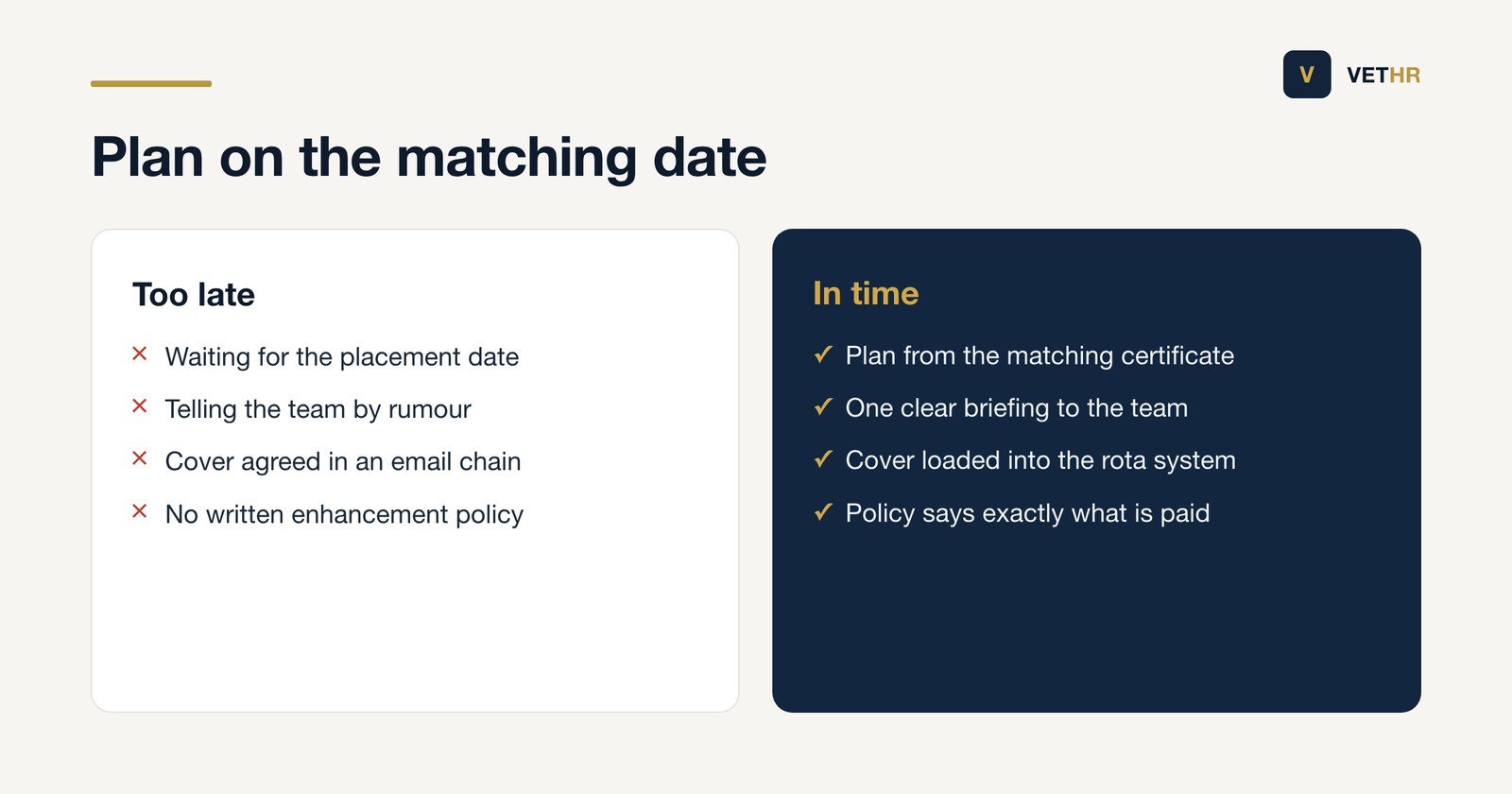
Unlike a pregnancy, there is no expected week of childbirth to plan around and no early scan date to give you nine months of warning. Matching can happen quickly. A practice that only starts thinking about cover when the leave is confirmed has left it late.
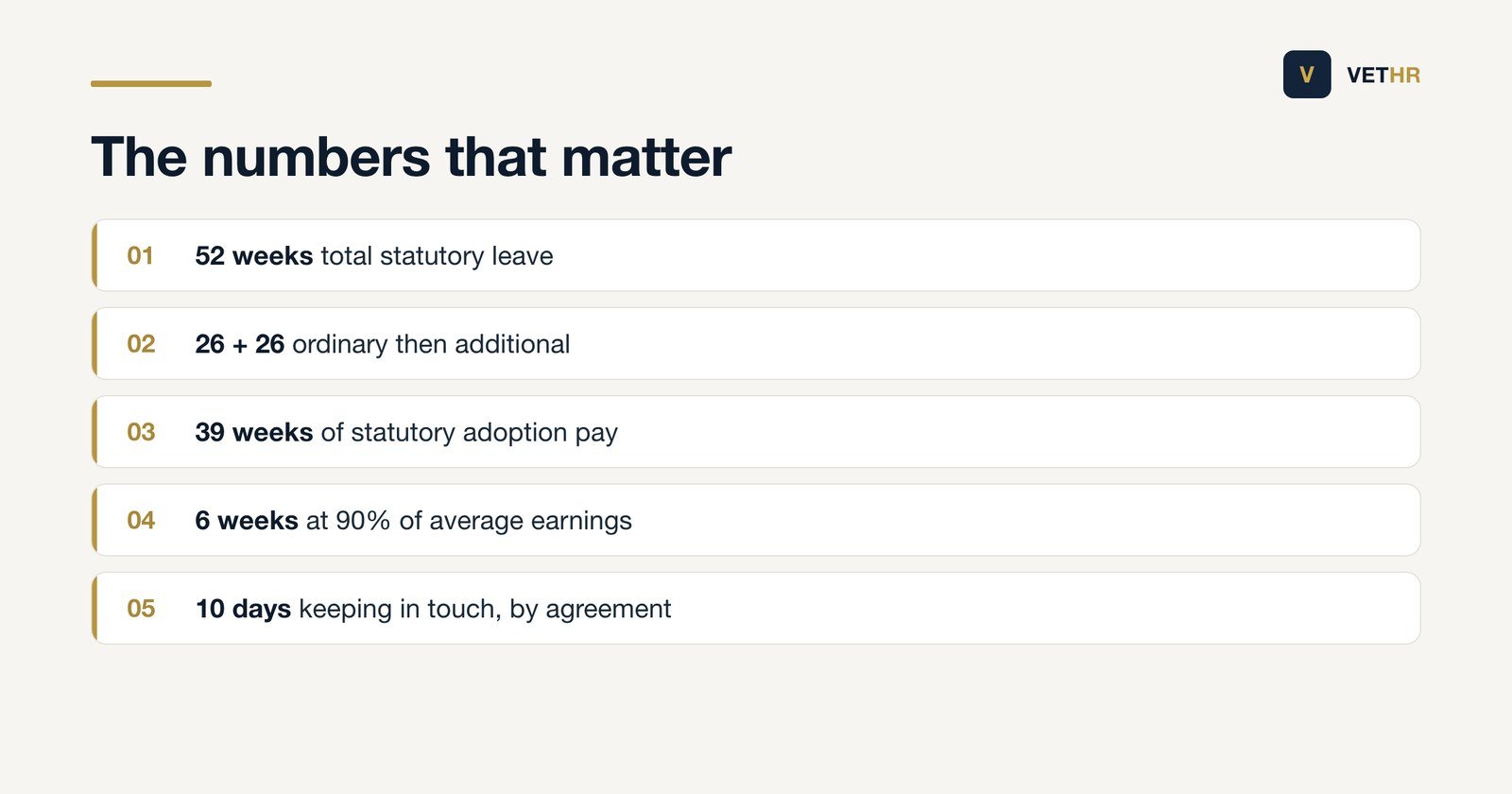
Statutory adoption pay is paid for up to 39 weeks. GOV.UK sets the structure as 90 per cent of average weekly earnings for the first 6 weeks, then 33 weeks at the standard weekly rate or 90 per cent of average weekly earnings, whichever is lower. Tax and National Insurance are deducted as normal, and it is paid in the same cycle as wages.
That leaves up to 13 weeks of the 52 unpaid, which is the same position as maternity leave. Employees plan around this, so say it clearly at the start rather than letting them work it out from a payslip in month ten.
Some practices pay an enhanced rate. If yours does, write down exactly what it is, who qualifies, and whether any of it is repayable if the person does not return. An enhancement that lives in one manager’s memory turns into an argument later. Our note on employment contracts for veterinary staff covers where clauses like this belong.
Whatever you offer, keep it consistent with what you pay on maternity. Paying an enhanced maternity rate and only the statutory rate on adoption leave is difficult to justify and invites a complaint you do not need.
Less than you would like. The employee tells you when they have been matched, which is when they get the matching certificate from the agency, and that is usually the first solid date you will have. Ask for it in writing, note the intended start date, and confirm your response in writing too.
There is one notice period you can rely on. If the employee wants to change their return date, GOV.UK guidance says they must give at least 8 weeks notice. That cuts both ways: it protects your rota, and it means you cannot expect someone to come back early at short notice.
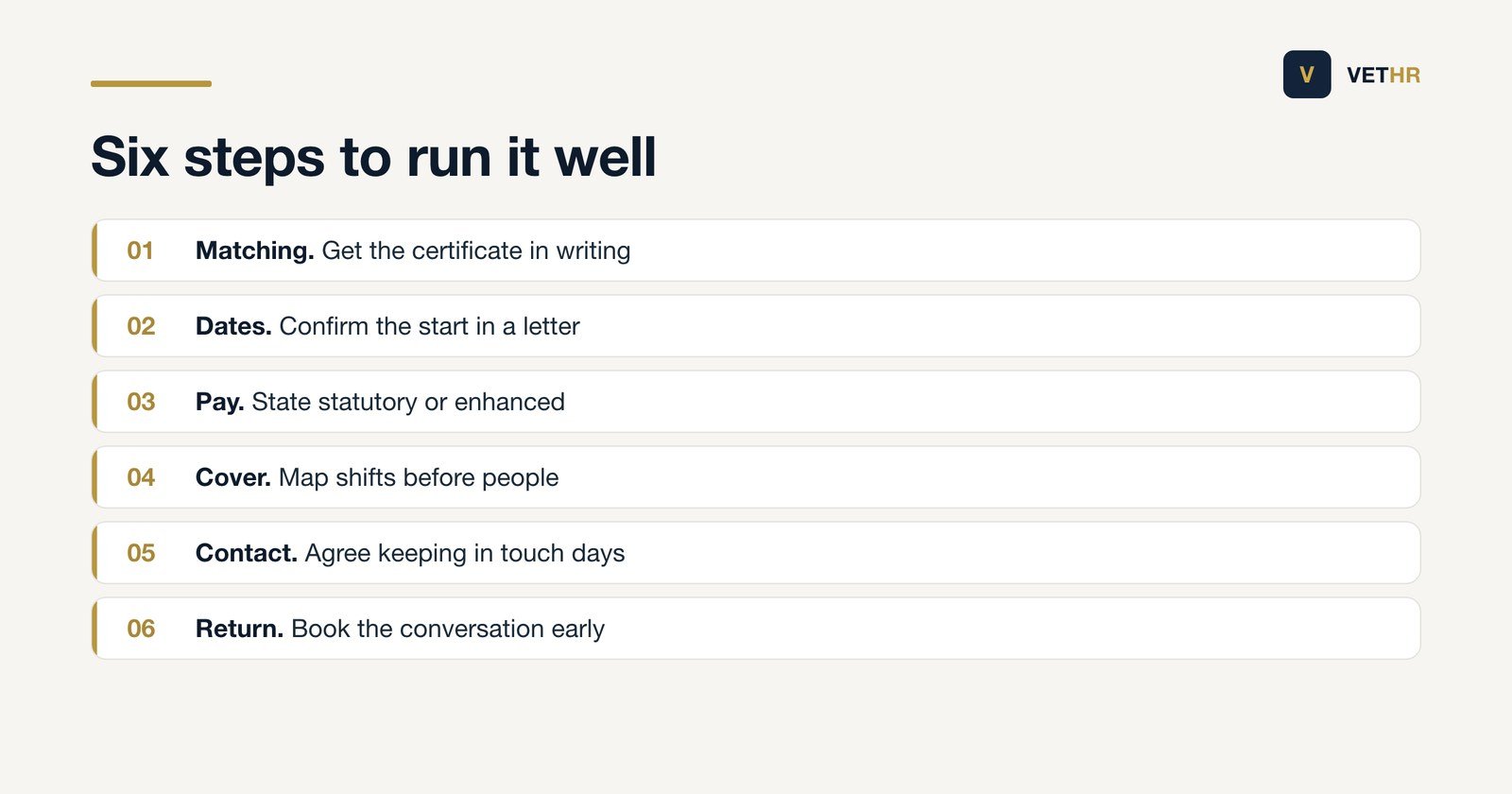
Write the sequence into your policy so nobody has to improvise. Matching certificate, start date, response letter, cover plan, keeping in touch arrangements, return date. Six steps, each with a name against it. That is all the policy really needs to do.
Yes, by agreement. Employees can work up to 10 keeping in touch days during maternity leave, adoption leave or bereaved partner’s paternity leave, and those days do not end the leave or stop the pay. Both sides have to agree. Neither can insist.
Any amount of work counts as one whole day, so an hour at a team meeting uses a full keeping in touch day. Agree the work and the pay before the person comes in, not afterwards.
Used well, these days are the single best tool you have for a smooth return. A CPD session, a new practice management system rollout, a team briefing about a change to the out of hours arrangement: all of it means the person comes back to a practice they still recognise.
Treat it as a fixed term gap with a moveable start. The options are the ones you already know: a fixed term appointment, extra hours for part-time staff who want them, freelance vet cover for the clinical shifts, or a redistribution that you review after a month. What changes is the timescale you have to arrange it.
Start with the shifts, not the person. Map which consults, ops lists and out of hours slots the role actually carries, then decide which of them genuinely need the same skill mix. Practices routinely discover that a single full-time absence is really three separate problems, and only one of them is urgent.
Put the cover in the rota system rather than in an email chain. If you are still running the rota on a shared spreadsheet, a year-long absence is exactly the situation that exposes it. Our rota system for veterinary practices is built for this, and the write-up on staffing levels in a veterinary practice covers how to work out what the gap really is.
Tell the team the plan once and in full. Rumours about who is covering what do more damage to morale than the absence itself.
Someone coming back within the first 26 weeks has the right to return to the same job. Someone returning after that has the right to the same job, or to a suitable alternative on no less favourable terms if the same job is genuinely not reasonably practicable. Keep a record of the reasoning if you ever rely on the second limb.
Expect a flexible working request. A new placement changes childcare, and a request to move to four days or drop out of hours is common. Handle it as a formal request with a proper answer, not a corridor conversation, and read our guide to flexible working requests in a veterinary practice before you reply.
Book a proper return conversation for the first week back. What has changed clinically, what has changed in the team, what training has been missed, what the first month looks like. Thirty minutes here saves a resignation in month three.
Three mistakes come up again and again, and none of them is about the law.
If your staff handbook has a maternity section and nothing else, that is the gap. Adoption leave, paternity leave, shared parental leave and unpaid parental leave all need a short, plain entry of their own. Our page on policies for veterinary practices shows what a usable set looks like.
If you want a second pair of eyes on your family leave policies before someone needs them, book a free 30-minute HR health check and we will go through what you have.
It is 52 weeks in total, made up of 26 weeks of ordinary adoption leave and 26 weeks of additional adoption leave. The employee does not have to take the full year, but they can, and the practice should plan on the basis that they will.
No. GOV.UK guidance is clear that only one person in a couple can take adoption leave. The other partner may be eligible for paternity leave instead, and the couple can look at shared parental leave if they want to split the time differently.
No. Statutory adoption pay is the legal minimum: 90 per cent of average weekly earnings for 6 weeks, then up to 33 weeks at the lower of the standard rate or 90 per cent of earnings. Anything above that is a contractual choice, and it should be written down and applied consistently.
You can ask, and they can say no. Keeping in touch days are optional on both sides, capped at 10, and the work and pay should be agreed before the day. An hour counts as a whole day, so use them for something that matters.
Leave that has already started can continue for a period after a disrupted placement. This is the point to take advice rather than improvise, because the dates depend on when the placement ended and how the leave was notified.
Adoption leave is not complicated. It is 52 weeks, up to 39 of them paid, one parent, short notice, and a rota gap you need to fill. The practices that handle it well are the ones that wrote the plan down before anyone needed it.
If yours has not, start with the policy and the contract wording, then the cover plan. We do this with independent practices every week through fixed-price HR consultancy for veterinary practices and ongoing HR support on subscription.
The Vet HR Team provides HR consultancy and white-labelled staff systems exclusively to UK veterinary practices.
Contracts, rotas, holiday, a difficult conversation. Tell us what you are dealing with and we will come back within one working day. Nothing to sign up to.
Got it. We will come back to you within one working day. If you do not see a reply, please check your spam folder.
