Last updated: 24 September 2026
TL;DR: Unpaid parental leave gives each parent 18 weeks off for each child, up to that child’s 18th birthday, capped at 4 weeks per child per year. It is taken in whole weeks unless the child is disabled or you agree otherwise, and employees give 21 days notice. The government roadmap makes it a day one right from 6 April 2026.
A vet asks for a week off in October to settle his son into a new school. He has no annual leave left. You either say no, or you find a week of goodwill from somewhere. Most practice managers do not realise there is a third answer sitting in employment law, and that the employee already has a right to that week.
Unpaid parental leave is a statutory right for parents to take time off to look after a child’s welfare. It is unpaid, it is separate from annual leave, and it is separate from time off for dependants, which covers emergencies. Unpaid parental leave is for the planned things: settling a child into school, a hospital appointment series, time with a child during a house move.
Unpaid parental leave sits with the parent, not the job. It follows the employee through their working life, and it applies to birth parents and adoptive parents alike.
Very few veterinary employees ever ask for unpaid parental leave, which is exactly why it is worth knowing. A practice that offers it as an answer, rather than waiting to be asked, looks like a practice that knows what it is doing.
GOV.UK states the entitlement plainly: 18 weeks leave for each child and adopted child, up to their 18th birthday. The limit on how much each parent can take in a year is 4 weeks for each child, unless the employer agrees otherwise.
Read that twice, because both halves matter. An RVN with three children has an 18 week entitlement for each of them. In any one year she could take up to 4 weeks for each child. The annual cap is per child, not per employee.
In practice, almost nobody uses anything like the full allowance. The typical request is one week, occasionally two. But the arithmetic is worth understanding before you assume a request is unreasonable.
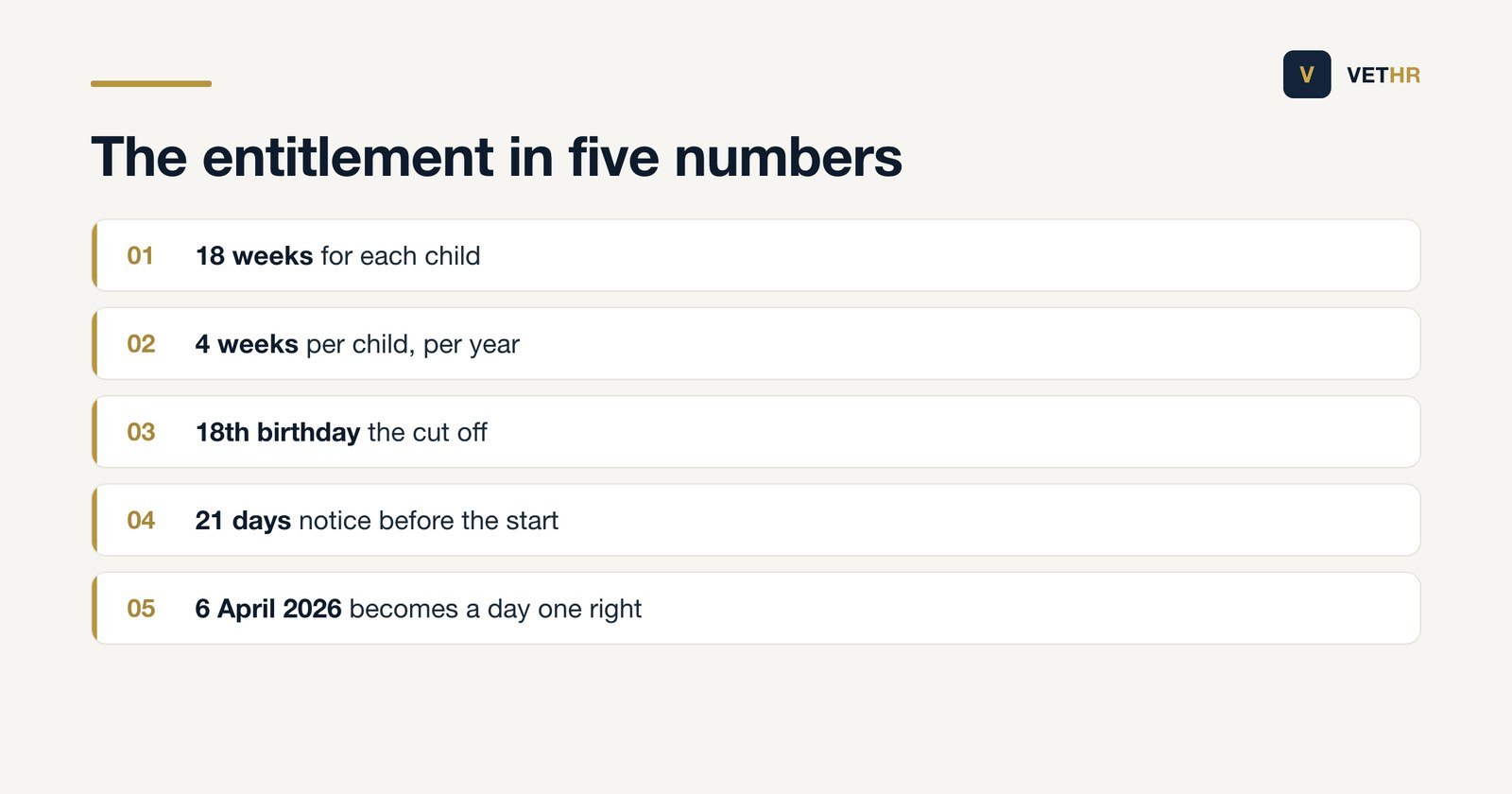
The same GOV.UK page is specific: leave must be taken as whole weeks, for example 1 week or 2 weeks, rather than individual days, unless the employer agrees otherwise or the child is disabled. Where the child is disabled, it can be taken in single days.
A week means the length of time the employee normally works over 7 days. For someone on three 12 hour shifts, one week of leave is three shifts, not five days. Get this wrong in a rota system and you will either short the employee or lose cover you did not need to lose.
You can agree to single days if you want to. Many practices do, because a half day for a school assembly costs almost nothing and buys a lot of goodwill. Just record that you agreed it, so the next manager knows it was a choice rather than the rule.
GOV.UK guidance says employees must give 21 days notice before their intended start date, confirming the start and end dates. For a birth or adoption it is 21 days before the week the baby or child is expected. The notice does not have to be in writing unless you ask for it.
Ask for it in writing. Put that one line in the policy and the whole thing becomes auditable: who asked, for which child, for how long, and when they gave notice.
Twenty one days is not a lot of warning for a branch surgery with two vets. It is, however, more notice than you get for most sickness absence, and considerably more than you get when someone resigns. Plan it like any other short absence.
The qualifying service goes. The government’s implementation timeline for the Employment Rights Act lists day one paternity leave and unpaid parental leave for 6 April 2026, with a related notice period step on 18 February 2026.
Today unpaid parental leave depends on a year of continuous service. From that date a new starter can ask on their first week, which matters for a profession that recruits new graduates every summer and freelance staff all year round.
That same timeline carries several other changes practices should be diarising: statutory sick pay without the lower earnings limit or waiting period from 6 April 2026, the employment tribunal claim time limit rising from 3 to 6 months on 1 October 2026, and a reduction in the unfair dismissal qualifying period to 6 months for dismissals from 1 January 2027. Our summary of employment law changes for veterinary practices tracks the lot.
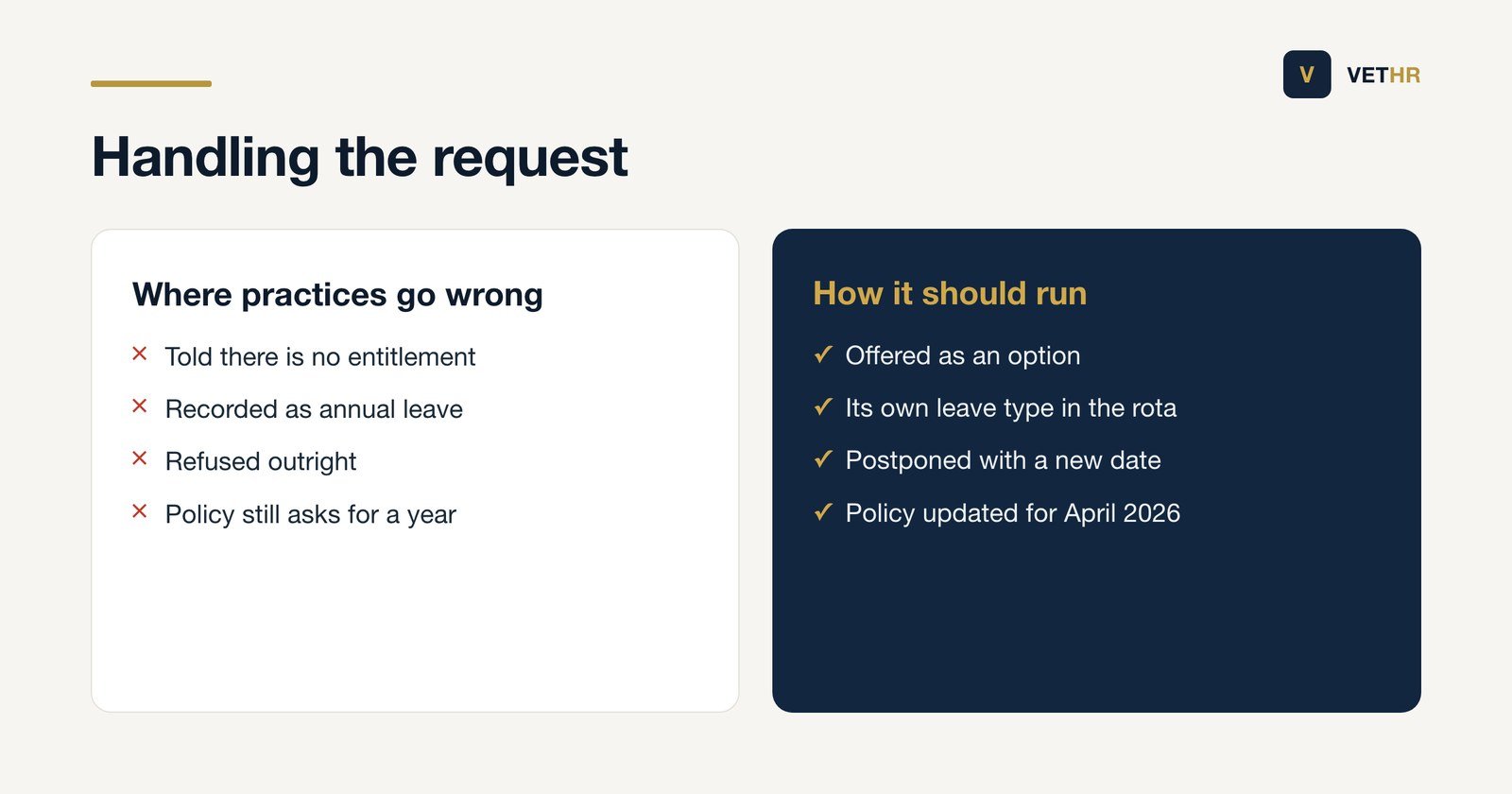
The same way you handle any planned week off, with one difference: you cannot simply refuse it. You can postpone in limited business circumstances, but a flat no to a properly notified request is not one of your options, so plan rather than argue.
Log it in the rota system as its own leave type. If unpaid parental leave is recorded as annual leave, two things break. The employee’s holiday balance is wrong, and your absence reporting tells you a story that is not true.
A practice with three vets and one week of notice has a real problem, and pretending otherwise helps nobody. Keep a standing list of who will pick up extra shifts and which freelance vet cover you trust, so the answer to a short-notice week is a phone call rather than a crisis. Our veterinary rota system holds both.
Remember that the leave is unpaid. Some employees will want to combine a week of it with a week of annual leave so that the month is affordable. Say yes if you can.
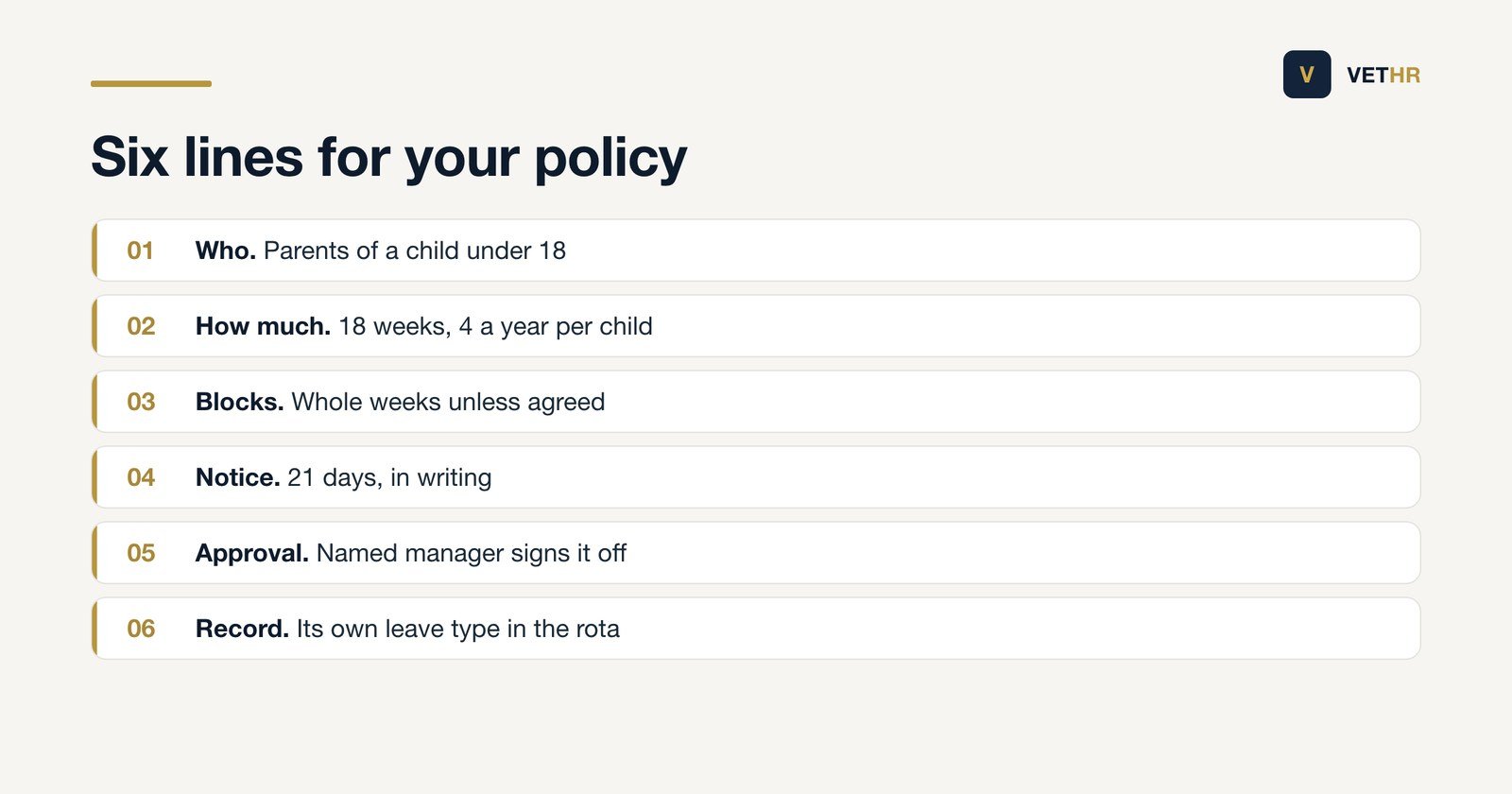
Six lines will do it. Who it applies to, the 18 weeks per child and 4 weeks a year, whole weeks unless agreed, 21 days notice in writing, who approves, and how it is recorded. Anything longer will not get read.
Put it next to the other family leave entries rather than in a separate document. Staff look in one place, and so do you. Our page on policies for veterinary practices shows how the family leave set fits together, and the note on carer’s leave in a veterinary practice covers the entitlement people most often confuse with this one.
If your handbook still says the employee needs a year’s service, put a date in the diary for March 2026 to change it.
Want someone to check the whole family leave section before April? Book a free 30-minute HR health check and we will tell you what needs rewriting.
No. The statutory entitlement is unpaid. A practice can choose to pay some or all of it, but it must then apply that choice consistently, and it should be written into the policy rather than agreed case by case.
You cannot simply refuse a properly notified request from an eligible employee. There is scope to postpone where the business would be unduly disrupted, but that is a postponement with a new date, not a refusal, and it does not apply around a birth or adoption.
A week is the length of time the employee normally works over 7 days. For a nurse who works three days a week, one week of unpaid parental leave is three days. Record it in shifts in the rota system so the maths is never done twice.
No. Time off for dependants covers unexpected emergencies and is usually a day or two. Unpaid parental leave is planned, taken in whole weeks, and capped at 4 weeks per child per year. The two entitlements sit alongside each other.
No. The 18 weeks belongs to the parent and the child, so time already taken with a previous employer counts. Ask on recruitment how much has been used, and record the answer with the rest of the new starter paperwork.
Unpaid parental leave costs the practice cover, not wages, and it solves a problem that otherwise comes to you as a resignation. A vet who cannot get a week for a family reason in October starts looking at job adverts in November.
Write the six lines, log it properly, and diarise the April 2026 change. If you would rather someone else did the writing, we draft policies and contracts for independent practices through fixed-price HR consultancy and ongoing HR support on subscription.
The Vet HR Team provides HR consultancy and white-labelled staff systems exclusively to UK veterinary practices.
Contracts, rotas, holiday, a difficult conversation. Tell us what you are dealing with and we will come back within one working day. Nothing to sign up to.
Got it. We will come back to you within one working day. If you do not see a reply, please check your spam folder.
