Last updated: 5 September 2026
TL;DR: A social media policy for a veterinary practice has to do three jobs at once: protect client confidentiality, protect staff from online abuse, and set fair limits on conduct without gagging anyone. From 30 October 2026 employers must take all reasonable steps to prevent harassment by third parties, which includes what clients post about your team.
A euthanasia goes badly for the owner and appears on the local Facebook group by teatime. A nurse posts a photo of a patient with the collar tag visible. A one-star review names a vet personally. Each of these needs a decision within hours, and a social media policy is what turns that decision into procedure rather than panic.
A social media policy matters here because the risks are unusually concentrated. A practice holds confidential client information, employs professionals bound by a regulator, markets itself through the same channels where complaints appear, and has a young team who use those channels constantly.
Acas guidance on social media in the workplace advises employers to work with staff to agree the details of a policy, and sets out its aims plainly: that employees do not feel gagged, that staff and managers feel protected against online bullying, and that the organisation feels confident its reputation will be guarded.
Those three aims are worth keeping in view, because most practice policies achieve only the third. A social media policy that reads as a list of prohibitions protects the business and leaves the team exposed, which is exactly backwards given what your staff absorb online.
The same as it means anywhere. RCVS guidance states that a veterinary surgeon or veterinary nurse should not disclose to any third party any information about a client or their animal, unless consent has been given, animal welfare or the public interest justifies it, or the law requires it.
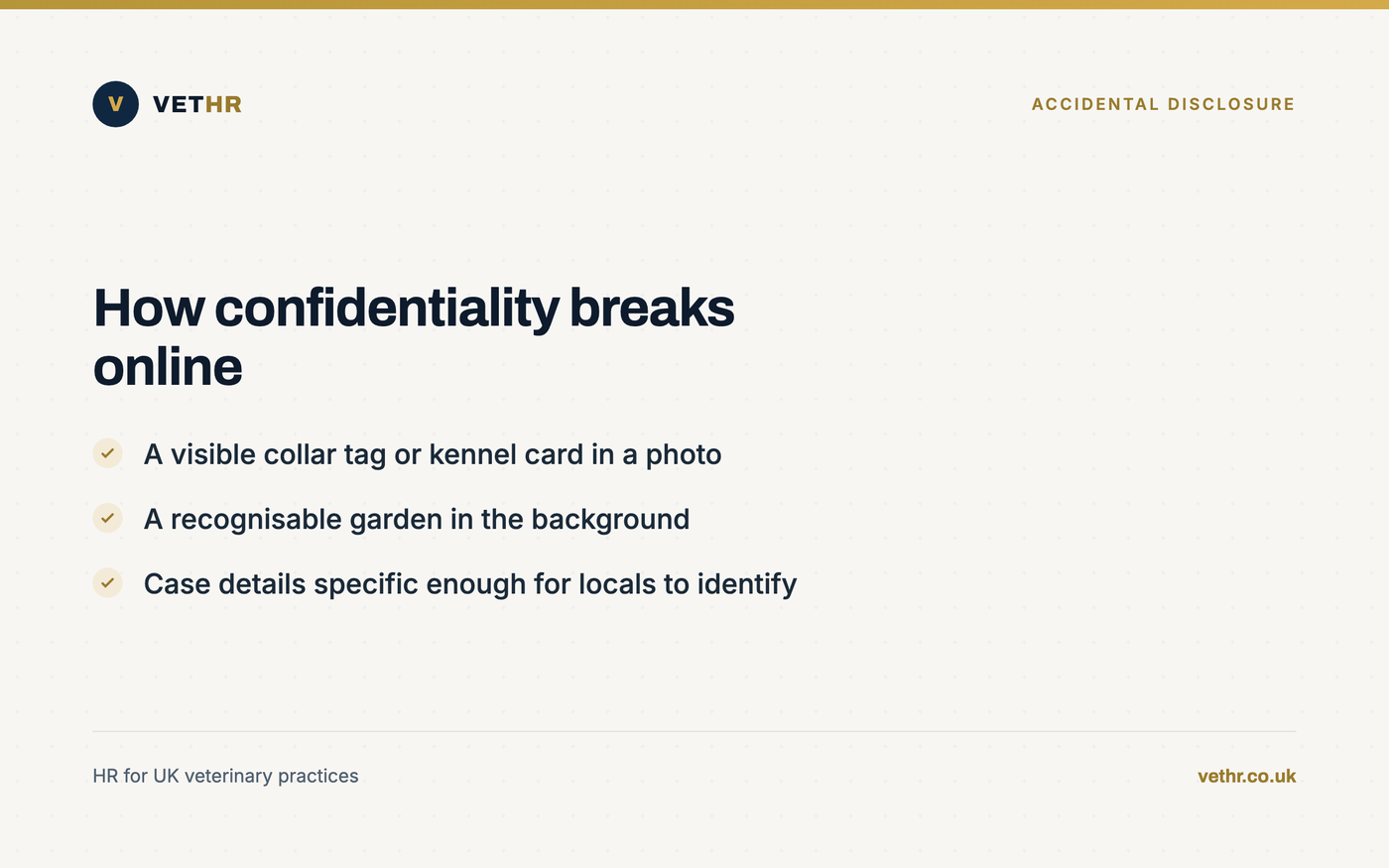
Online, disclosure happens accidentally far more often than deliberately. A visible collar tag, a name badge on a kennel card, a recognisable garden in the background of a photo, a case detail specific enough that anyone local would know the dog. None of it is malicious. All of it is disclosure.
The rule to write into the social media policy is simple: no patient or client content is posted without written consent, and consent is recorded. Make it easy by keeping a short consent line on the admission form rather than chasing owners afterwards.
Sometimes, and the test your social media policy should apply is the connection to work. Acas guidance is that an employee could face disciplinary action for misconduct outside work where the behaviour reflects badly on the organisation, and that it depends on how serious the misconduct is and whether it could affect the business.
Acas also advises applying the same standards of conduct online as offline. That is a useful test for a practice manager. Would this have been a disciplinary matter if it had been said in the waiting room? If yes, the medium does not change the answer. If no, think carefully before treating it as one.
Equally, Acas notes that individuals have a right to express themselves freely, especially in measured and moderate terms. A nurse posting about pay in the profession generally, or about the pressures of out of hours work, is not misconduct. Your social media policy should say so explicitly, because ambiguity chills honest speech and breeds resentment.
Whatever the situation, follow your normal process. Our guide to disciplinary procedures in a veterinary practice sets out the steps.
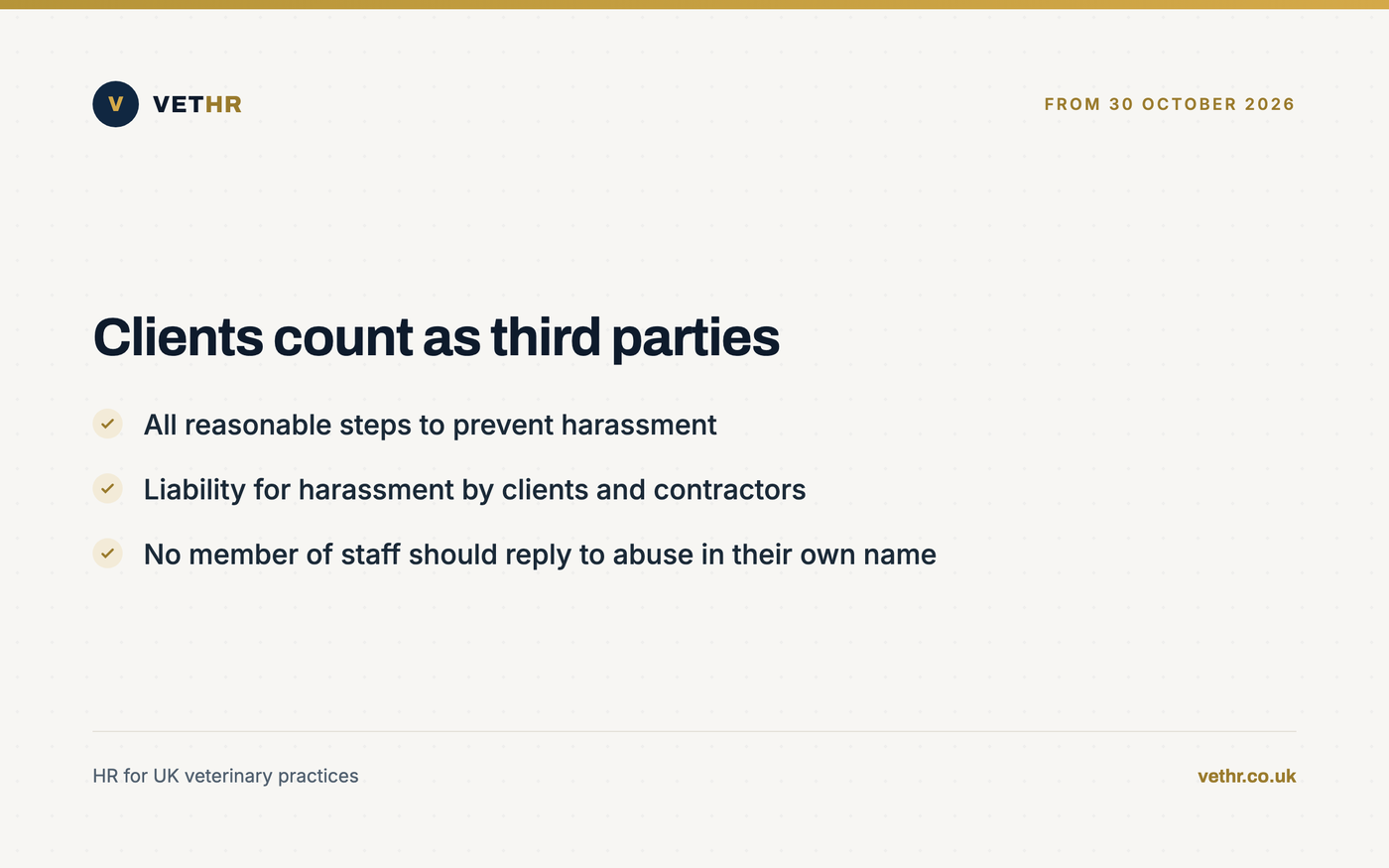
This is the part that changes on 30 October 2026. Acas records that from that date employers must take all reasonable steps to prevent sexual harassment, and will be liable for harassment from third parties unless they have taken all reasonable steps.
Clients are third parties. A comment thread that targets a named receptionist, repeated messages to a nurse’s personal account, or a review that crosses from criticism into personal abuse are all workplace issues rather than private misfortunes.
Reasonable steps for a practice look like this: a policy that names third-party harassment, a reporting route staff will use, someone with authority to respond publicly so individuals do not have to defend themselves, a willingness to report content or deregister a client, and a record of what was done. Our See It Report It system provides that record.
Say clearly in the policy that no member of staff is expected to reply to abuse in their own name. That single sentence removes a great deal of anxiety.
Briefly, publicly, and without disclosing anything, following the protocol your social media policy sets out. Confidentiality applies even when the client has posted the details themselves, so the reply cannot confirm that the person is a client or discuss the case. That constraint is precisely why an unplanned reply is so risky.
Resist the urge to correct the factual record in public. You will always be arguing with one hand tied, because the client can say anything and you can say almost nothing.
Write it with the team and take twenty minutes to talk it through, rather than emailing a PDF and recording that it was sent. Acas advises agreeing the details of a social media policy with staff, and in a small practice that is not a formality: the people who use these platforms daily will spot the gaps you missed.
Run the session around real examples rather than principles. The collar tag in the photo. The client who messages a nurse’s personal account. The review that names someone. Ask what each person would do now, and you will quickly learn which parts of the policy need to be clearer.
Then record acknowledgement. A dated record that each member of staff received and discussed the policy is what turns it into evidence of reasonable steps, which is exactly what the October duty will be measured against.
Repeat it at induction. Every new starter should get the social media policy in their first week, alongside confidentiality and the practice’s photography rules. Our new starter checklist covers what else belongs there.
No social media policy, or one written in 2019? A free 30-minute HR health check will tell you what is missing before October. Book your HR health check.
A blanket ban is neither realistic nor advisable. Acas warns against staff feeling gagged, and notes that readers can usually tell the difference between private opinion and an organisation’s views. Set expectations about confidentiality and conduct instead, and consider asking staff to make clear that personal views are their own.
The practice should, and the policy should say so. Accounts set up on a personal email by a former nurse become a genuine problem the day she leaves. Keep credentials in the practice’s control, list account access in your leaver checklist, and change passwords on the last day.
You can ask, calmly and in writing, and you can report content that breaches a platform’s rules. Where abuse is persistent or targets an individual, deregistering the client is a legitimate option, provided you follow your own process on ending a client relationship and handle continuity of care properly.
Yes, and it should say so. Practice WhatsApp groups are where rota swaps, patient details and workplace banter all live in the same thread. Set the same confidentiality standard there, and be clear about whether staff are expected to read work messages outside their hours.
Annually, and after any incident. Platforms change, and so does the law: the third-party harassment duty arriving on 30 October 2026 is a good reason to review yours this quarter rather than next year.
The best social media policy we see in veterinary practice is short, written with the team rather than at them, and weighted towards protecting staff. It says what confidentiality means, who replies to complaints, and what the practice will do when a client crosses the line.
If yours is a paragraph in a handbook nobody has opened since 2019, it will not meet the October duty. Our policy library and HR consultancy keep documents current, and the free HR health check will show you the gap in half an hour.
The Vet HR Team provides HR consultancy and white-labelled staff systems exclusively to UK veterinary practices.
Read next: A Drugs and Alcohol Policy for Your Veterinary Practice.
Contracts, rotas, holiday, a difficult conversation. Tell us what you are dealing with and we will come back within one working day. Nothing to sign up to.
Got it. We will come back to you within one working day. If you do not see a reply, please check your spam folder.
