Last updated: 5 September 2026
TL;DR: Employers have a legal duty to protect employees from stress at work by doing a risk assessment and acting on it, and the HSE Management Standards cover six areas: demands, control, support, relationships, role and change. A staff survey is how a small practice gathers that evidence, provided anonymity is genuine and something visibly changes afterwards.
Practice owners often say a survey is unnecessary because they already know how everyone feels. Sometimes that is true. More often it means they know how the two most confident people feel, and have not heard from the nurse who has quietly decided to leave in the spring.
Because there is a legal duty behind a staff survey as well as a management case. HSE states that employers have a legal duty to protect employees from stress at work by doing a risk assessment and acting on it.
Following the Management Standards approach is considered suitable and sufficient for that purpose, and a survey is the practical way a small practice gathers the evidence rather than guessing at it.
The management case for a staff survey is simpler. Resignations in veterinary practice rarely come out of nowhere, and a survey run in October catches the things that would otherwise be explained at an exit interview in March.
It also gives you a baseline. Without one, every change you make is judged on the loudest reaction rather than on whether the team as a whole is better off, as our guide to managing burnout discusses.
Start a staff survey from the six HSE Management Standards, then add the veterinary specifics. HSE sets out the six areas as demands, control, support, relationships, role and change.
HSE also publishes an Indicator Tool, a 35 item questionnaire mapping to those six standards and completed anonymously. For a practice of twelve people, a shorter version drawn from the same six areas is usually more realistic.
Then add what is specific to your building: rota predictability, out of hours load, breaks actually taken, client aggression, euthanasia support, CPD access and whether people would recommend the practice to a colleague.

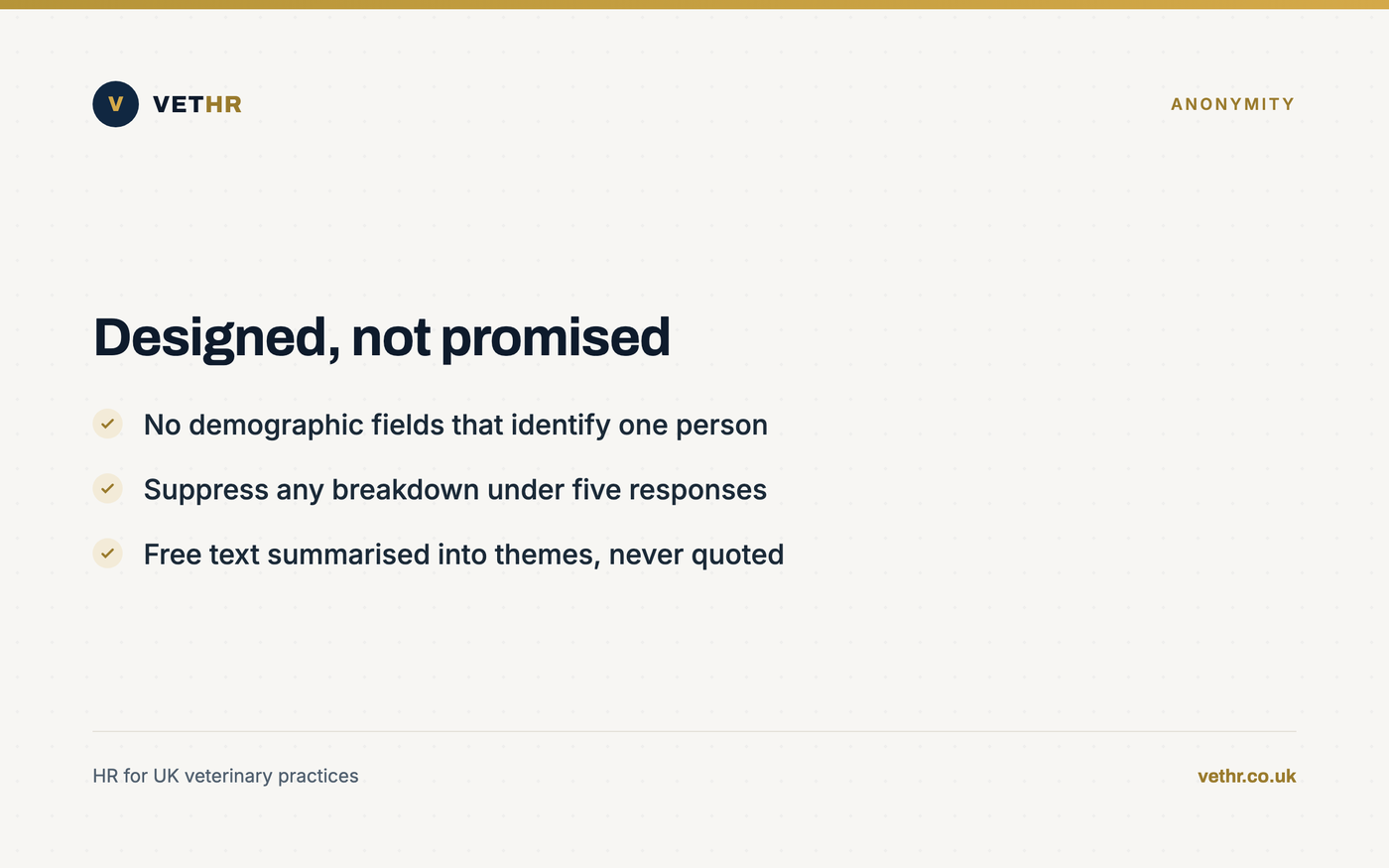
By removing the fields that identify people, which is harder than it sounds in a small practice. Ask for role, site and length of service and you have identified the only nurse who has been there eight years.
Free text is where anonymity actually breaks. People write in their own voice about a specific incident, and everyone recognises it, so tell them that free text will be summarised into themes rather than quoted.
Handle survey responses as you would any other people data, with limited access and a defined retention period, as our guide to GDPR and staff records sets out.
Keep the staff survey short, time it well and announce it before it arrives. Eight steps cover it, and the whole exercise takes a fortnight of elapsed time in a practice.
Step eight is where credibility is won or lost. A practice that publishes only the positive results has told the team exactly how much the next survey is worth.
HSE describes the same method in its guidance on assessing the risk of work related stress, which treats the survey as one input into a risk assessment rather than as an exercise in its own right.
Annual is the right cadence for most practices. More often and you generate fatigue without time to act; less often and the data ages past usefulness.
Pick three things, fix one quickly, and say what you are not doing. The instinct to address everything produces a plan that delivers nothing, and the team notices that faster than you would expect.
Rota predictability is the most common top three item in veterinary practice, and it is usually the cheapest to fix. Publishing four to six weeks ahead costs nothing, as our guide to building a veterinary rota sets out.
Feed the findings into your stress risk assessment rather than keeping them separate. That is what turns a wellbeing exercise into the documented assessment HSE expects.
Never surveyed your team, or surveyed and never acted? A free 30-minute HR health check will help you start properly. Book your HR health check.
Four reasons, and all of them are about what the practice does after the staff survey rather than about the questions asked.
The first is by far the most common. If you are not prepared to change anything, do not run a staff survey, because asking and ignoring is worse for morale than never having asked.
There is a fifth failure worth naming: running a staff survey and then acting only on the items that were already on the owner’s list. The team can tell, and the next round of answers becomes the answers people think you want.
Watch the response rate as a result in itself. Under half the team responding is telling you something about trust before you read a single answer, as our guide to veterinary staff retention discusses.
The survey itself is not, but the underlying duty is. HSE states that employers have a legal duty to protect employees from stress at work by doing a risk assessment and acting on it, and following the Management Standards approach is considered suitable and sufficient for that.
Yes, with care. Collect little or no demographic data, use a third party platform, report only aggregated results and suppress any breakdown with fewer than five responses. Tell people in advance that free text will be summarised into themes rather than quoted.
Annually suits most practices. That gives time to act between rounds and keeps the data current enough to be useful. Running one every quarter generates fatigue and rarely leaves room to show that anything changed as a result.
The six HSE Management Standards are the backbone: demands, control, support, relationships, role and change. Add veterinary specifics such as rota predictability, out of hours load, breaks actually taken, client aggression, euthanasia support and CPD access.
Publish them anyway. A practice that shares uncomfortable findings and fixes one thing quickly builds more trust than one that reports selectively. Bad results discovered in a survey are considerably cheaper than the same information arriving as three resignations.
A staff survey is not a wellbeing gesture. It is the evidence behind a risk assessment you are already required to do, and it is the cheapest early warning system available to a practice that would rather not re-recruit an experienced nurse next spring.
Ask about the six standards plus your own specifics, design the anonymity properly, publish everything and change one thing fast. Our HR consultancy and See It Report It system cover the follow-up, and the free HR health check is where to start.
The Vet HR Team provides HR consultancy and white-labelled staff systems exclusively to UK veterinary practices. Check current HSE guidance on managing work related stress.
Contracts, rotas, holiday, a difficult conversation. Tell us what you are dealing with and we will come back within one working day. Nothing to sign up to.
Got it. We will come back to you within one working day. If you do not see a reply, please check your spam folder.
