Last updated: 13 October 2026
TL;DR: Salary sacrifice is an agreement to reduce cash pay in return for a non-cash benefit, and it requires a change to the employment contract. Pension contributions and cycle to work schemes keep their tax advantages. The trap is statutory pay: if the sacrifice takes average weekly earnings below the lower earnings limit, statutory payments can disappear.
A part-time nurse signs up to a cycle to work scheme and puts an extra three per cent into her pension. Eight months later she is pregnant, and the practice discovers her average weekly earnings have been sitting below the lower earnings limit since March. She is not entitled to statutory maternity pay. Nobody did anything dishonest, and nobody checked.
HMRC guidance describes it as an agreement to reduce an employee’s entitlement to cash pay, usually in return for a non-cash benefit.
The employee gives up pay. The employer provides something instead. Because the pay was never received, the tax and National Insurance position changes, and that is the whole appeal.
It is a genuinely useful tool in a profession where headline salaries are constrained. It is also one of the few benefits arrangements that can leave a member of staff worse off if nobody does the arithmetic.
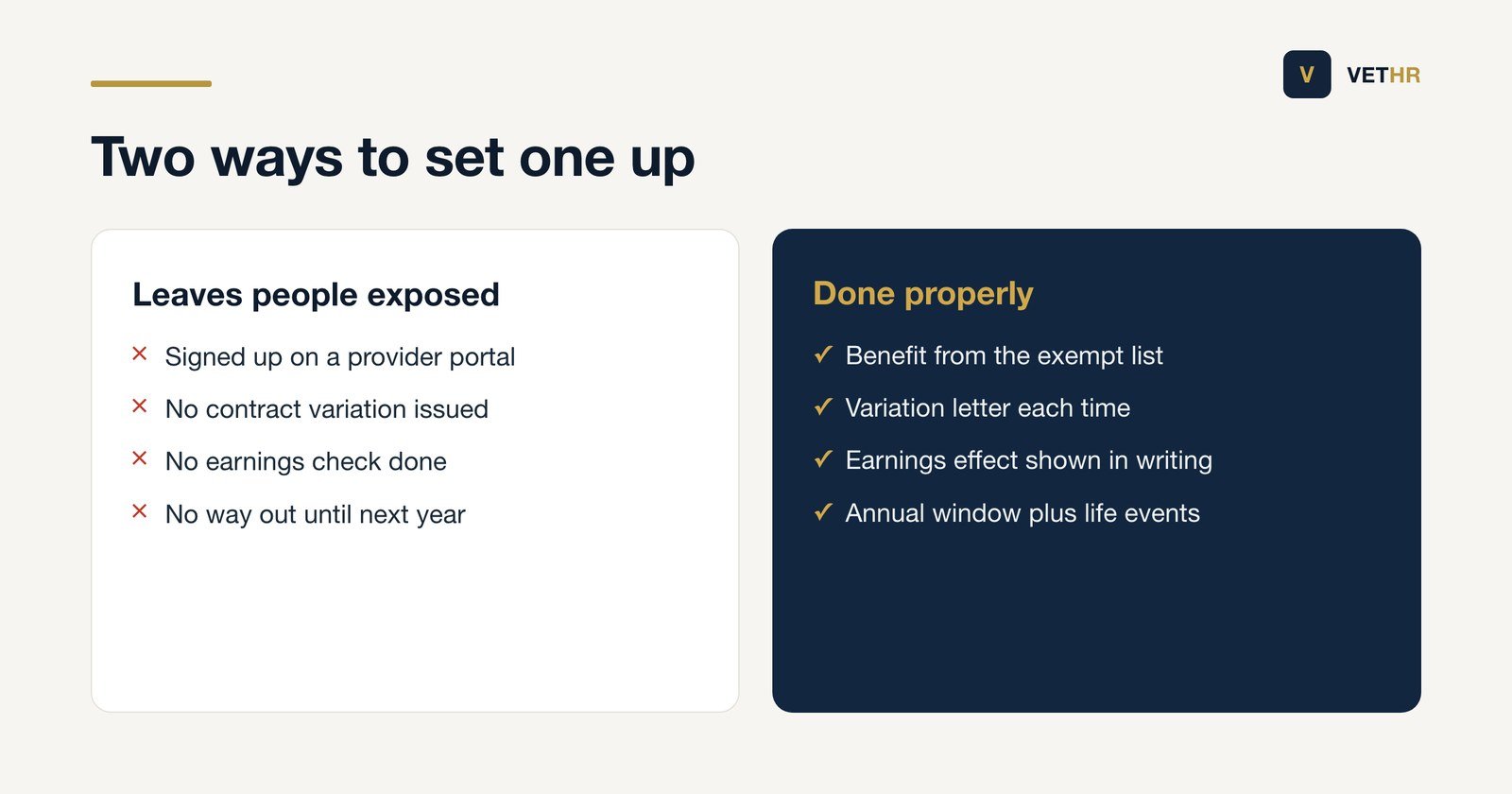
This is the first thing practices get wrong. HMRC is clear that to set up a salary sacrifice arrangement the employer must alter the employment contract, and that the contract must be clear on what the employee’s cash and non-cash entitlements are at any given time.
So a scheme signed up to through a provider’s online portal, with nothing changed in the contract, is not properly documented. The provider arranges the benefit; it does not vary the contract for you.
Issue a short variation letter each time, stating the reduced cash pay, the benefit provided, the start date and the end date. Our guide to contract changes in a veterinary practice covers the mechanics.
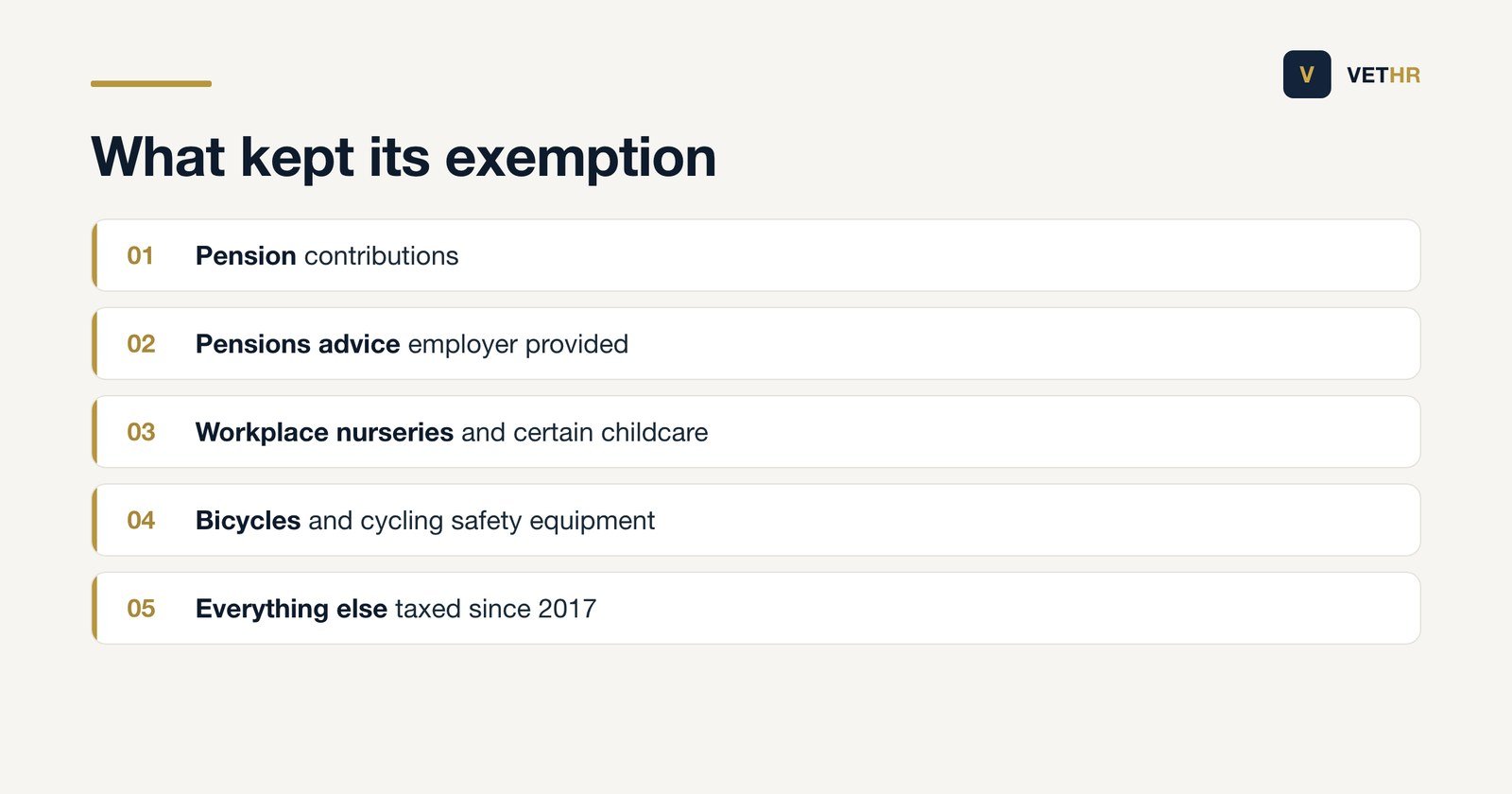
Most salary sacrifice benefits lost their tax advantages in 2017. HMRC lists the ones that kept their exemptions.
For an independent practice that realistically means two things: the pension and a bike. Anything else marketed as a salary sacrifice benefit needs checking against that list before you offer it, because outside it the value is taxed anyway.
Where a benefit is outside the exemptions, HMRC values it at the higher of the amount of salary given up or the earnings charge under the normal benefit in kind rules.
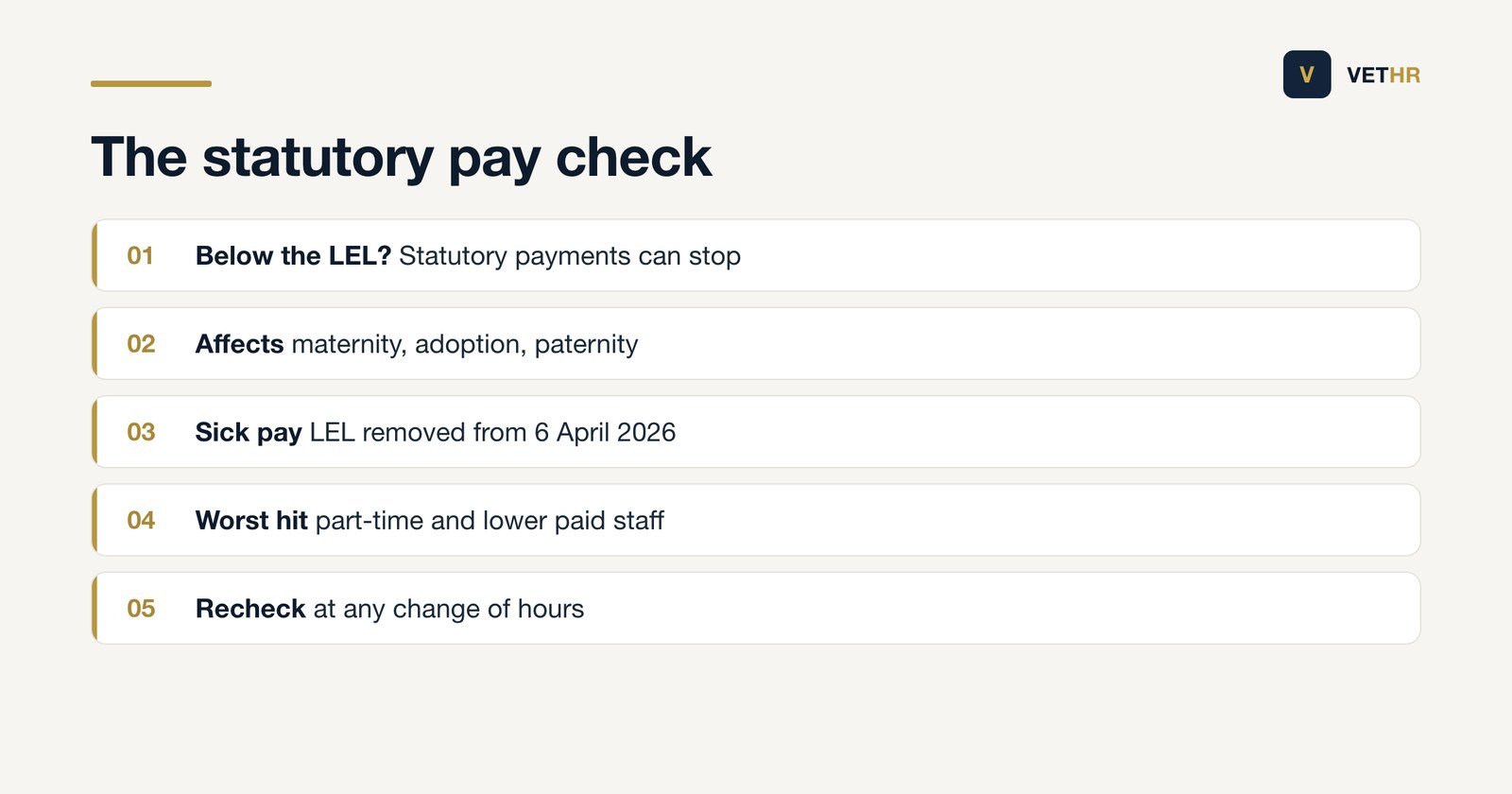
This is the one that hurts real people. HMRC states plainly that if a salary sacrifice arrangement reduces an employee’s average weekly earnings below the lower earnings limit, the employer does not have to make any statutory payments to them.
Statutory maternity pay, statutory adoption pay, statutory paternity pay and statutory sick pay all follow from average weekly earnings. A sacrifice that looked like a sensible pension decision in March can remove an entitlement in November.
It bites hardest on part-time staff, which in veterinary practice means a large share of the nursing and reception team. Run the figure before agreeing any salary sacrifice for someone on lower or part-time hours, and tell them the answer.
One change worth noting. The government’s Employment Rights Act implementation timeline removes the lower earnings limit and the waiting period for statutory sick pay from 6 April 2026, which changes the sick pay part of this picture but not maternity, adoption or paternity pay.
Mortgage applications are the other place this surfaces. A reduced gross salary is what appears on the payslip, and some lenders assess affordability on that figure rather than on the pre-sacrifice amount. Mention it when someone joins a scheme, because a nurse buying a first flat would rather know in advance than find out at the application.
Redundancy pay and notice pay can be affected too, depending on how the contract defines pay. If your scheme is going to run for years, say in the variation letter which figure those calculations use.
HMRC guidance says that if an employee swaps between cash earnings and a non-cash benefit whenever they like, the expected tax and National Insurance advantages under a salary sacrifice arrangement will not apply.
So the arrangement needs a defined term, and changes need a fresh contract variation rather than an email. Most practices run an annual window, plus a list of life events that allow a change in between.
Write the life events down: pregnancy, a change in hours, a partner’s job loss, long term sickness. It is the difference between a scheme that treats people decently and one that traps them.
Tell the whole team what is available, not only the people who ask. Schemes that are mentioned once at induction get taken up by the confident and missed by everybody else, which is a fairness problem as much as a communication one.
Two places, honestly. Pension contributions above the auto enrolment minimum, for staff who want them and can afford them. And a cycle to work scheme, which in a profession full of people who work unsociable hours close to home is more popular than most owners expect.
Be careful about offering it as a solution to a pay problem. Salary sacrifice improves the efficiency of money someone is already choosing to spend; it does not make a salary competitive. Our note on pay bands for a veterinary practice deals with the underlying question.
Check how it interacts with auto enrolment before you start. The two arrangements sit together and the contribution basis matters. Our guide to auto enrolment in a veterinary practice covers the duties.
Five steps, and the third is the one nobody does.
Step three takes ten minutes and prevents the situation at the top of this article. Tell people in writing what their new average weekly earnings will be and what it means for statutory pay, then let them decide. Our note on veterinary payroll covers where the calculation lives.
If you are setting up a scheme, or you already have one and nobody has checked the earnings position, book a free 30-minute HR health check.
Yes. HMRC guidance says the employer must alter the employment contract, and the contract must be clear on the employee’s cash and non-cash entitlements at any given time. Signing up through a provider’s portal does not achieve that.
HMRC lists pension contributions, employer provided pensions advice, workplace nurseries, certain childcare arrangements that started on or before 4 October 2018, and bicycles and cycling safety equipment including cycle to work.
It can. Statutory payments follow from average weekly earnings, and HMRC states that where a salary sacrifice arrangement reduces those earnings below the lower earnings limit, the employer does not have to make statutory payments. Check before agreeing anything.
Not without consequence. HMRC says the expected tax and National Insurance advantages will not apply if an employee swaps between cash and the benefit whenever they like. Use a defined term with an annual window and a written list of qualifying life events.
For pension contributions and a bike scheme, usually yes, and it costs little to administer. As a substitute for competitive pay it is not worth it, because salary sacrifice only improves money someone was already spending.
Salary sacrifice is a good arrangement badly implemented in most small practices: no contract variation, no earnings check, and no route back out for someone whose circumstances change.
Fix those three and it becomes a benefit people value. We set up and document schemes for independent practices through HR consultancy for veterinary practices and employment contract drafting.
The Vet HR Team provides HR consultancy and white-labelled staff systems exclusively to UK veterinary practices.
Contracts, rotas, holiday, a difficult conversation. Tell us what you are dealing with and we will come back within one working day. Nothing to sign up to.
Got it. We will come back to you within one working day. If you do not see a reply, please check your spam folder.
