Last updated: 19 October 2026
TL;DR: There is no legal requirement to give time or facilities for religious observance, but Acas is clear that unreasonably refusing a request could be discrimination. Try to allow time off for festivals, accommodate prayer in a way that fits business needs, and make clear prayer time is not time off because everyone works the same total hours.
A nurse asks for two days off in the spring for a festival the practice manager has not heard of. The rota is already thin, the request is not in the holiday system, and the honest first reaction is that nobody else gets extra days. How that request is handled is the difference between a routine conversation about religious observance and a discrimination complaint.
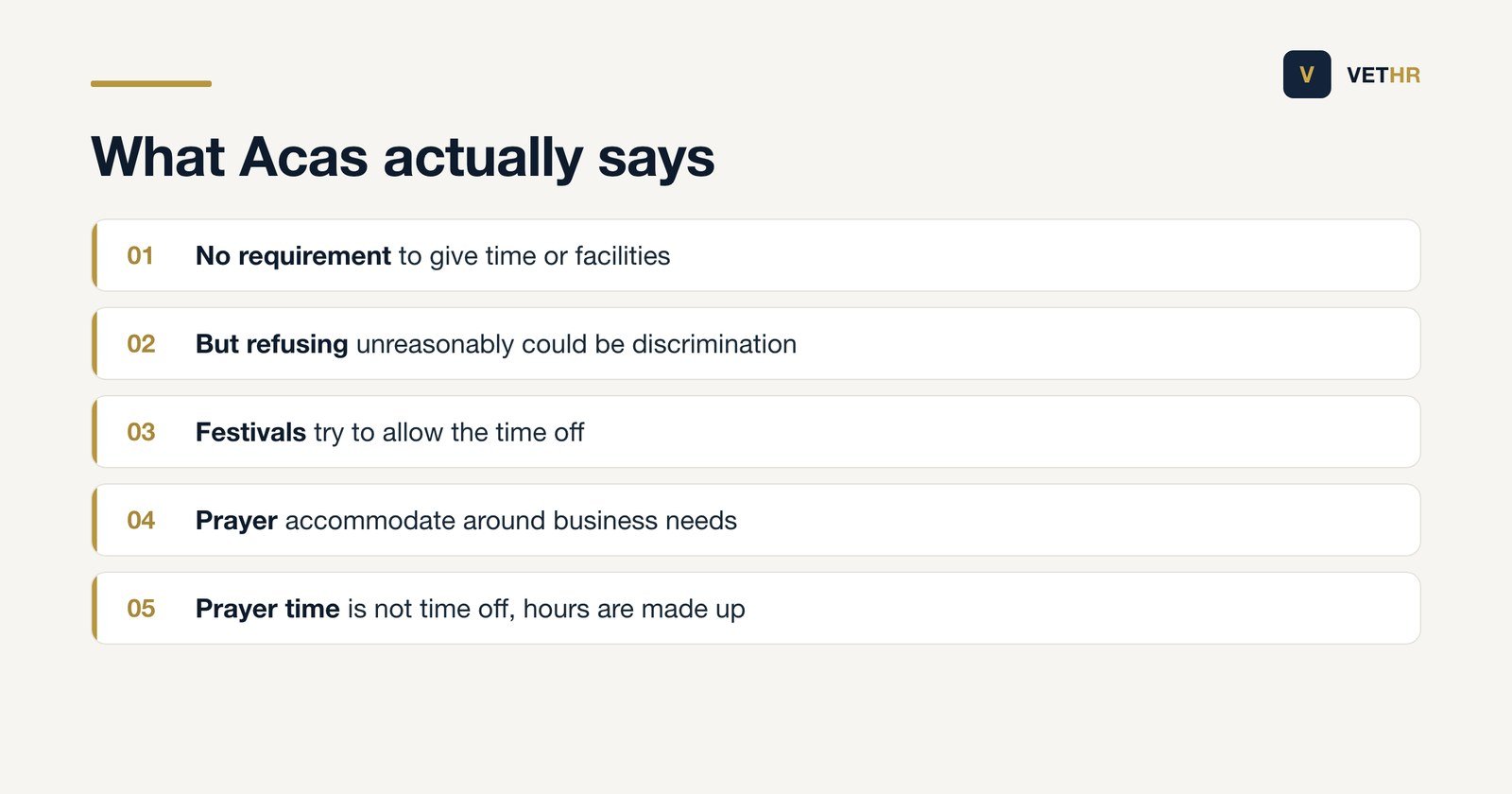
Less than people expect, and more than they hope. Acas states that there is no legal requirement for employers to allow time or facilities for religious reasons, while also warning that it could be discrimination if you unreasonably refuse.
Read those two sentences together and the practical rule appears. There is no absolute entitlement, but there is a duty not to refuse without a good reason, and the reason has to be about the business rather than about the belief.
Religion or belief is a protected characteristic, which is why a refusal that looks arbitrary is worth avoiding. The safe position is a process you apply to everybody, not a judgement about whose festival matters.
Acas advice on religious observance is to try to allow people time off for festivals and services which are important to them, and to manage it by asking staff to book in advance and agreeing in advance how to handle situations where too many people want the same days.
In most practices the time itself comes out of the statutory 5.6 weeks of paid holiday that GOV.UK sets for almost all workers, which is 28 days for someone on a five day week. Religious observance is usually a request about when leave is taken rather than a request for extra leave.
Say that out loud when the request arrives. It reframes an awkward conversation into an ordinary one about the holiday rota, which is a problem your practice already knows how to solve.
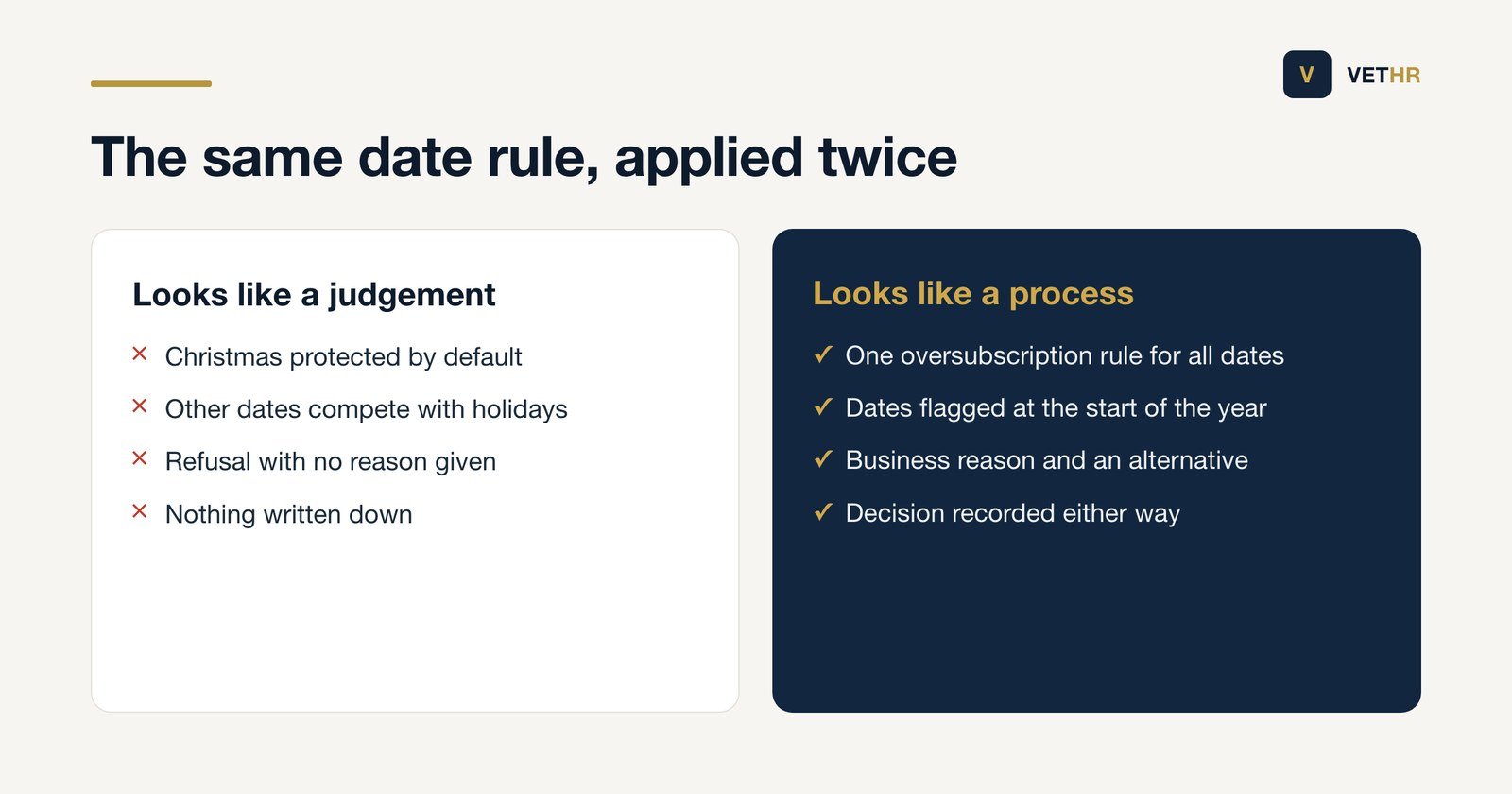
Christmas is the religious observance test most practices fail without noticing. A rota that protects 25 December for everyone who asks, while treating Eid or Diwali as an ordinary request competing with half-term holidays, is not neutral.
Three things fix it. Publish the leave year and the booking deadline. Ask people in advance to flag the dates that matter to them for religious observance. Then apply the same oversubscription rule to every date, whether it is 25 December or a date most of the team has never heard of.
Our guides to the Christmas rota and the holiday booking system cover how to run that without anyone keeping score in their head.
Where a date cannot be given, say why in business terms, offer an alternative, and record it. A refusal that comes with a reason and an offer is a very different document from a refusal that comes with nothing.
Acas advises employers to try to accommodate requests for prayer in a way that fits in with business needs, suggesting options such as starting earlier, finishing later or taking a shorter lunch break.
It also makes the point that removes most of the resentment before it starts: employers should make clear that time for prayer is not time off, and that everyone is working the same total hours.
On space, Acas says employers do not need to provide a dedicated prayer room but should consider providing a suitable space. In a veterinary building that usually means naming a room that is quiet at a predictable time, rather than building anything.
Consults and emergencies do not pause, so agree what happens when the timing collides with a crash call. Someone who knows the answer in advance is not put in the position of choosing on the spot.
Bank and part-time staff need including in the same question. A practice that asks only its full-time team which dates matter will discover the gap at the worst moment, usually a fortnight before the date itself.
Keep the list of dates somewhere the rota builder actually looks. A note of religious observance dates held in one manager’s inbox is a plan that survives exactly as long as that manager does.
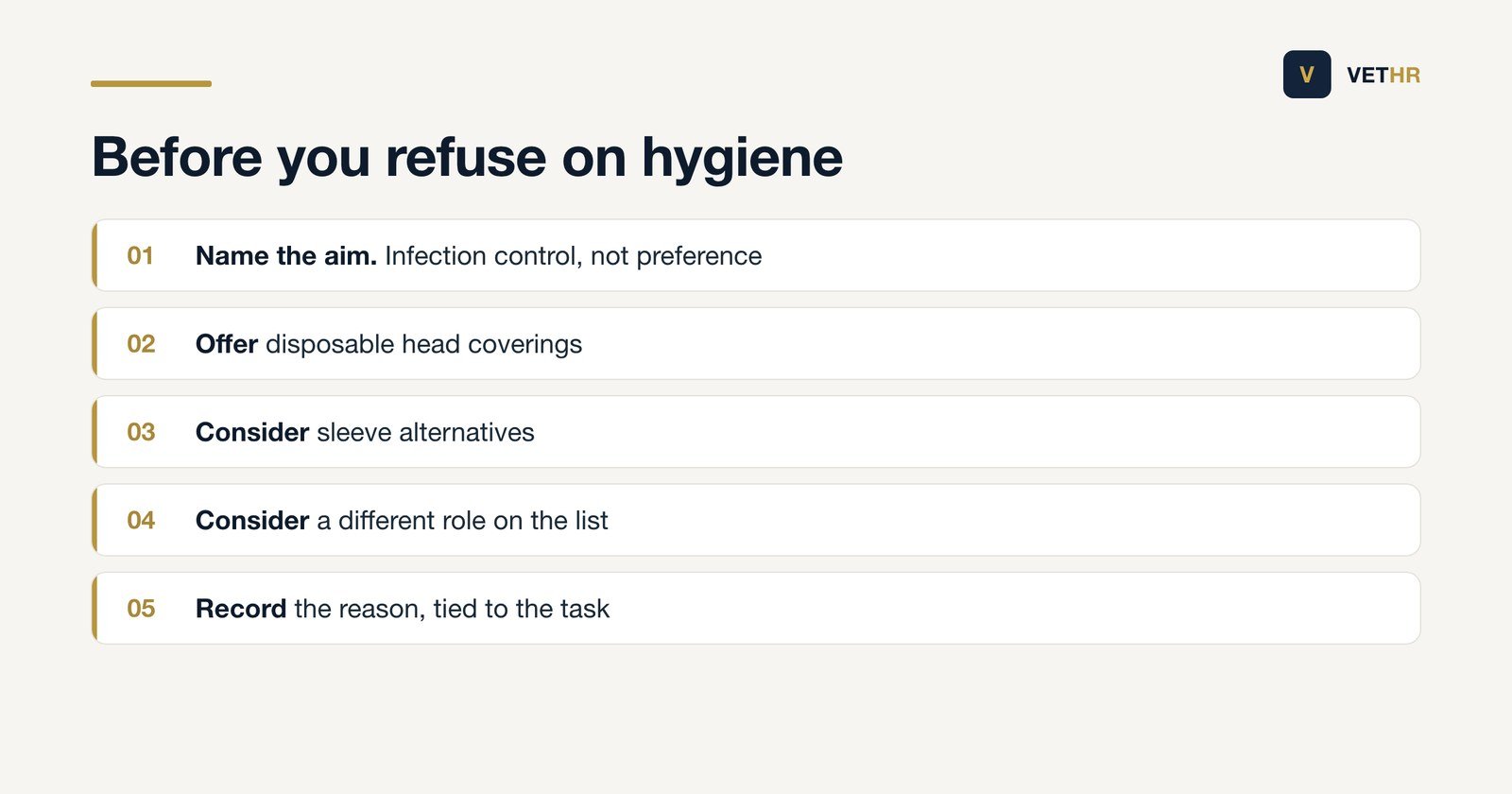
This is where religious observance meets clinical reality, and where practices are on strong ground if they think it through. Acas says restrictions on religious dress must have a legitimate aim and must not discriminate more than is necessary, giving health, safety, hygiene and business image as examples of legitimate aims.
Infection control in theatre is a legitimate aim. That does not end the conversation, it starts it: disposable head coverings, sleeve alternatives, a different role on a surgical list, or fitted alternatives to a loose garment are all worth discussing before anyone is told no.
Write the reason down when you do restrict something, and keep it specific to the task rather than the person. Our guide to the dress code in a veterinary practice covers how to word a policy that holds up.
Acas says employers providing food should consider dietary needs connected to religion or belief, and should think about how to accommodate requests related to fasting.
For a practice the practical version is small. A team lunch that has one option everybody can eat. A surgical list that does not put the person fasting on the longest afternoon without a break. Breaks that can be taken at a different time rather than not at all.
None of that costs money, and all of it is noticed. Our note on working time rules covers the breaks you owe people anyway.
Ask rather than assume. Practices get this wrong in both directions, refusing things nobody needed and offering things nobody asked for. A short question in the induction conversation, repeated once a year, gets better answers than any amount of guesswork about what religious observance requires.
Five lines, in the leave and conduct sections rather than a separate document nobody opens.
That is the whole policy. Our page on policies for veterinary practices shows where it sits, and a free 30-minute HR health check will tell you what else your handbook is missing.
There is no legal requirement to allow time or facilities for religious reasons, but Acas warns that unreasonably refusing a request could be discrimination. Try to accommodate, and give a business reason if you cannot.
Usually yes. In most practices a request connected to religious observance is a request about when annual leave is taken, not a request for additional days. Say so clearly when the request arrives.
Acas says employers do not need to provide a dedicated prayer room but should consider providing a suitable space. Naming a room that is reliably quiet at a given time is usually enough in a veterinary building.
Hygiene is a legitimate aim, so a requirement can be justified, but Acas says it must not discriminate more than necessary. Discuss alternatives such as disposable coverings or a different role on the list before refusing anything outright.
Use the oversubscription rule you already apply at Christmas, and apply it to every date equally. Agreeing that rule in advance, and writing it down, is what stops the decision looking like a judgement about whose observance counts.
Almost every complaint about religious observance in a practice comes from the same place: a rota that quietly protects one set of dates and treats the rest as competing requests.
Publish the rule, ask people in advance which dates matter, and give reasons when you cannot say yes. We write leave and conduct policies for independent practices through HR consultancy for veterinary practices and ongoing HR support on subscription.
The Vet HR Team provides HR consultancy and white-labelled staff systems exclusively to UK veterinary practices.
Contracts, rotas, holiday, a difficult conversation. Tell us what you are dealing with and we will come back within one working day. Nothing to sign up to.
Got it. We will come back to you within one working day. If you do not see a reply, please check your spam folder.
