Last updated: 11 November 2026
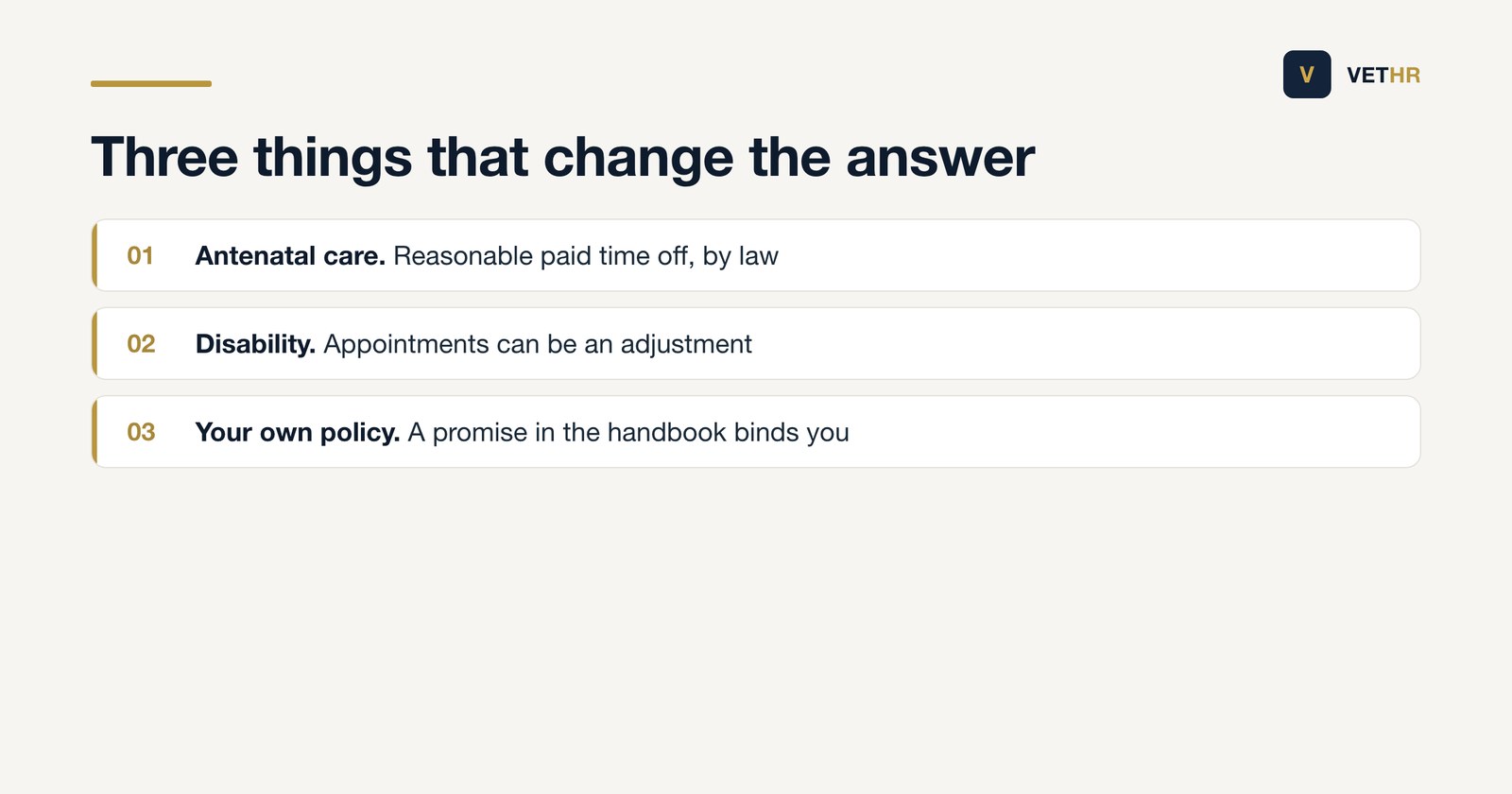
TL;DR: Acas is clear that there is no legal right to time off work for a medical appointment. Three things change that: antenatal care, which carries a statutory right to reasonable paid time off, disability-related appointments, which can be a reasonable adjustment, and whatever your own contract or policy promises. Everything else is your practice’s choice, so make the choice in writing.
A veterinary nurse asks for Thursday morning off for a hospital appointment. The practice manager says yes, because saying no to that feels impossible. Two months later a receptionist asks for the same thing and is told to take it unpaid, because the rota is tighter that week. Nobody wrote anything down, and now there are two rules.
It says less than most practice owners assume. Acas states plainly that there is no legal right to time off work for a medical appointment.
To find out whether they can take time off for medical appointments, and whether that time is paid, Acas tells employees to check their contract and any relevant policies their employer has. In other words, the answer lives in your paperwork rather than in statute.
Acas also notes that the time off might be unpaid, and encourages employers to be flexible because it can improve staff wellbeing and help reduce sickness absence. That last point is worth holding on to. A person who cannot get an hour for the dentist usually ends up taking a whole day sick instead.
So the discretion is real, but it cuts both ways. Having no written rule does not mean the practice is free of risk. It means every decision about medical appointments is made under pressure, by whoever is holding the rota, and inconsistency is the thing that actually gets challenged.
First, antenatal care. By law, pregnant employees are entitled to a reasonable amount of paid time off for antenatal appointments. This one is not discretionary and it is not unpaid.
Second, disability. Acas says that where an employee has a number of absences related to their disability, or is likely to, they might need reasonable adjustments, and that those absences could include planned or unexpected medical appointments. Treating a disabled employee’s hospital list exactly like everybody else’s dental check is where practices get this wrong.
Third, your own contract or policy. If the handbook promises paid time off for medical appointments, that promise is enforceable whatever the statutory position is. Read yours before you tell somebody the answer is no. Custom and practice counts too: a benefit given consistently for years can become contractual even if it was never written down, which is another reason to be deliberate about it.
Three workable models, and any of them is defensible as long as you pick one.
Most independent practices we work with land on the first for routine appointments and the third for anything longer. What none of them should do is decide case by case in the corridor.
Whichever model you choose, apply it to the whole team. A rule that quietly works better for vets than for nurses or reception staff is the kind of thing that surfaces in a grievance eighteen months later.
Practices mix these two up constantly, and they work in opposite directions.
Time off for dependants is a statutory right covering emergencies. GOV.UK describes a dependant as a spouse, partner, child, grandchild, parent, or someone who depends on you for care, and says you are allowed a reasonable amount of time off to deal with the emergency, with no set amount because it depends on the situation. Your employer may pay you for it, but they do not have to.
The crucial line is this one: you cannot have time off if you knew about the situation beforehand. A booked appointment is known about beforehand by definition, so planned medical appointments for a family member fall outside the dependants right and back into your policy. Our guide to time off for dependants in a veterinary practice covers the emergency side.
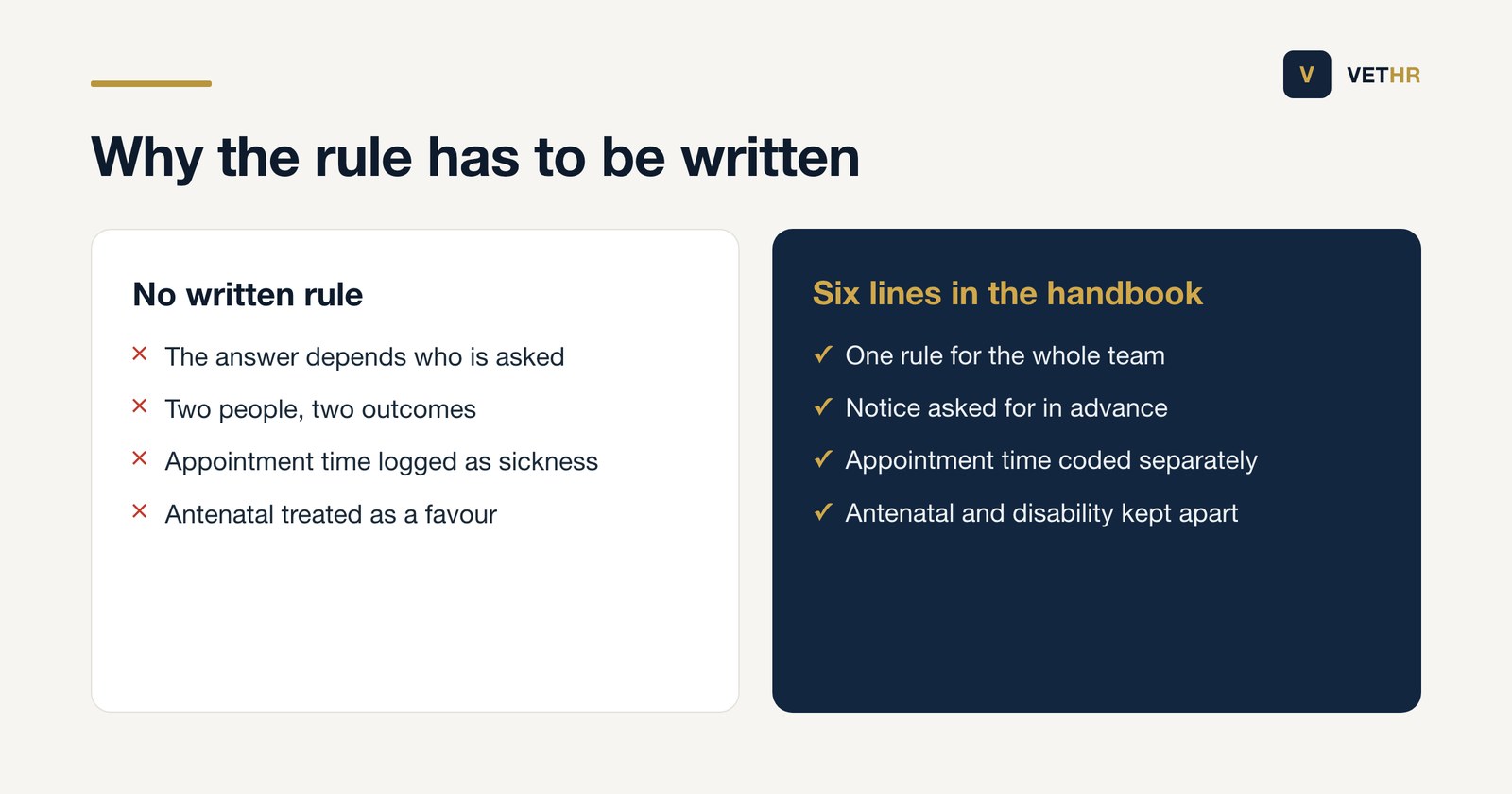
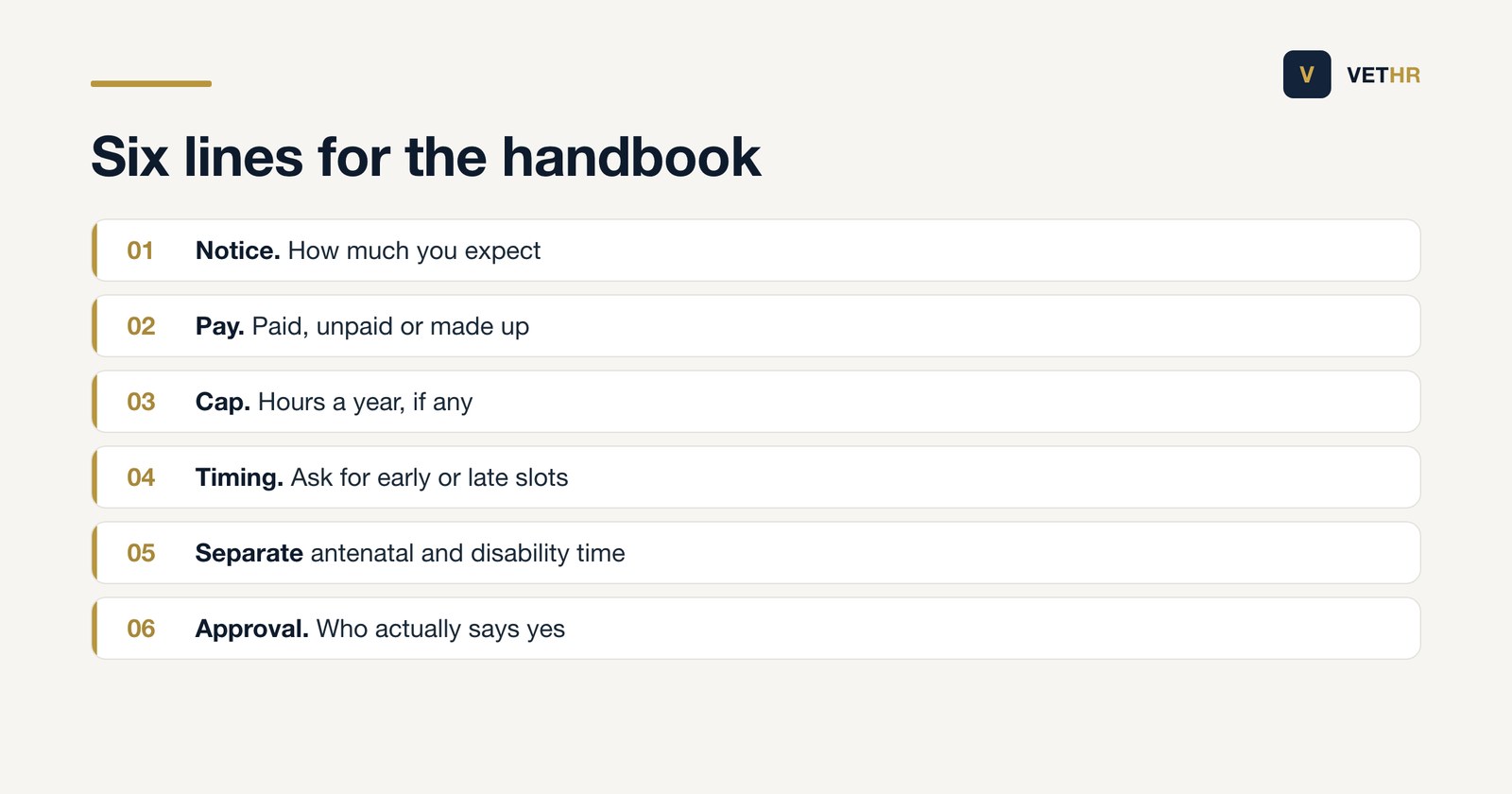
Six lines will do it. How much notice you expect. Whether medical appointments are paid, unpaid or made up. Whether a cap applies and what it is. That appointments should be booked at the start or end of a shift where the practice allows a choice. That antenatal and disability-related appointments are handled separately. And who says yes.
Be careful with the wording about booking times. Asking somebody to try for an early or late slot is reasonable. Requiring it is not, because most people cannot choose when a hospital offers them a bed.
Put it in the handbook rather than in an email. Our notes on the staff handbook for a veterinary practice and on reasonable adjustments cover where this sits alongside everything else.
In a five-person branch, one person at a hospital appointment is twenty per cent of the clinical cover. That is the real constraint, and pretending otherwise helps nobody.
Handle it with notice rather than refusal. Ask for appointment dates as soon as they are known, so the rota is built around them rather than repaired afterwards. A fortnight’s warning turns a crisis into an ordinary Tuesday.
It helps to be honest with the team about which sessions are genuinely immovable. Most people will shift a routine check to a quieter week if they are asked early and told why, and almost nobody will if the first they hear of the problem is a refusal on the morning.
Where a run of medical appointments genuinely cannot be covered, talk about the pattern openly instead of declining the next one. Our note on how to build a veterinary rota covers the cover question properly.
If you run trigger points, decide now whether medical appointments count towards them. Our strong recommendation is that authorised appointment time sits outside the trigger, because counting it punishes people for looking after themselves.
Disability-related appointments should definitely be discounted, and that is a standard reasonable adjustment rather than a favour. Our guides to absence trigger points and managing sickness absence set out how to record it.
Record medical appointments under their own code rather than as sickness. It keeps the absence figures honest and it stops somebody appearing on a capability report for attending physiotherapy. Book a free 30-minute HR health check if your absence records cannot currently tell the two apart.
Not as a general rule. Acas states there is no legal right to time off work for a medical appointment, and says the time off might be unpaid. Antenatal appointments are the clear exception, and your own contract or policy may promise more.
Acas confirms that by law, pregnant employees are entitled to a reasonable amount of paid time off for antenatal appointments. That right does not depend on your policy and should be stated separately in the handbook so nobody has to ask.
You can ask, and it is reasonable to ask. You cannot sensibly insist, because patients rarely choose their hospital slot. Requiring it also risks disadvantaging anyone with a condition that generates frequent medical appointments.
No. Routine dental and optical visits sit in the same category as other medical appointments, which means your policy decides. Practices that allow a modest paid annual allowance for them rarely regret it.
Not usually. GOV.UK says you cannot have time off for dependants if you knew about the situation beforehand, and a booked appointment is known in advance. Emergencies are covered, planned medical appointments are a policy matter.
The nurse got her Thursday morning and the receptionist did not, and the only difference between them was which week they asked. That is the whole problem with leaving medical appointments to the corridor.
Pick a model, write six lines, keep antenatal and disability-related time separate, and apply it to everybody. We write the policy and the recording codes through HR consultancy for veterinary practices and the policy document set.
The Vet HR Team provides HR consultancy and white-labelled staff systems exclusively to UK veterinary practices.
Contracts, rotas, holiday, a difficult conversation. Tell us what you are dealing with and we will come back within one working day. Nothing to sign up to.
Got it. We will come back to you within one working day. If you do not see a reply, please check your spam folder.
