Last updated: 9 October 2026
TL;DR: Make every job offer conditional and put it in writing. A conditional offer can be withdrawn if the conditions are not met; withdrawing an unconditional one could be against the law. You must ask for proof of the right to work in the UK, and you could be fined if you do not check.
A practice finds a good nurse after four months of trying, phones her on the Friday, and tells her the job is hers. On Monday the reference from her previous employer raises something serious. The practice now wants to withdraw, and discovers that an unconditional offer made on the phone is not as easy to take back as it hoped.
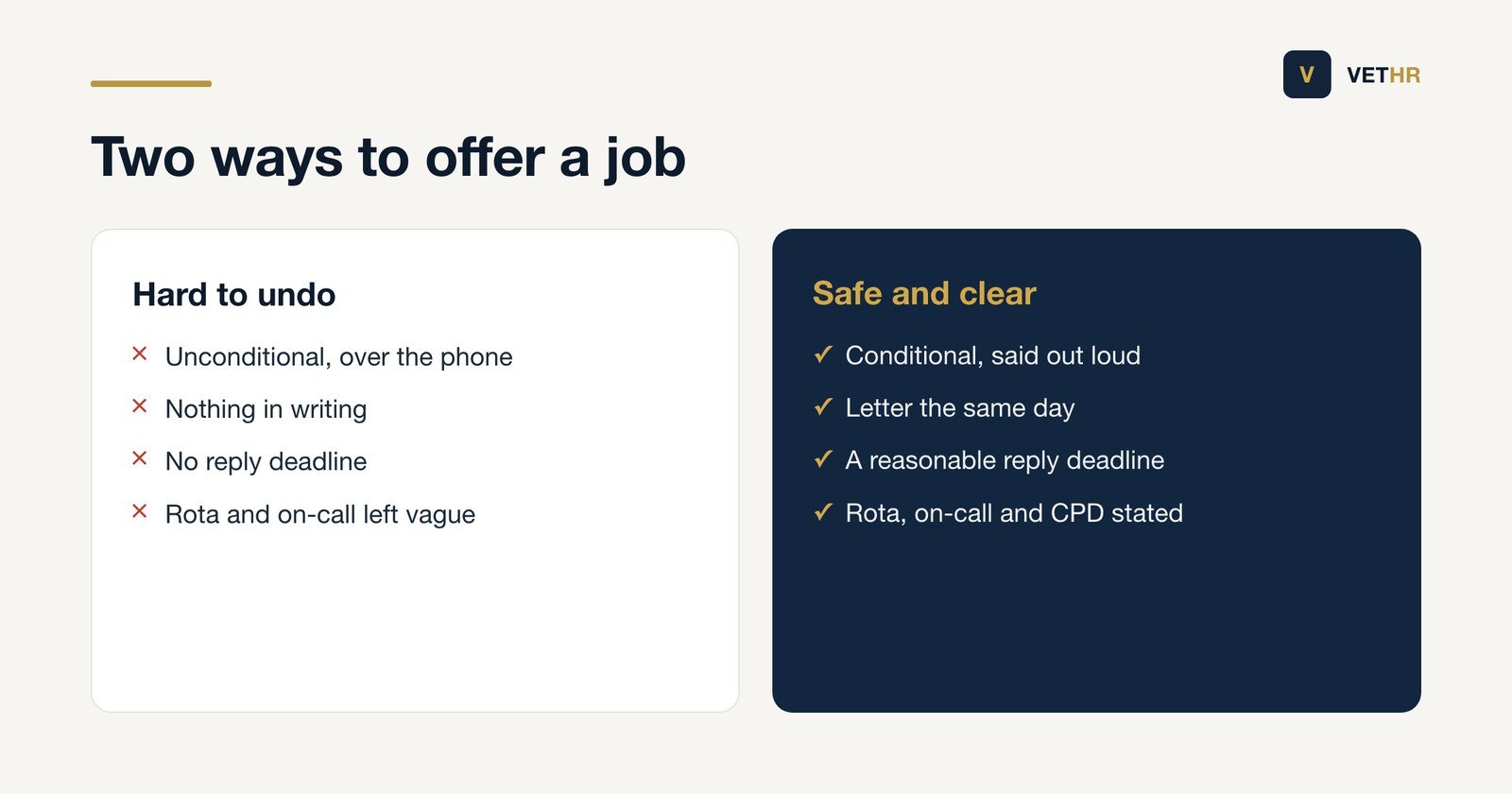
Acas draws a straightforward distinction. A conditional job offer means there are conditions the applicant must meet before you employ them, and an employer can withdraw a conditional offer where those conditions are not met. Withdrawing an unconditional offer, by contrast, could be against the law.
That is the whole reason to make a job offer conditional. It is not distrust; it is the mechanism that lets you complete your checks without either side being stuck.
Say it clearly in the phone call as well as the letter. This job offer is subject to satisfactory references and proof of your right to work is a single sentence, and it changes the legal position of the whole conversation.
Acas gives suitable references and criminal record checks as examples. In a veterinary practice the useful list is slightly longer.
Acas also notes that conditions need to be consistent and fair, which means applying the same set to every candidate for the same role. Asking one applicant for three references and another for none is exactly the inconsistency that causes a problem later.
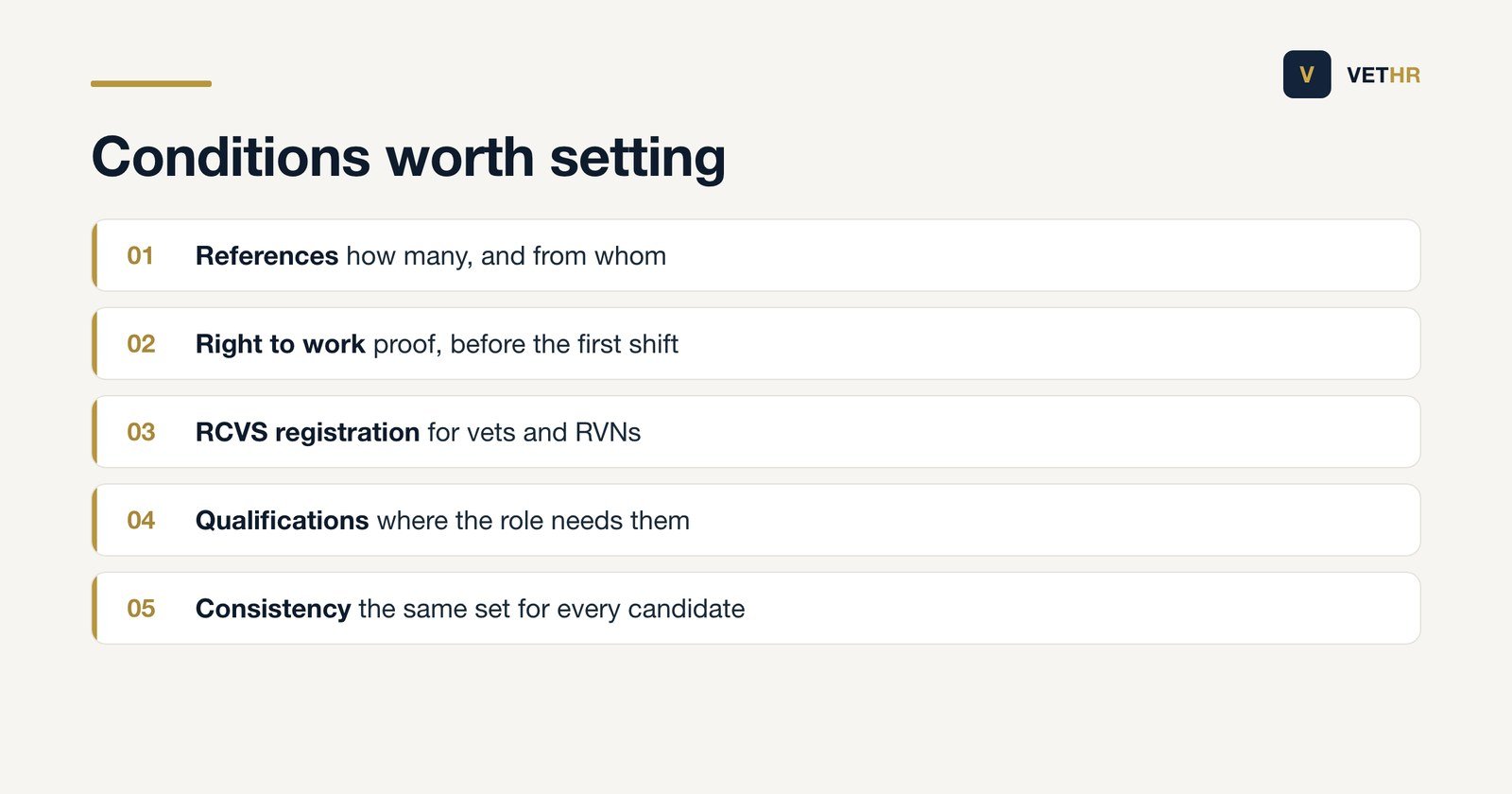
Acas is blunt about this one: when you offer someone a job you must ask for proof that they have the right to work in the UK, and you could be fined if you do not check.
Do the check before the first shift, keep a dated copy of what you saw, and repeat it where someone’s permission to work has an expiry date. Our guide to right to work checks for veterinary practices covers the process and the follow up dates.
If you are recruiting from overseas, the sponsorship question sits alongside this rather than instead of it. Our note on the sponsor licence for a veterinary practice covers what that involves.
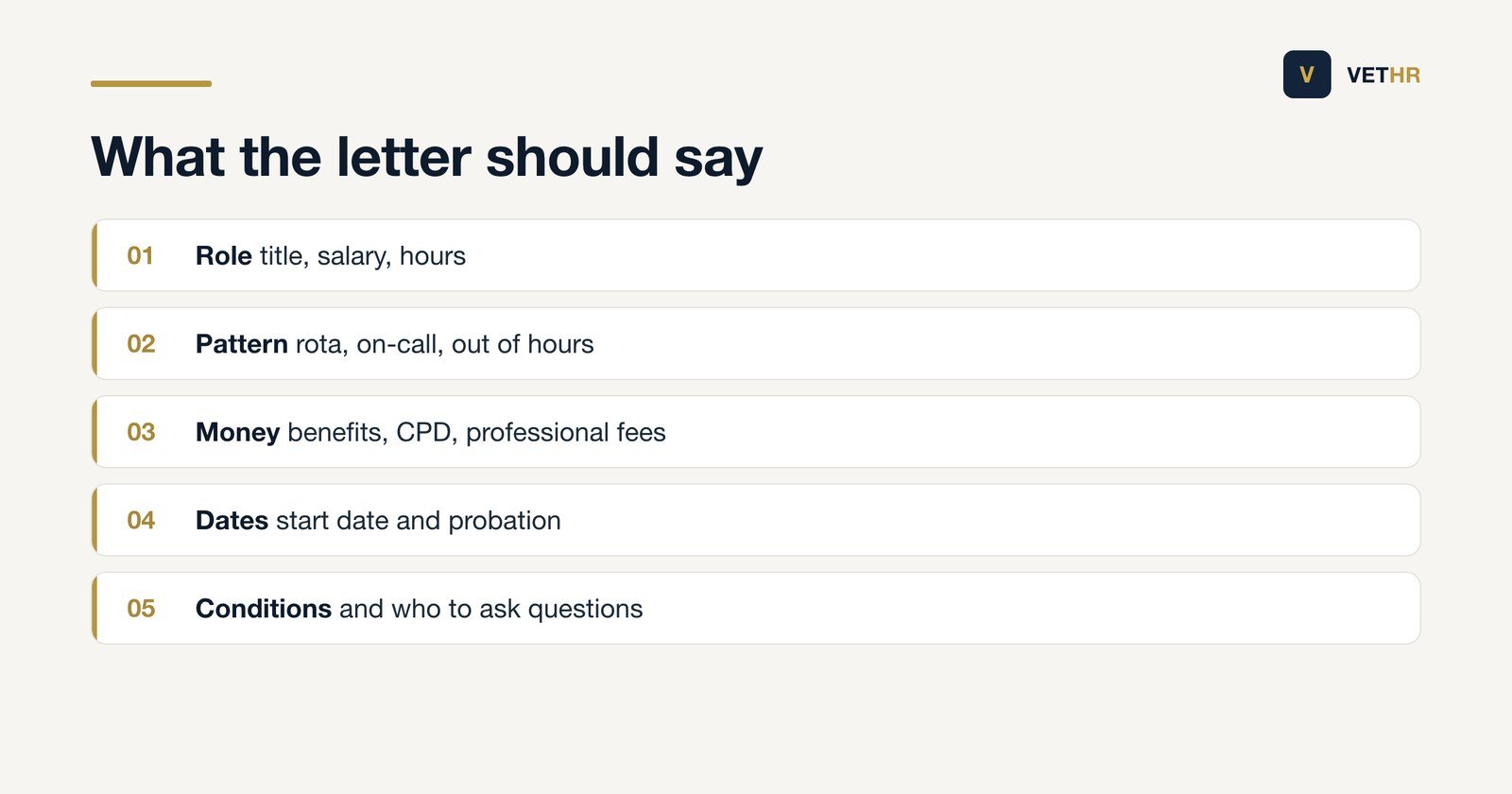
Acas recommends putting the job offer in writing and lists what it should cover: job title, salary, hours, benefits, start date, probationary period, and contact details for questions.
For a veterinary role, add the things that decide whether someone actually accepts. The rota pattern, whether out of hours or on-call is included and how it is paid, the CPD allowance, who pays professional fees, and the notice period.
Ambiguity in the job offer becomes an argument in month two. If the on-call arrangement is not written down, the candidate will remember the version they hoped for. Our guide to employment contracts for veterinary staff covers what then needs to match.
Keep the offer letter and the contract consistent. Two documents saying different things about probation or notice is a problem you have created for yourself.
Say what happens next, in order. Most candidates have never seen the back end of a recruitment process and do not know whether silence means they are being checked or being reconsidered. Two lines about references, the right to work check and when the contract will arrive prevents a week of anxiety.
Name one person as the contact. A job offer that comes from a partner, with references chased by the practice manager and the contract sent by a bookkeeper, leaves nobody to ask when something goes quiet.
Acas suggests you can make a job offer verbally but that it is better in writing, and that you should ask the applicant to confirm in writing that they have accepted.
An email reply is enough. What matters is having a record of what was offered and what was accepted, because that is the document you will reach for if anything is disputed.
Set a reply deadline, and make it reasonable. A good candidate is probably talking to two other practices, and a 24 hour ultimatum reads as pressure rather than enthusiasm.
Ask for references at the right moment. Acas advises requesting them at the final stage of recruitment, once a conditional offer has been made, with the applicant’s permission, and having made clear at application stage whether you need a work or character reference. Chasing a current employer before the candidate has resigned is how a hire gets lost.
Where the job offer was conditional and a condition has not been met, it can be withdrawn, and Acas says you should tell the person the reasons. Do that in writing, factually, without editorialising.
Be careful with references in particular. GOV.UK notes that an employer does not usually have to give a work reference, but that if they do, it must be fair and accurate. A reference that seems inconsistent with everything else you know is worth checking before you act on it.
Where a condition relates to health or a disability, stop and take advice before withdrawing. That is the situation where a withdrawn job offer most often becomes a discrimination claim rather than a recruitment decision.
Veterinary notice periods are long, and three months between acceptance and the first shift is normal. That gap is where good hires get lost, usually to a counter offer from the practice they are leaving.
Keep in touch deliberately. A rota sent through when it is published, an invitation to the Christmas night out, an introduction to the team by email. It costs nothing and it makes withdrawal socially harder.
Then have the first week ready before they arrive. Our new starter checklist and digital onboarding guides cover what should be done before day one, and our note on the counter offer covers what you are competing with.
If your offer letters are currently an email written from scratch each time, book a free 30-minute HR health check and we will give you a template that matches your contracts.
It can create a binding position, which is why Acas recommends making offers in writing. If you do speak first, say in the same breath that the offer is subject to your conditions, and send the letter the same day.
If it was conditional and a condition has not been met, yes, and you should give the reasons. If it was unconditional, withdrawing it could be against the law, and you should take advice before doing anything.
Pick a number, say it in the offer letter, and apply it to everyone for that role. Two is the usual standard, and consistency matters more than the number itself.
Yes. Acas states that you must ask for proof of the right to work in the UK and that you could be fined if you do not check. Do it before the first shift and keep a dated copy.
Yes, and it should match the contract. Acas lists a probationary period among the things an offer should cover, and a mismatch between the letter and the contract is the sort of detail that undermines an otherwise sound process.
Make the job offer conditional and say so on the phone. Put it in writing with the rota and on-call detail included. Set consistent conditions. Get the acceptance in writing. Complete the right to work check before the first shift. Stay in touch through the notice period.
Six steps, one template, and a recruitment process that does not fall over at the last hurdle. We write offer letters and contracts that match for independent practices through employment contract drafting and HR consultancy.
The Vet HR Team provides HR consultancy and white-labelled staff systems exclusively to UK veterinary practices.
Contracts, rotas, holiday, a difficult conversation. Tell us what you are dealing with and we will come back within one working day. Nothing to sign up to.
Got it. We will come back to you within one working day. If you do not see a reply, please check your spam folder.
