TL;DR: Once an employee tells you in writing that she is breastfeeding, HSE and Acas say you must carry out an individual risk assessment and review it regularly. You must also provide a suitable area to rest. Good practice is a clean, private space to express milk, which is never a toilet, with somewhere to store milk such as a fridge. Treating a breastfeeding employee badly can also be unlawful discrimination.
Last updated: 6 November 2026
A nurse returns from maternity leave and asks, quietly, where she can express milk. The honest answer in many practices is the staff toilet, the manager’s office with a door that does not lock, or nowhere at all. None of these is good enough, and the first one is something HSE specifically says to avoid.
This guide explains breastfeeding at work in a veterinary practice: what the law and the regulators expect, how a risk assessment works for clinical roles, what a workable room looks like in a small building and how to handle the conversations. It is general information and not legal advice.
There is no law that gives a breastfeeding employee a right to paid breaks, but employers have health and safety duties and equality duties. HSE says you must provide a suitable area to rest and must carry out an individual risk assessment once you are told in writing. Discrimination because of breastfeeding can be unlawful.
HSE’s guidance on rest and breastfeeding at work says you must provide a suitable area where pregnant workers and breastfeeding mothers can rest. It adds that the area should be clean and private so that a worker can express milk if she chooses, that toilets are not a suitable place for this, and that it should include somewhere to store milk.
The risk assessment duty comes from the same body of guidance. HSE’s employer overview for new and expectant mothers says you must carry out an individual risk assessment for workers who are pregnant, have given birth in the last 6 months or are breastfeeding, once the worker has informed you in writing. Acas gives the same trigger on its page about health and safety risks.
Notice what is not in those sources about breastfeeding at work. They set a duty to assess risk and to provide a rest area. They do not set a legal right to any particular number of breaks, and they do not say how long a mother may breastfeed. HSE’s text says the assessment applies for as long as she wishes to continue breastfeeding. Beyond the legal minimum, flexibility is a matter of good practice and sensible management, and our guide to flexible working requests covers the formal route.
The duty to carry out an individual risk assessment starts when the employee tells you in writing that she is breastfeeding. That is a different trigger from telling you verbally in the corridor. A verbal mention should still prompt you to ask for the written notice and to start the conversation, but the formal duty follows the written notice.
Make the notice for breastfeeding at work easy. A one-line email saying she is breastfeeding and would like to discuss arrangements is enough. Put the process in your maternity policy so nobody has to guess, and tell staff before they go on leave, not after they return. Our guide to maternity leave in a veterinary practice covers the keeping-in-touch and return stages where this conversation belongs.
Do not wait for the notice before thinking about the room. A practice that already supports breastfeeding at work, with a private space and a fridge answers the question in a minute. One that has to build it from nothing starts a delay that falls on the employee.
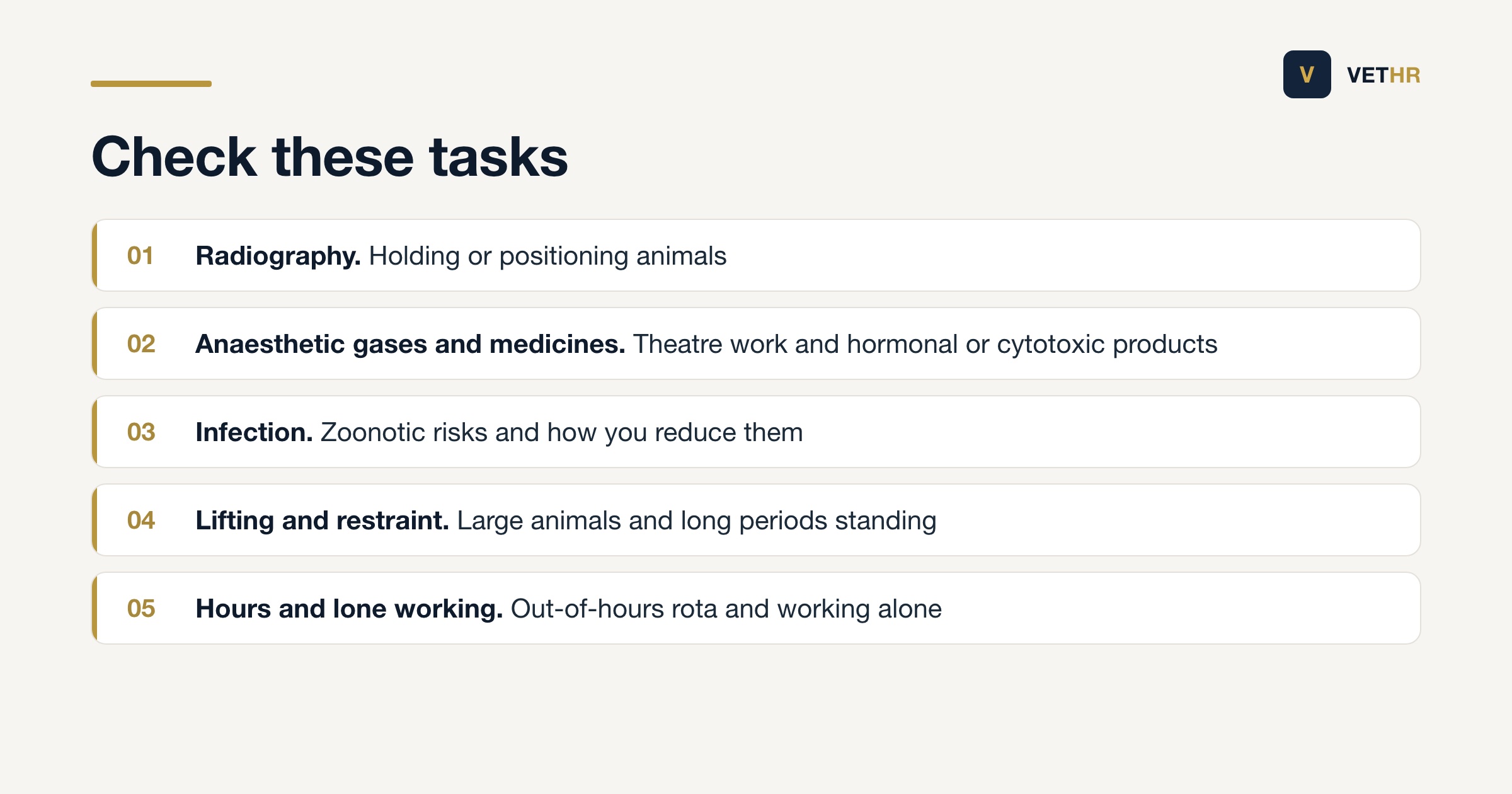
An individual risk assessment looks at the hazards in the employee’s actual job and decides whether any could affect her or her baby, then removes or reduces them. It is reviewed regularly because the baby grows, the working pattern changes and tasks change. For clinical roles it should be done task by task.
HSE says some work carries extra risk for breastfeeding mothers and their babies, and names organic mercury, radioactive material and lead as examples to include in the individual assessment. A veterinary practice has other tasks that deserve a look too, because nothing in a generic checklist knows your building. Think through:
Take advice from the practice’s competent persons where you have them, such as the radiation protection adviser for radiography tasks, and use HSE’s own pages on common risks for the detail. The point of the assessment is a short, specific note: this task, this risk, this control, and who will review it and when.
Acas says that where a risk cannot be removed or reduced, employers must temporarily change working conditions or hours where possible, and must offer suitable alternative work if it is available. In practice that might mean a different task for a period, not a lasting change to the job. Check the exact wording before acting.
Acas frames these further steps on its page mainly around pregnancy, and the same body of guidance applies to new mothers. Because the detail differs by situation, treat this as the point at which to take advice rather than improvise. Do not cut pay, remove hours or move someone to a less favourable role without agreement. Doing so can be both a breach of contract and discrimination.
Many practical fixes for breastfeeding at work are small. Swap a radiography duty with a colleague for a few months. Move an out-of-hours rota slot. Give a nurse a theatre list that avoids a particular task. Most of these keep the employee in her own role with her pay and status intact, which is what you want. For the cover implications see our guide to short staffing in a veterinary practice.
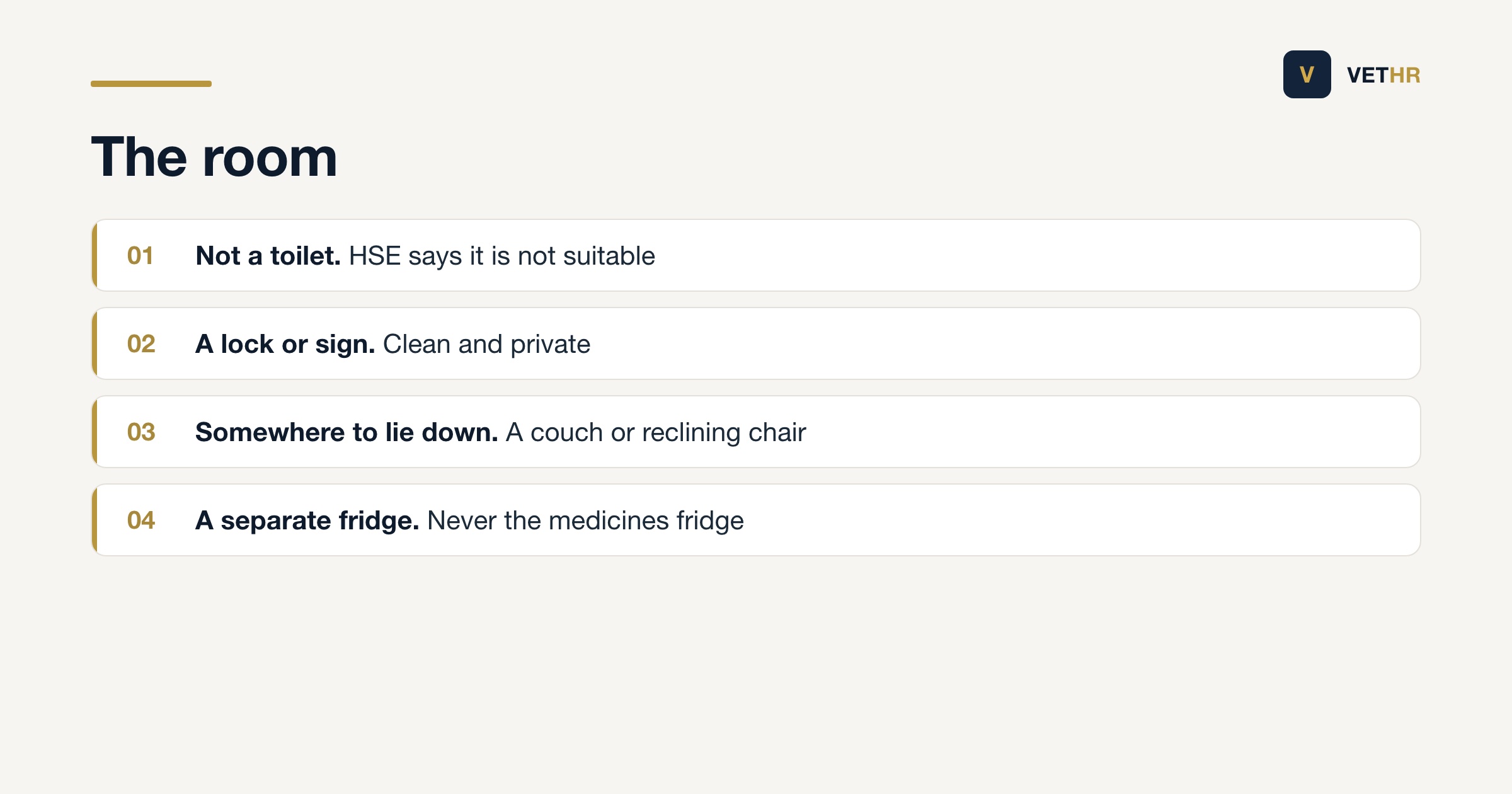
HSE says the area should let a worker rest, include somewhere to lie down when needed, be clean and private enough to express milk, and have somewhere to store milk. A toilet does not meet that need. In a small practice a dedicated corner of a staff room with a lockable door can work.
A practical checklist for a modest building:
Do not use a fridge that holds clinical products. Medicines, vaccines and samples do not share space with food or milk. A small separate fridge is cheap and avoids the argument.
If the building is genuinely tight, say so to the employee and work out the options together. A private office used by arrangement, a quiet consulting room in a quiet part of the day or a small partitioned corner may all work. The test is whether it is suitable, clean and private, not whether it is large.
Breastfeeding at work needs a pattern, not a rule. The sources above do not set a number of breaks. A sensible practice agrees a pattern with the employee, based on her baby’s age, her hours and the work. Most people express at predictable times, so a short written arrangement works well. Review it as the baby’s needs change and when the rota changes.
Agree how the time is covered: a fixed slot in the day, a short break with a colleague covering the desk, or a pause between consultations. Agree what happens on a day when an emergency makes the slot impossible, so nobody is put in the position of a refusal. Agree whether the time is paid or part of ordinary breaks, and put it in writing.
If you decide to allow paid time, keep it consistent. If you decide to use ordinary breaks, check that the pattern is workable. Either way, stay open to adjusting it. A rigid rule that does not fit the working day will be ignored, resented or both.
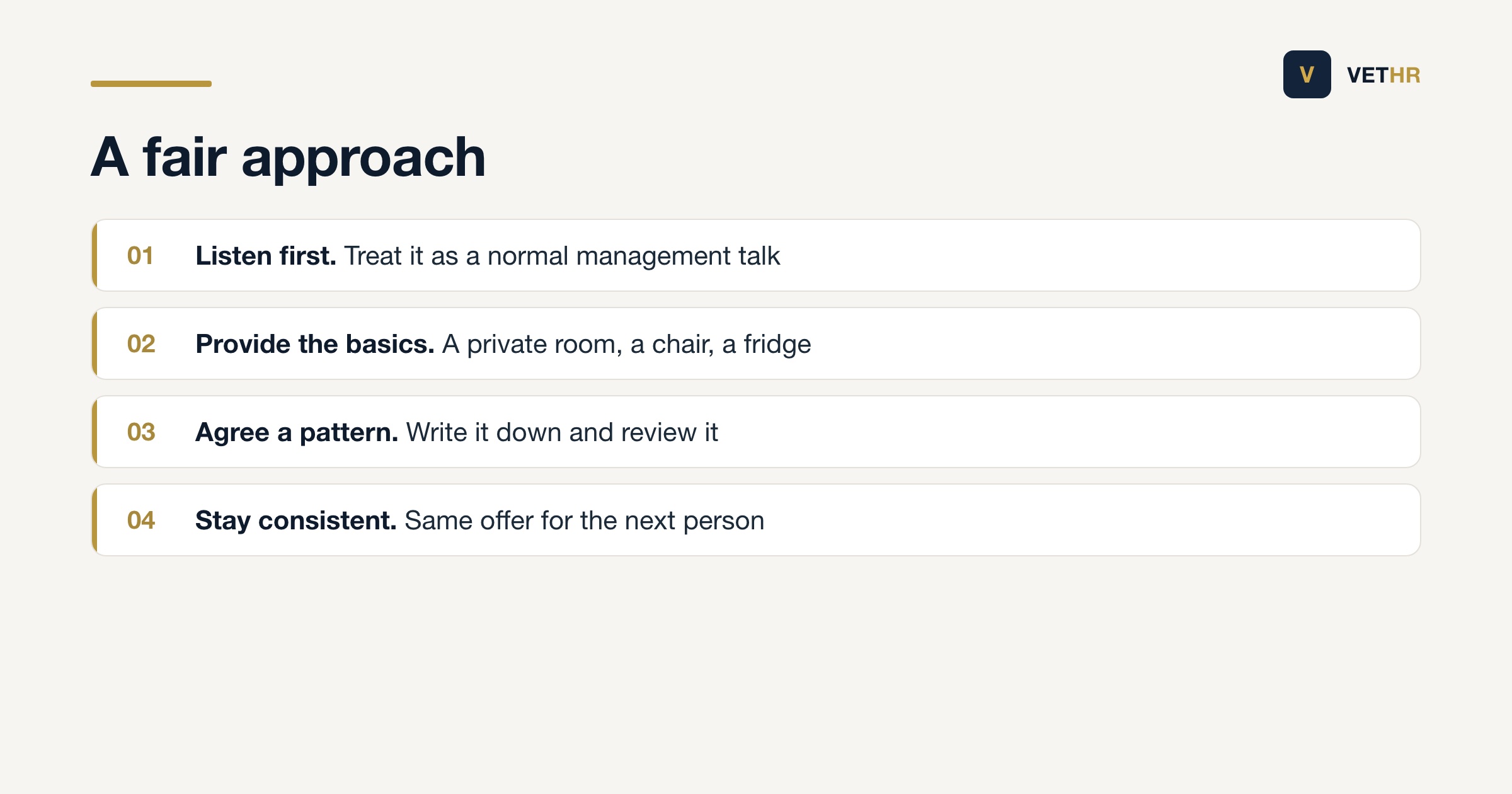
Treat a request for arrangements as a normal management conversation, not a favour. The Equality Act 2010 makes it unlawful to treat a woman unfavourably because she is breastfeeding, and refusing to discuss reasonable arrangements can lead to claims. Be fair, consistent, and record what you offered and why.
Sources summarising the law advise that a blanket refusal to consider a request can support a claim of sex discrimination. You do not have to say yes to every request, but you do have to listen, consider what is workable and give a reason if you cannot do something. Avoid comments about commitment, about whether she should still be breastfeeding or about how her colleagues feel. Those remarks are the raw material of a tribunal claim.
Be consistent between people. If a practice offers a room and a fridge to one nurse it must offer them to the next. If it adjusts a rota for one vet, it should consider the same for another in the same position.
Our guide to employment law changes for veterinary practices tracks the wider reforms to family-friendly rights, which are worth checking when you review your policy.
A short policy on breastfeeding at work answers the questions before they are asked: how to give notice, who carries out the risk assessment, where the room is, how breaks are agreed, what happens if a risk cannot be removed and who to speak to. Keep it to a page. Include it in your maternity policy or staff handbook and mention it in the keeping-in-touch conversation.
Acas suggests employers consider policies on pregnancy and maternity that include breastfeeding. Our policies and handbook system includes wording you can adapt, and you can book a free 30-minute HR health check through our contact page if you want someone to look at yours.
Cover these points:
Breastfeeding at work is covered for them too. HSE says to treat agency, temporary and gig economy workers the same as other workers for health and safety. In a practice that uses agency nurses or temporary reception cover, the same assessment and the same rest area apply. Agree with the agency who carries out the assessment and how information is shared.
For employees on fixed-term contracts, the same duties apply for the length of the contract. Do not use a contract end date to avoid a conversation. A decision not to renew that follows a request for arrangements is exactly the kind of timing that can look like discrimination.
The usual mistakes are waiting for a formal request before thinking about a room, pointing to the toilet, using the medicines fridge, treating the assessment as a one-off form, refusing to discuss arrangements, and letting colleagues comment. Each is avoidable with a short policy and one honest conversation.
HSE says you must provide a suitable area where breastfeeding mothers can rest, and that it should be clean and private so she can express milk if she chooses. It adds that toilets are not a suitable place and that the space should include somewhere to store milk.
Once the employee tells you in writing that she is breastfeeding. HSE and Acas both say an individual risk assessment is needed and should be reviewed regularly. It applies for as long as she wishes to continue breastfeeding.
The sources above set no number of breaks and no right to paid time. Agree a sensible pattern in writing, review it, and apply it consistently. Take advice if you plan to refuse a reasonable request.
Only where a risk cannot be removed or reduced, and then by temporary change to conditions or hours where possible, or by suitable alternative work if available. Do not reduce pay or status without agreement, and take advice first.
Yes. HSE says to treat agency, temporary and gig economy workers the same as other workers for health and safety.
If a colleague is about to return to breastfeeding at work and you have no room, no policy and no assessment, book a free 30-minute HR health check through our contact page and we will help you put them in place. See also our HR consultancy for veterinary practices.
Sources: HSE: rest and breastfeeding at work, HSE: new and expectant mothers, employer guidance, Acas: check health and safety risks.
Contracts, rotas, holiday, a difficult conversation. Tell us what you are dealing with and we will come back within one working day. Nothing to sign up to.
Got it. We will come back to you within one working day. If you do not see a reply, please check your spam folder.
