Last updated: 17 September 2026
TL;DR: A safe shift handover passes on every in-patient’s condition, plan, medication and warning signs, face to face and in writing, with time for questions. RCVS guidance expects in-patient protocols to cover the transfer of information when shifts change. Build paid overlap into the rota, use one structure such as SBAR, and have the incoming person read the plan back.
It is 7pm. The day vet has been in theatre since lunch, the evening vet has just arrived, and there are six patients on the ward: a dog on fluids, a cat recovering from a dental, a rabbit that has not eaten. Everything the night needs to know has to move from one head to another in about ten minutes.
Shift handover is the point where responsibility for a patient changes hands, and anything not passed on is effectively lost. A missed medication time, an owner who was promised a call, or a warning sign the day team was watching can all disappear between one shift and the next.
Other safety-critical industries learned this the hard way. The HSE guidance on shift handover notes that many accidents have occurred because of failures of communication at shift handover, and cites the 1983 Sellafield beach incident and the Piper Alpha disaster among the examples.
A veterinary ward is smaller than a refinery, but the mechanism is identical. The outgoing person knows what matters and is tired; the incoming person does not yet know what they do not know.
Handover also carries a people cost. When no time is built into the rota for it, the outgoing vet stays late and unpaid, evening after evening. Our guide to managing burnout covers why that pattern matters.
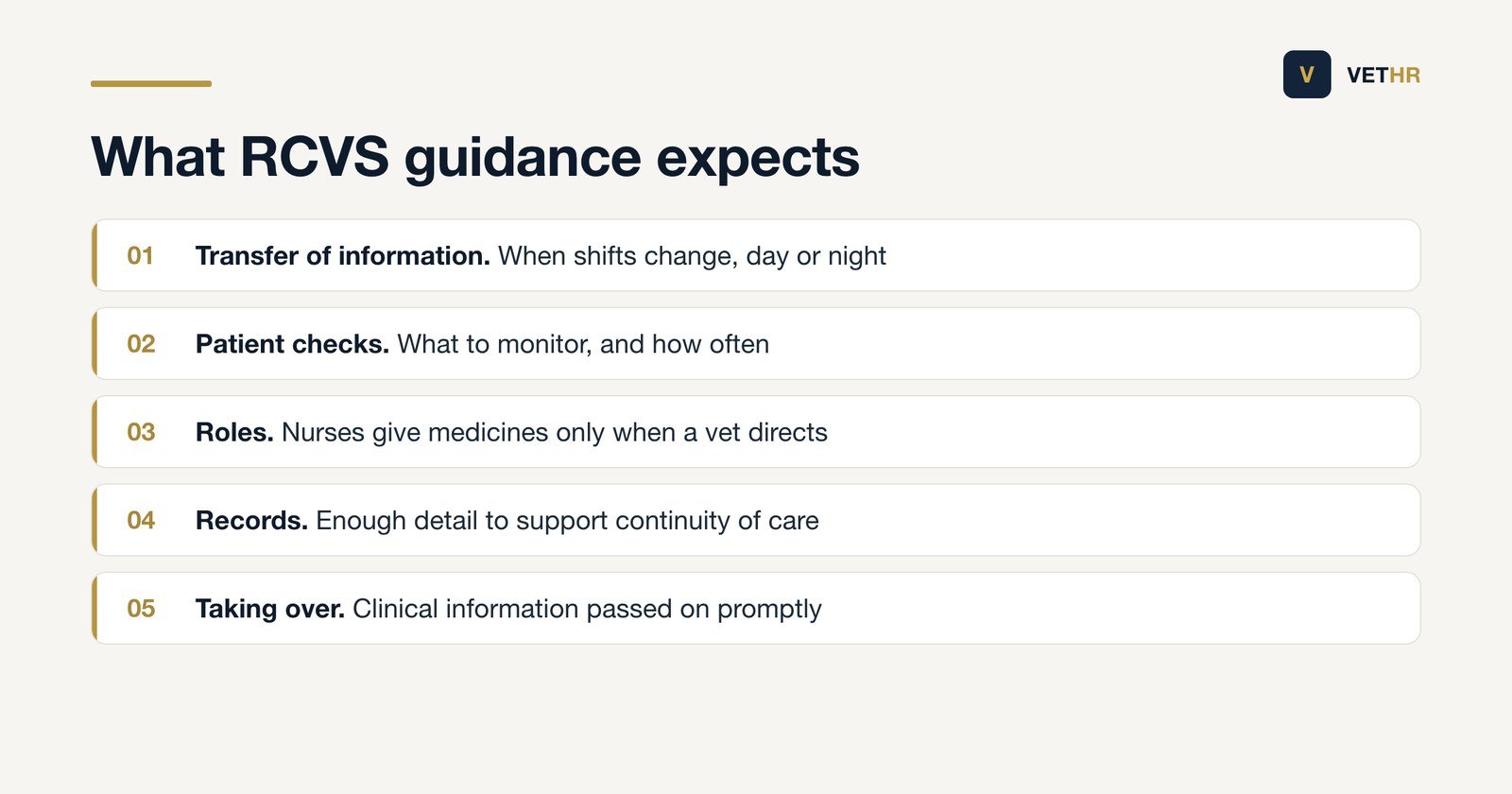
RCVS supporting guidance says practices should have protocols for in-patient care, and that those protocols should cover the transfer of information, so staff taking over in-patients have all the necessary information when shifts change during the day or out of hours. It also expects clarity on checks and on each person’s role.
Paragraph 2.11 of the RCVS guidance on veterinary care lists three basic areas those protocols should cover:
The records have to carry the same load. The RCVS guidance on clinical records says they should give an account of the animal’s clinical history sufficient to support continuity of care, including examinations, treatments, test results, plans, who provided care and the advice given to the client.
It also says relevant clinical information should be provided promptly to any veterinary surgeon taking over responsibility for a case. A good shift handover is how a practice meets that in real time.
For each in-patient, a shift handover should cover who and where the patient is, why they are in, how they are now and which way they are heading, what has been given and what is due, what to watch for, and what the owner has been told. If any of those is missing, the incoming team is guessing.
In a busy shift handover, the owner line is the easiest one to drop. An owner told at 5pm that someone will ring before 9pm will judge the whole practice on whether that call happens, and the evening vet cannot make a call they never heard about.
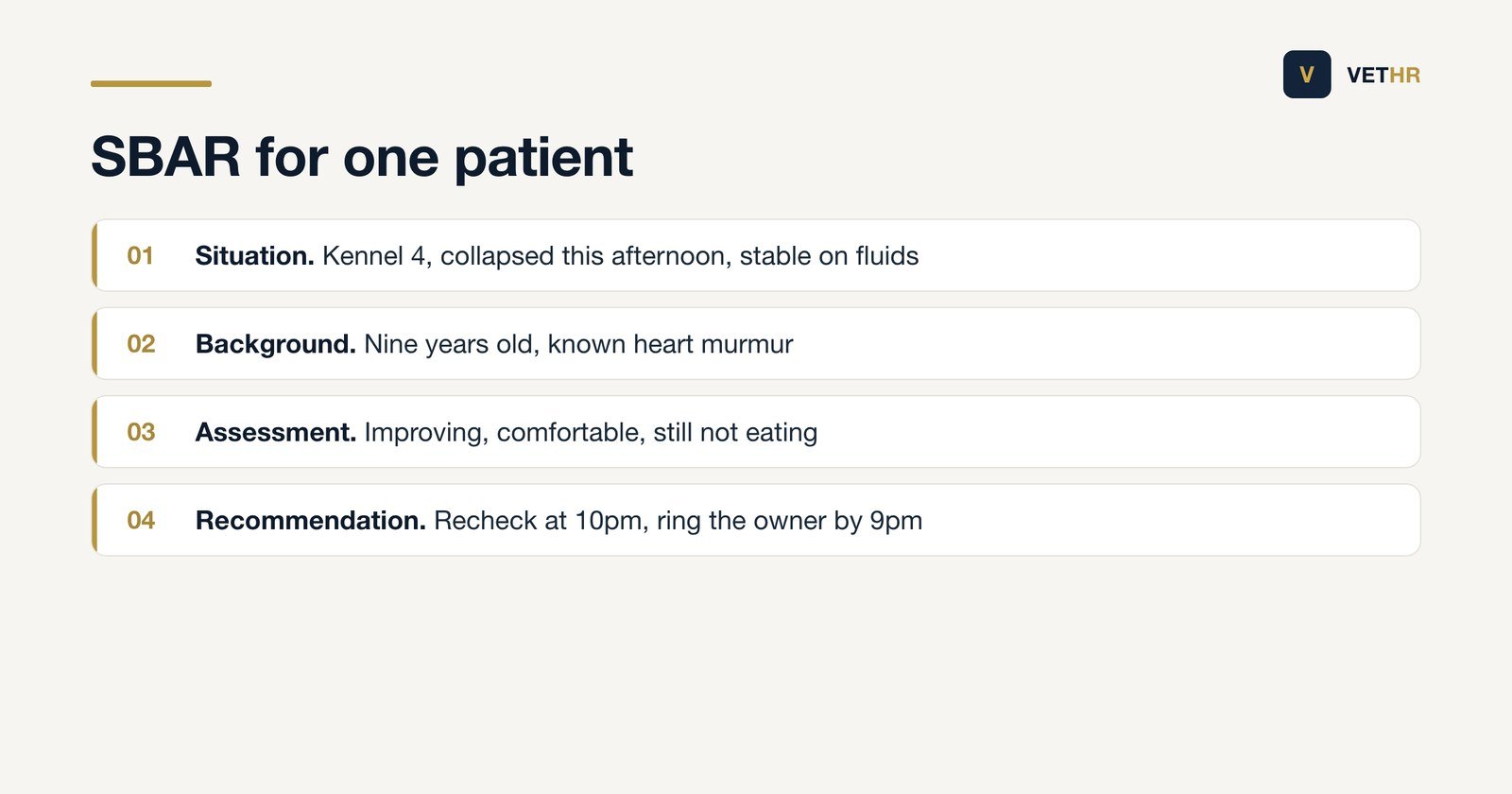
SBAR stands for Situation, Background, Assessment and Recommendation. It gives every shift handover the same order, so the incoming vet or nurse always knows where to find the plan. The NHS SBAR training guide describes it as a structured way of communicating information that requires a response.
The same guide says SBAR can be used very effectively to escalate a clinical problem or to support efficient handover of patients between clinicians or clinical teams. It adapts well to a veterinary ward:
Keep each patient to under a minute where you can. Complex cases take longer, and that is exactly why the routine ones should be quick and consistent.
HSE guidance says shift handover should be face to face, two-way with both people taking joint responsibility, done using both verbal and written communication, based on what the incoming staff need to know, and given as much time as necessary. That translates directly into a veterinary ward routine.
HSE describes three elements: preparation by the outgoing person, the exchange of information, and cross-checking by the incoming person as they take on responsibility. In a practice, that looks like this:
Reading back feels awkward in the first week of a new shift handover routine, then becomes normal. It is also the single step most likely to catch a medication time that was heard wrongly.
Handovers running late every evening? A free 30-minute HR health check will show where the rota needs its overlap. Book your HR health check.
Put the overlap in the rota and treat it as working time. If the day shift ends at 7pm and the evening shift starts at 7pm, the handover happens in someone’s unpaid time or not at all. The length should reflect how many in-patients you usually carry and how complex they tend to be.
That last point is expected, not optional. RCVS guidance says vets and nurses should facilitate the safe transfer of patients between practices, including outside normal hours. Our guides to the out of hours rota and building a veterinary rota cover the planning.
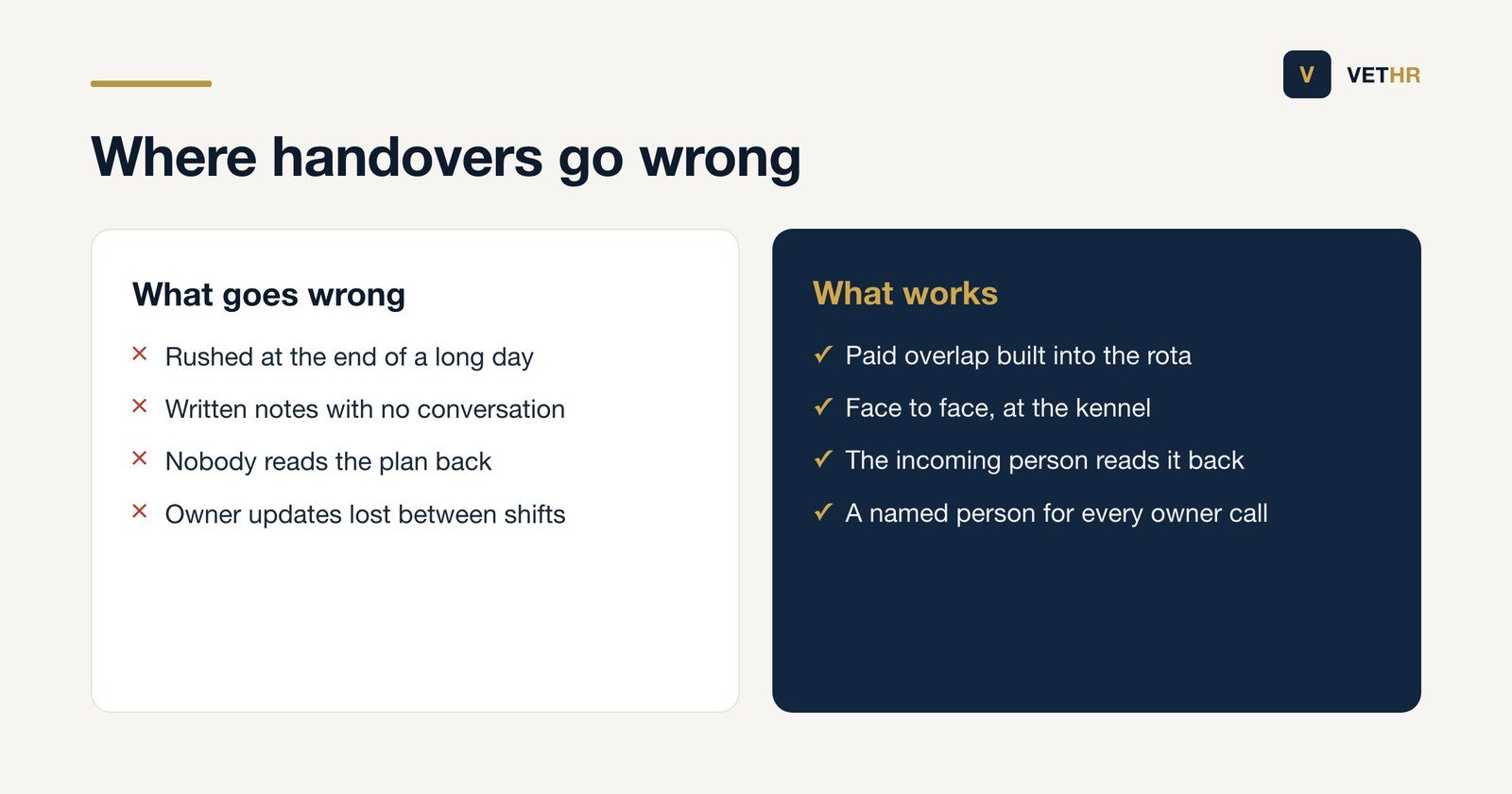
Most handover failures are predictable: a rush at the end of a long day, notes with no conversation, nobody reading the plan back, and owner updates falling between shifts. Each one has a simple fix, and most of the fixes are about the rota and routine rather than about individual effort.
Track the near misses. A medication nearly given twice, or an owner call missed, is information. A reporting route that staff trust, such as our See It Report It system, turns those moments into changes before they become incidents, as our guide to incident reporting explains.
Watch the shift handover that happens while someone is still consulting. If the evening vet is taking handover between appointments, it is not really a handover, and the rota needs to protect those minutes.
Treat it as part of the working day. Build the overlap into both shifts and pay it, rather than relying on people staying late. Unplanned handovers after the end of a shift quickly become unpaid overtime and resentment.
As long as the patients need. HSE guidance says handover should be given as much time and resource as necessary. A quiet ward may need ten minutes and a busy one far longer, so set the overlap from your usual in-patient numbers.
Yes, nurses often know the ward best. But medication decisions stay with the vet: RCVS guidance says veterinary nurses and student nurses should not administer medicines unless directed to do so by a veterinary surgeon, so the plan needs a vet’s direction behind it.
Patient identity and kennel, reason for admission, current condition, medication given and due, monitoring plan, fluids and feeding, escalation triggers, owner communication and outstanding tasks, with both names and the time of handover at the bottom.
Yes. RCVS guidance says vets and nurses should facilitate the safe transfer of patients between practices, including outside normal hours, and that relevant clinical information should be provided promptly to any vet taking over a case.
A shift handover is ten minutes that protects twelve hours. Give it a structure, a place in the rota and a read-back, and the evening team starts with everything the day team knew.
Our rota system lets you build the overlap into every shift pattern, and a free HR health check will show where your handovers are running on goodwill.
The Vet HR Team provides HR consultancy and white-labelled staff systems exclusively to UK veterinary practices. This guide covers workforce and process, not clinical advice.
Contracts, rotas, holiday, a difficult conversation. Tell us what you are dealing with and we will come back within one working day. Nothing to sign up to.
Got it. We will come back to you within one working day. If you do not see a reply, please check your spam folder.
