Last updated: 5 September 2026
TL;DR: Acas defines bullying as unwanted behaviour that is offensive, intimidating, malicious or insulting, or an abuse or misuse of power that undermines or humiliates someone. There is no specific law against it in the UK, but where it relates to a protected characteristic it becomes unlawful harassment, and severe cases can support a constructive dismissal claim.
Nobody in a veterinary practice describes themselves as a bully. What people describe instead is a senior vet who is fine most days, a prep room where one person is always the joke, and a nurse who has started taking her breaks in the car. That is usually what the problem looks like from the inside.
Acas defines bullying as unwanted behaviour from a person or group that is offensive, intimidating, malicious or insulting, or an abuse or misuse of power that undermines, humiliates or causes physical or emotional harm.
The examples Acas gives are recognisable in any workplace: constantly criticising someone’s work, spreading malicious rumours, humiliating people in meetings, setting excessive workloads, excluding colleagues from social events and posting offensive content online.
Acas also covers upward bullying, directed at managers. In practice that is the version nobody expects, and a practice manager being undermined by a clinical team is a real and under-reported situation.
What it is not is every difficult conversation. Firm, fair management of performance is not bullying at work, and treating it as though it were leaves managers unable to manage, which our guide to managing underperformance covers.
Bullying at work is not directly unlawful, and that is the point practices misread as reassurance. There is no specific law against bullying in the UK, but the routes into legal liability are wide open.
The sexual harassment duty is worth reading alongside this, because the preventative obligation there is more demanding than anything that applies to general bullying at work. Our guide to preventing sexual harassment sets it out.
Acas also sets out how bullying at work overlaps with discrimination in its guidance on the Equality Act 2010, where harassment is one of the four types of unlawful discrimination an employer can be liable for.
Practically, the absence of a dedicated law is irrelevant to the cost. Practices lose experienced nurses to bullying without a single claim ever being filed.
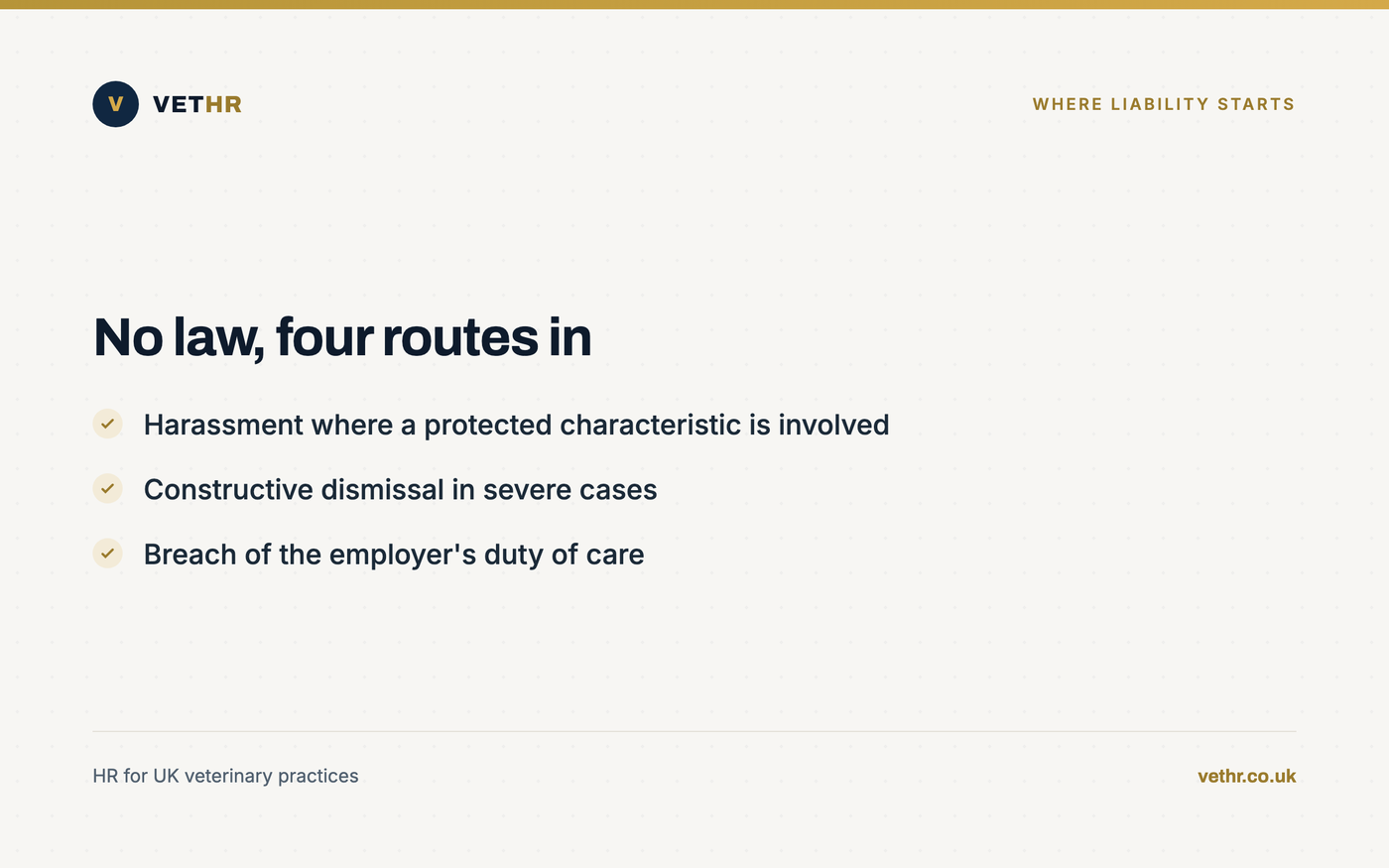
Bullying at work in a practice is rarely dramatic, and usually structural. The clinical hierarchy, the intensity of the work and the small size of the team combine to produce specific patterns that outsiders miss.
Number two is the one practices should audit rather than debate. Rota allocation is recorded data, so a pattern is visible, and an unexplained pattern is a real problem, as our guide to building a veterinary rota covers.
Number four is where most evidence sits. Practice group chats used for shift cover routinely carry the commentary too, and those messages are disclosable, as our guide to the subject access request explains.
Prevent bullying at work where possible and investigate it promptly when it is raised. Acas states that employers must do all they can to try to prevent bullying happening, and must take any complaint seriously and look into it as soon as possible.
That first duty is the one practices skip. Waiting for a complaint means waiting for someone to take a considerable personal risk in a team of fifteen where everyone knows everyone.
The second duty has a speed element written into it. A complaint sitting unaddressed for a month has already told the whole team what happens to people who raise things.
Both duties need a named route that does not run through the person complained about. In a small practice that usually means naming a second contact and an external option in the policy.
Through a proper process, at pace, with the complainant protected. Seven steps cover it, and the sequence matters more than the paperwork.
Step five is where practices accidentally punish the person who spoke up. Moving the complainant to a branch or off the good clinics reads as a consequence of complaining, whatever the intention was.
Run it through your grievance procedure so the process is recognisable and consistent, as our guide to handling a grievance sets out.
Something brewing in your team and no clear route to raise it? A free 30-minute HR health check will help. Book your HR health check.
By making the standard explicit and the reporting route real. Prevention in a small practice is mostly about removing the reasons people stay silent.
The anonymous check does the heavy lifting. Most bullying at work in veterinary practice is known to several people and reported by none, and a survey is the only route that does not require someone to go first, as our guide to the staff survey covers.
Induction is the cheapest moment to set the standard. Telling a new starter in week one exactly what bullying at work means here, and who to speak to about it, costs ten minutes and removes the excuse that nobody knew where the line was.
Then act on what you find quickly. A practice that asks and does nothing has confirmed exactly why nobody reported it the first time.
There is no specific law against bullying. However, where the behaviour relates to a protected characteristic it becomes unlawful harassment under the Equality Act 2010, and Acas notes that severe bullying may contribute to a constructive dismissal claim. Employers also owe a duty of care.
No. Setting clear expectations, addressing performance and giving direct feedback are legitimate management activities. The distinction lies in whether the behaviour is offensive, intimidating, malicious or insulting, or amounts to an abuse or misuse of power that undermines or humiliates someone.
Yes. Acas guidance covers upward bullying directed at managers. In veterinary practice this often looks like a practice manager whose decisions are publicly reversed or whose instructions are collectively ignored, and it is significantly under-reported because it feels difficult to raise.
The process must still happen, and it should be run by someone independent. Name an external route in your policy for exactly this situation, because a practice where every reporting line ends at the person complained about has no functioning route at all.
A dignity at work policy covering bullying, harassment and expected behaviour is the usual approach, sitting alongside your grievance procedure and your specific sexual harassment policy. Name actual behaviours rather than listing values, because values do not tell anyone where the line is.
Bullying at work is expensive long before it is legal. It shows up as resignations, sickness absence and a team that has quietly stopped raising concerns, and none of that appears on a claim form or in a set of accounts.
Write the policy, name two contacts and an external route, train managers on the line between managing and undermining, and check anonymously once a year. Our policy library and HR consultancy cover all four, and the free HR health check is where to start.
The Vet HR Team provides HR consultancy and white-labelled staff systems exclusively to UK veterinary practices. This is HR guidance, not legal advice; take advice on any live complaint.
Contracts, rotas, holiday, a difficult conversation. Tell us what you are dealing with and we will come back within one working day. Nothing to sign up to.
Got it. We will come back to you within one working day. If you do not see a reply, please check your spam folder.
