Last updated: 5 September 2026
TL;DR: A job description sets out the duties of a role and a person specification sets out what the postholder needs. Acas expects employers to be able to prove they have a good reason for any job requirement, and to avoid terms that discriminate by age, sex, race or religion. Nine parts cover a veterinary role properly.
Most practices write one when a vacancy appears and never look at it again. Then a performance conversation goes badly, a nurse says the job is nothing like what she applied for, and everyone reaches for a document that has not been true since 2022.
Because it is the reference point for four separate processes. Recruitment is the obvious one; appraisal, capability and restructuring all quietly depend on the same document, and all three go badly when it does not exist.
It also does quiet retention work. A large share of early resignations trace back to a gap between the role advertised and the role experienced, and the honest version of the document closes that gap before it costs you the hire.
Note it is not the contract. Duties should sit in the job description with a contractual reference to it, so the role can develop without varying terms, as our guide to employment contracts explains.
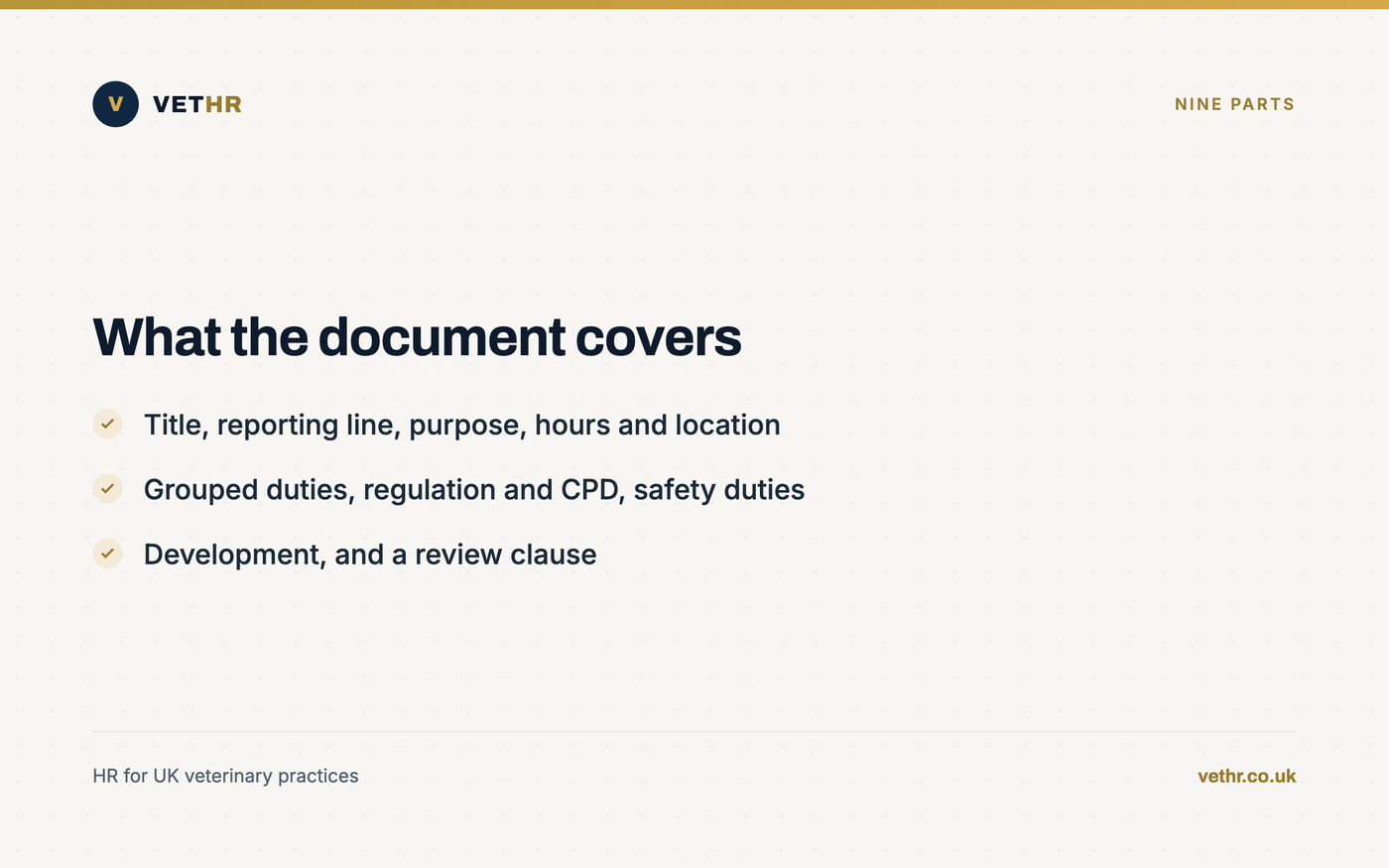
These nine cover a veterinary role without becoming a document nobody reads. Two pages is plenty.
Number three is the one candidates care about most and practices write most vaguely. “Occasional weekends” means one in eight to some people and one in two to others, and the ambiguity is discovered in week three.
Number nine prevents the “that’s not in my job description” conversation from ending the discussion. Roles in small practices genuinely do develop, and saying so in advance is fairer than pretending otherwise.
To separate what someone must have from what would be useful, before you see any applications. Written afterwards, it tends to describe the candidate you liked rather than the role you need.
Split it into essential and desirable, and be ruthless about the essential list. Every essential criterion narrows your field, and in a tight veterinary recruitment market that has a direct cost.
Acas describes turning each point in the job description and person specification into a checklist, assessing each application against it and scoring them, with two or more people involved to reduce the risk of personal bias or unintended discrimination.
Acas sets that method out in its guidance on choosing who to interview, and it is worth following even for a single vacancy, because a scored checklist is the only version of a shortlisting decision that survives being questioned.
Keep the scoring sheets. If a rejected applicant challenges the decision, a scored checklist completed at the time is the difference between a defensible process and a recollection, as our guide to the veterinary job advert covers.
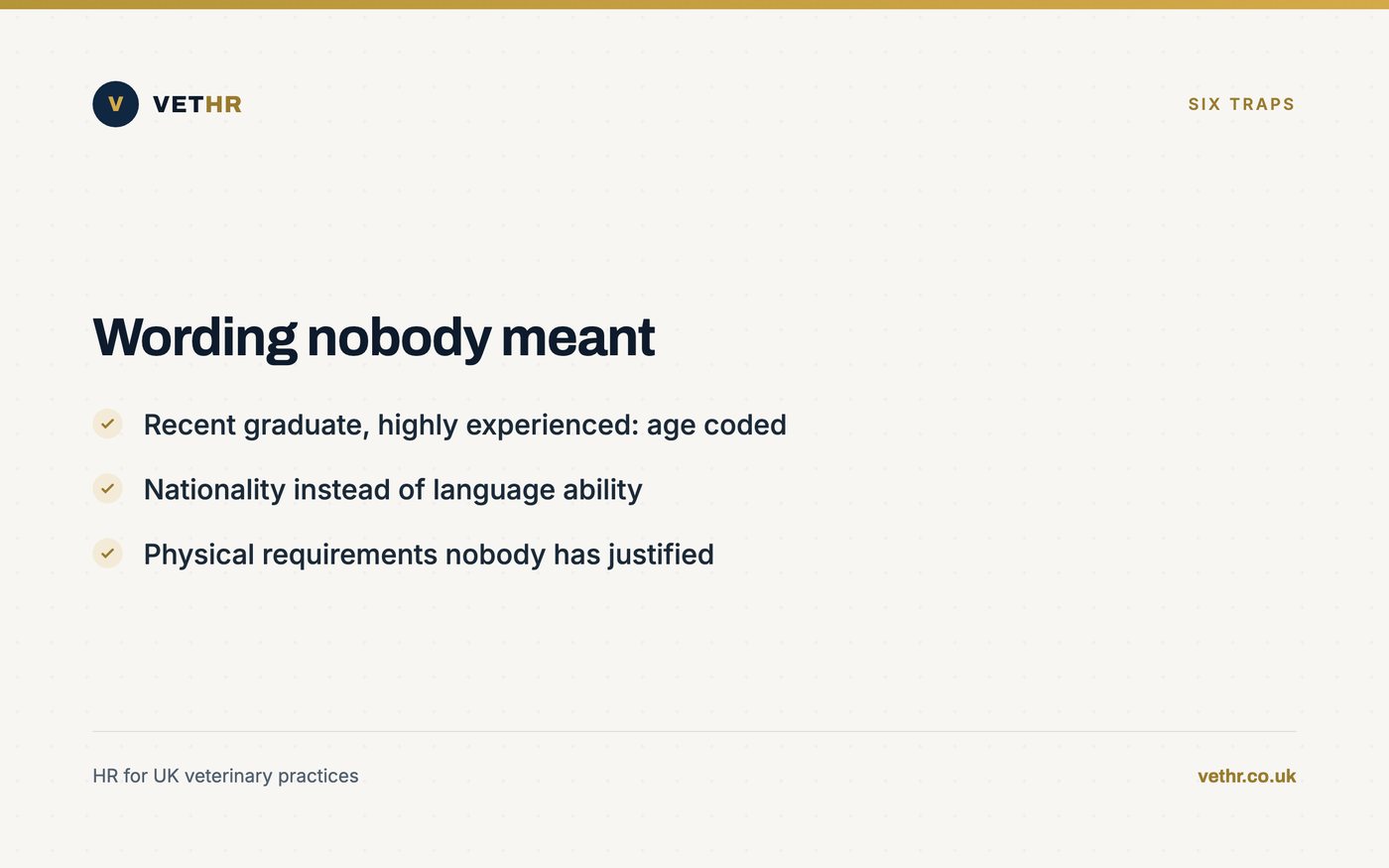
Mostly wording that nobody meant as exclusionary. Acas warns that you must be able to prove you have a good reason for any job requirement in your advert.
Number six deserves care in veterinary work. Lifting and restraint are real, but a blanket requirement written into every nursing job description without thought will screen out candidates who could do the job with adjustments, as our guide to reasonable adjustments explains.
Advertise in at least two places. Acas notes that relying on a single channel, such as social media alone, carries its own discrimination risk because of who it reaches.
Five things a generic template will not contain, and they are the five that determine whether the hire stays.
Be specific about CPD in the document, because candidates compare it directly. “35 hours protected time plus a stated budget” is a differentiator; “CPD supported” is what everybody writes, as our guide to CPD requirements sets out.
Write the job description with someone doing the role now. Fifteen minutes with an experienced RVN produces a far more accurate list of duties than an hour of management guesswork, and it usually surfaces two or three tasks nobody realised she had absorbed.
Naming the emotional demands honestly is the strongest signal a practice can send. Applicants know the work is hard; what they are looking for is evidence that you know it too.
Recruiting and not sure the paperwork holds up? A free 30-minute HR health check will review it with you. Book your HR health check.
By reviewing it at the appraisal, every year, with the postholder in the room. A document written once at recruitment is out of date within eighteen months in any small practice.
Step one produces useful information about workload creep. When four people have quietly absorbed duties nobody assigned them, an appraisal review surfaces it before it becomes a resignation, as our guide to staff appraisals covers.
The document itself is not, though the written statement of employment particulars is and must include the job title or a brief description of the work. In practice a proper job description is how you evidence a fair recruitment process and a clear expectation of the role.
Usually not directly. Referencing it from the contract, rather than incorporating it, lets duties develop without a formal variation each time. Include a line stating that duties may reasonably develop and will be reviewed with the postholder.
Only where you can justify it. Acas warns that terms such as “recent graduate” or “highly experienced” can discriminate on age, and that employers must be able to prove they have a good reason for any requirement. Describe the capability you need rather than the years.
Two pages is usually right. Long enough to cover duties, hours, regulation, safety and development, short enough that a candidate reads it and a manager uses it at appraisal. Anything longer tends to be filed rather than referred to.
Yes, and they are often the people with the least clarity about what is expected. A short version covering duties, supervision, safety responsibilities and who to report to prevents most of the misunderstandings that arise with staff who are in the building less often.
The best test of a job description is whether the person doing the job would recognise it. If it describes a role that stopped existing two restructures ago, it is not protecting the practice and it is not helping anyone in it.
Write nine sections honestly, be specific about hours and out of hours, justify every requirement and review it at appraisal each year. Our HR consultancy and contract service build these alongside the contract, and the free HR health check is where to start.
The Vet HR Team provides HR consultancy and white-labelled staff systems exclusively to UK veterinary practices. Discrimination questions are legal matters; take advice where a requirement is contested.
Contracts, rotas, holiday, a difficult conversation. Tell us what you are dealing with and we will come back within one working day. Nothing to sign up to.
Got it. We will come back to you within one working day. If you do not see a reply, please check your spam folder.
