Last updated: 27 June 2026
TL;DR: Staff appraisals in a veterinary practice work best as a calm, regular conversation, not an annual form. Run a proper review at least once a year, back it with short one-to-ones in between, and give each one a simple shape: review what happened, exchange honest feedback, agree a few clear objectives, and plan development. Done well, appraisals support retention and CPD. Done as a tick-box, they quietly damage trust.
Most practice owners know appraisals matter, yet they sit at the bottom of the list behind consults, cover and the rota. This is a practical guide to running them in a way the team looks forward to, rather than dreads, and to making the time you spend actually count.
Appraisals matter because they are one of the few structured moments where a person feels seen, heard and invested in. People rarely leave over pay alone. They leave when work feels unmanaged and their growth feels invisible, and a good appraisal directly answers both of those quiet worries.
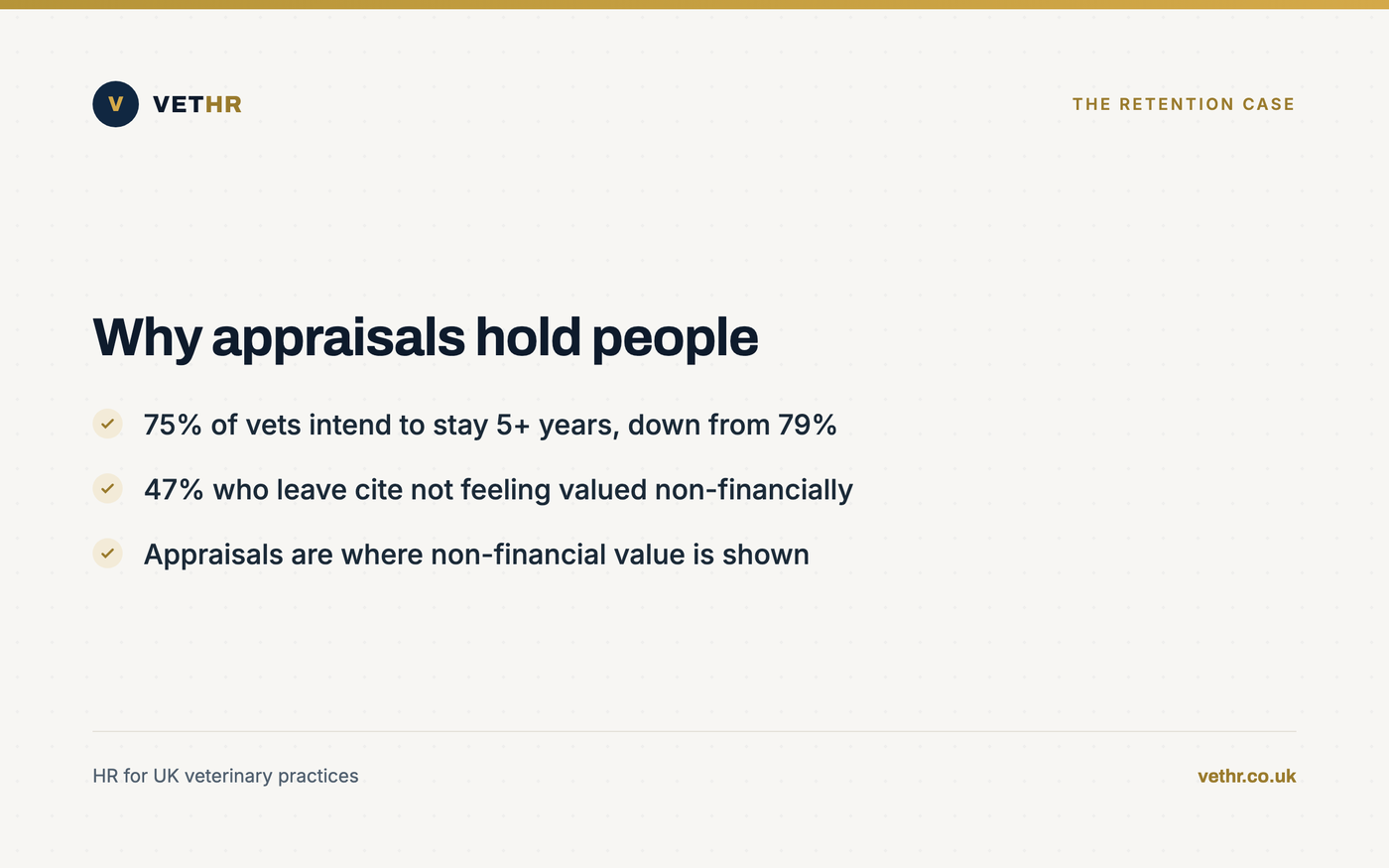
The retention data makes the case plainly. In the RCVS Surveys of the Professions 2024, the share of vets intending to stay in the profession for five or more years fell to 75 percent, down from 79 percent in 2019, according to the RCVS. A few points may sound small, but across a sector under recruitment pressure it is a meaningful drift toward the door.
Why people leave matters even more than how many. The same RCVS research lists the leading reasons as poor work-life balance at 56 percent, chronic stress at 54 percent, and not feeling rewarded or valued in a non-financial sense at 47 percent. That last figure is the appraisal’s home ground. A regular, genuine review is exactly where non-financial value gets shown rather than assumed.
Development is the other half of the story. An appraisal that ends with a clear plan for someone’s next skill, ticket or responsibility tells them the practice sees a future for them here. That sense of a future is often the difference between a nurse who stays and grows and one who quietly starts scrolling job boards on a hard week.
Run a full appraisal at least once a year, and support it with shorter one-to-ones every one to three months. The annual review is the anchor, but on its own it is too rare to be useful. The check-ins in between are where small problems get fixed early, before they harden into reasons to leave.
This mirrors the official guidance. Acas advises that it is a good idea to hold a performance review at least once a year, and that alongside it managers should still talk to people informally about their performance on a regular basis through regular check-ins, sometimes known as one-to-ones, as set out in its guidance on reviews and appraisals. The annual form is the floor, not the whole job.
In a clinic, the rhythm has to bend around the work. A monthly fifteen-minute one-to-one with a nurse is more realistic, and more valuable, than a grand ninety-minute session nobody can find time for. Short and frequent beats long and rare almost every time, because it keeps feedback close to the thing it is about.
Acas also makes the point that performance issues should be raised as they arise rather than saved up. Storing problems for the annual appraisal is how a review becomes an ambush, and an ambush is the fastest way to lose the trust the whole exercise depends on.
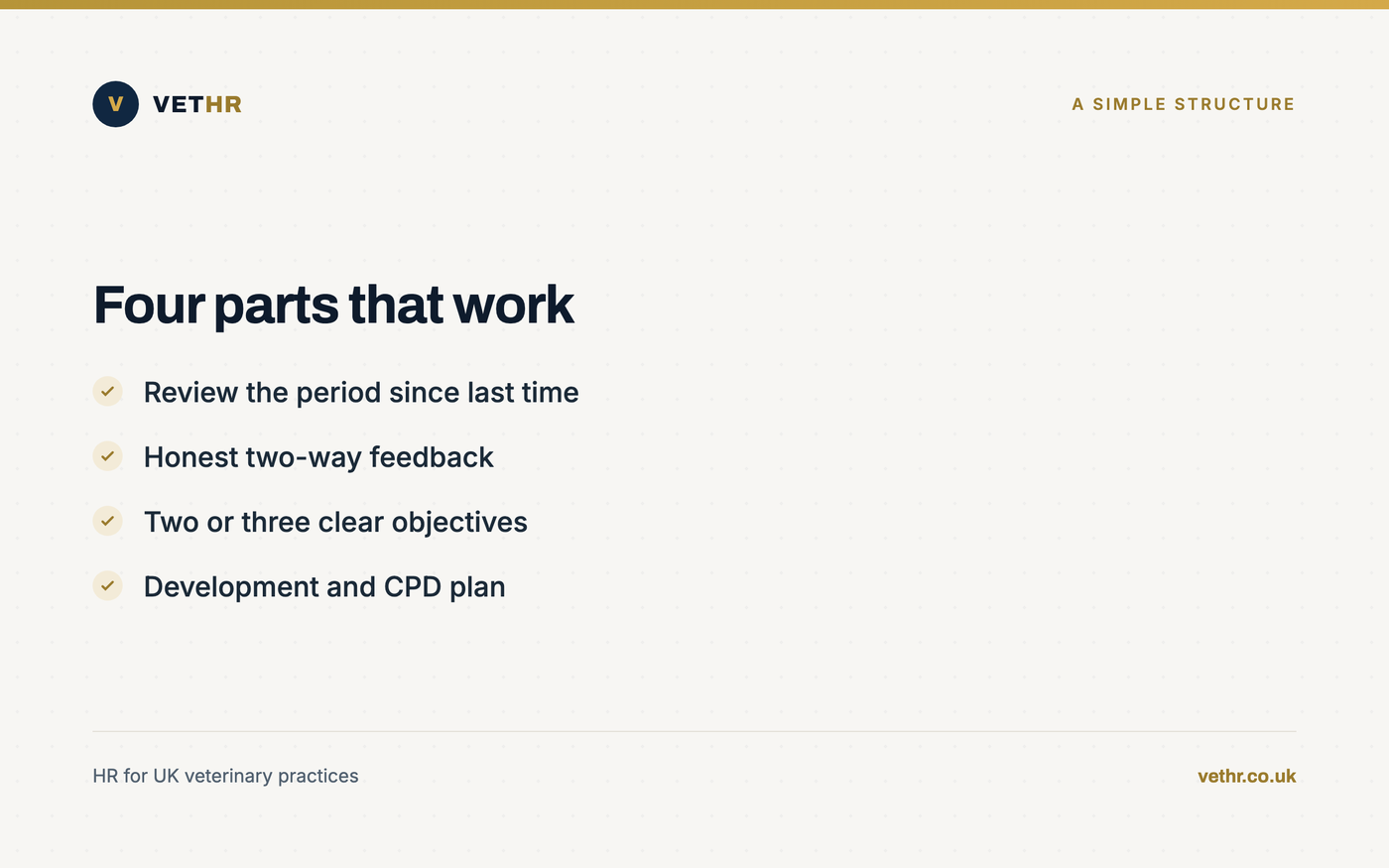
A good appraisal process has four simple parts: review, feedback, objectives and development. Walking through them in order keeps the conversation balanced, so it is not all praise, all criticism, or all paperwork. Each part has a job, and skipping one is usually where appraisals go wrong.
Keep the objectives sharp. Acas recommends SMART objectives, meaning specific, measurable, achievable, relevant and time-bound, in its performance management guidance. “Be more confident in consults” is a hope. “Lead three nurse consults a week by September, with a review in October” is an objective you can both actually track.
One detail people skip costs them later. Acas is clear that you should keep a written record of what is discussed, and that this record should be shared with the employee afterwards. A short, agreed summary protects everyone, anchors the next conversation, and means nobody is relying on memory six months on.
Not sure whether your appraisal process is helping or just generating paperwork? A 30-minute conversation usually makes it clear. Book a free HR health check and we will look at how you run reviews, objectives and records today, then tell you honestly where a tweak would lift retention and where you are already doing it well. No jargon, nothing sold for the sake of it.
The four-part shape stays the same for everyone, but the content shifts by role. A vet, a registered nurse and a receptionist are doing very different jobs, so the same generic form for all three is the first sign an appraisal has become a tick-box. Tailor the objectives and development to the actual work in front of each person, and to where they realistically want their career to go next.
The point is that everyone deserves a real conversation, not just the clinical staff. Reception and support roles are frequently left out of appraisals altogether, which quietly tells those team members the practice values them less. They are usually the first voice a client hears, so their development is far from a side issue.
Pay and progression sit slightly to one side of all this. Acas notes that appraisals may link to rewards, but a review that becomes purely a pay negotiation loses its value as a development conversation. Many practices keep the two on separate tracks so the appraisal can stay honest about growth.
The appraisal is the natural home for CPD planning, because the development section is where you decide what learning the person needs next and the practice commits to supporting it. Linking the two turns CPD from a box ticked in a panic each December into a deliberate plan tied to real goals.
The requirements are firm and worth planning around. The RCVS requires veterinary surgeons to complete 35 hours of CPD a year plus reflection, and registered veterinary nurses to complete 15 hours plus reflection, with activities only counting once they have been reflected on, as set out in its CPD guidance. An appraisal is the ideal moment to map those hours to something the person actually wants to learn.
Reflection is the part practices most often miss, and the RCVS makes it mandatory rather than optional. The appraisal conversation is reflection in its most useful form: looking back at what a course or case taught someone, and deciding what it changes about how they work. That turns CPD from hours logged into skill genuinely gained.
It also helps your CPD budget go further. When learning is chosen against agreed objectives rather than whatever course lands in the inbox, the money buys development the practice actually needs. The appraisal gives you a clear, honest basis for saying yes to the right things and not to the rest. It is also where you spot a quieter risk: the team member who keeps logging the same comfortable hours year after year without stretching. A short, direct conversation about what would actually move them forward is worth more than another certificate filed away.
You avoid the tick-box trap by treating the appraisal as a conversation the form serves, not the other way round. The moment the goal becomes “complete the paperwork” rather than “understand and support this person”, the team feels it instantly, and the exercise starts costing you trust rather than building it.
The honest test is simple. A month after the appraisal, has anything actually changed for that person, in their work, their development or how supported they feel? If the only output was a signed form in a folder, you ran the ritual but missed the point.
Good documentation should make this easier, not harder. A simple, consistent record of objectives and development plans, somewhere the whole team can find it, is what turns this year’s appraisal into next year’s starting point. Our policies and documentation support is built to keep exactly that kind of record tidy and current.
At least once a year for a full review, supported by shorter one-to-ones every one to three months. Acas advises a formal review at least annually, with regular informal check-ins in between. In a busy clinic, a short monthly one-to-one is usually more realistic and more valuable than a single long session, because it keeps feedback close to the work.
Four parts: review the period since the last conversation, exchange honest two-way feedback, agree two or three clear objectives, and plan development including CPD. Keep the objectives specific and time-bound, and keep a short written record that you share with the employee afterwards so the next review has a real starting point.
No, appraisals are not a legal requirement, but they are strongly recommended good practice. Acas advises holding a performance review at least once a year and keeping a written record shared with the employee. They also help you manage performance and development fairly and consistently, which matters if you ever need a clear history of conversations.
The development part of the appraisal is where you plan CPD against real goals. The RCVS requires 35 hours of CPD a year plus reflection for vets and 15 hours plus reflection for nurses. An appraisal links those required hours to learning the person actually wants, and the conversation itself is a useful form of the reflection the RCVS asks for.
Treat the form as a tool for the conversation, not the goal. Bring no surprises, listen more than you talk, agree only a few objectives and keep revisiting them, and actually deliver the development you promise. The test is whether anything has genuinely changed for that person a month later, not whether the form is signed.
Staff appraisals in a veterinary practice are not paperwork to survive; they are one of the cheapest, most powerful retention tools you have. Run regularly, structured simply and kept honest, they tell people they are seen, valued and growing, which is exactly what the data says holds them in the profession. The practices that get this right are rarely the ones with the fanciest template. They are the ones that treat the conversation as the thing that matters and the form as a place to record it.
If your reviews have drifted into a once-a-year form nobody enjoys, start small: one clear structure, a few real objectives, and a record everyone can find. To make that stick, explore our policies and documentation support, see how we work in HR consultancy and monthly support, or simply book a free HR health check and we will give you a straight recommendation for your practice.
The Vet HR Team provides HR consultancy and white-labelled staff systems exclusively to UK veterinary practices.
—
Read next: Staff Recognition in a Veterinary Practice.
Contracts, rotas, holiday, a difficult conversation. Tell us what you are dealing with and we will come back within one working day. Nothing to sign up to.
Got it. We will come back to you within one working day. If you do not see a reply, please check your spam folder.
