Last updated: 5 September 2026
TL;DR: Occupational health is a medical service that helps employers make informed decisions about health at work. A referral needs the employee’s consent, and where a report is sought from their own doctor they have rights under the Access to Medical Reports Act 1988, including seeing it first and asking for corrections. The service advises; the employer decides.
A nurse has been off for seven weeks with a back injury. The practice manager wants to know when she is coming back, whether she can restrain dogs, and whether anything can be done to help. Those are three different questions, and only one of them is really a medical one.
Occupational health is a medical service focused on the relationship between health and work. Acas describes occupational health as a type of medical service that employers use to make informed decisions about worker health and workplace adjustments.
It is not your employee’s treating clinician and it does not exist to prove anyone wrong. The service answers work-related questions: what someone can do safely, what would help, and what timescale is realistic.
Acas lists the usual reasons employers refer: physical or mental health concerns, working out suitable adjustments for a disabled employee, managing long term sickness absence, and evaluating workplace risks such as excessive pressure or bullying.
Larger organisations should have a written policy setting out when referrals happen and how assessments work. In a practice, a one page policy in the handbook is enough and removes most of the awkwardness at the point of use.
Earlier than most practices use occupational health at present. Acas suggests using occupational health at an earlier stage where possible and appropriate, to support employers in retaining people at work, rather than only once someone has been absent for months.
Do not use a referral to delay a simple change. If someone needs a different chair or a later start, make that change now and refer for advice on the complicated parts, as our guide to reasonable adjustments sets out.
Frame it as support when you raise it. The words a manager uses in that first conversation decide how the employee reads the whole process, and “we want occupational health to tell us how to get you back safely” lands very differently from “we are referring you”.
Referring early is cheaper than referring late. Six weeks in, you are shaping a return; six months in, you are usually managing a capability process instead, as our guide to managing sickness absence covers.
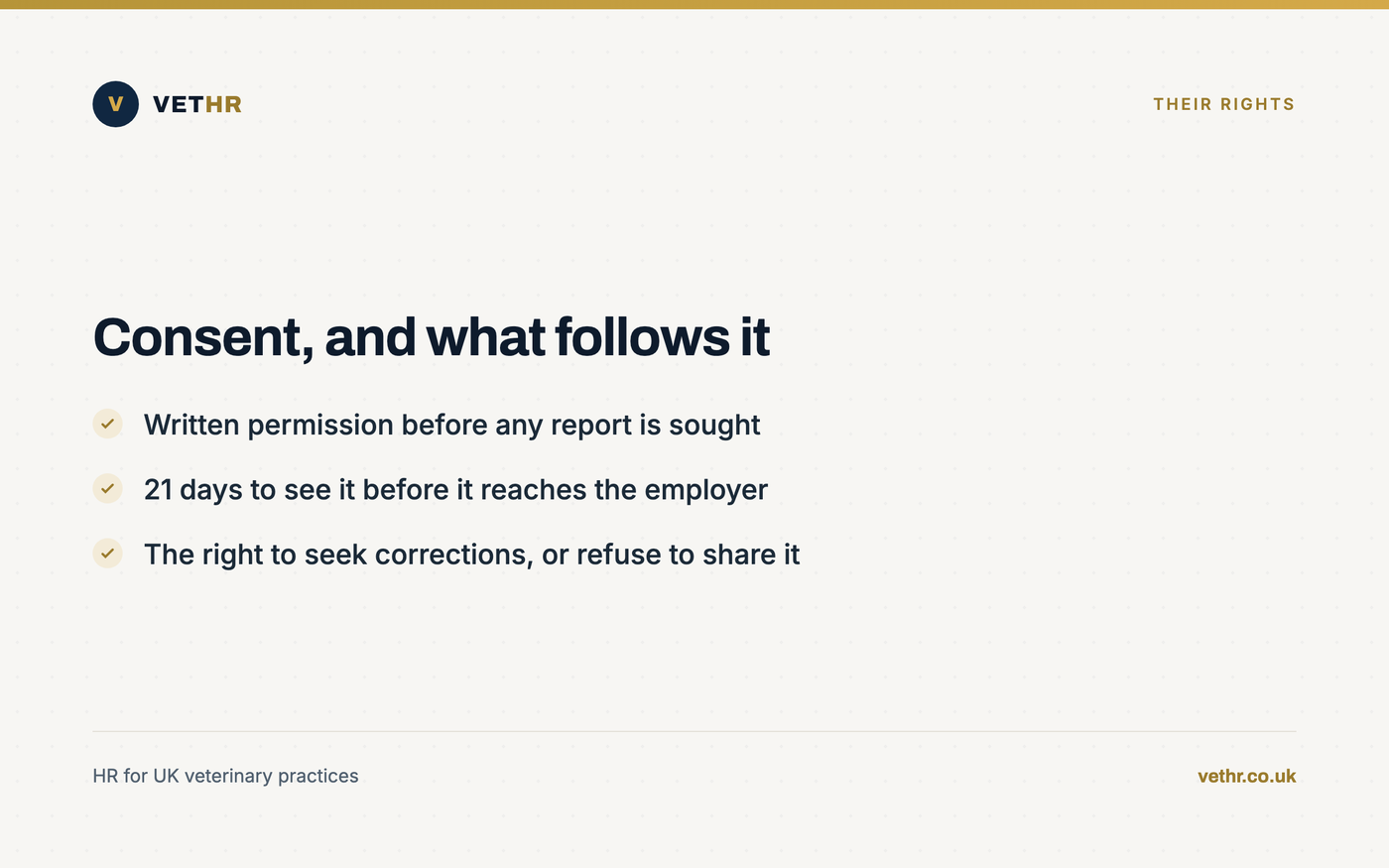
Explicit consent, obtained before anything happens and revocable afterwards. Acas is clear that employers must obtain permission before contacting a worker’s doctor, and that workers should be told from the start how to withdraw consent later.
Where a report is sought from the employee’s own GP or specialist, the Access to Medical Reports Act 1988 applies. Acas confirms the employee has the right to refuse their employer permission to get a medical report, and employers must get written permission first.
Health information is special category data, so keep it confidential and limit access to those who genuinely need it, typically the line manager and whoever handles HR. Our guide to GDPR and staff records covers storage and retention.
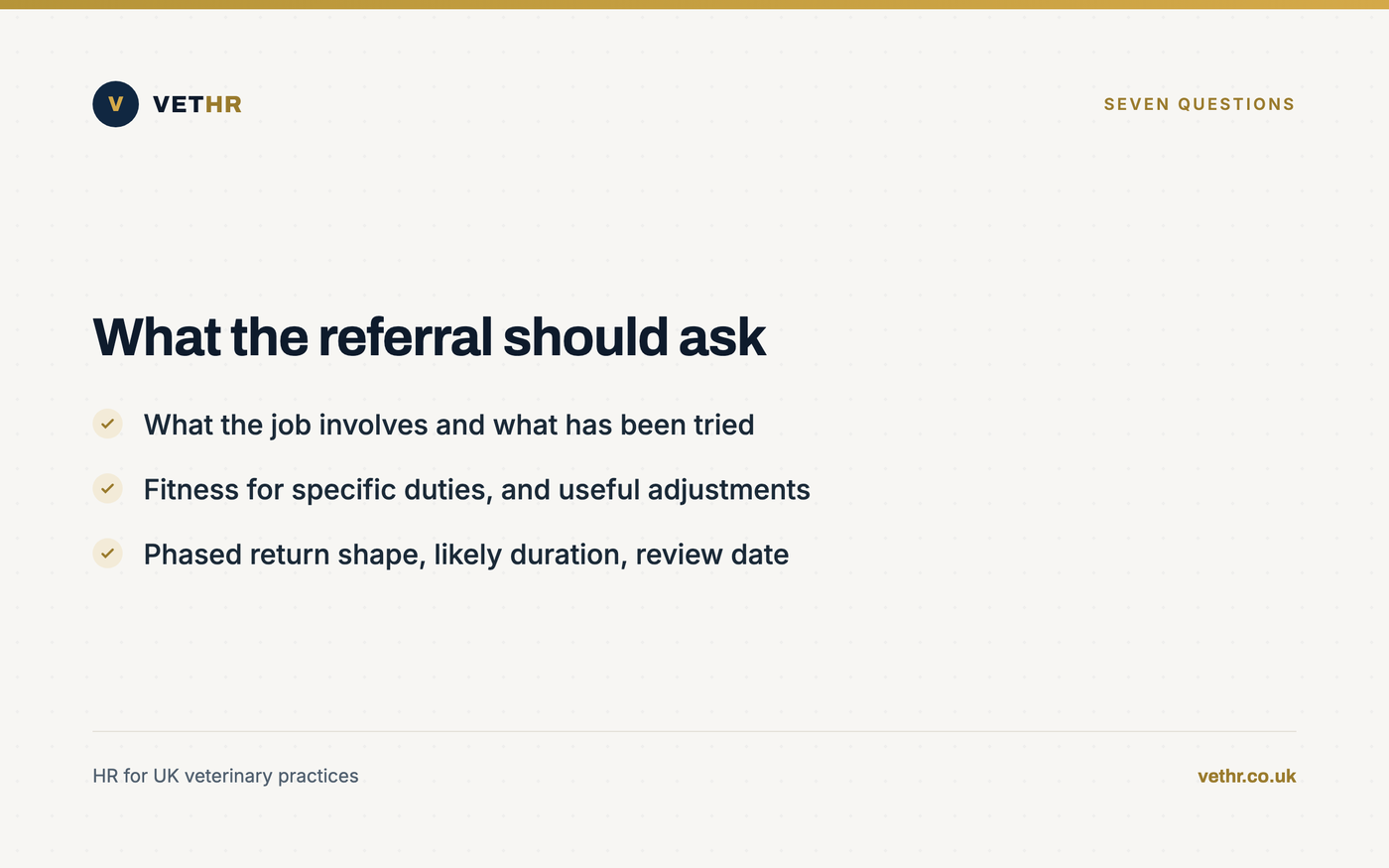
Specific, work-related questions, because occupational health only has what you give it. Acas notes that occupational health only have the information provided in the referral, and that it helps to explain what support has already been offered.
Attach the actual job description rather than a job title. An occupational health clinician who has never worked in a practice cannot guess what an RVN does across an eleven hour day, and the resulting advice is generic because the input was.
Never ask for a diagnosis. You are entitled to know about function and capability, not about the underlying condition, and asking the wrong question makes the whole process feel like an investigation.
Treat it as advice and then make the decision yourself. The report informs the employer; it does not bind them, and it does not transfer responsibility for what happens next.
If you cannot follow a recommendation, say why in writing at the time. “We considered a phased return over eight weeks and could offer six because of overnight cover” is a defensible record; silence is not.
Step four is where practices leak confidential information. The rota owner needs to know that someone cannot do sole charge nights for three months, not why, as our guide to lone working illustrates.
Long term absence and no clear next step? A free 30-minute HR health check will map the options. Book your HR health check.
You cannot compel an occupational health appointment, and you can still act. Consent is required, so a refusal ends the referral, but it does not end the practice’s need to make decisions about attendance and capability.
Find out why first. Most refusals are fear rather than obstruction: fear of losing the job, of the practice learning something private, or of a process they have never had explained to them.
Explain what will happen, share the referral questions in advance, and offer to remove anything that is not needed. That conversation converts most refusals, and it costs one meeting.
Offer a choice of provider where you can. Some employees will accept an occupational health assessment from an independent service while refusing one they believe reports directly to the partners, and that distinction is often the whole objection.
Where a refusal stands, say plainly and in writing that decisions will have to be made on the information available. Then take advice before any capability step, as our guide to managing capability covers.
No. Consent is required, and Acas is clear that employers must obtain permission before contacting a worker’s doctor. A contractual clause requiring cooperation with medical assessment may make refusal relevant to a capability process, but it does not override the need for consent.
Where a report is obtained from their own doctor, they can ask to see it before it goes to the employer and have 21 days to arrange access. They can ask for corrections to anything inaccurate or misleading, and can refuse to share it even after reading it.
Not automatically. The report is advice and the employer makes the decision. Where a recommendation cannot be followed, record the reason at the time. Ignoring recommendations without explanation is difficult to defend, particularly where the duty to make reasonable adjustments applies.
The employer. It is a service the practice commissions for its own decision-making, so the cost sits with the practice rather than the individual. Budget for it in the same way as any other professional advice, and factor it in before absence becomes long term.
Ask about function, not diagnosis. The legitimate questions concern capability, adjustments, likely timescales and whether the condition is long term. Requesting a diagnosis is rarely necessary, tends not to be answered, and makes the process feel like an investigation rather than support.
Occupational health works best when it is used early, framed as support and asked a specific question. Used late, as a step towards dismissal, it produces a defensive employee, a vague report and a worse outcome for everyone.
Get consent properly, attach the real job description, ask about function rather than diagnosis, and write down what you decided and why. Our HR consultancy and policy library cover the process end to end, and the free HR health check is where to start.
The Vet HR Team provides HR consultancy and white-labelled staff systems exclusively to UK veterinary practices. This is HR guidance, not medical or legal advice.
Contracts, rotas, holiday, a difficult conversation. Tell us what you are dealing with and we will come back within one working day. Nothing to sign up to.
Got it. We will come back to you within one working day. If you do not see a reply, please check your spam folder.
