Last updated: 5 September 2026
TL;DR: The RCVS CPD requirements are 35 hours a year for veterinary surgeons and 15 hours a year for registered veterinary nurses, regardless of whether they work full-time or part-time, and hours cannot be carried over between years. CPD must be recorded on 1CPD and reflected on. The practice is not the registrant, but it controls the two things CPD needs: time and money.
Every practice funds CPD. Rather fewer protect the time for it, and the difference shows up in November when three nurses realise they are short of hours and the rota has no room. That gap between the budget and the diary is the whole problem in one sentence.
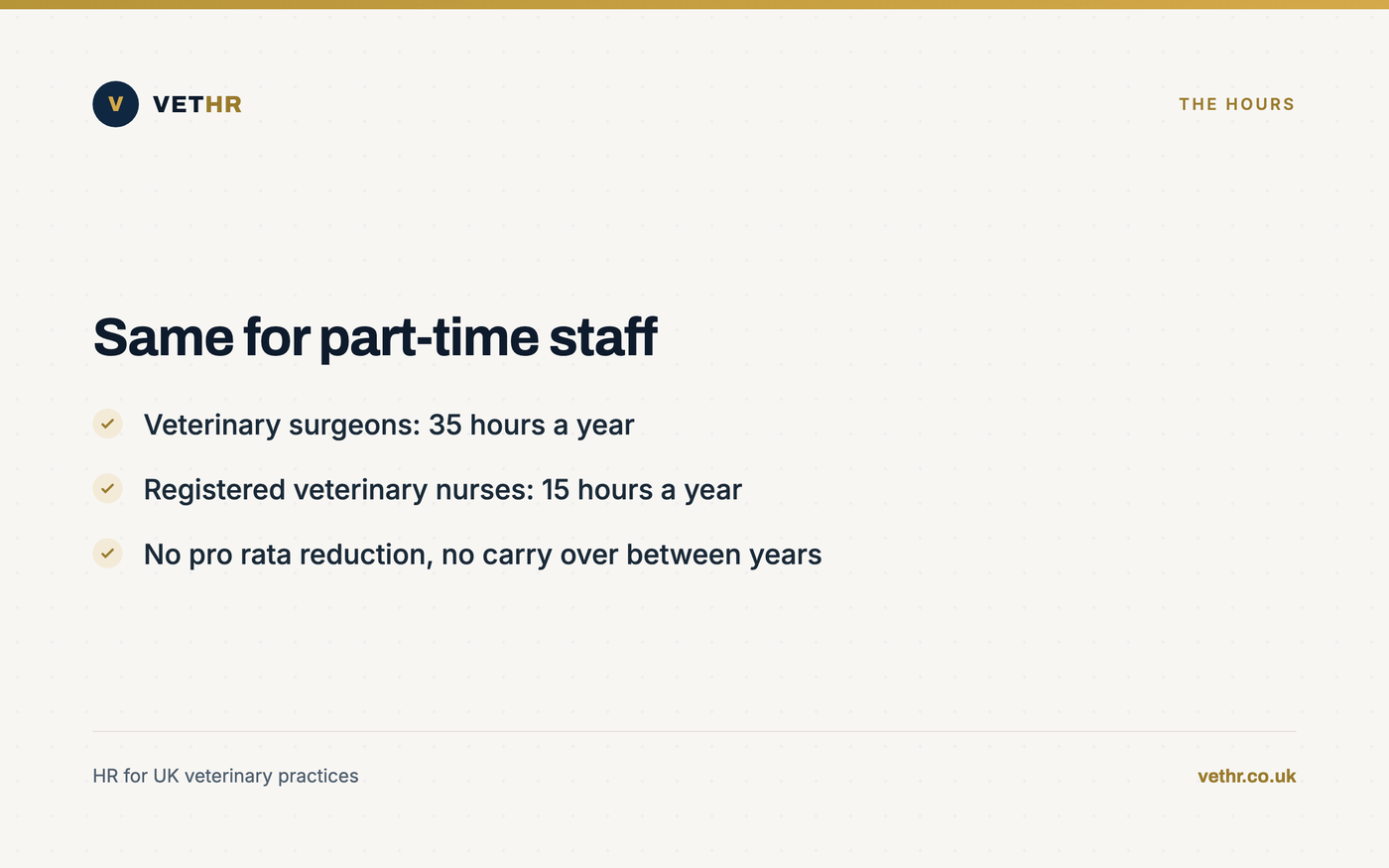
Thirty five hours a year for veterinary surgeons and fifteen hours a year for veterinary nurses. The RCVS sets out the annual CPD requirement and the outcomes focused model, and confirms these apply to everyone on the Register.
The part-time point catches practices out. A nurse working two days a week has exactly the same fifteen hours to complete as a full-time colleague, which is proportionally a much larger demand on her working time.
These sit alongside, rather than instead of, any statutory training rights. GOV.UK notes that the written statement of employment particulars must set out any training the employer requires the employee to complete, so what you mandate belongs in writing at the start.
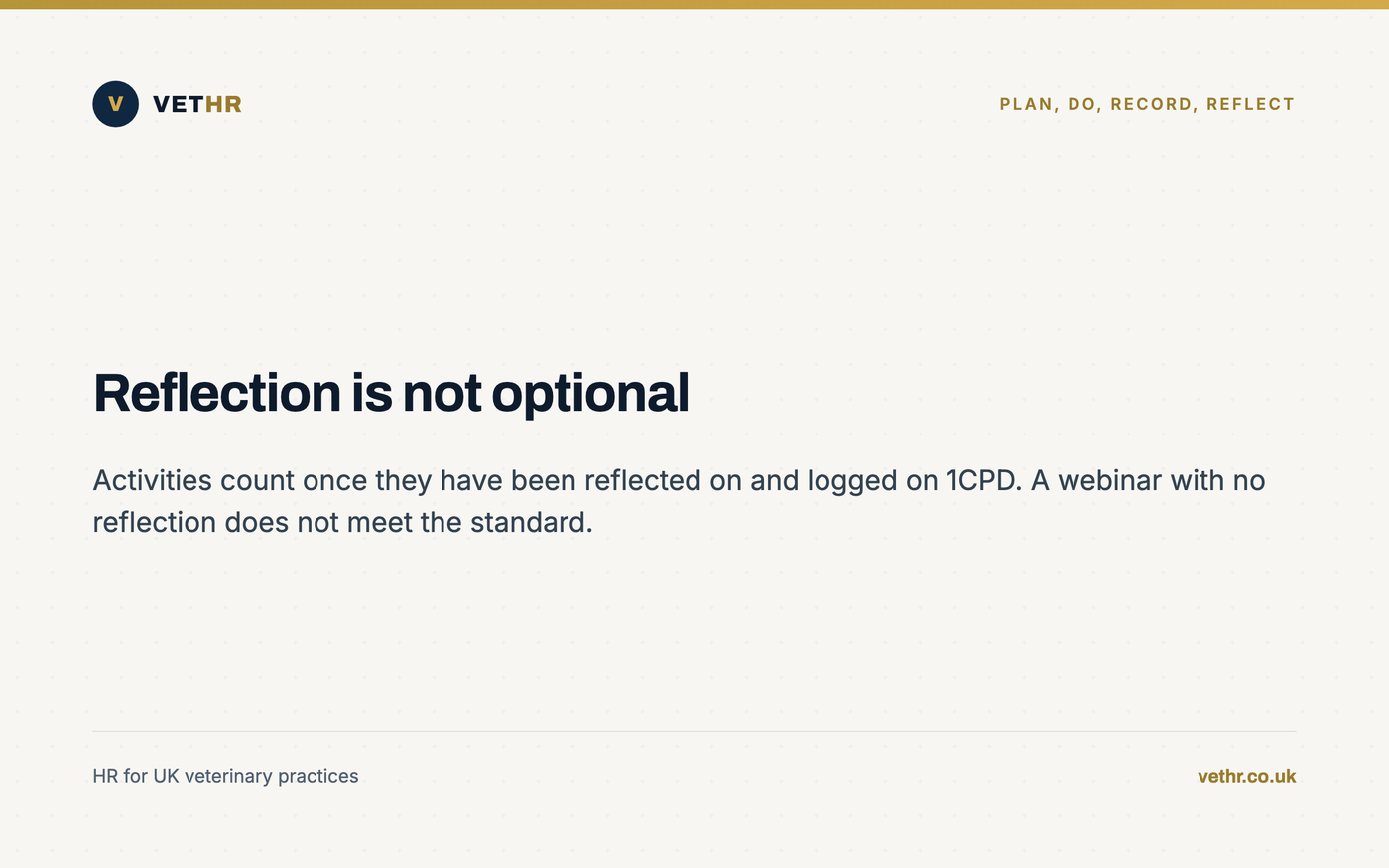
Recording happens on 1CPD, the RCVS platform, available on the website and as a mobile app. Activities only count once they have been reflected on, so a logged webinar with no reflection does not meet the standard.
That the value of the CPD requirements is judged by what changed, not by hours attended. The RCVS model runs plan, do, record, reflect, and it became mandatory in 2022, replacing a simple hours count with a cycle.
The steps do not have to be followed in strict order; the RCVS describes it as an ongoing cycle. What is not optional is reflection, and that is the step practices can genuinely help with.
Build reflection into your existing conversations. Ten minutes at an appraisal asking what someone learned this year and what changed as a result serves both the CPD requirements and the review, as our guide to staff appraisals covers.
The individual registrant’s, in regulatory terms. The obligation sits with the vet or nurse personally, and a practice cannot complete it for them or be sanctioned in their place.
That is the formal position and it is not the useful one. The practice controls the rota, the budget and the culture, and those three things decide whether the CPD requirements are met comfortably or scrambled through in December.
Practice Standards Scheme accreditation also brings staff development into scope, so a practice that treats CPD as a private matter for each employee is likely to find the topic raised at assessment. Our guide to the Practice Standards Scheme and your HR covers what assessors ask about.
Treat the CPD requirements as shared. The registrant owns the obligation; the practice owns the conditions that make it achievable.
Meeting the CPD requirements starts by booking study leave as far ahead as annual leave and defending it just as firmly. A CPD allowance with no rostered days is an allowance that disappears the first time someone goes off sick.
Point three prevents the usual failure, where everyone books CPD in the same fortnight and the practice cancels most of it. Our rota system makes concurrent absence visible when the request is made rather than in the week it lands.
Freelance vet cover is worth budgeting for alongside the course fee. A practice that funds a two day course and then cannot release the vet has spent the money and met none of the CPD requirements, which is the worst of both outcomes.
Some CPD does not need a whole day. Webinars, journal reading and structured case discussion all count, and a practice that protects one hour a fortnight for a nurse covers most of her fifteen hours without a single day off site.
Set out what you pay for and what you do not, and apply it consistently by role. Ambiguity here creates resentment quickly, because CPD spending is one of the most visible differences between how a practice treats vets and nurses.
Nurse CPD budgets are routinely a fraction of vet budgets, and while the hours requirement is lower, the gap is often far wider than the ratio justifies. It is one of the quiet reasons experienced RVNs move practices.
For expensive qualifications, consider a written training cost agreement rather than an informal understanding. Our guide to training cost agreements covers how to do that fairly and enforceably.
CPD budget spent but nobody’s hours logged? A free 30-minute HR health check will get the policy and the rota aligned. Book your HR health check.
One page, covering the CPD requirements and six other things, kept non-contractual in the handbook so the budget can be reviewed annually without varying anyone’s contract.
Write the CPD requirements into the induction pack as well. A new graduate vet joining in August has the same 35 hours for that calendar year as everyone else, and nobody tells them that in their first week unless the practice does.
Point six is worth deciding explicitly. Unused allowance that quietly expires teaches people that the budget was never really theirs, which is a poor lesson to pay for.
Keep the policy with your other people documents rather than in a training folder. Our policy library and staff handbook guidance both cover where it belongs.
Thirty five hours a year for veterinary surgeons and fifteen hours a year for registered veterinary nurses, according to the RCVS. The requirement applies to everyone on the Register regardless of whether they work full-time or part-time, and hours cannot be carried over between years.
There is no legal obligation to fund it, but almost all practices do, and it is a standard expectation at interview. Where a contract or policy promises a CPD allowance, that promise should be honoured. Be clear in writing about the amount, what it covers and whether time is paid.
That depends on your policy, since there is no statutory right to paid study leave for CPD. Most practices provide a set number of paid days a year for each role. Whatever you offer, roster the days rather than leaving them as an allowance that competes with clinical cover.
It can, where it is planned, relevant, recorded and reflected on. Under the outcomes focused model the question is what the person learned and how it applies to their work, not whether the session took place off site. Structured case discussion and journal clubs count on the same basis.
It is a matter between the registrant and the RCVS, but the practice should not be discovering it in December. Track hours through the year, review at the half year point and provide dates for anyone falling behind, because in most cases the barrier is rota access rather than willingness.
The CPD requirements are the individual’s obligation and the practice’s opportunity. Vets and nurses leave practices where learning is promised and then cancelled, and they stay where a study day appears in the rota in February and is still there in October.
Write the policy, roster the days, fund nurses properly and check the hours at the half year. Our rota system and HR consultancy make that routine, and the free HR health check is where to start.
The Vet HR Team provides HR consultancy and white-labelled staff systems exclusively to UK veterinary practices. Check current RCVS guidance for the definitive CPD position.
Contracts, rotas, holiday, a difficult conversation. Tell us what you are dealing with and we will come back within one working day. Nothing to sign up to.
Got it. We will come back to you within one working day. If you do not see a reply, please check your spam folder.
