Last updated: 5 September 2026
TL;DR: Employers must make reasonable adjustments by law under the Equality Act 2010, and the employer pays for them. The duty covers employees, workers, contractors, the self-employed hired for personal work and job applicants. It applies once you know, or reasonably should know, that someone is disabled.
A nurse returns from a back injury and cannot restrain large dogs. A receptionist is diagnosed with a condition that makes early starts unmanageable. A vet with dyslexia is struggling with the new records system. None of these are unusual, and how a practice responds to them is a legal question as well as a human one.
Acas states plainly that employers must make reasonable adjustments by law, and defines them as changes an employer makes to remove or reduce a disadvantage related to someone’s disability. It is a duty, not a discretion.
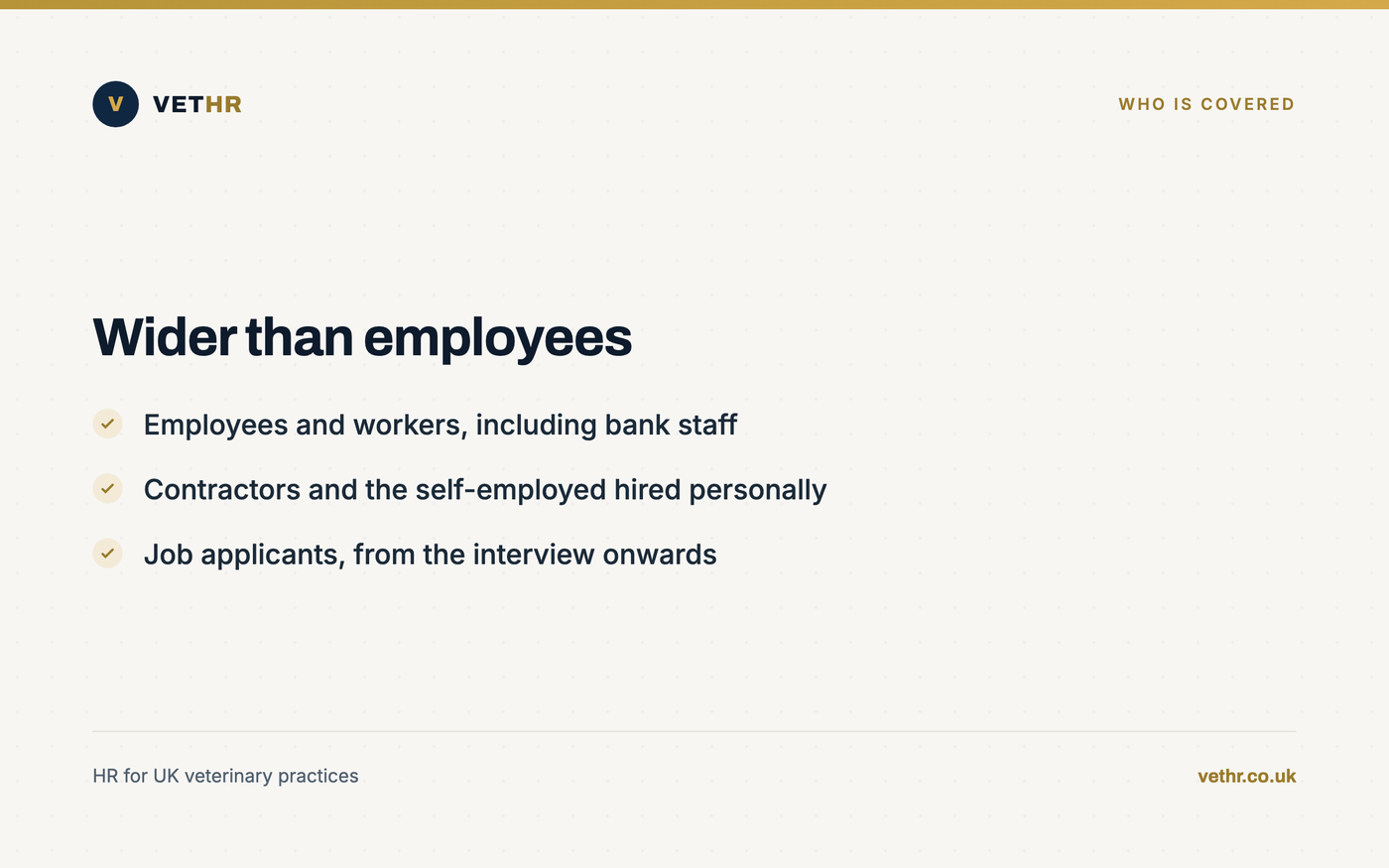
The scope is wider than most practices assume. According to Acas, the duty covers employees, workers, contractors, self-employed people hired to do the work personally, and job applicants. Your freelance vet cover and your bank nurses are inside it.
The employer pays. Acas is explicit that the employer is responsible for paying for any reasonable adjustments, and that Access to Work grants do not replace that obligation. Passing the cost to the individual is not an option.
That said, the grant scheme is worth knowing about. Access to Work can help with the cost of specialist equipment or support for someone with a disability or health condition, and it sits alongside the employer’s duty rather than replacing it.
Note also that the duty is anticipatory in spirit even where it is not strictly so in law. A practice that has already thought about step-free access, a quiet room and flexible start times will make reasonable adjustments in an afternoon rather than in a fortnight of meetings.
Applicants are included, which catches practices out at interview. If a candidate tells you they need extra time in a written assessment or a ground floor interview room, the duty is already live before they have worked a shift.
When you know, or reasonably should know, that someone is disabled. Acas puts the trigger there deliberately, because employers cannot avoid the duty by not asking questions they could obviously have asked.
That second limb is where practices get caught. A nurse who has had six weeks off with a mental health condition and returns visibly struggling has not needed to say the word disability for a manager to be on notice.
Age and pregnancy sit alongside this. A pregnant employee is covered by a separate risk assessment duty rather than by the reasonable adjustments duty, and our guide to the pregnancy risk assessment covers that route.
The person does not need a formal diagnosis or a label. Under the Equality Act 2010 the test is whether an impairment has a substantial and long term adverse effect on their ability to carry out normal day to day activities.
Practically, treat any request for a change on health grounds as potentially engaging the duty. Our guide to managing sickness absence covers the return to work conversation where this most often surfaces.
Context decides it. Acas sets out that reasonable adjustments must remove or reduce the disadvantage, be practical and affordable, and not harm the health and safety of others, and that an employer does not have to change the basic nature of the job.
Size cuts both ways when you judge whether reasonable adjustments are affordable. A four-person branch surgery genuinely cannot do everything a fifty-person hospital can, but a practice that says no to a £60 piece of equipment because it is small will not be believed.
Cost is the argument practices reach for and the one that most often fails. Most reasonable adjustments in veterinary settings are rota changes, task reallocation or cheap equipment, and the expensive ones are rarer than the conversation suggests.
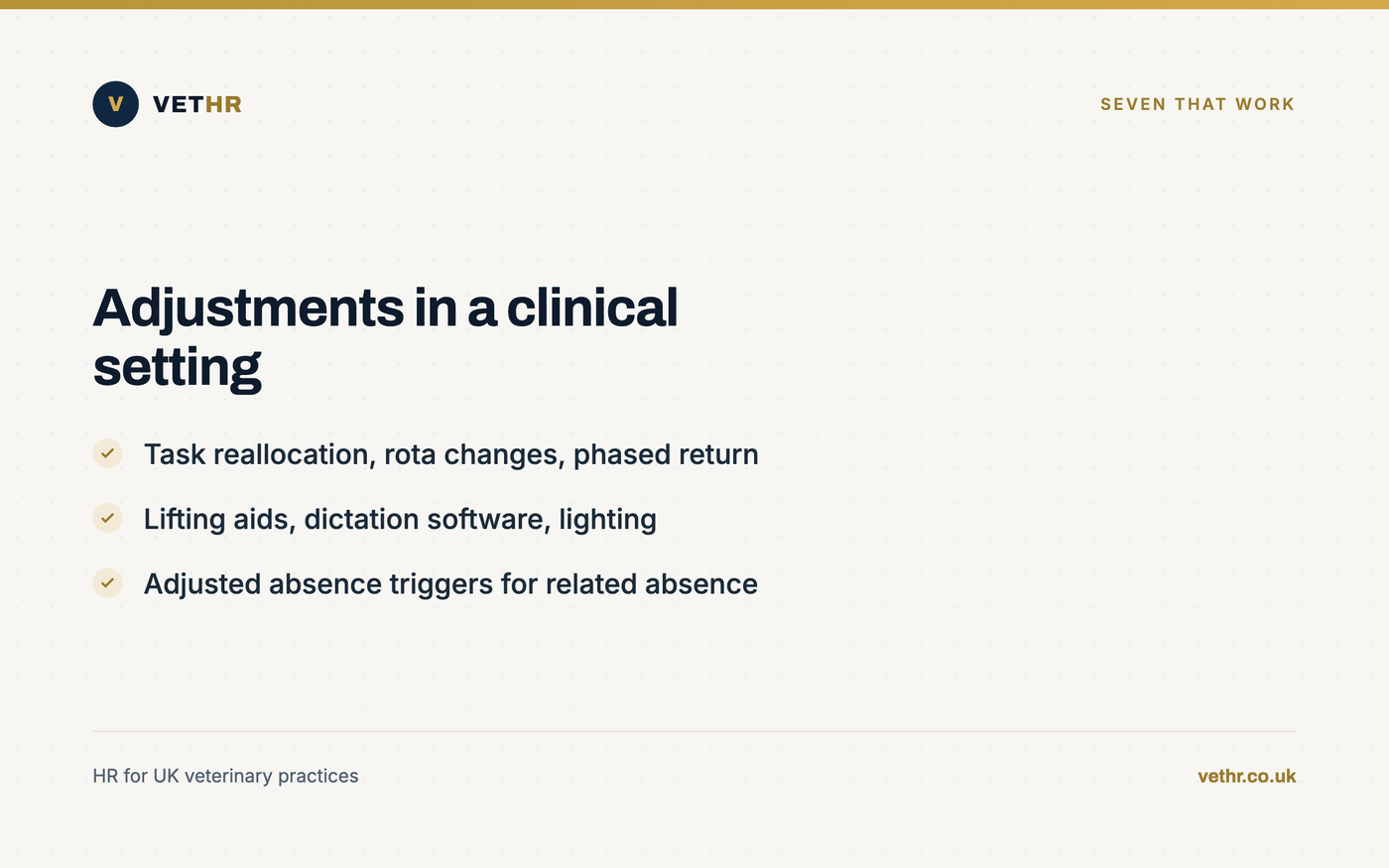
Ones that respect the clinical reality of the building. Acas groups adjustments into different working methods, workplace modifications, changes to arrangements, and equipment or support, and each translates directly into practice life.
Number seven is quietly important. Applying a standard absence trigger to disability related absence is a common source of claims, and adjusting the trigger is often itself the reasonable adjustment.
Rota adjustments need to be real rather than promised. If the agreed change is no early starts, it has to survive the week a colleague goes off sick, which our guide to building a veterinary rota covers.
A short, documented reasonable adjustments process that ends in a decision. The most common failure is not refusal, it is drift: a conversation happens, nothing is written down, and three months later nobody can say what was agreed.
Occupational health advises; it does not decide. The employer owns the decision, and a report that says an adjustment is recommended does not remove your judgement or your responsibility for the outcome.
Involve the rota owner early. Reasonable adjustments that exist only in a manager’s agreement, and never reach the person who builds next month’s rota, fail within two weeks and leave the employee having to raise it again from the beginning.
Keep the record in the staff file, not in a manager’s inbox. Health information is special category data, so store it properly, as our guide to GDPR and staff records sets out.
Facing an adjustment request you are not sure about? A free 30-minute HR health check will work through it with you. Book your HR health check.
Yes, where the adjustment is genuinely not reasonable, but the reasoning must be specific and recorded at the time. A refusal built on a general sense that it would be difficult will not survive scrutiny.
Health and safety is the strongest ground in clinical work, and also the most misused. Restraint of a large aggressive dog by someone with an unhealed injury creates real risk. Avoiding one type of consult does not.
Where you refuse, offer the alternative you can do. A refusal accompanied by a genuine counter-proposal reads completely differently from a flat no, both to the employee and to anyone reviewing it later.
Record the reasoning on the day. Reconstructed justification written six months later during a grievance carries very little weight, as our guide to handling a grievance explains.
The employer. Acas states that the employer is responsible for paying for any reasonable adjustments, and that while Access to Work grants exist, they do not replace the employer’s legal obligation to fund them. Asking the employee to contribute is not an option.
No. The Equality Act test is whether an impairment has a substantial and long term adverse effect on normal day to day activities, not whether a label has been applied. The duty also starts when you reasonably should have known someone was disabled, even if they have not told you directly.
Yes. Acas confirms the duty covers employees, workers, contractors, self-employed people hired to do work personally, and job applicants. Practices often assume the duty only applies to permanent employees, which leaves bank nurses and freelance cover outside a process they are legally inside.
You can, and it is often sensible, but do not use it to delay simple changes. If someone needs a different chair or a later start, make that change now and refer for advice on the complicated parts. Occupational health advises; the employer decides and remains responsible.
For as long as they are needed, with reviews at sensible intervals. Some are permanent, some are temporary during recovery. Set a review date when you agree them, and be careful about withdrawing an adjustment that has become part of how someone does their job successfully.
Reasonable adjustments are usually cheaper than the alternative. A nurse who cannot restrain large dogs can still run clinics, monitor anaesthetics and train students, and losing that person over an unmade rota change costs a practice far more than the change would have.
Ask what would help, decide quickly, write the reasonable adjustments down and review them. Our HR consultancy and policy library cover the process end to end, and the free HR health check is where to start if a request is sitting on your desk.
The Vet HR Team provides HR consultancy and white-labelled staff systems exclusively to UK veterinary practices. Disability discrimination is a legal area; take advice from a solicitor where a case is complex.
Contracts, rotas, holiday, a difficult conversation. Tell us what you are dealing with and we will come back within one working day. Nothing to sign up to.
Got it. We will come back to you within one working day. If you do not see a reply, please check your spam folder.
