Last updated: 17 July 2026
TL;DR: A veterinary rota app has to cope with things generic shift tools ignore: OOH and on-call layers, swaps with an audit trail, conflict warnings against rest rules, multi-site views and clean links to hours and holiday. This guide sets out what to look for, the questions to ask any vendor about branding, data export and pricing, and when a white-labelled build makes more sense.
Most practices do not outgrow the rota spreadsheet gracefully. It fails quietly: a missed on-call handover, a swap nobody wrote down, a branch nobody can see. This guide sets out what a veterinary rota app genuinely needs to do, and how to choose one without paying for screens nobody opens.
A veterinary rota app should model the shifts a practice actually runs: consults, ops, OOH and on-call layers, split days and freelance vet cover. It should warn when a pattern breaks rest rules, record every swap with an audit trail, show every site in one view, and feed hours and holiday without retyping.
Start by writing down every shift type your practice ran last month. Most lists look something like this:
That list is the test. If a tool cannot show every one of those without a workaround, the workaround becomes the system. Notes fields fill up with the real rota, a shadow spreadsheet reappears, and within a quarter the app is a display board for decisions made somewhere else.
Because most shift tools assume one person works one shift in one place, and a practice week does not look like that. On-call sits underneath days off, ops lists need a specific skill mix, staff move between branches, and OOH handovers happen at unsociable hours. Tools built for retail and hospitality rotas have no shape for any of it.
The symptoms are consistent. On-call lives in a WhatsApp thread because the app has no layer for it. The second branch runs as a separate account, so nobody sees both sites at once. Skill mix is checked by eye, so a rota can look fully staffed while no RVN is booked for the ops list.
None of this means the generic tools are bad software. It means they design and price for a different problem. A rota tool built for practices earns its keep precisely on the exceptions: the on-call layer, the branch view, the skill warning. Those are not edge cases in a practice. They are the job.
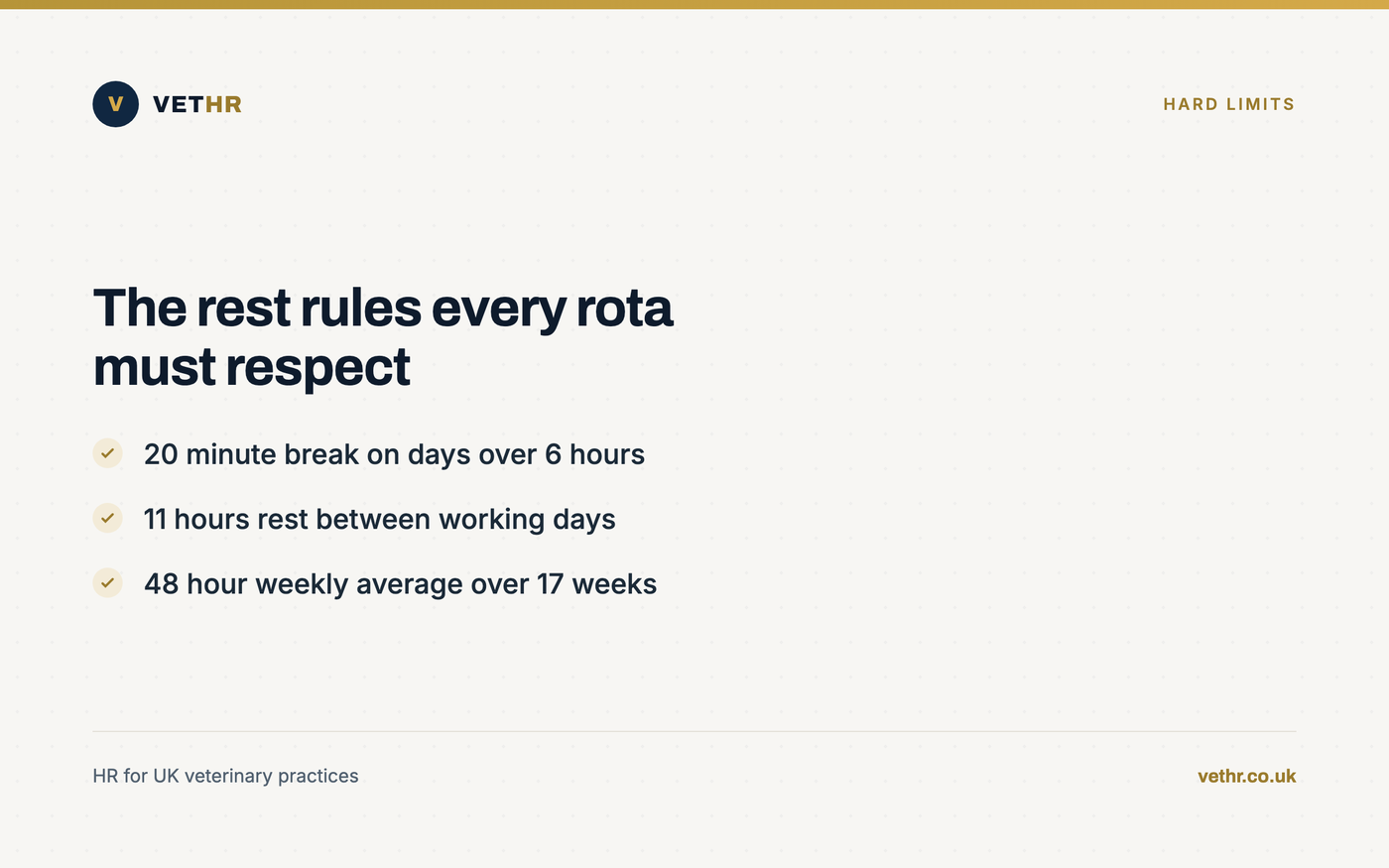
Rest rules set the hard edges of every rota. Most adult workers are entitled to a 20 minute break on a day longer than 6 hours, 11 hours of rest between working days, and a full day clear of work each week or two each fortnight. Weekly hours are capped at an average of 48 unless the worker opts out.
The detail sits in GOV.UK guidance on rest breaks at work: an uninterrupted 20 minute rest break where the working day is more than 6 hours, 11 hours of rest between working days, and either 24 hours without any work each week or 48 hours each fortnight. A 10pm OOH finish followed by an 8am consult start is exactly the pattern those numbers exist to catch.
Weekly totals have a ceiling too. GOV.UK guidance on maximum weekly working hours states that staff cannot work more than 48 hours a week on average, normally averaged over 17 weeks, unless they have chosen to opt out. Workers under 18 are stricter still, at no more than 8 hours a day and 40 hours a week, which matters if you employ young kennel or reception staff.
This is what conflict warnings are for. A good rota tool checks the draft, not the aftermath: it flags the short turnaround before publication, counts on-call patterns across weeks rather than days, and shows the running average for anyone close to the cap. A warning that fires after the rota is live is just a record of the problem.
Every swap should pass through the same gate: a request, an approval, a notification, and a dated record of all three. That audit trail is the difference between a rota that settles disagreements and one that starts them, because a swap agreed verbally exists only in two people’s memories.
Approval is not bureaucracy. A swap can be fair on hours and still wrong for the practice: two colleagues trading days can leave an ops list with no RVN at all. A manager sign-off, with the skill check done by the tool, keeps the rota safe without making every change a meeting.
The trail matters most months later. When a missed OOH shift turns into a dispute, the question is who agreed what and when. A dated swap record answers it in seconds. This is the standard we hold our own rota system for veterinary practices to: every change carries a name, a time stamp and an approval.
Not sure whether your current rota would stand up to a working time complaint or a swap dispute? Book a free HR health check. In 30 minutes we will look at how your rota, hours and holiday records actually fit together and tell you plainly what needs attention first.
The rota plans time, the clock records it, and holiday entitlement depends on both. Almost all workers are legally entitled to 5.6 weeks of paid holiday a year, and staff on irregular hours accrue it from the hours they actually work, which is exactly what a connected rota already knows.
The numbers come from GOV.UK guidance on holiday entitlement: 5.6 weeks a year for almost all workers, with statutory paid leave capped at 28 days and part-time staff pro rata. For irregular hours workers, leave builds up from the hours they have worked rather than arriving as a fixed block, which describes half the staff in a typical practice.
Disconnected systems make that accrual a monthly spreadsheet job, and spreadsheet accrual drifts. A rota tool that feeds worked hours straight into holiday calculations removes the retyping and the drift at the same time. When you assess any candidate tool, ask to see the whole journey: shift planned, shift worked, hours banked, holiday accrued.
Ask who owns the staff-facing branding, what data leaves with you at exit, and what the price becomes once every module you need is added. The demo shows the rota screen. The contract decides whether the tool serves your practice or the other way round.
Put the answers next to each other before you shortlist. We keep a plain-English page on how the main veterinary rota vendors compare, which is a sensible starting point if you are weighing the established options.
When you want the tool to carry your practice’s name, match your exact workflows and include only the modules you will use. Buying off the shelf means adapting the practice to the product. A white-labelled build adapts the product to the practice, which suits independents and small groups with their own identity.
The case is strongest where identity and workflow both matter: a group that wants staff logging into its own branded system rather than a vendor’s, or a practice whose OOH and branch patterns never quite fit the template. Our custom white-label systems are built this way: your branding, your workflows, and only the modules you actually need.
Hold a build to the same standard as a vendor. Ask who hosts it, who supports it and what you keep if you part ways. The exit question does not disappear because the system is yours in name. It should simply have a better answer.
No. Nothing requires a practice to use rota software. The rules that shape rotas, such as rest breaks, daily rest and the 48 hour weekly average set out on GOV.UK, apply however the rota is made. Software simply makes the limits visible before a draft is published rather than after someone complains.
For most adult workers, 11 hours between working days, plus either 24 hours clear of work each week or 48 hours each fortnight, according to GOV.UK guidance on rest breaks at work. A rota tool should flag any pattern that breaches those gaps before the rota is published.
That is a policy decision, but unapproved swaps carry real risk: a trade that works on hours can strip an RVN from an ops list or leave OOH uncovered. The safer pattern is self-service requests with a manager approval step and a dated record of every change.
Set the standard in your own policy and keep to it. Publish on a fixed rhythm, far enough ahead for people to plan their lives, and record any change after publication with a reason and a notification. Consistency is what staff remember, and what protects you when patterns are questioned.
Whatever the contract says, which is why the question belongs in procurement rather than at exit. Ask for the export format, what history is included, whether the audit trail comes with it, and the cost. If the answer is vague before you sign, it will not improve afterwards.
A rota is the practice’s operating memory: who was where, who agreed what, and whether the pattern stayed inside the legal limits. A veterinary rota app is worth paying for when it models your real week, warns before a draft breaks the rules, and keeps a record nobody has to reconstruct.
If you are choosing, start with the shift-type list and the vendor questions above. Then look at how our rota system for veterinary practices handles OOH, swaps and multi-site views, consider a custom white-label build if you want it under your own name, or book a free HR health check and we will tell you plainly what your rota setup is missing.
The Vet HR Team provides HR consultancy and white-labelled staff systems exclusively to UK veterinary practices.
Read next: Best Veterinary Rota Software UK (2026) and Self Rostering in a Veterinary Practice.
Contracts, rotas, holiday, a difficult conversation. Tell us what you are dealing with and we will come back within one working day. Nothing to sign up to.
Got it. We will come back to you within one working day. If you do not see a reply, please check your spam folder.
