Last updated: 29 October 2026
TL;DR: In severe weather an employer has a duty of care and should not encourage staff to travel when it is not safe. If the contract says nothing, an employer does not have to pay someone who cannot get in. If the practice closes and staff were ready, willing and able to work, they are usually entitled to normal pay.
It snows overnight. Three of the team get in, two cannot, one makes it after two hours and is shaken by the drive. There are inpatients that need care regardless, a full consult list, and a practice manager deciding on the spot who gets paid. Almost every severe weather argument in practice comes from that decision being made in the moment.
Before pay, safety. Acas states that employers have a duty of care for the health and safety of all staff, which means they should not encourage staff to travel when it is not safe.
Say that out loud to your team when severe weather arrives, because veterinary staff will try. People who drive through snow to reach inpatients are behaving exactly as the profession teaches them to, and the practice has to be the one applying the brake.
It also means a manager should never imply that coming in is what a good colleague does. That sentence, said once on a bad morning, is how someone ends up in a ditch.
The default in severe weather is unpaid, and that surprises people. Acas states that if there is nothing in the contract about pay in these circumstances, an employer does not have to pay.
Plenty of practices pay anyway, and Acas notes that where an employer does so at its discretion it should treat staff fairly and consistently, and make clear that it is a discretionary arrangement that does not apply to future similar circumstances.
Write that sentence into the letter or the email. Paying once without saying it is discretionary is how a snow day becomes a custom, and custom becomes a term of the contract.
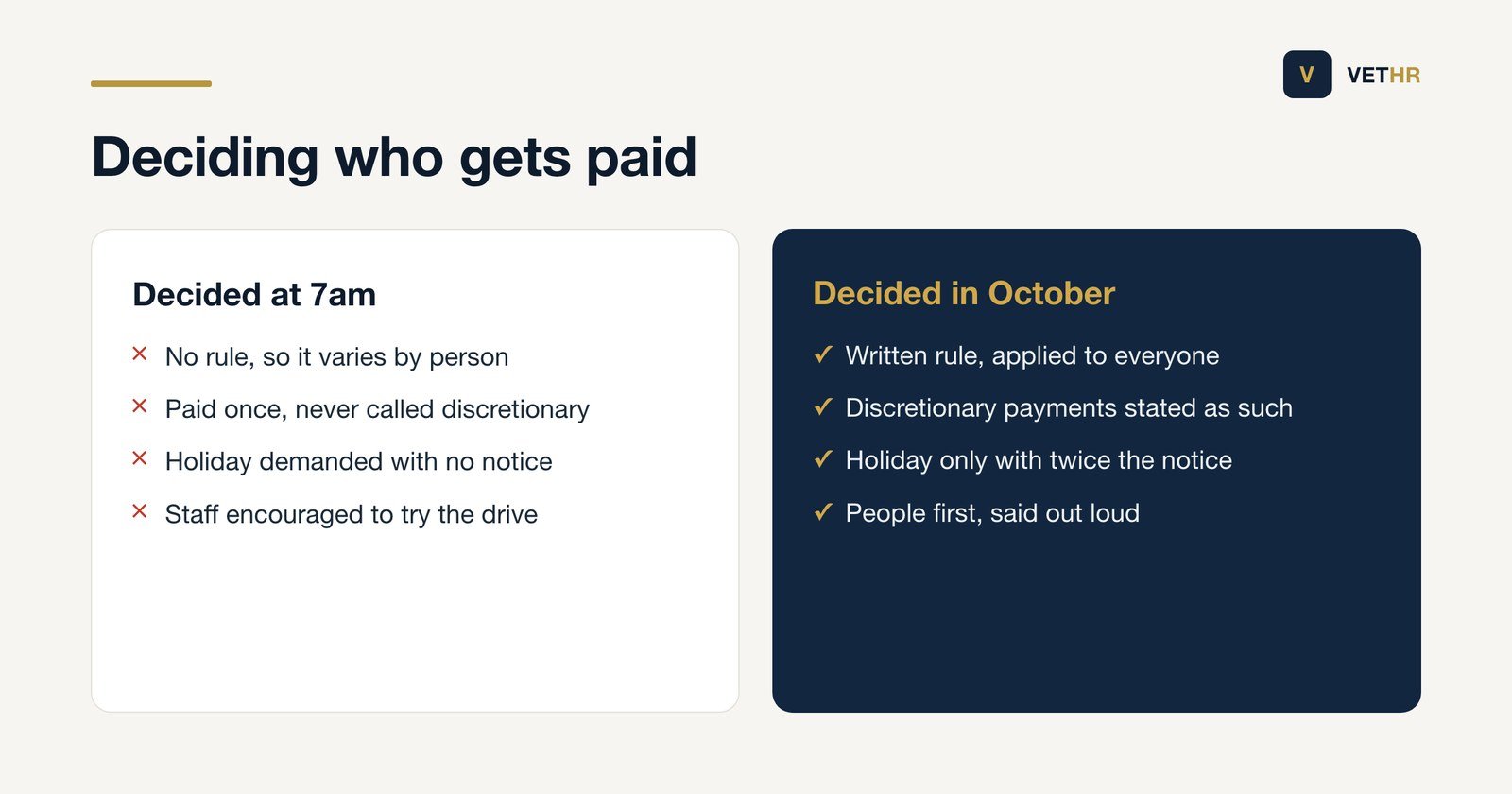
This is the other way round. Acas says that where employees are ready, willing and able to work for the day or shift, they are usually entitled to their normal pay if the employer chooses to fully or partly close the workplace.
So the distinction is not the weather, it is who made the decision. A road that is impassable is the employee’s problem to report; a practice that decides to shut its branch is the employer’s decision to pay for.
The same applies if you cancel transport you provide. Acas says employees remain entitled to usual pay where an employer cancels its own transport service, as long as they were ready, willing and able to work, unless the contract states otherwise.
Veterinary closures are rarely total. If you close the branch but the main surgery runs, be clear whether branch staff are expected to travel to the main site, and whether that is reasonable in the conditions.
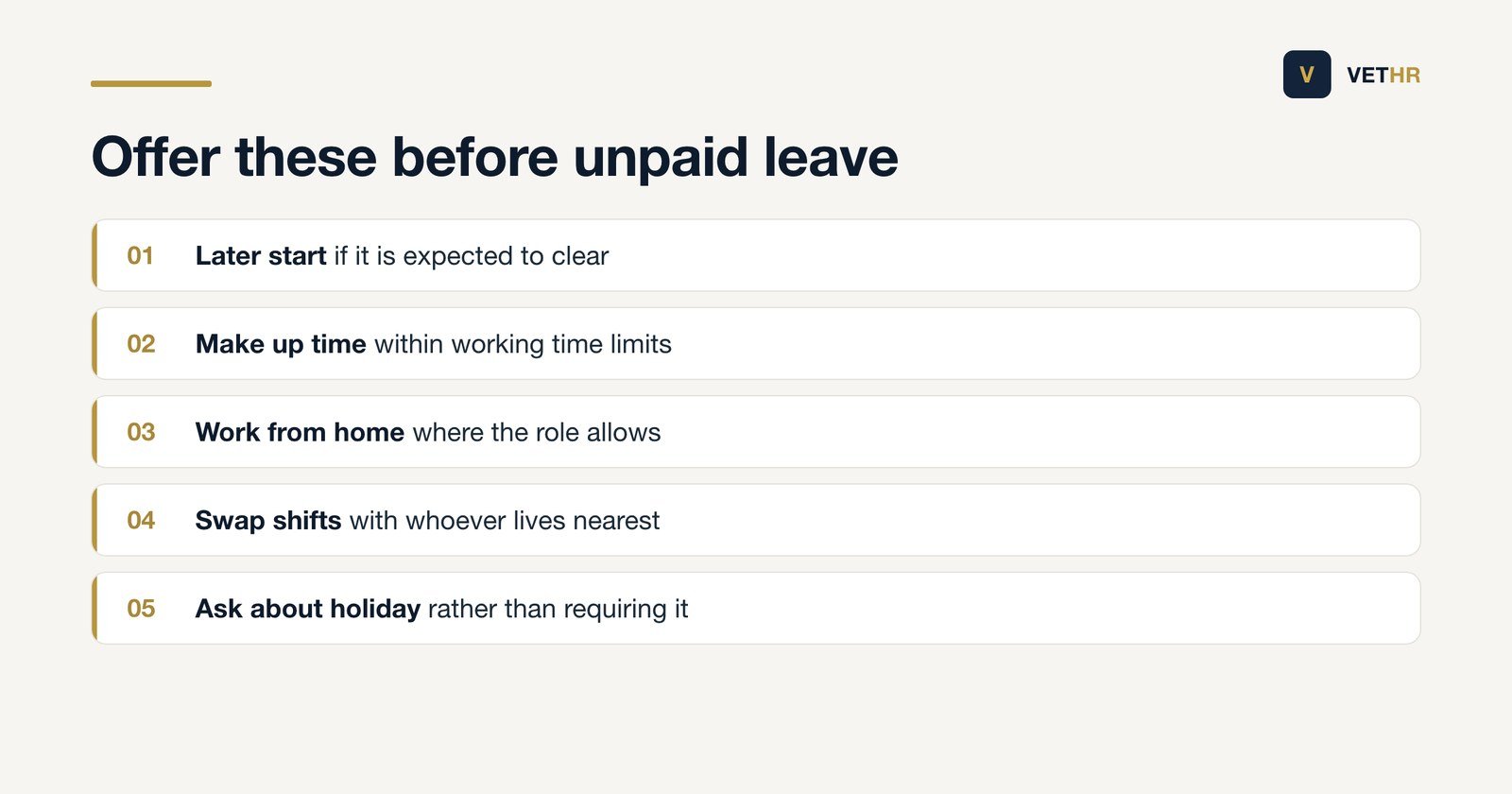
Acas lists the alternatives, and all of them are better than an argument about a day’s pay.
Shift swapping is the one that works best in a practice, because geography decides everything on a snowy morning. The nurse who lives ten minutes away covers, and the one who lives up a hill takes a later shift that week. Our guides to shift swaps and working from home cover both.
Making up time needs care so it does not quietly breach working time limits in the same week. Our note on working time rules has the limits.
Keep a note of what each person was offered and what they chose. A short line per employee is enough, and it is what makes the arrangement look consistent the next time rather than improvised.
An employer can ask whether someone would like to take the day as holiday, and most people say yes rather than lose the pay.
Telling them they must take holiday is different. Acas explains that an employer can require holiday to be taken if advance notice is given, and that the notice must be twice the length of the holiday. One day of holiday needs two days of notice.
Which is exactly why this does not work on the morning it snows. Requiring holiday is a tool for disruption you can see coming, not for a decision made at 7am.
Think about the journey home as well as the journey in. Severe weather often worsens during the afternoon, and a team that came in safely at eight can face far worse conditions at six. Sending people home early is cheaper than any of the alternatives, and it is the decision owners most often leave too late.
Tell clients before they set out too. A morning of cancelled routine appointments, posted early, keeps a waiting room from filling with people who should not have driven and frees the team to look after the animals already in the building.
Most employers can simply close in severe weather. A practice with inpatients cannot, and that changes the planning rather than the law.
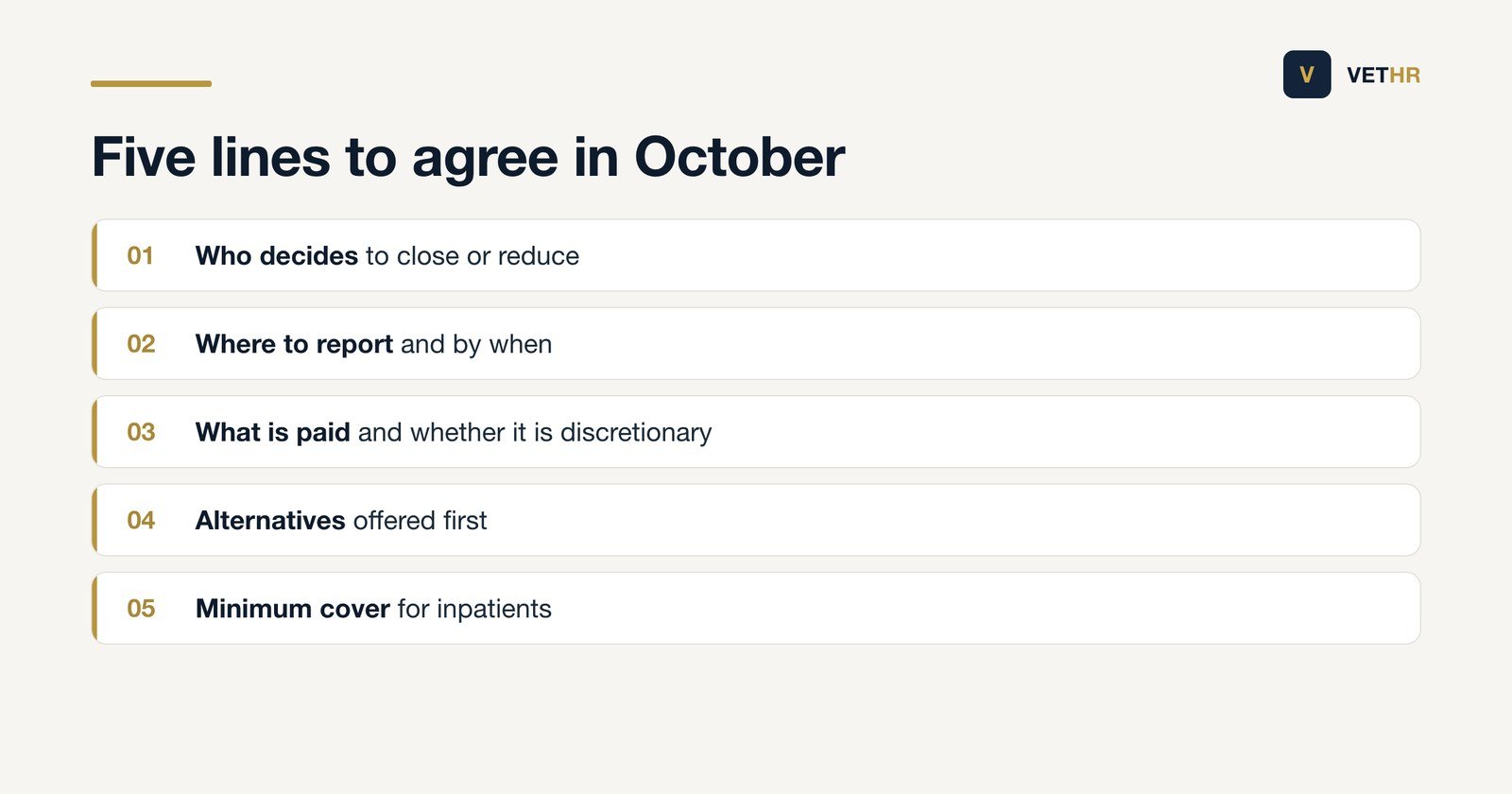
Decide in advance what the minimum safe team looks like for a day when almost nobody can travel, and who is nearest. Know whether you can safely reduce the inpatient load by discharging early or transferring, and who makes that call.
Agree the out of hours position too, because severe weather affects the provider as much as it affects you. Our notes on out of hours rotas and staffing levels cover the arithmetic.
Five lines in the handbook, agreed while the weather is fine, remove almost all of the severe weather argument.
Say it once each autumn at a team meeting. Our note on the HR calendar covers where that sits in the year, and a free 30-minute HR health check will tell you if your contracts already say anything about it.
If the contract says nothing about pay in those circumstances, Acas states that an employer does not have to pay. Many practices choose to, and should then say clearly that it is discretionary and does not set a precedent.
Different answer. Where staff were ready, willing and able to work, they are usually entitled to normal pay if the employer chooses to close fully or partly. The deciding factor is who made the decision, not the weather.
Only with notice of twice the length of the holiday, so one day requires two days of notice. That makes it useful for disruption you can see coming and useless on the morning itself. Asking is always available.
No. Acas is explicit that the duty of care means employers should not encourage staff to travel when it is not safe. In a profession where people will try anyway, the practice has to be the one saying stop.
Plan it before the season. Know your minimum safe team, who lives nearest, whether the inpatient load can be reduced in advance, and what the out of hours provider can absorb if conditions are bad for several days.
A practice manager deciding at 7am on a severe weather morning who gets paid is making a contractual decision under pressure with no information. That is how inconsistency starts, and inconsistency is what people remember.
Write the five lines in October. We put severe weather into handbooks and contracts for independent practices through HR consultancy for veterinary practices and employment contract drafting.
The Vet HR Team provides HR consultancy and white-labelled staff systems exclusively to UK veterinary practices.
Contracts, rotas, holiday, a difficult conversation. Tell us what you are dealing with and we will come back within one working day. Nothing to sign up to.
Got it. We will come back to you within one working day. If you do not see a reply, please check your spam folder.
