Last updated: 16 October 2026
TL;DR: There is no default retirement age for workers in most jobs, and Acas warns that putting pressure on someone to retire is likely to be age discrimination. Leave it to the worker to raise retirement. If you genuinely need to plan, ask everyone about their future plans, never just the oldest person on the rota.
A practice owner needs to know whether the senior vet, who is 63 and has been there nineteen years, is planning to go in the next two years. The recruitment market is brutal and the answer changes everything. So he asks, in an appraisal, straight out. That question about retirement has just created more risk than the staffing problem it was meant to solve.
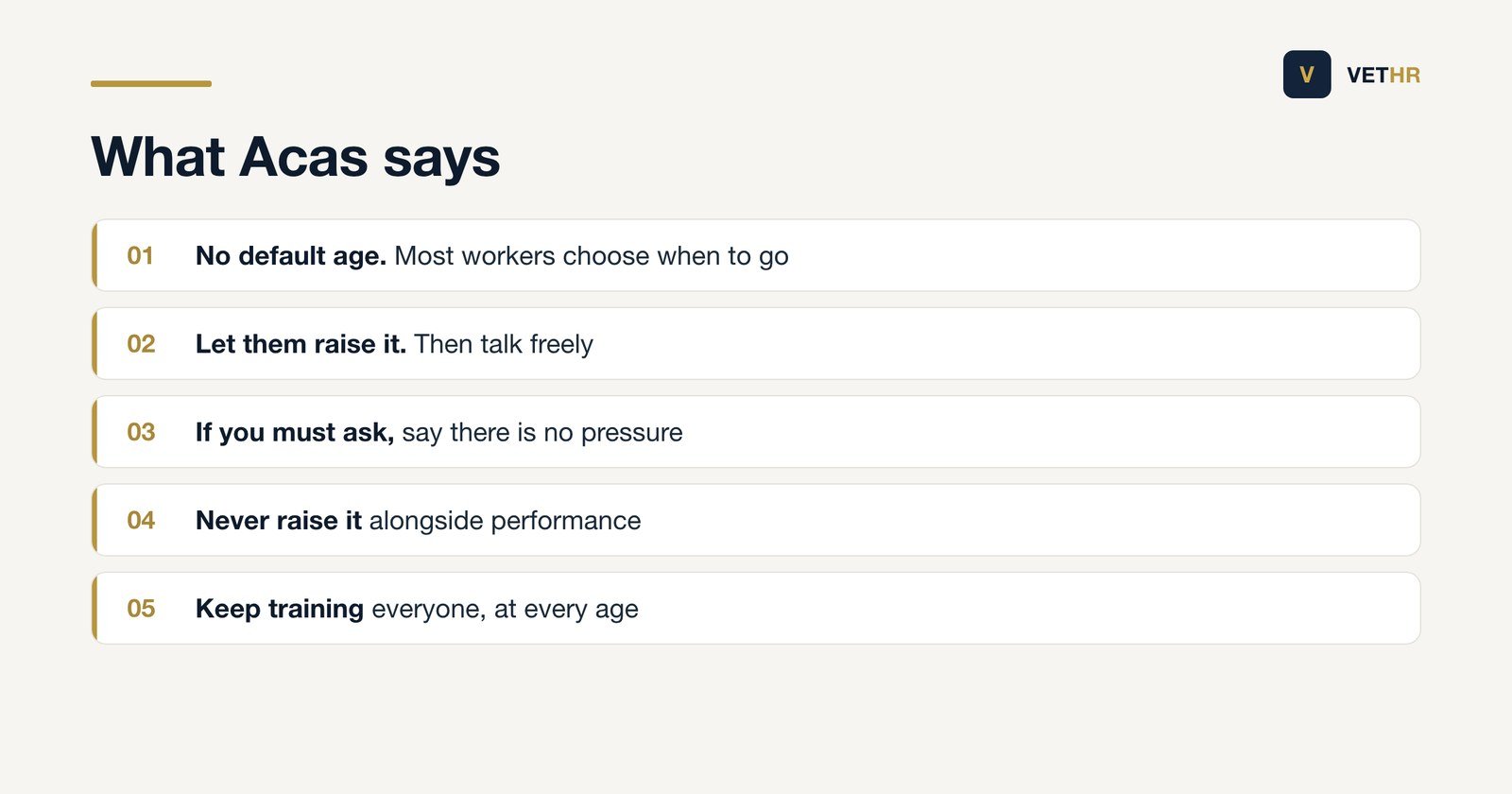
No, for practical purposes. Acas states that workers in most jobs can choose when to retire, and there is no default retirement age, except for a small number of jobs.
Veterinary work is not one of those exceptions. An RVN of 70 who can do the job has the same right to keep doing it as a nurse of 30.
It is not a decision the practice makes. It is a decision the individual makes, and the practice’s job is to make the workplace one they want to stay in while they are still choosing to.
Acas is clear that it is best to leave it to workers to raise the subject, and that once they do, it is fine to talk about their plans. Unless there is a good business reason, employers should not ask directly.
Where an employer does need to ask for genuine business planning reasons, Acas says they must make it very clear that there is no pressure to retire or to make any decision about retiring.
That is a high bar, and it is easy to fail by accident. Asking once, in a careful sentence, is defensible. Asking again three months later, after the first answer was not the one you wanted, is not.
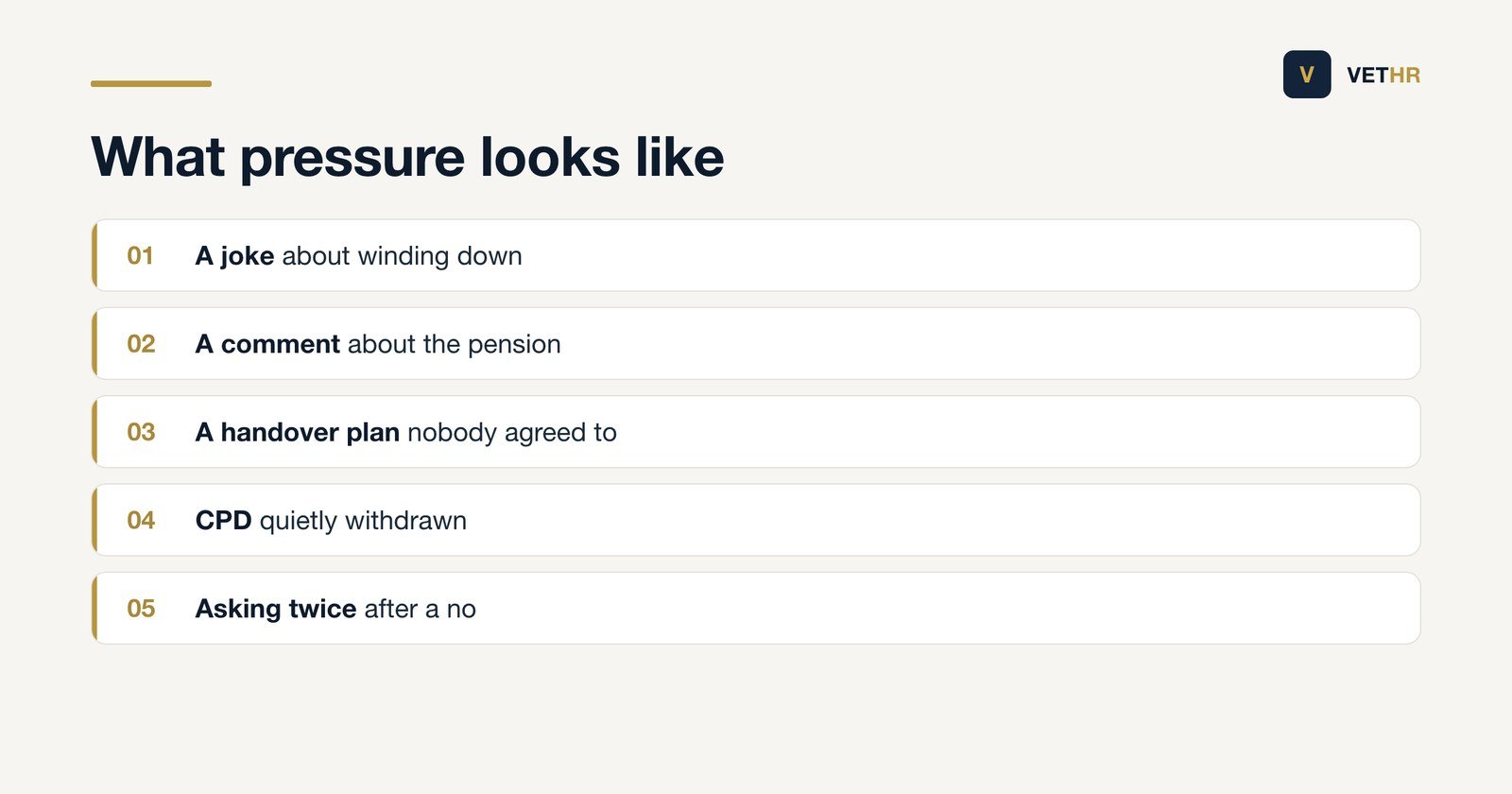
More than most owners realise. Acas puts it plainly: putting pressure on someone to retire is likely to be age discrimination.
In a small practice, pressure rarely looks like a demand. It looks like a joke about winding down, a comment about the pension, a decision to stop sending someone on CPD, or a handover plan drawn up before anyone has said they are leaving.
Acas also warns against deciding that workers who might be nearing the end of their career are not worth training, and links this to preventing age discrimination more generally. Cutting someone’s development budget because of their age is both the clearest evidence of discrimination and a reliable way to make them leave.
This is where practices get into real trouble. Acas says employers must not raise retirement as part of any discussion about problems such as performance or attendance.
The logic is obvious once stated. Mentioning retirement in a conversation about a clinical error, a sickness record or a complaint turns a management issue into an age issue, and a tribunal will read it that way too.
If there is a genuine performance concern, handle it as a performance concern, with the same process you would use for a 28 year old. Our guide to managing underperformance in a veterinary practice covers that process, and occupational health covers the route where health is genuinely the question.
Keep the two subjects in separate meetings, separate notes and separate letters.
Watch the language around the practice too. Teasing about a gold watch, or introducing someone as the one who has been here longest, is meant warmly and lands differently when the person has been wondering whether they are still wanted. Managers set that tone, and it costs nothing to change.
Experience is worth protecting on its own terms. A vet with thirty years of consulting behind them is the person who spots the case that does not fit the pattern, and who newer colleagues ask when they are unsure at four o’clock on a Friday. Losing that early is expensive in ways no rota shows.
Acas gives the answer, and it is better management anyway. Have regular discussions with all your workers about their future plans and aims, what is important to them now, and how they want to progress. Those conversations often lead to retirement being raised by the person themselves.
The practical version is a question you ask everybody, once a year: what would you like to be doing in one year and in three years, and what would have to change for that to happen.
A 27 year old answers with a certificate. A 45 year old answers with school hours. A 63 year old sometimes answers with a plan to go in eighteen months, which is the information you wanted, offered rather than extracted.
Our guides to one to one meetings and staff appraisals in a veterinary practice cover how to build that question in so it is asked of everyone.
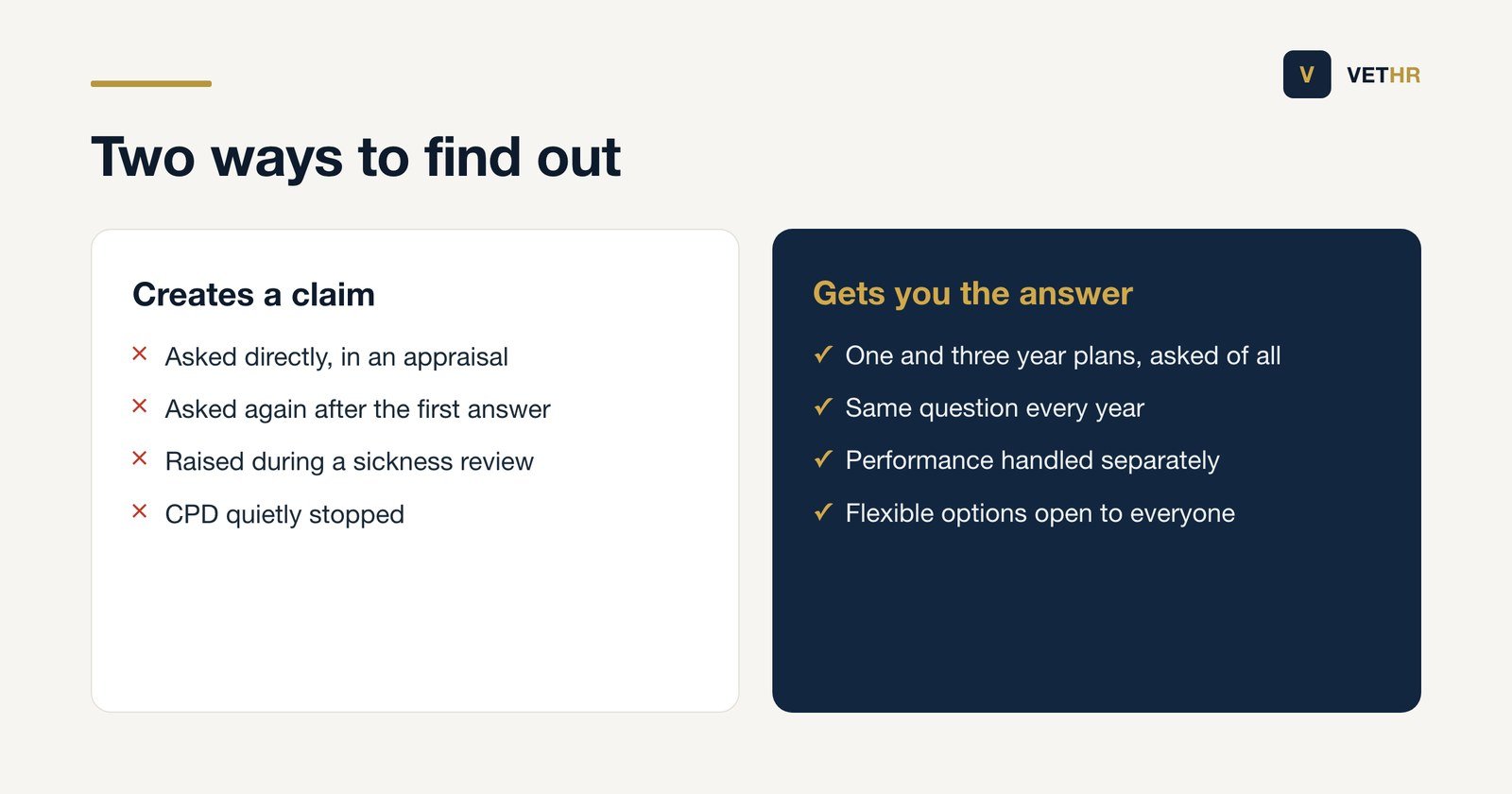
Acas notes that some employers offer options like phased retirement, and that workers can request reduced hours or a changed working pattern, although an employer is not obliged to agree.
For a practice this is the most valuable part of the whole subject. A senior vet who drops to three days, stops out of hours and keeps the complex medicine caseload is worth far more than the same person gone entirely.
Say in the handbook that flexible options are available to everyone at any career stage. That way the offer is not something you invent for one person at 63, which is exactly how a well meant offer starts to look like a nudge. Our notes on flexible working requests and job shares cover the mechanics.
Handle any pension question by pointing to a proper adviser rather than answering it yourself. It is the one part of retirement where being helpful can go badly wrong.
Those five rules cover almost every situation an independent practice meets. Book a free 30-minute HR health check if you have a specific conversation coming up and want to get the wording right first.
No. Acas states that workers in most jobs can choose when to retire and that there is no default retirement age except for a small number of jobs. Veterinary roles are not among them.
Acas advises leaving it to workers to raise. Where there is a good business reason to ask, you must make very clear there is no pressure to retire or to decide anything. Ask once, in writing if possible, and record the answer.
Treat it as capability or health, not age. Use your normal performance process or an occupational health referral, and keep retirement out of that conversation entirely. Mentioning it there is what turns a manageable issue into a claim.
No. Acas specifically warns against deciding that workers who might be nearing the end of their career are not worth training. It is strong evidence of age discrimination, and it pushes people out faster than anything else.
Yes, and many practices should. Offer reduced hours and changed patterns as options open to the whole team at any stage, so that the offer never looks like it was designed for one person because of their age.
The owner who needs to know about the 63 year old senior vet has a real problem. The answer is not a direct question about retirement, it is a career conversation that every member of the team has, every year, in which people volunteer their plans because it is safe to.
We build that into appraisal and succession processes for independent practices through fixed-price HR consultancy for veterinary practices and ongoing HR support on subscription.
The Vet HR Team provides HR consultancy and white-labelled staff systems exclusively to UK veterinary practices.
Contracts, rotas, holiday, a difficult conversation. Tell us what you are dealing with and we will come back within one working day. Nothing to sign up to.
Got it. We will come back to you within one working day. If you do not see a reply, please check your spam folder.
