Last updated: 17 November 2026
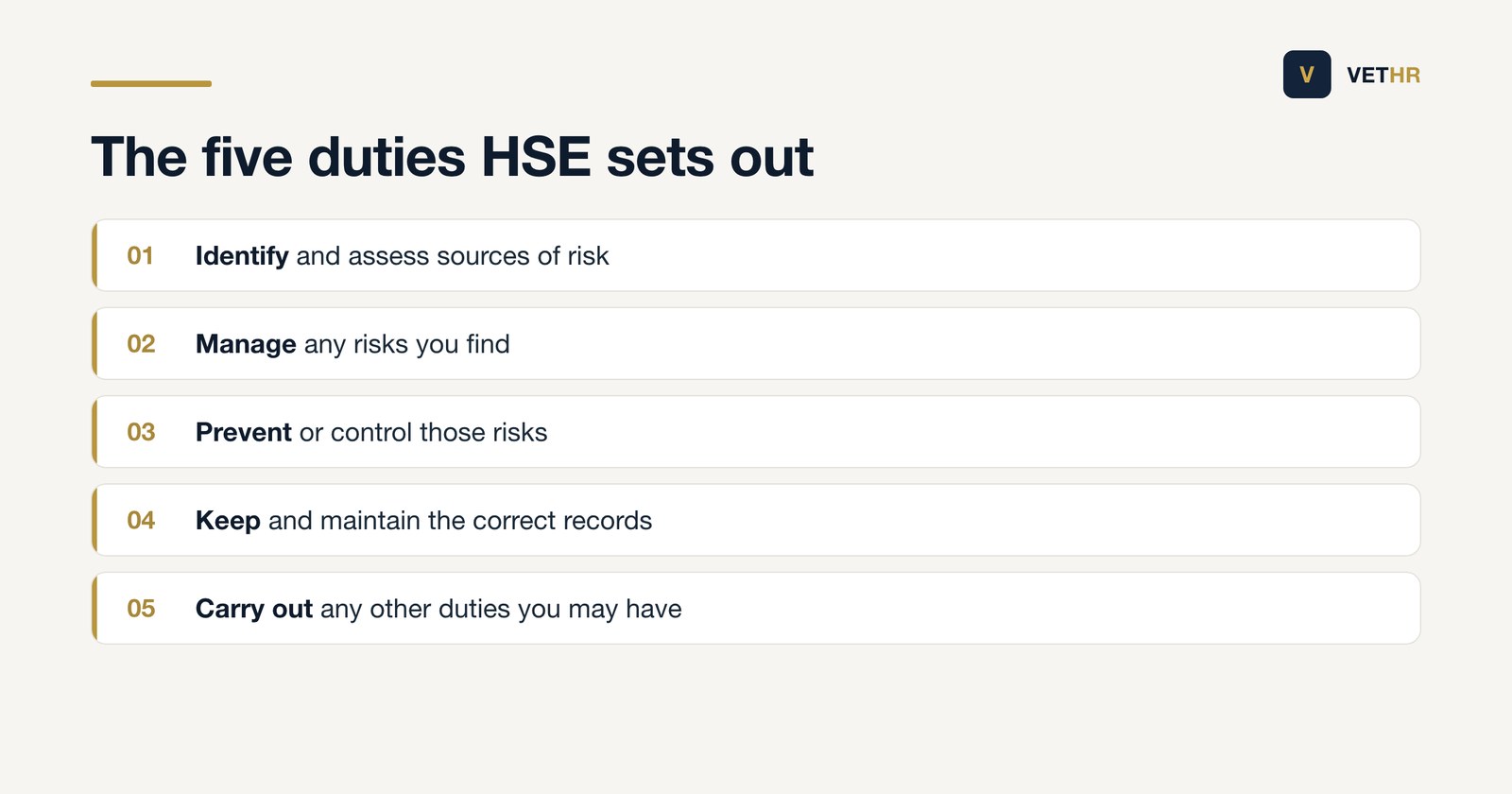
TL;DR: HSE requires employers and those in control of premises to identify and assess sources of risk, manage any risks, prevent or control any risks, keep and maintain the correct records, and carry out any other duties they may have. Records are kept while current and for at least two years after, and monitoring inspection records for at least five years.

Legionella is the compliance item that practices either take completely seriously, usually because a water hygiene company sold them a contract, or have never thought about once. There is rarely anything in between, and the second group is larger than you would expect.
HSE states that employers and those in control of premises must assess and manage sources of risk, and sets out what that means as five things.
There is no size threshold in there. A two-room branch with a hot water cylinder and a shower carries the legionella duty in the same way a hospital does. What changes with size is how much work the assessment turns out to involve, not whether you need one.
It is also worth being clear about why this sits in an HR and compliance article rather than a plumbing one. The duty falls on the employer. The people most exposed are your own staff, particularly whoever cleans the kennels with a hose or uses the on-call shower after a night shift. And the evidence that you met the duty is a set of records that somebody in the practice has to keep.
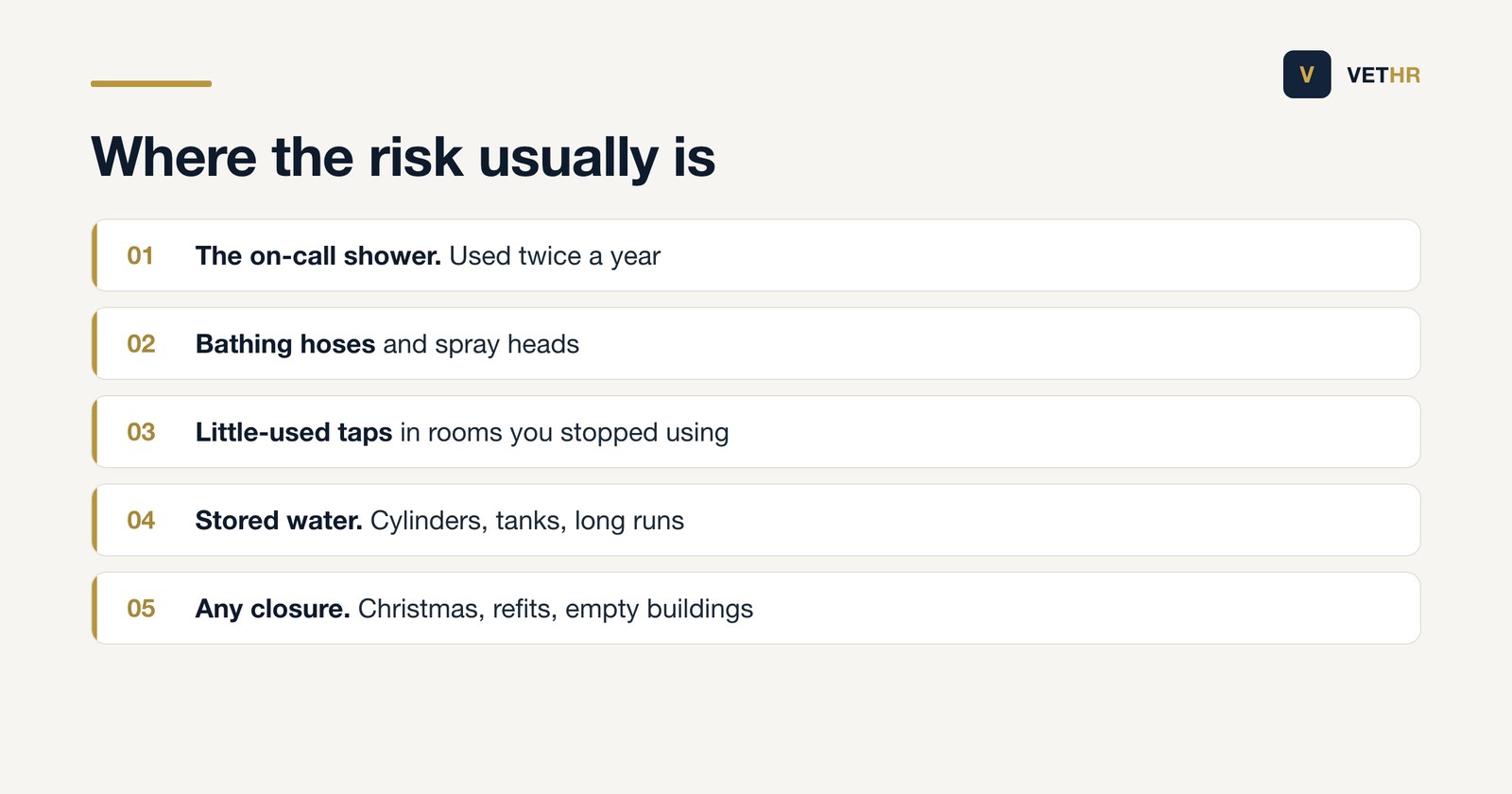
Legionella risk is about water that sits, warms up and then gets turned into a fine spray somebody can breathe. Map your building against that and the list is short but real.
Most veterinary buildings turn out to be low legionella risk once someone actually looks. The point of looking is to be able to say so with a document behind it.
The legionella risk assessment surveys the water system, identifies where water stagnates or sits at a temperature that suits legionella, records who is responsible, and sets out the controls. It has to be reviewed when things change, and a practice changes more often than people think.
New consult room, a shower taken out, a branch closed for a month, a cylinder replaced, an extension built. Every one of those is a reason to look at the assessment again rather than file it for another two years.
You can commission it from a water hygiene contractor, and most practices do. That is fine. It does not transfer the duty, which stays with the employer and whoever controls the premises.
The assessment says what the risk is. The written control scheme says what you do about it, week by week, and who does it.
In a small practice that is usually a short list of recurring tasks: flushing the outlets nobody uses, running the shower, checking temperatures, descaling and disinfecting shower heads and spray outlets, and looking at the cylinder. None of it is skilled work. All of it needs to actually happen and be written down, because an unrecorded task and an undone task look identical a year later.
Put those tasks on the same rota or checklist as everything else. A legionella scheme that lives only in a contractor’s folder is a scheme nobody in the building is following.

HSE is specific here, and this is the part most practices get wrong. Records should include details of the person or people responsible for conducting the risk assessment, managing and implementing the written scheme, the significant findings of the risk assessment, the written control scheme and details of its implementation, details of the state of operation of the system, meaning in use or not in use, and the results of any monitoring inspection, test or check carried out, with the dates.
The retention rule has two halves. Records should be retained throughout the period for which they remain current and for at least two years after that period. Records of any monitoring inspection should be retained for at least five years.
Two years for the scheme, five for the monitoring. Practices that scan everything into a shared drive have no problem with this. Practices keeping a paper logbook in a plant room usually do, because the logbook gets thrown out when it fills up.
Anything that leaves water sitting still is worth a moment’s thought, and practices generate these events routinely.
A branch shut for two weeks over Christmas. A treatment room closed while flooring is replaced. A building bought and left empty for a month between exchange and opening. In each case the water system is doing exactly what legionella likes, which is nothing at all.
Build a flushing routine into the closure plan rather than remembering afterwards. It takes one person twenty minutes a week and it belongs in the same checklist as the alarm and the fridge temperatures. Our note on fire safety in a veterinary practice covers the other half of the premises file.
Name somebody. The records have to show who is responsible for conducting the risk assessment and for managing and implementing the written scheme, so that person needs to exist and to know they hold it.
In most independent practices it is the practice manager, with a contractor doing the technical work. That is a perfectly good arrangement as long as the name is written down and updated when people leave, which is the step that gets missed.
Keep the legionella file with the rest of the compliance records rather than in a plant room cupboard. Our guides to COSHH assessments, RIDDOR reporting and digital staff records cover how the rest of it should be stored. Book a free 30-minute HR health check if you want to know which premises records you are missing.
Yes. HSE places the duty on employers and those in control of premises to identify and assess sources of risk, manage them, prevent or control them and keep records. There is no minimum size, although a small simple system produces a short assessment.
HSE says records should be retained throughout the period for which they remain current and for at least two years after that period, and that records of any monitoring inspection should be retained for at least five years.
The people responsible for the assessment and for managing and implementing the written scheme, the significant findings of the assessment, the written control scheme and its implementation, whether the system is in use or not, and the results and dates of any monitoring inspection, test or check.
No. You can buy the survey, the testing and the paperwork, and most practices sensibly do. The duty stays with the employer and whoever controls the premises, which is why a named responsible person inside the practice still matters.
Treat it as a change worth acting on. Water standing still in a warm building is the condition legionella needs, so put a flushing routine in the closure plan and record that it was done, in the same way you would record a fridge temperature.
Assess the system once, write the control scheme, name the responsible person, put the recurring tasks on a checklist somebody actually uses, and keep the records for two years and the monitoring for five.
That is legionella dealt with properly in a small practice. We build the premises compliance file that holds it through HR consultancy for veterinary practices and the policy document set.
The Vet HR Team provides HR consultancy and white-labelled staff systems exclusively to UK veterinary practices.
Contracts, rotas, holiday, a difficult conversation. Tell us what you are dealing with and we will come back within one working day. Nothing to sign up to.
Got it. We will come back to you within one working day. If you do not see a reply, please check your spam folder.
