Last updated: 24 September 2026
TL;DR: Employees can work up to 10 keeping in touch days during maternity leave, adoption leave or bereaved partner’s paternity leave without ending the leave or losing statutory pay. They are optional on both sides, the work and the pay are agreed beforehand, and any amount of work counts as a whole day. Shared parental leave has 20 separate days.
A nurse goes on maternity leave in March. In September the practice replaces the practice management system, changes the out of hours provider and takes on two new vets. She comes back in January to a building she does not recognise, spends three weeks feeling like a new starter, and hands in her notice in April. Ten days would have prevented all of it.
They are days an employee on certain family leave can come in and work without that work ending the leave or stopping their statutory pay. Normally, doing any work would bring the leave to an end. Keeping in touch days are the carve out.
Work means any work done under the contract of employment, and it can include training or any activity done for the purpose of keeping in touch with the workplace. That definition is broader than most practices assume, and it is what makes the days useful.
They are not a way of getting free cover for a busy Saturday. Used like that they generate resentment and achieve nothing. Used properly, keeping in touch days are the cheapest retention tool in family leave.
GOV.UK states that employees can work up to 10 days during their maternity leave, adoption leave or bereaved partner’s paternity leave, and that these are called keeping in touch days.
Ten is the ceiling for the whole leave period, not ten a month. For someone taking the full 52 weeks of statutory maternity leave, which GOV.UK sets out as 26 weeks of ordinary maternity leave and 26 weeks of additional maternity leave, that is roughly one day every five weeks if you space them out.
They cannot be used during compulsory maternity leave, which is the two weeks immediately after the birth, or four weeks for factory work. Nobody should be asking in that window anyway.
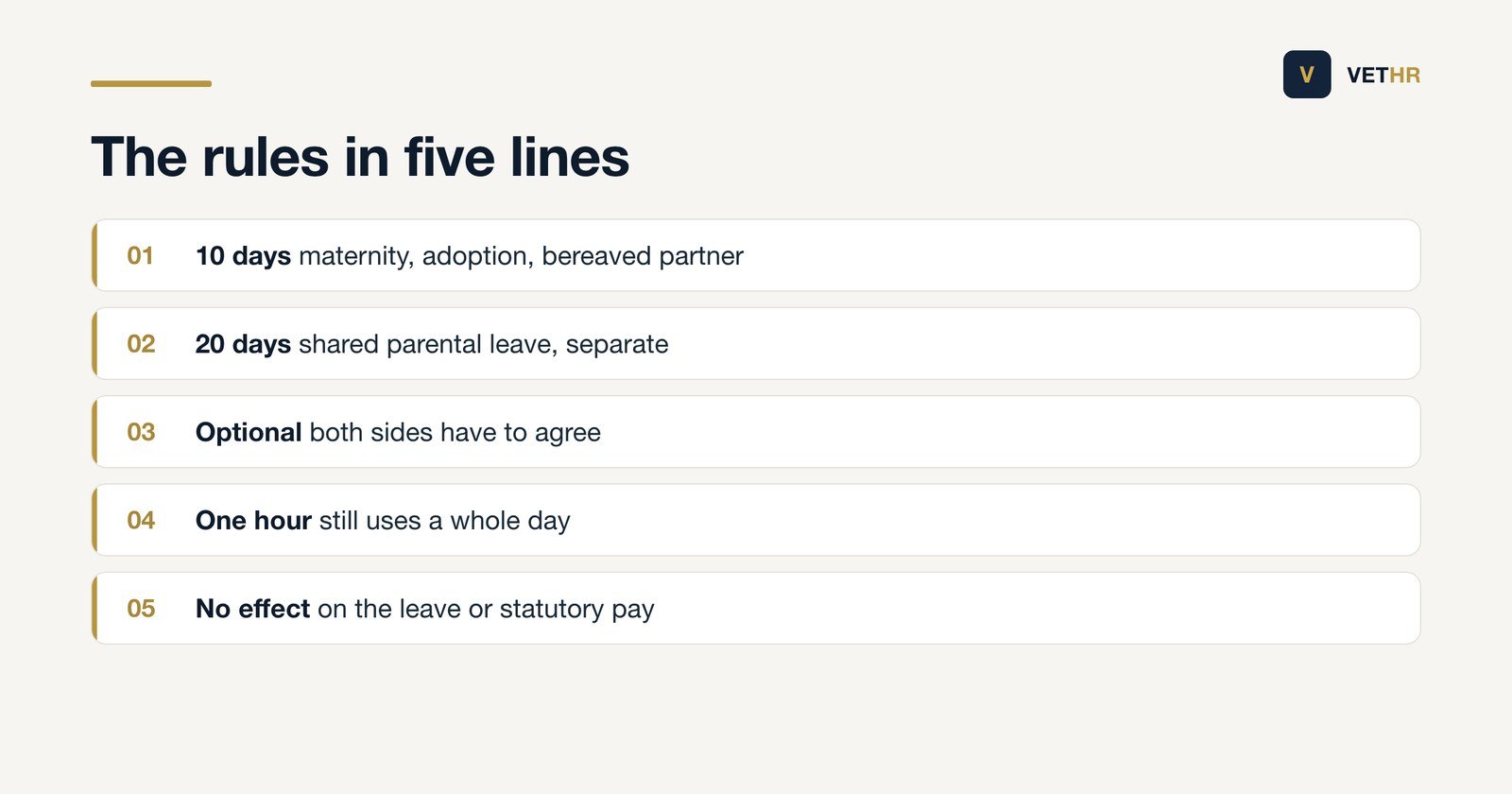
The type of work and the pay should be agreed before the employee comes in. There is no fixed statutory rate for the day itself, so this is a conversation, and most practices pay the normal hourly or daily rate for the work done.
The rule that surprises people: any amount of work done counts as one full keeping in touch day. An hour at a team meeting, a training session, or a single appraisal uses a whole day out of the ten.
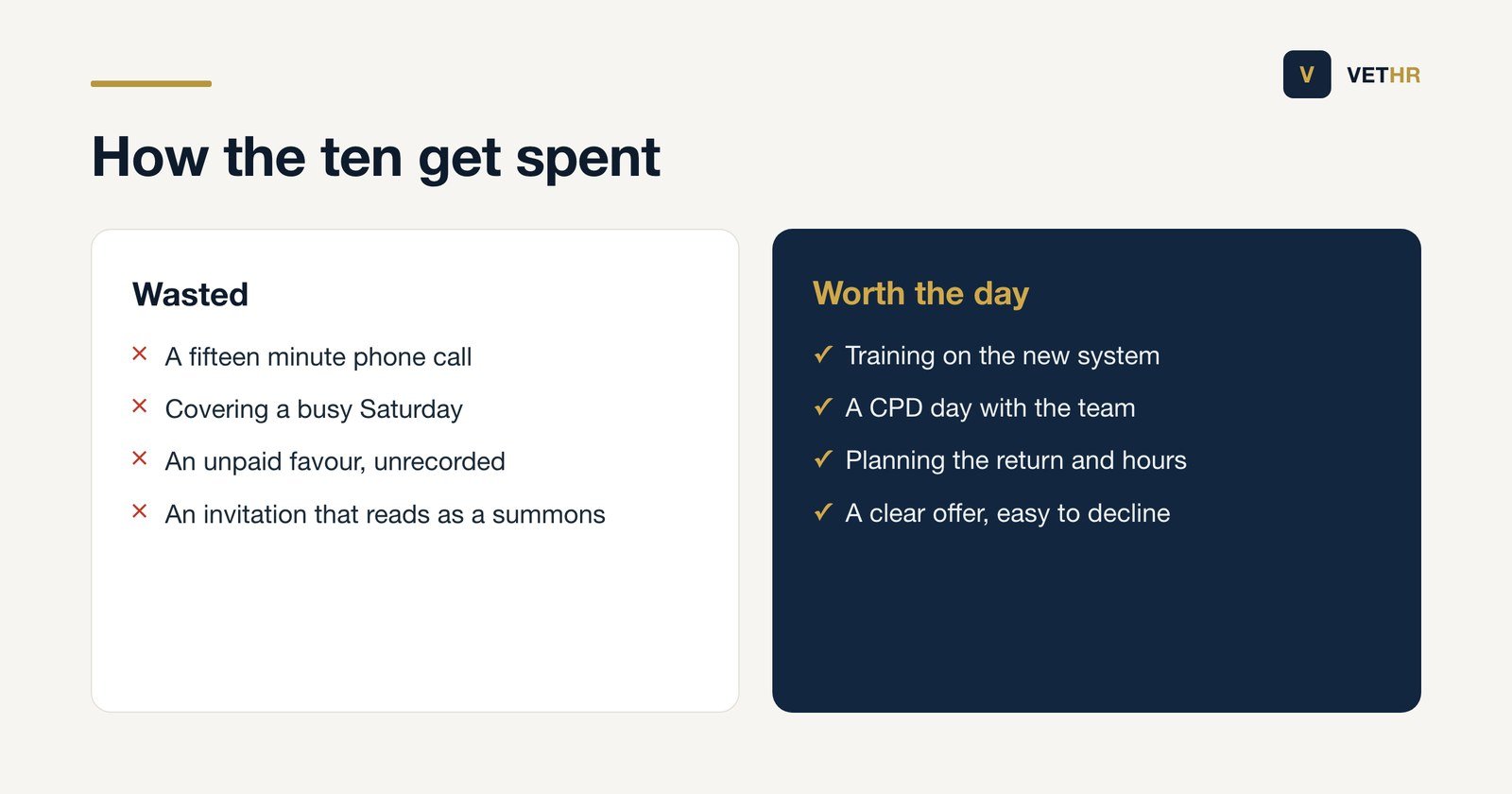
So do not spend one on a fifteen minute phone call. Group things together, make the day worth travelling in for, and treat the ten as a budget rather than a series of favours.
Say in the letter how the day will be paid and when it will hit payroll. Unclear pay for keeping in touch days is one of the few ways to make a goodwill gesture feel like a grievance. Our note on veterinary payroll covers where this sits.
Keeping in touch days are optional. Both the employee and the employer need to agree to them, which means the practice cannot require someone to come in, and the employee cannot demand a day the practice has no work for.
Put that in writing when you offer one, because it changes how the offer lands. An invitation that says clearly there is no obligation to accept gets a warmer response than one that reads like a summons.
An employee who declines every offer is not doing anything wrong. Keep inviting, keep the newsletter going, and plan the return to work on the assumption that nothing was passed on.
Pick things that are worth a whole day and that make the return easier. The list below covers what practices actually get value from.
That last one is the highest value day of the ten. Our guide to flexible working requests in a veterinary practice covers what usually gets asked for after family leave, and it is far better discussed in November than on the first Monday in January.
Shared parental leave has its own version. GOV.UK states that employees can work up to 20 days during shared parental leave, called shared parental leave in touch or SPLIT days, and that these are in addition to the 10 keeping in touch days available on maternity, adoption or bereaved partner’s paternity leave.
Twenty days is a lot, and in a practice where both parents work in the profession it can make a genuine difference to how a year is structured. Our note on shared parental leave in a veterinary practice explains how the blocks work.
Track the two allowances separately. A person who moves from maternity leave into shared parental leave has both, and mixing them up is how a payroll query turns into a complaint.
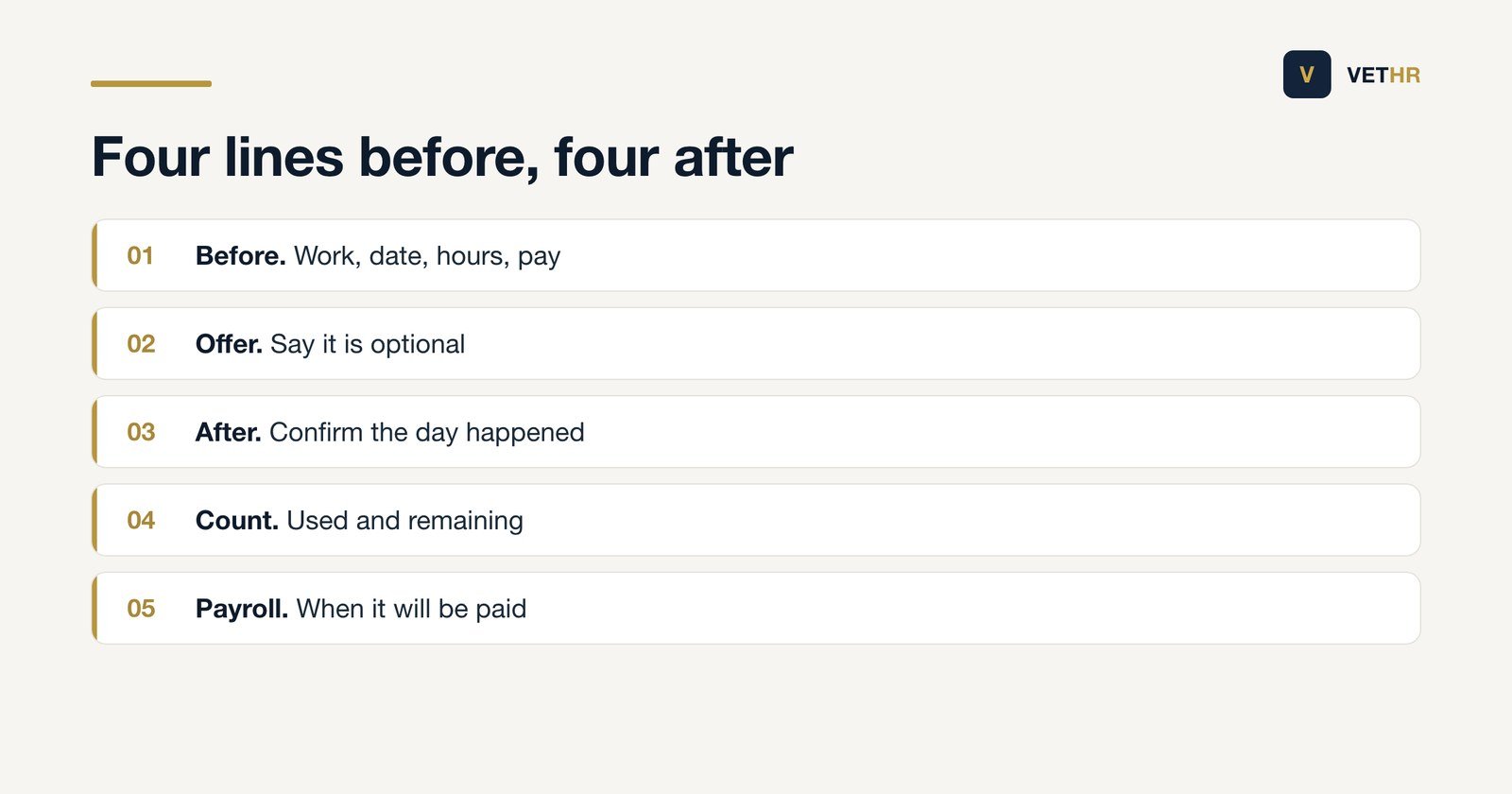
Four lines in an email before the day: what the work is, the date, the hours, and the pay. Four lines after it: confirmation the day happened, the number used, the number remaining, and when it will be paid.
Record the running total somewhere both sides can see. Ten days across a year is exactly the sort of count that goes wrong in a spreadsheet, and our rota and absence system holds it next to everything else.
Agree a plan at the start of the leave rather than improvising. A single conversation in the last week before leave starts, covering how often to be in touch and what the ten days might be used for, is worth more than every reminder you will send afterwards. Book a free 30-minute HR health check if you want help building that into your family leave policy.
The work and the pay should be agreed before the employee comes in. There is no separate statutory rate for the day, so most practices pay the normal rate for the hours worked, and say so in writing before the day happens.
Yes. Any amount of work counts as one full keeping in touch day, including coming in for a single meeting or a training session. Group activities together so the ten days go further.
No. Keeping in touch days are optional on both sides. The practice can invite, the employee can decline, and declining should have no consequence. Say that explicitly in the invitation.
No. That is the entire point of them. Working a keeping in touch day does not bring the leave to an end and does not stop statutory maternity or adoption pay for that week.
Once the ten are used, further work can affect the leave and the statutory pay for the week in question. Take advice before agreeing an eleventh day rather than assuming it can simply be added.
The nurse who came back in January to a practice she did not recognise did not leave because of the baby. She left because nobody had spent one of the ten keeping in touch days showing her the new system, and week one back felt like week one ever.
Plan the days at the start, agree them in writing, and use them on the things that make the return easy. We build family leave policies that say all of this in plain English through HR consultancy for veterinary practices and ongoing HR support on subscription.
The Vet HR Team provides HR consultancy and white-labelled staff systems exclusively to UK veterinary practices.
Contracts, rotas, holiday, a difficult conversation. Tell us what you are dealing with and we will come back within one working day. Nothing to sign up to.
Got it. We will come back to you within one working day. If you do not see a reply, please check your spam folder.
