Last updated: 28 September 2026
TL;DR: The Employment Rights Act creates a right to guaranteed hours for zero hours and low hours workers, so that the contract reflects the hours actually worked over a reference period. The government timeline puts it in 2027, with the detail to follow consultation. Practices that rely on bank staff should start measuring now.
A practice has four nurses on the bank list. One of them has worked between 22 and 30 hours every week since February, always the same three days, and has never had a contract that says so. Under the coming rules that pattern is exactly what a right to guaranteed hours is designed to capture, and the practice has eighteen months to decide what to do about it.
The idea is simple. A worker on a zero hours or low hours arrangement who regularly works more than their contract says gets the right to be offered a contract reflecting the hours they actually worked over a reference period.
It is aimed at what the government calls one sided flexibility: the situation where the employer keeps all the freedom and the worker carries all the uncertainty, while in practice working a settled pattern.
Guaranteed hours do not abolish bank working. Genuine flexibility, used genuinely, remains available. What changes is that a settled pattern has to be recognised as one.
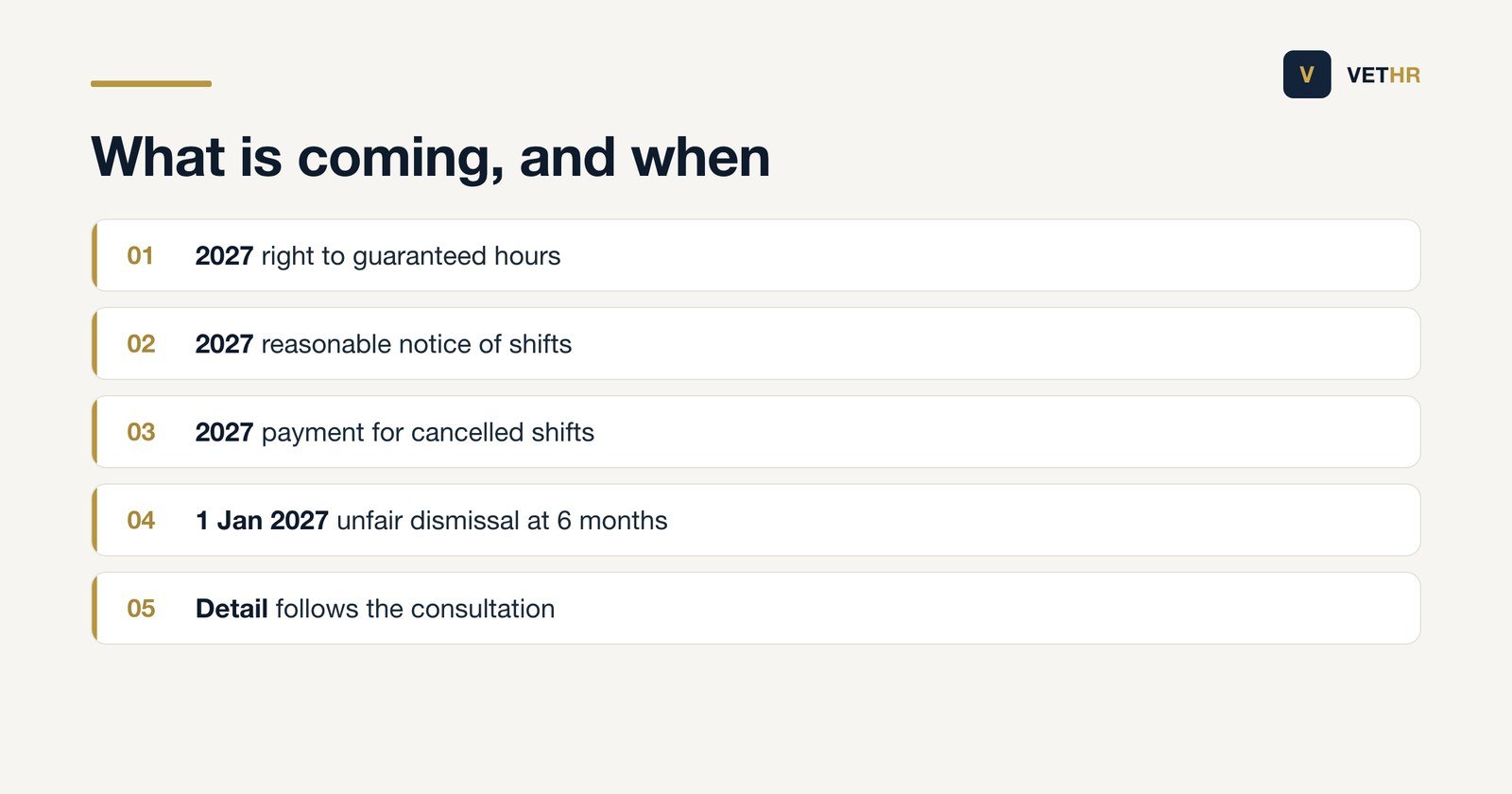
The government’s implementation timeline for the Employment Rights Act lists the introduction of the right to guaranteed hours and the right to reasonable notice and short notice payments in 2027, and says the timings will be updated after consultation.
So the direction is fixed and the detail is not. The reference period, the qualifying threshold and the mechanics all follow the consultation, and it would be a mistake to rewrite every contract on the basis of a summary.
It is not the only thing on that timeline. Statutory sick pay loses its lower earnings limit and waiting period on 6 April 2026, the employment tribunal claim time limit rises from 3 to 6 months on 1 October 2026, and the unfair dismissal qualifying period drops to 6 months for dismissals from 1 January 2027. Our tracker on employment law changes for veterinary practices keeps the dates in one place.
Four groups, and most practices have all four.
That last category is the one practices forget, because the person is not on a zero hours contract at all. A low hours contract that never matches reality is squarely within the intention behind guaranteed hours. Our note on casual workers in a veterinary practice covers the arrangements most often used.
There is a recruitment angle too. New graduates and returners increasingly ask what the contract actually guarantees, because they have watched colleagues carry a full workload on paper terms that promise nothing. A practice that can answer that question clearly is already ahead of most of the adverts they are reading.
The same package includes a right to reasonable notice of shifts and payment where a shift is cancelled or cut at short notice. For a practice that fills tomorrow’s rota at 8pm tonight, that is the more immediate operational change.
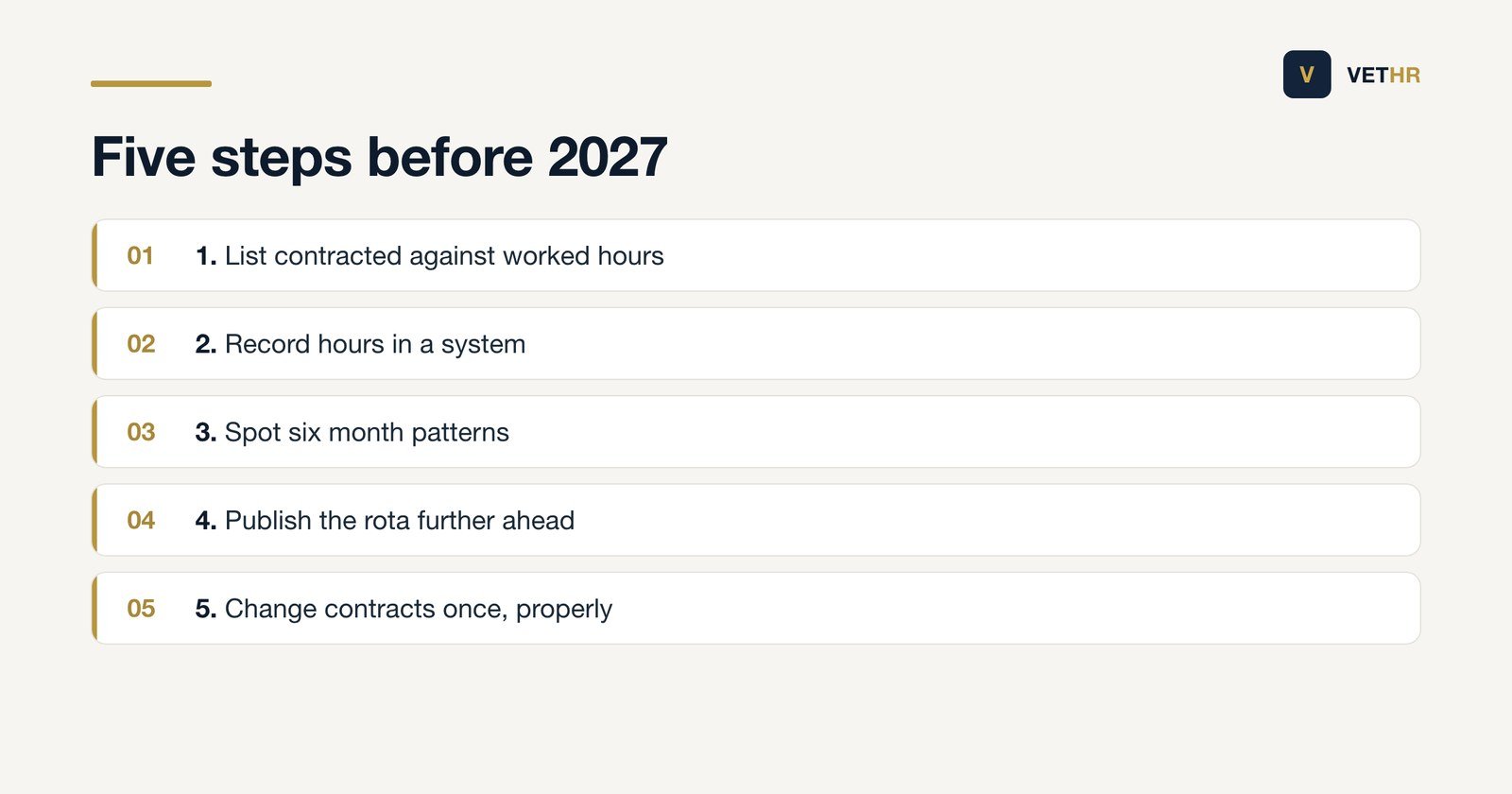
Start with the habit rather than the law. Publishing the rota further ahead costs nothing legally and solves a retention problem you already have. Our guide to shift cancellation in a veterinary practice covers the notice question in detail.
Practices that already publish four weeks ahead will barely notice these rules. Practices running week to week will feel them, and the adjustment takes longer than a policy change.
Whatever the final reference period turns out to be, it will be measured from worked hours. A practice that cannot produce twelve months of accurate hours per person will be guessing when the rules land.
Pull the last six months now, by person, by week. You are looking for the gap between contracted hours and worked hours, and for anyone whose worked hours have been stable enough to look like a pattern.
If the numbers live in a paper rota and a WhatsApp group, this is the moment to fix that. Our clock in and out system records actual worked hours and the rota system holds the plan next to it, which is the comparison guaranteed hours will require.
Accurate hours matter for another reason. GOV.UK guidance on which hours count for the minimum wage includes time spent training and travel between work assignments, and those hours are easy to lose in a manual system.
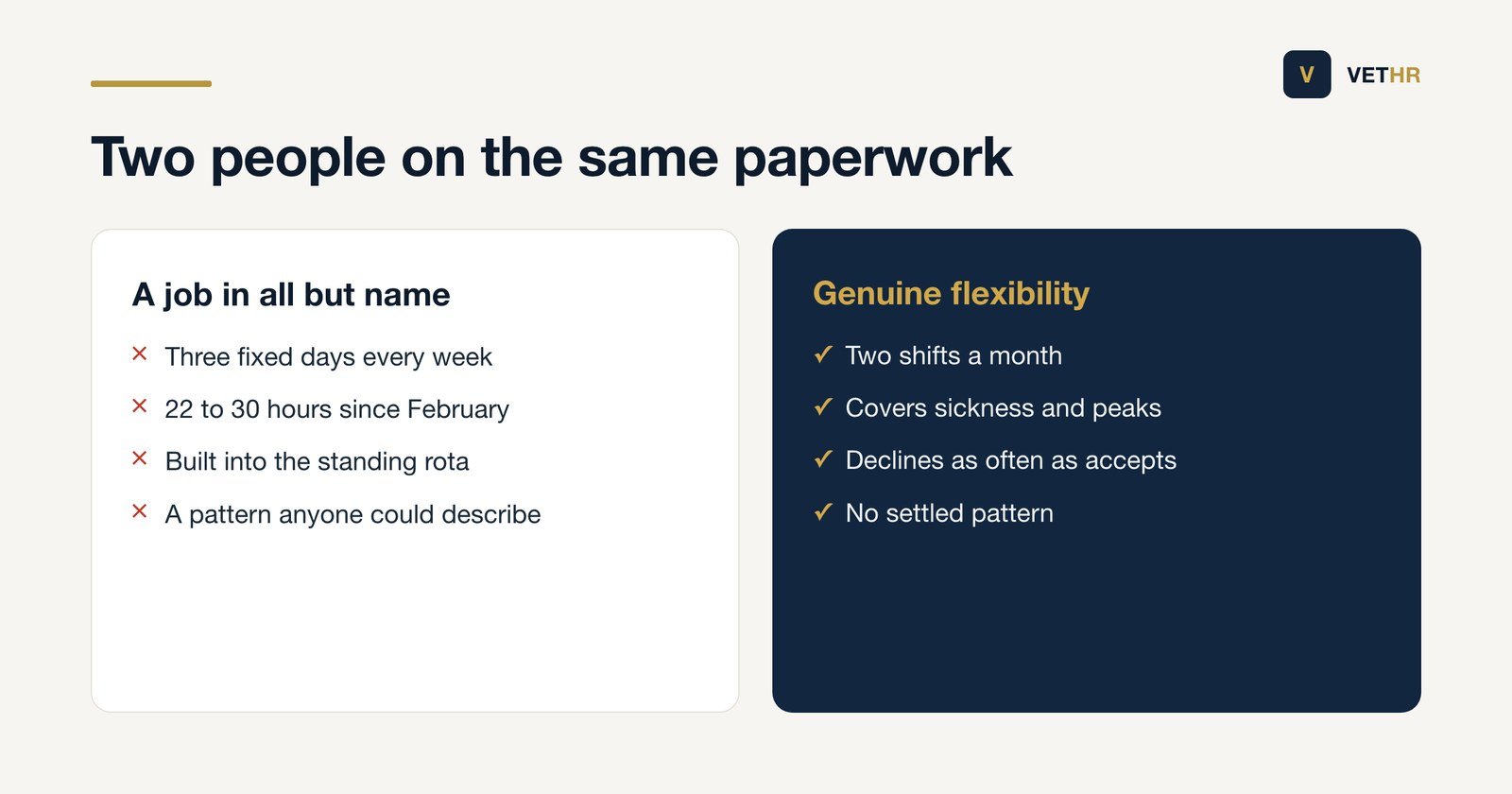
Keep the bank, but use it for what it is for. A bank list works when it covers genuine peaks, sickness and holiday. It stops working when it quietly becomes the staffing model.
Look at each person separately. Someone doing two shifts a month is in a different position from someone doing three fixed days a week, even though both are on the same paperwork.
For the second group, consider offering a contract now rather than waiting. The person on 28 hours a week for a year is already carrying your rota, and offering guaranteed hours before you are required to is a retention move rather than a compliance one. Our note on staffing levels in a veterinary practice covers how to work out what you actually need.
Watch the knock on effects as well. Holiday entitlement, pension auto enrolment and statutory sick pay all follow from earnings and hours, so moving someone onto guaranteed hours changes more than the rota line. None of those changes are difficult, but they are easier to plan than to discover in a payroll run.
Talk to the people affected before anything is decided. Some bank staff will want a contract and have been waiting to be asked. Others chose the arrangement deliberately, around study, family or a second role, and would see a guaranteed hours offer as a threat to that. You will not know which is which until you ask, and the conversation itself is worth having.
None of that requires a decision about guaranteed hours today. All of it makes the decision easy when the detail arrives. Book a free 30-minute HR health check if you want help reading your own numbers.
No. The measures create a right to be offered guaranteed hours reflecting hours actually worked, alongside rights to reasonable notice of shifts and payment for short notice cancellations. Genuine flexible working arrangements remain lawful.
Not yet settled. The government timeline says the timings and detail will be updated after consultation, so any specific figure you read today should be treated as a prediction rather than a rule.
The design is a right to be offered guaranteed hours, not a compulsory conversion. Many bank staff value flexibility and will decline. Keep a written record of the offer and the response either way.
It depends on status. Someone genuinely self-employed and invoicing you is in a different position from a worker on your books. Our guide to employment status covers the tests, and status is worth settling before 2027 rather than after.
Not wholesale. Measure now, publish the rota further ahead now, and change contracts once the detail is published. Rewriting everything twice costs more than waiting and achieves nothing extra.
The practices that will find guaranteed hours difficult are the ones running a permanent staffing gap through a bank list. The measurement will simply make visible what the rota already shows.
Start with the numbers, not the contracts. We help independent practices read theirs and plan the change through fixed-price HR consultancy and ongoing HR support on subscription.
The Vet HR Team provides HR consultancy and white-labelled staff systems exclusively to UK veterinary practices.
Contracts, rotas, holiday, a difficult conversation. Tell us what you are dealing with and we will come back within one working day. Nothing to sign up to.
Got it. We will come back to you within one working day. If you do not see a reply, please check your spam folder.
