Last updated: 5 October 2026
TL;DR: The display screen equipment regulations apply to workers who use screens daily for continuous periods of an hour or more. A DSE assessment is one of four duties, alongside reducing risk including breaks, providing an eye test on request, and giving training and information. Reception and the practice manager are almost always in scope.
A practice with three consult rooms, an ops room, a kennel block and a dispensary has done risk assessments for all of them. The one place nobody has assessed is the reception desk, where two people spend seven hours a day on a screen at a counter built for standing, with a monitor angled for whoever sat there in 2019. That is the DSE assessment nobody got round to.
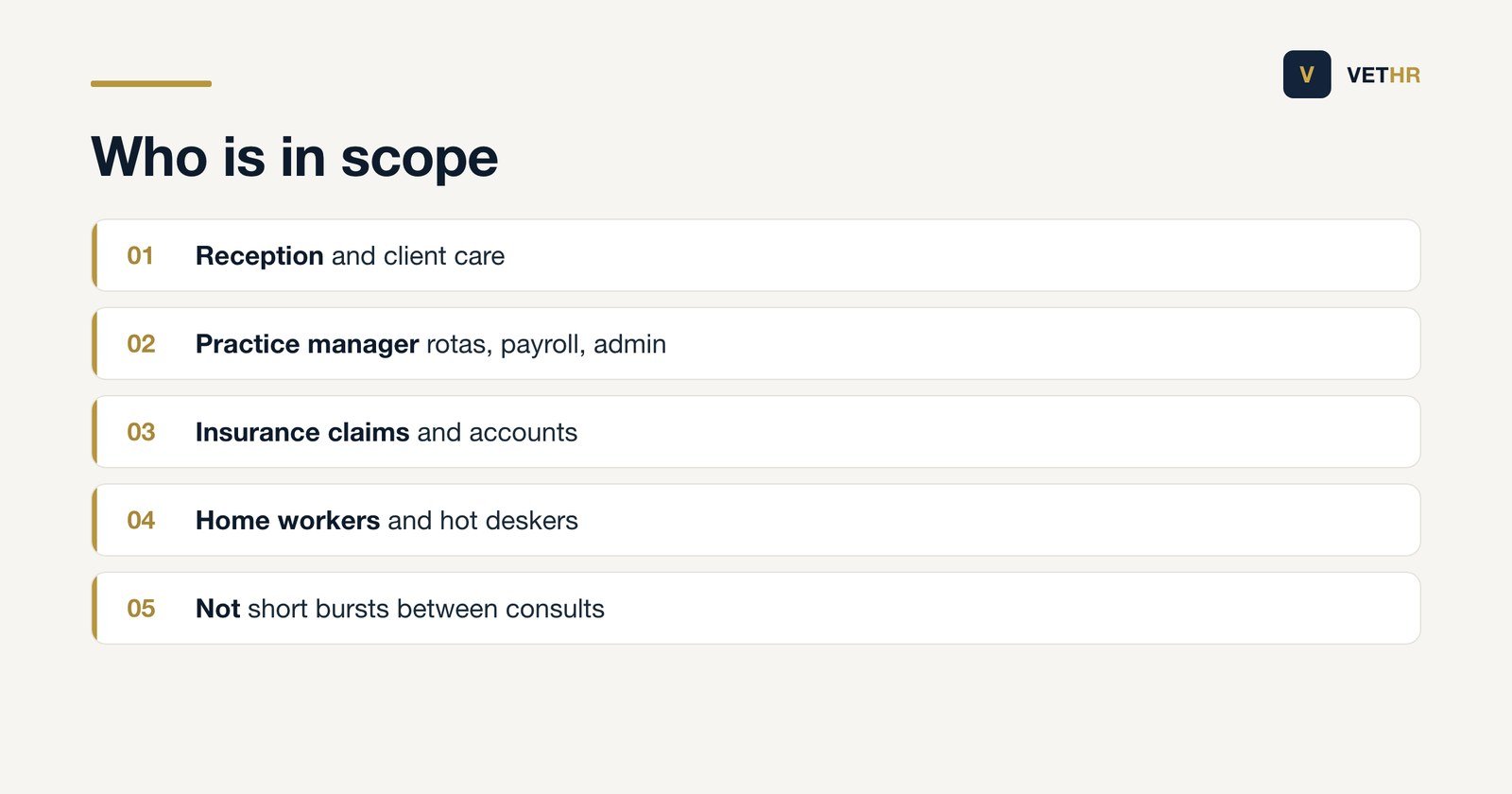
The HSE states that the display screen equipment regulations apply to workers who use DSE daily, for continuous periods of an hour or more, and that they do not apply to those who use it infrequently or briefly.
Applied to a veterinary practice, that captures reception and client care staff, the practice manager, anyone doing insurance claims or accounts, and often a clinical director doing admin between consults.
It does not capture a vet who types up a consult in five minute bursts. The test is a continuous hour or more, daily, which is why the split usually runs along the front desk rather than along job titles.
HSE sets out four things employers must do. They are short enough to put on one page.
The second one is the one that gets ignored, because a busy reception does not feel like it needs a break policy. HSE guidance is clear that breaks or changes of activity are part of reducing the risk, not an optional extra.
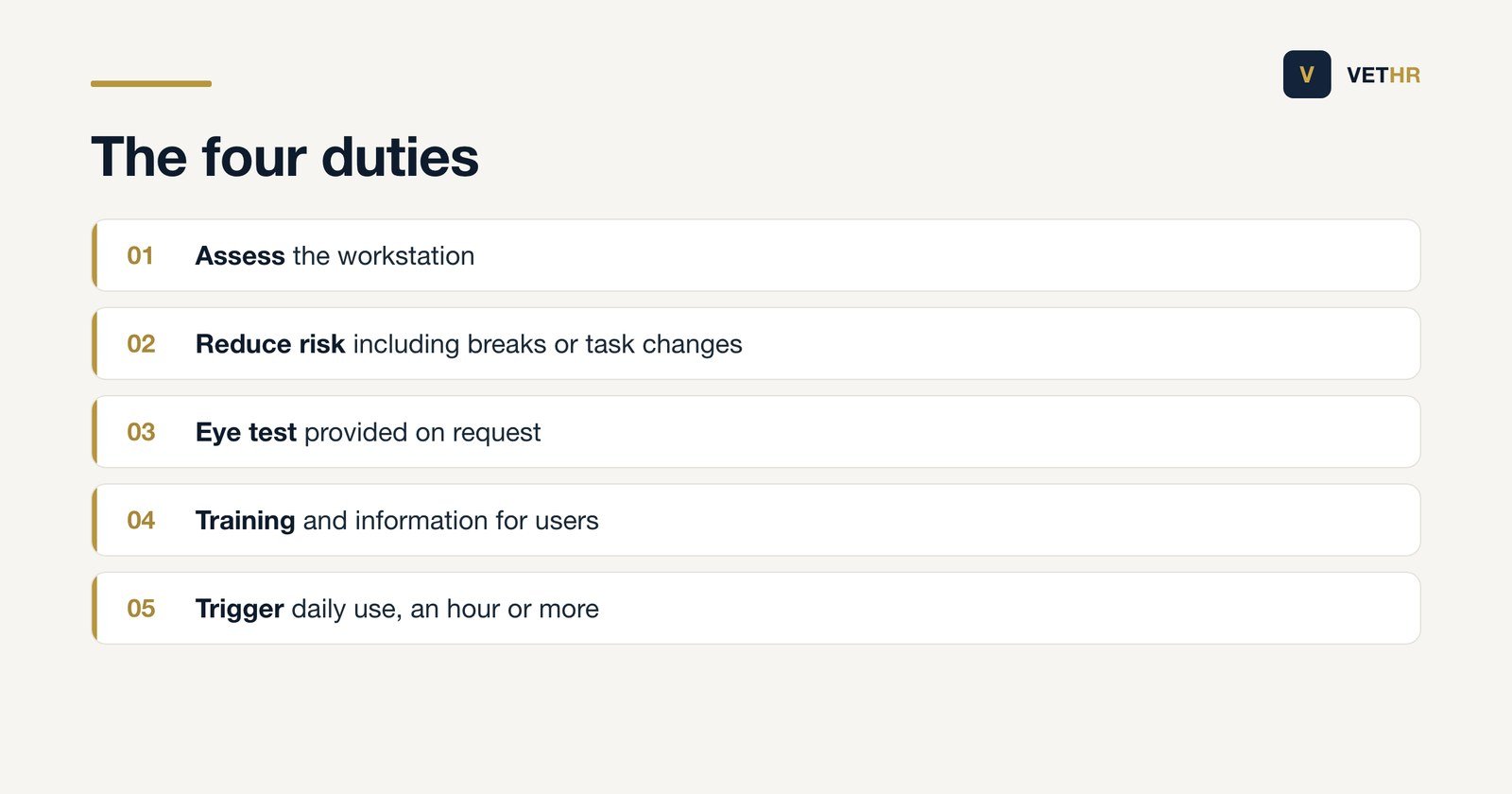
Run the DSE assessment with the person who uses the workstation, not from a desk upstairs. Screen height and distance, keyboard and mouse position, chair adjustment, desk space, lighting and glare, cable trip hazards, and whether there is room for a document holder.
Then act on what you find. A DSE assessment that identifies a chair with no working height adjustment and changes nothing is worse than none, because it records the problem and leaves it.
Redo the DSE assessment when the workstation changes, when the person changes, or after any absence involving a musculoskeletal or eye problem. Put a review date in the annual calendar so it happens without anyone remembering. Our HR calendar for veterinary practices covers what else belongs in that cycle.
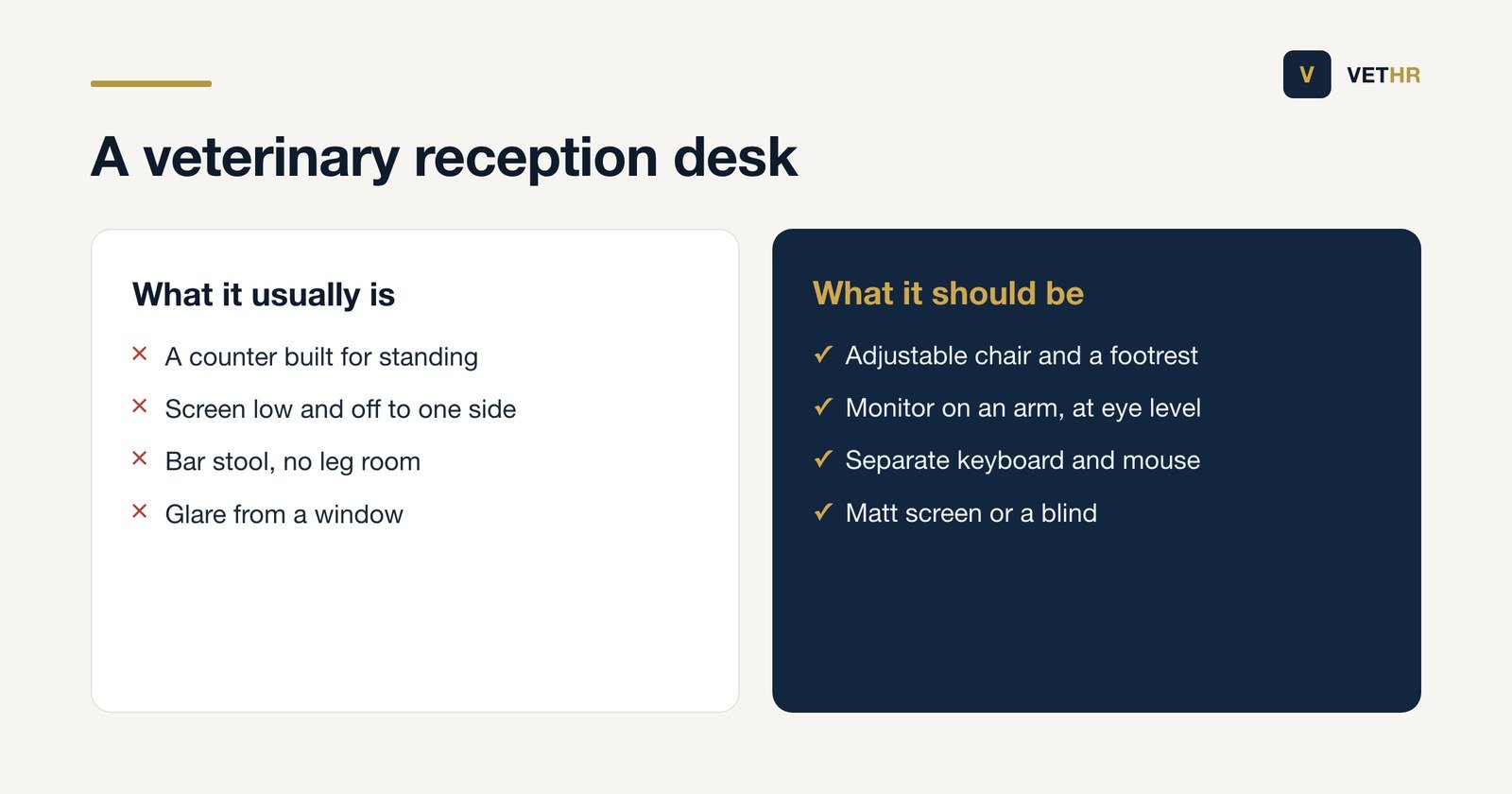
Veterinary reception desks are rarely designed as workstations. They are designed as counters: high, deep, often with the screen tucked underneath or off to one side so it cannot be seen by clients.
That produces a predictable set of problems. Screens too low and too far away, a keyboard at standing height being used by someone sitting on a bar stool, no leg room, and glare from a window that was never a factor when the counter was installed.
A DSE assessment usually finds that most of it is fixable cheaply: a proper adjustable chair with a footrest, a monitor arm, a separate keyboard and mouse, and a matt screen or a blind. None of that needs a refit, and all of it comes out of a DSE assessment that was actually done.
Reception also carries the client facing load, which is its own risk. Our note on third party harassment in a veterinary practice covers the other half of that job.
Involve the person in choosing the kit. A chair that somebody picked for them, at the wrong height, ends up with a cushion on it within a fortnight. Ten minutes of trying two chairs is a better use of a DSE assessment than a catalogue order.
Reasonable adjustments sit next to this, and they are a different legal duty. Where a member of staff has a disability, the adjustments conversation goes further than the workstation assessment does. Our guide to reasonable adjustments in a veterinary practice covers where the two meet.
If a DSE user asks for an eye test, the employer provides it. That is one of the four duties, and it applies on request rather than on a schedule.
Where the test shows that glasses are needed specifically for screen work, the employer covers the cost of a basic pair for that purpose. It does not extend to a general prescription or to designer frames, and saying so in the policy avoids an awkward conversation later.
Write both sentences into your health and safety policy, tell people at induction, and the whole subject stops being a negotiation. Our page on policies for veterinary practices covers where it sits.
HSE guidance says the regulations apply across fixed workstations, mobile workers, home workers and hot desking arrangements. A practice manager doing rotas and payroll from a kitchen table two days a week is a DSE user.
You cannot run a DSE assessment on a kitchen table in person, so use a self assessment checklist and follow it up. The point is not paperwork, it is finding the person working from a laptop on a sofa and giving them a stand, a keyboard and somewhere to sit.
Hot desking needs a rule rather than a DSE assessment per person: every shared position must be adjustable, and everyone must know how to adjust it. Our note on flexible working requests covers how home working usually arrives in a practice.
Ask people what actually hurts. A short question in the monthly one to one, about wrists, necks and eyes, finds problems months before a fit note does, and it costs nothing to add.
Screen work injuries are slow, which is why they get missed. HSE lists the risks as pain in necks, shoulders, backs, arms, wrists and hands, as well as fatigue and eye strain.
Some of those become reportable. Diagnosed carpal tunnel syndrome, and tendonitis or tenosynovitis of the hand or forearm, appear on the list of occupational diseases reportable to the HSE where the work is the cause.
So a receptionist who comes back with a diagnosis is not just an absence to cover. Our guide to RIDDOR in a veterinary practice covers the decision, and occupational health covers the referral that usually follows.
If nobody has ever assessed your front desk, book a free 30-minute HR health check and we will start there.
No. The regulations apply to workers who use display screen equipment daily for continuous periods of an hour or more. In most practices that means reception, the practice manager and admin staff, rather than clinical staff using a screen in short bursts.
You provide an eye test on request, and where the test shows glasses are needed specifically for screen work, you cover a basic pair for that purpose. A general prescription or an upgrade to designer frames is the employee’s own cost.
Whenever the workstation changes, the user changes, or after an absence involving a musculoskeletal or eye problem. An annual review date keeps it honest even when nothing obvious has changed.
They are covered. HSE guidance applies the regulations to home workers and hot desking as well as fixed workstations. Use a self assessment checklist and act on what it shows, particularly for anyone working from a laptop without a stand or a keyboard.
They have to be real, not formal. HSE frames the duty as making sure workers take breaks from screen work or do something different, and in a practice that is usually achieved by rotating reception tasks rather than by a timetable.
Every practice assesses its dispensary, its ops room and its kennels. The front desk gets missed because it does not look like a hazard, and then somebody spends four years at a counter built for standing.
Sit at it, run the DSE assessment with the person who uses it, and buy the chair. We help independent practices build the whole health and safety document set through HR consultancy for veterinary practices and ongoing HR support on subscription.
The Vet HR Team provides HR consultancy and white-labelled staff systems exclusively to UK veterinary practices.
Contracts, rotas, holiday, a difficult conversation. Tell us what you are dealing with and we will come back within one working day. Nothing to sign up to.
Got it. We will come back to you within one working day. If you do not see a reply, please check your spam folder.
