Last updated: 23 November 2026
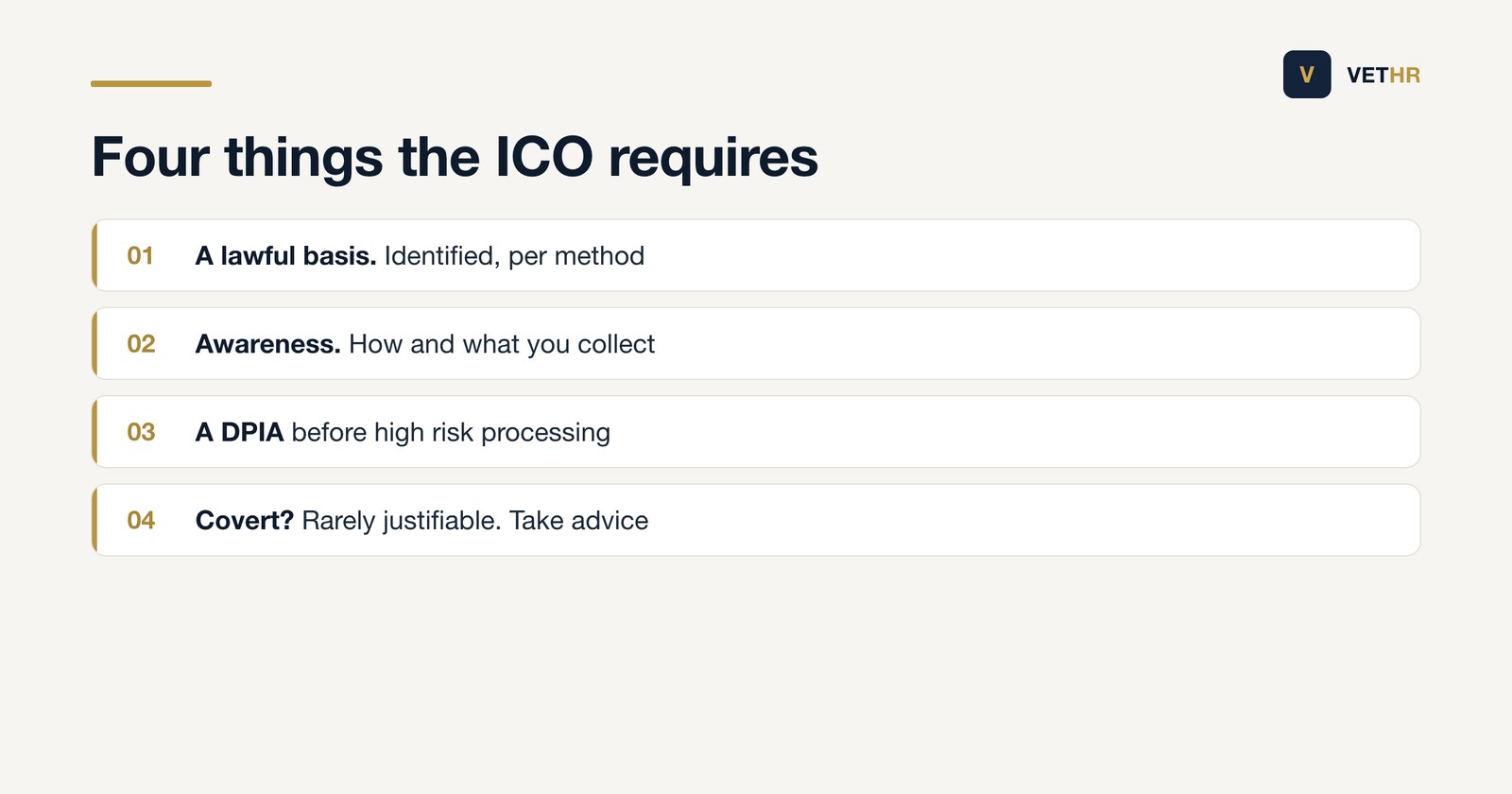
TL;DR: The ICO says data protection law does not prevent you from monitoring workers, but you must do so in a way which is compliant with data protection requirements. That means identifying a lawful basis, making sure workers are aware of how and what personal information you are collecting, and carrying out a DPIA before any processing likely to cause high risk.
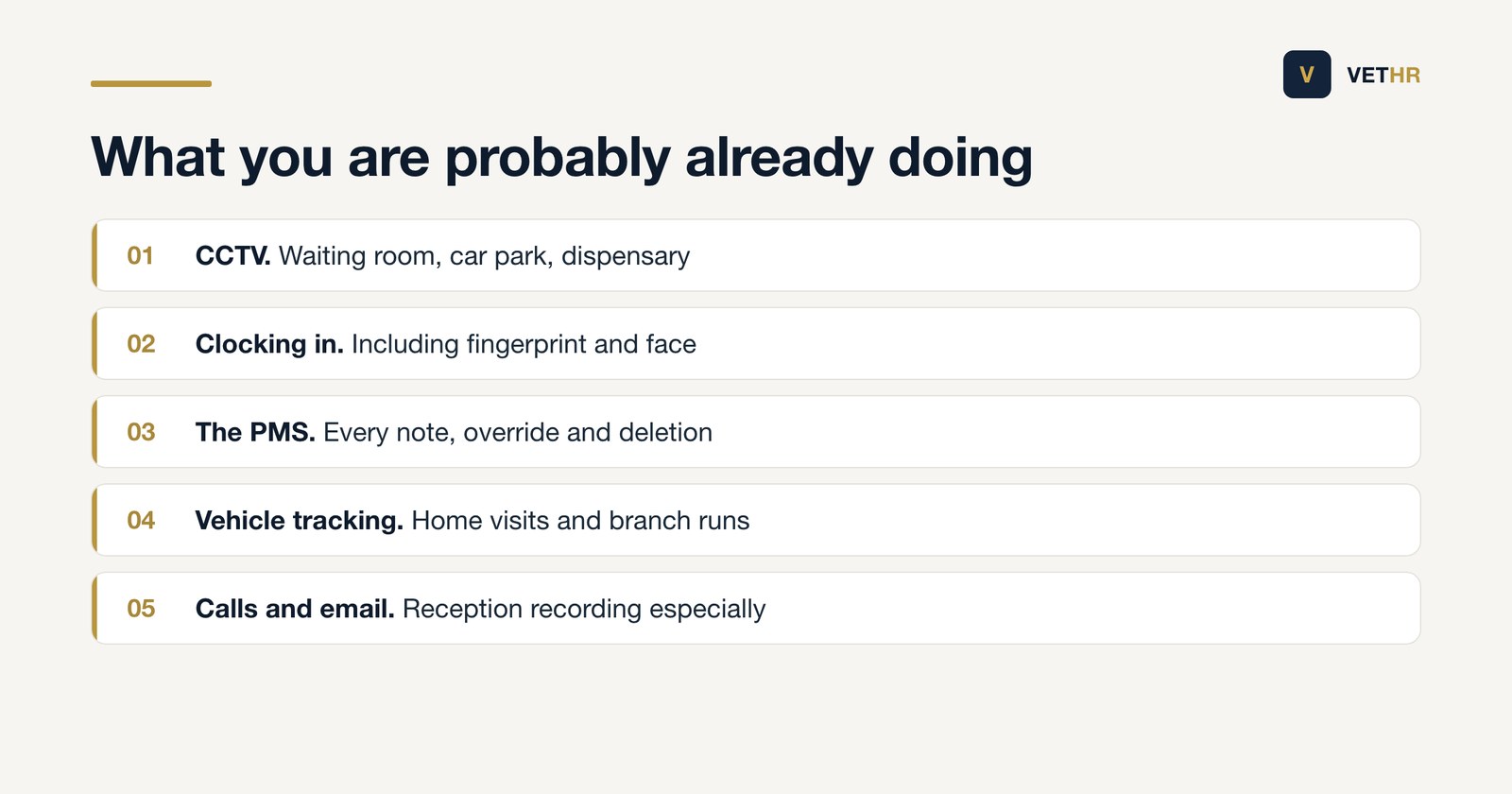
Most practice owners would say they do not monitor their staff. Then you count the cameras in the waiting room and the dispensary, the clocking-in system, the audit trail in the practice management software, the tracker on the branch car, and the fact that every consult note carries a name and a timestamp.
Start by listing it honestly, because you cannot comply with rules you have not noticed you are engaging. Almost every practice is monitoring staff in five ways before anybody has decided to monitor anything.
None of that is sinister and most of it exists for good reasons, including reasons the RCVS and your insurer would approve of. It is still monitoring staff, and the rules apply to it.
The ICO’s position is not that you cannot do it. Its guidance on data protection and monitoring workers says data protection law does not prevent you from monitoring workers, but you must do so in a way which is compliant with data protection requirements.
That is a useful sentence to have in your pocket when somebody says cameras in the dispensary are illegal. They are not. They are regulated, and monitoring staff lawfully is mostly a documentation exercise.
The wider ICO guidance on monitoring workers sets out how the practice of monitoring interacts with data protection across the employment relationship.
The ICO is direct: to lawfully collect and process information from monitoring workers, you must identify a lawful basis.
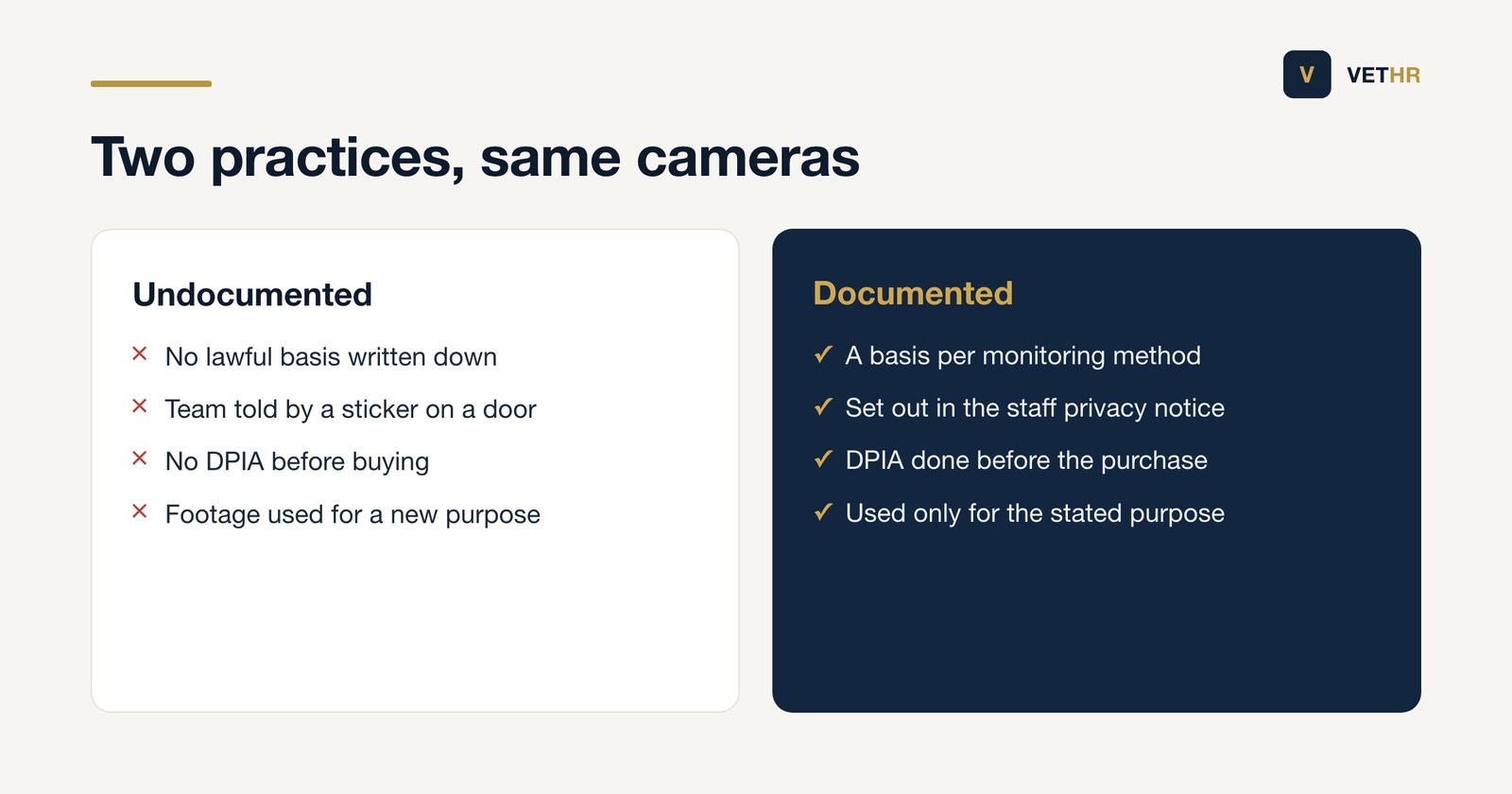
Pick the basis for monitoring staff deliberately and write it down, method by method. The basis for a camera on the controlled drugs cabinet is not the same as the basis for tracking a branch car, and one paragraph that says we rely on legitimate interests for everything is not an answer.
Be careful with consent in an employment context. A team member who feels they cannot say no has not freely given it, and a basis that collapses the moment somebody objects is not much of a basis. Our notes on the staff privacy notice and GDPR staff records cover where this gets documented.
You must make sure workers are aware of how and what personal information you are collecting during any monitoring. That is the ICO’s wording and it is not satisfied by a sticker on a door.
What the team should be able to answer without asking: what is recorded, where, why, who can look at it, how long it is kept, and whether it will ever be used in a disciplinary. If they cannot answer those, you are monitoring staff without meeting the transparency duty.
Put it in the privacy notice for staff, repeat it at induction and say it again whenever you add a camera or a system. Monitoring staff quietly, even for an honest reason, is how a reasonable practice ends up looking underhand.
The ICO says you must carry out a DPIA before undertaking any processing likely to cause high risk to workers’ and other people’s interests.
In a veterinary practice the obvious candidates are biometric clocking in, any camera covering a place people work all day rather than a place they pass through, call recording, and vehicle tracking that continues outside working hours. Those are the four ways of monitoring staff most likely to need one.
A DPIA is not a long document. It says what you want to do, why, what could go wrong for the people being monitored, and what you have changed to reduce that. Doing it before you buy the system rather than after is the whole point, because the findings often change what you buy.
This is the one to be careful with. The ICO defines covert monitoring as carrying out monitoring in a way designed to ensure workers are unaware that it is taking place, and says it is unlikely that you will be able to justify covert monitoring in most usual circumstances.
Practices consider monitoring staff covertly in one situation above all others, which is suspected theft from the dispensary or the till. The instinct is understandable and the route is still the wrong one to take on your own.
Take advice before you set anything up, and look first at what your existing, disclosed systems already show you. Stock reconciliation and the controlled drugs register usually answer the question without a hidden camera. Our guides to the controlled drugs register and workplace investigations cover the proper route.
Cameras are the part of monitoring staff that generates the most upset, and usually over placement rather than principle.
Nobody objects to a camera on the car park or the controlled drugs cabinet. People object, rightly, to one in a staff room, a changing area or anywhere with audio recording they were not told about. Before adding a camera, ask what specific problem it solves and whether a less intrusive answer exists.
Then deal with the boring parts of monitoring staff by camera: who can view the footage, how long it is kept, how a request to see it is handled, and what happens when somebody asks for a copy. Our note on the subject access request covers that last one, and data breaches covers what to do when footage goes somewhere it should not. Book a free 30-minute HR health check if you want your monitoring documented properly.
One table, six columns, and an afternoon. It is the single document that turns all of this from an anxiety into a file.
Review it once a year and whenever you buy something new. Practices add a camera or a system every couple of years and almost never revisit the paperwork, so the inventory drifts out of date faster than the policy does.
Yes, within the rules. The ICO says data protection law does not prevent you from monitoring workers, but you must do so in a way which is compliant with data protection requirements, which includes identifying a lawful basis and being open about what you collect.
Yes. The ICO says you must make sure workers are aware of how and what personal information you are collecting during any monitoring. In practice that means a staff privacy notice people have actually read, not a sign on a door.
Before undertaking any processing likely to cause high risk to workers’ and other people’s interests. Biometric clocking in, call recording, cameras covering places people work all day and out-of-hours vehicle tracking are the usual practice examples.
The ICO says it is unlikely that you will be able to justify covert monitoring in most usual circumstances. Take advice first, and check what your disclosed systems and your stock records already tell you.
Only if that use is consistent with why you said you were collecting it and with the lawful basis you identified. If the team were told the cameras are for security and stock control, using the footage for timekeeping is a different purpose.
Most practices are not monitoring too much. They are monitoring a normal amount and documenting none of it, which is the bit that turns an ordinary security camera into a grievance.
List every system, give each one a lawful basis, tell the team, and run a DPIA on the high risk ones. Monitoring staff well is not a matter of monitoring less. We do that inventory with practices through HR consultancy for veterinary practices and the policy document set.
The Vet HR Team provides HR consultancy and white-labelled staff systems exclusively to UK veterinary practices.
Contracts, rotas, holiday, a difficult conversation. Tell us what you are dealing with and we will come back within one working day. Nothing to sign up to.
Got it. We will come back to you within one working day. If you do not see a reply, please check your spam folder.
