Last updated: 21 September 2026
TL;DR: Auto enrolment means every practice with staff must assess them and put eligible people into a workplace pension. In 2026/27 that is staff aged 22 to State Pension age earning over £10,000 a year. The minimum total contribution is 8%, with at least 3% from the practice. Bank staff must be assessed every time payroll runs, and everyone is re-enrolled every three years.

Most practices set up their workplace pension years ago and have not looked at it since. The duties did not stop at set-up, though. Bank nurses who cross the earnings trigger in a busy month, a receptionist who turns 22, and a re-enrolment date nobody diarised are where auto enrolment quietly goes wrong.
Auto enrolment is the legal duty on every employer to assess its staff, put eligible people into a qualifying workplace pension without waiting to be asked, and pay at least the minimum contributions. It is overseen by The Pensions Regulator, and it applies to a two-person practice exactly as it does to a large group.
The duties are ongoing rather than one-off. The regulator describes a formal assessment of staff, a declaration of compliance telling it how the duties have been met, and a repeat of the process every three years. A practice has not finished its auto enrolment duties until that declaration has been submitted.
Responsibility stays with the practice even when an accountant or payroll bureau does the work. The regulator is explicit that the declaration is the employer’s legal duty, and that getting it wrong can lead to a fine.
A practice must automatically enrol staff aged 22 to State Pension age who earn more than £10,000 a year, which is £833 a month or £192 a week in 2026/27. Staff outside that group, aged 16 to 74, can still ask to opt in or join, and depending on what they earn the practice may have to contribute.
The Pensions Regulator’s earnings thresholds for 2026/27 are:
Someone who asks to opt in must be put into a scheme that can be used for auto enrolment, with employer contributions. Someone who asks to join, typically a lower earner, must be given a scheme to pay into, but the practice does not have to contribute.
Ages change as well as pay. A student nurse who turns 22, or a long-serving colleague who reaches State Pension age, moves category on that date, which is why assessment has to be built into every payroll run.
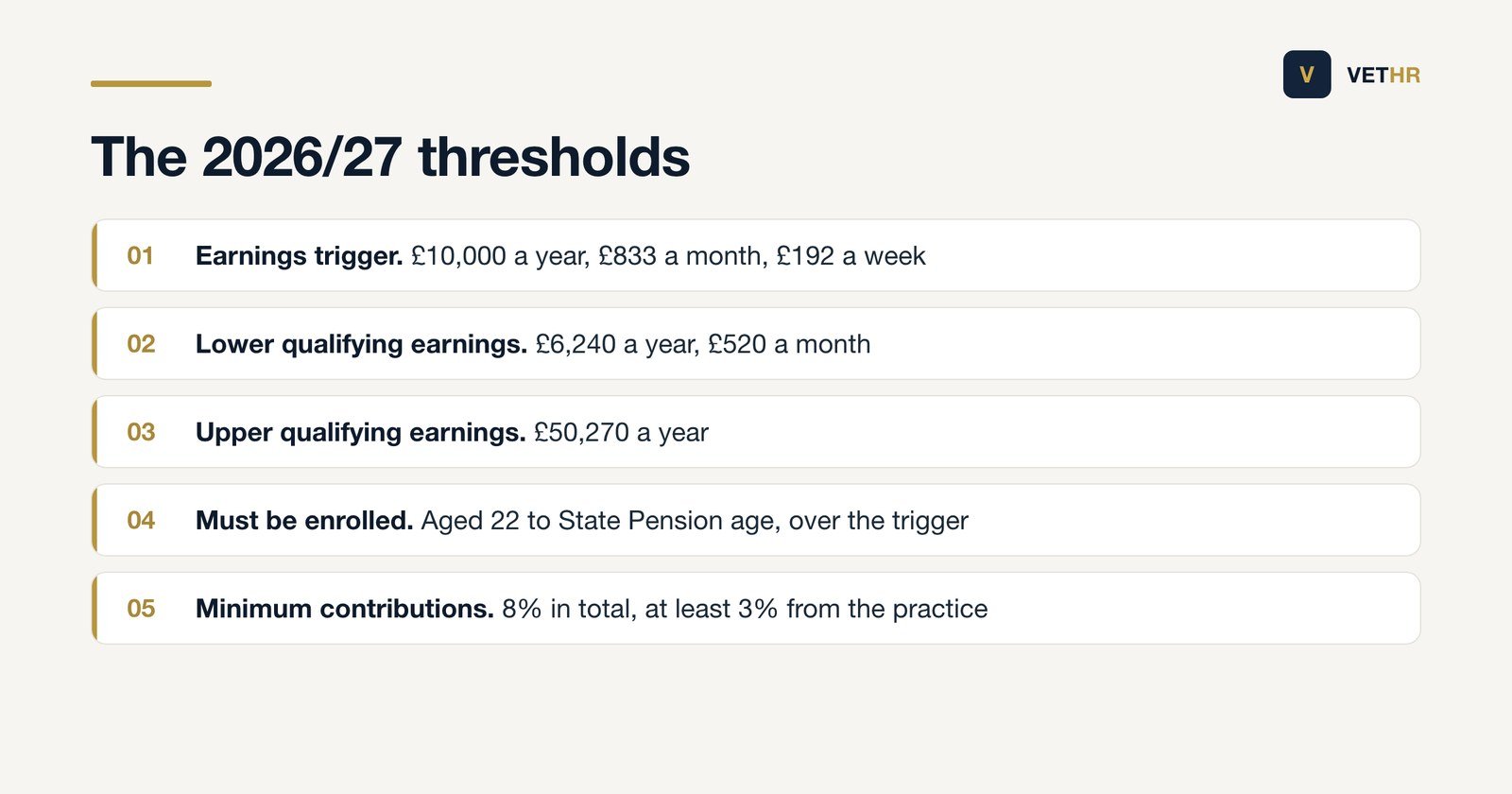
The legal minimum is a total contribution of 8%, of which the employer must pay at least 3% and the member of staff the rest. The practice can choose to pay more, including the full amount, in which case the employee pays nothing. Minimum contributions are worked out on qualifying earnings, between £6,240 and £50,270 a year.
The regulator’s guidance on costs sets out the split: an employer minimum of 3% and a staff contribution of 5%, making the 8% total. The amount can vary with the scheme, but never below the minimum.
Auto enrolment contributions are part of the total reward a practice offers. A higher employer contribution is one of the few benefits that costs the same whether the person is a vet or a receptionist, and it can matter to experienced RVNs comparing practices. Our guide to staff benefits covers how to present it.
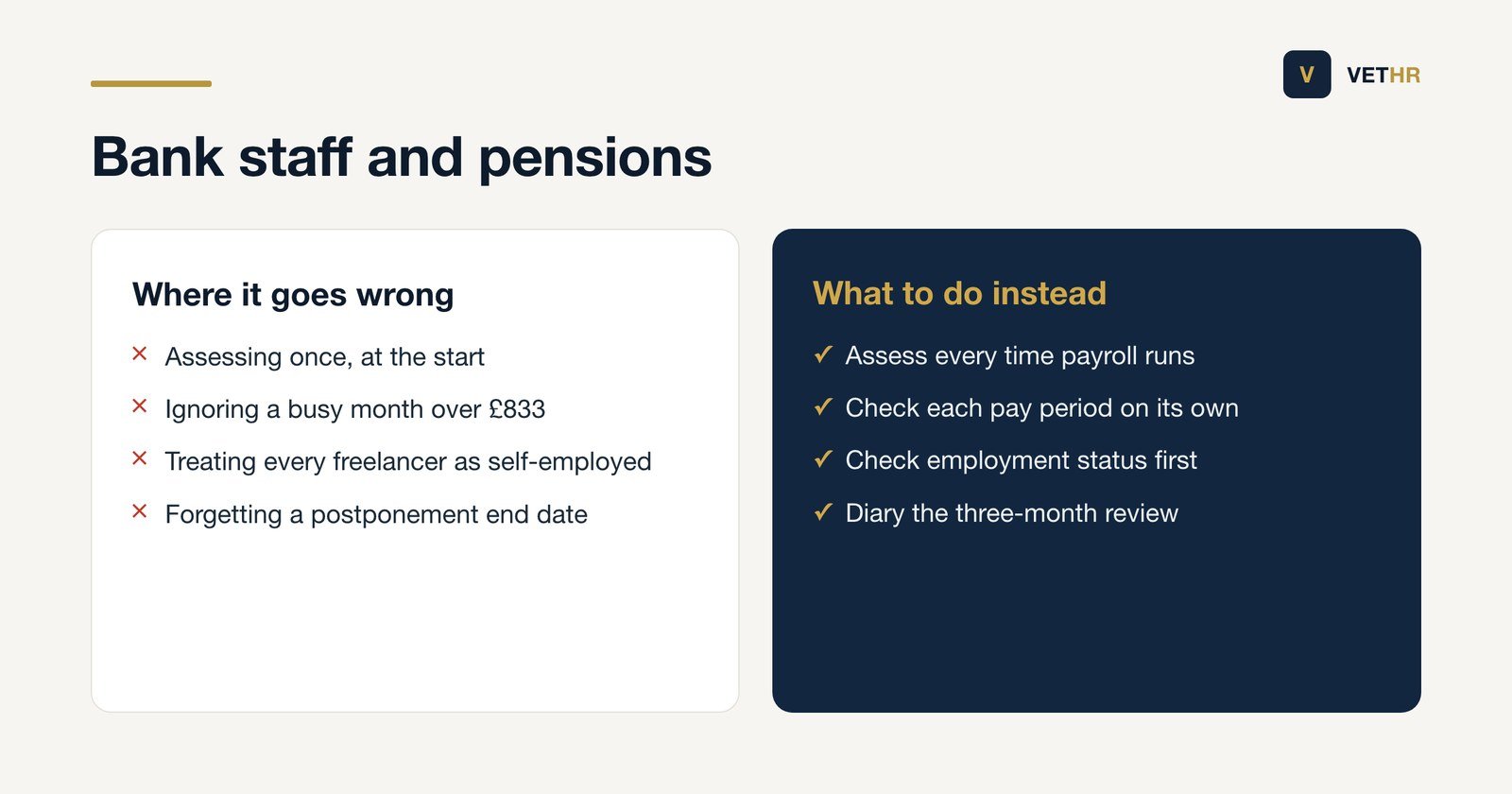
Bank staff are where auto enrolment most often goes wrong in a practice. The regulator says that even when hours and pay fluctuate, each person must be assessed individually every time payroll runs. A bank nurse aged 22 or over who earns more than £833 in a busy month may need enrolling from that pay period, even if they earn nothing the month after.
The regulator’s guidance on irregular hours also allows an employer to postpone assessment for up to three months, which suits temporary staff who will not stay longer. If they are still working after that, they must be assessed again.
The last point needs care. A long-standing freelance vet who works set shifts under the practice’s direction may not be as self-employed as their invoices suggest. Our guides to employment status and casual workers explain how to tell.
Every member of staff who has been assessed must be given information explaining how auto enrolment applies to them. The Pensions Regulator is specific about what counts: a letter, an email, or an attachment sent to them does; a poster in the staff room or a link to the intranet does not, because that only gives access to information.
The regulator’s guidance on writing to staff says this must happen within six weeks of the start of the legal duties, and it provides example letter templates. For a practice, the simplest habit is to send the right auto enrolment letter with every new starter’s first payslip, so nobody is missed.
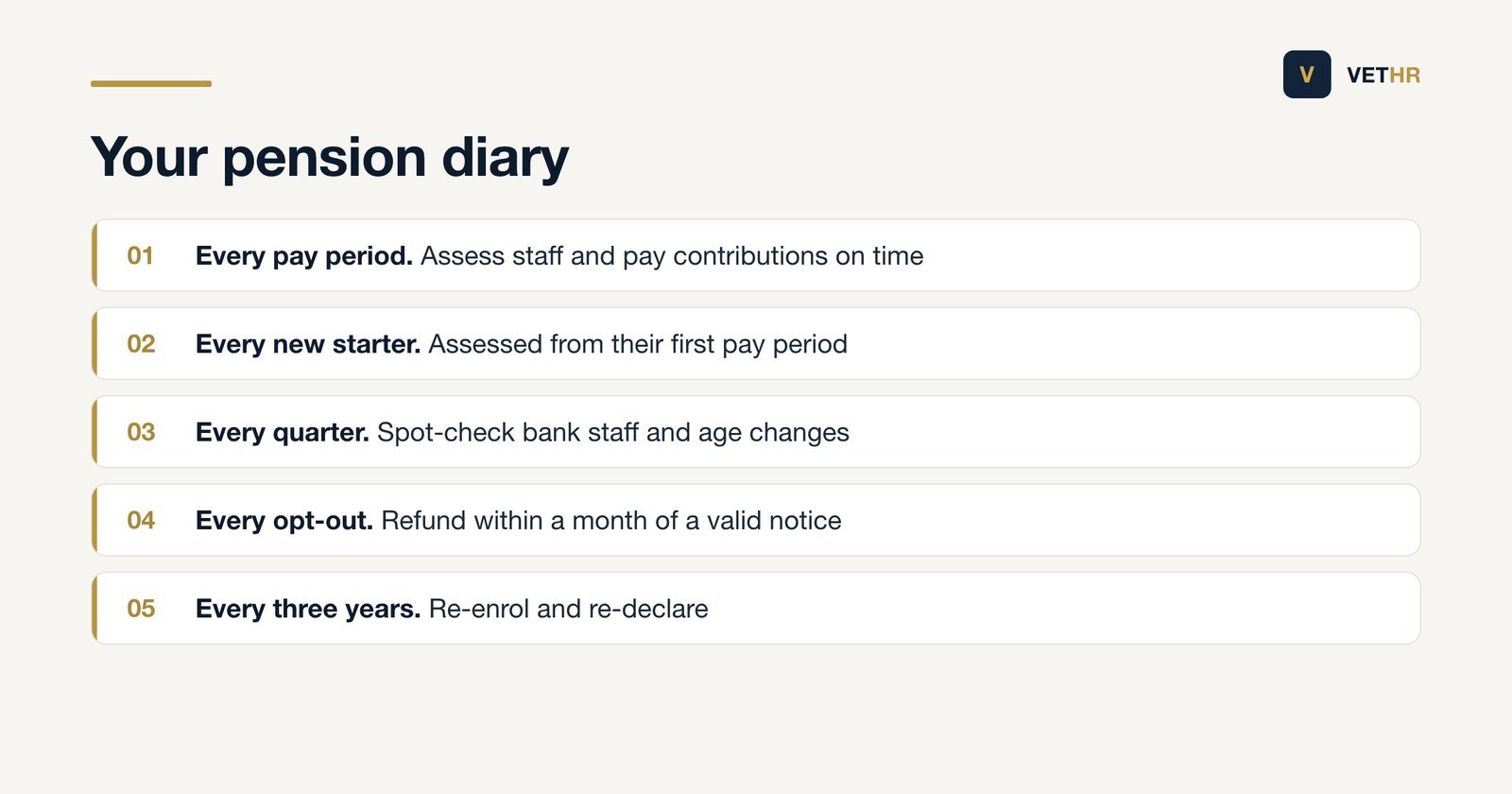
Once set up, a practice must keep assessing staff each pay period, process opt-outs correctly, keep records, and re-enrol every three years. Re-enrolment means putting back into the scheme anyone who left or reduced their contributions, and completing a re-declaration of compliance within five calendar months of the third anniversary of the duties start date.
Opt-outs have firm rules. According to the regulator’s guidance on opting out, staff can only opt out after they have been enrolled, the opt-out period is one month, and the employer must refund any contributions the person has made within a month of receiving a valid notice.
The practice must not encourage anyone to opt out. The regulator says the decision must be taken freely, and actively encouraging it could be considered an inducement. That includes well-meant comments in a busy staff room about take-home pay.
Put the re-enrolment date in the same diary as your other statutory deadlines. Our veterinary practice HR calendar shows how to keep them in one place.
Not sure your bank staff are being assessed correctly? A free 30-minute HR health check will tell you. Book your HR health check.
The regulator can issue compliance notices and unpaid contributions notices, and fines if they are not acted on. A fixed penalty is £400. An escalating penalty runs at £50 to £10,000 a day depending on the number of staff, and a civil penalty for failing to pay contributions can reach £50,000 for an organisation.
Those figures come from the regulator’s guidance on non-compliance, which also notes a fixed penalty can sometimes be issued without a statutory notice first. Unpaid contributions have to be calculated and paid for each person affected.
For most practices the real risk is less a dramatic fine and more a slow build-up of missed contributions for bank staff, discovered at a re-declaration and paid back in one go. Checking a sample of pay periods each quarter catches that early.
Less than most owners fear, once payroll does the assessing. The regulator’s research found that small employers with one to four staff usually spend about 15 hours in total on their auto enrolment tasks, and that ongoing duties typically take two hours or less a month.
The same research found that 58% of employers with one to four employees spend less than an hour a month on ongoing duties. The easiest route is payroll software with auto enrolment built in, assessing every pay period automatically, rather than a manual check someone forgets in a busy month.
Our guide to veterinary payroll covers choosing software that handles irregular hours properly.
Yes, but only after they have been enrolled, and the decision must be theirs. The opt-out period is one month, and the practice must refund any contributions they made within a month of receiving a valid opt-out notice.
Not automatically. Staff aged 16 to 21 are not automatically enrolled, but they can ask to opt in or join, and depending on their earnings the practice may have to contribute. Once they turn 22 and earn over the trigger, they must be enrolled.
Yes. The employer must pay at least 3% and the total must reach at least 8%. A practice can choose to pay the whole 8% or more, in which case the member of staff does not have to contribute at all.
Every three years, the practice must put back into the scheme anyone who left it or reduced their contributions, and complete a re-declaration of compliance within five calendar months of the third anniversary of its duties start date.
That depends on their employment status. A genuinely self-employed contractor is not assessed like staff, but someone working set shifts under the practice’s control may not be self-employed in law, so check the real working relationship.
Auto enrolment is rarely difficult, but it is easy to let drift. Assess every pay period, treat bank staff with the same care as salaried staff, never nudge anyone towards opting out, and put the three-year re-enrolment date in the diary today.
Our staff systems keep hours, pay periods and staff records in one place, and a free HR health check will flag any gaps in how your practice handles its pension duties.
The Vet HR Team provides HR consultancy and white-labelled staff systems exclusively to UK veterinary practices. This guide is general information, not financial or legal advice.
Contracts, rotas, holiday, a difficult conversation. Tell us what you are dealing with and we will come back within one working day. Nothing to sign up to.
Got it. We will come back to you within one working day. If you do not see a reply, please check your spam folder.
