Last updated: 16 September 2026
TL;DR: Time off for dependants lets an employee take a reasonable amount of time off to deal with an emergency involving a dependant, from their first day. There is no set limit, and it covers the emergency rather than planned care. Practices do not have to pay it, but must not treat people worse for using it, and dismissal for taking it is automatically unfair.
At 6.50am a nurse rings. Her son’s childminder has been taken ill and there is nobody else. She is due to scrub in for a 9am list. Every practice manager knows this call, and how it is handled decides whether she trusts the practice, and whether the practice stays on the right side of the law.
Time off for dependants is a legal right for employees to take a reasonable amount of time off to deal with an unexpected problem or emergency involving someone who depends on them. It applies from the first day of employment, has no fixed number of days, and exists to sort out the emergency rather than to provide ongoing care.
Acas explains that the right comes from the Employment Rights Act 1996 and applies to anyone legally classed as an employee. Workers and self-employed contractors are not covered by the statutory right, although nothing stops a practice treating them the same way.
In a practice that opens at 8am and runs early surgical lists, these calls tend to arrive before anyone senior is in the building. A clear, simple approach to time off for dependants that every shift lead understands matters more than a long policy nobody reads.
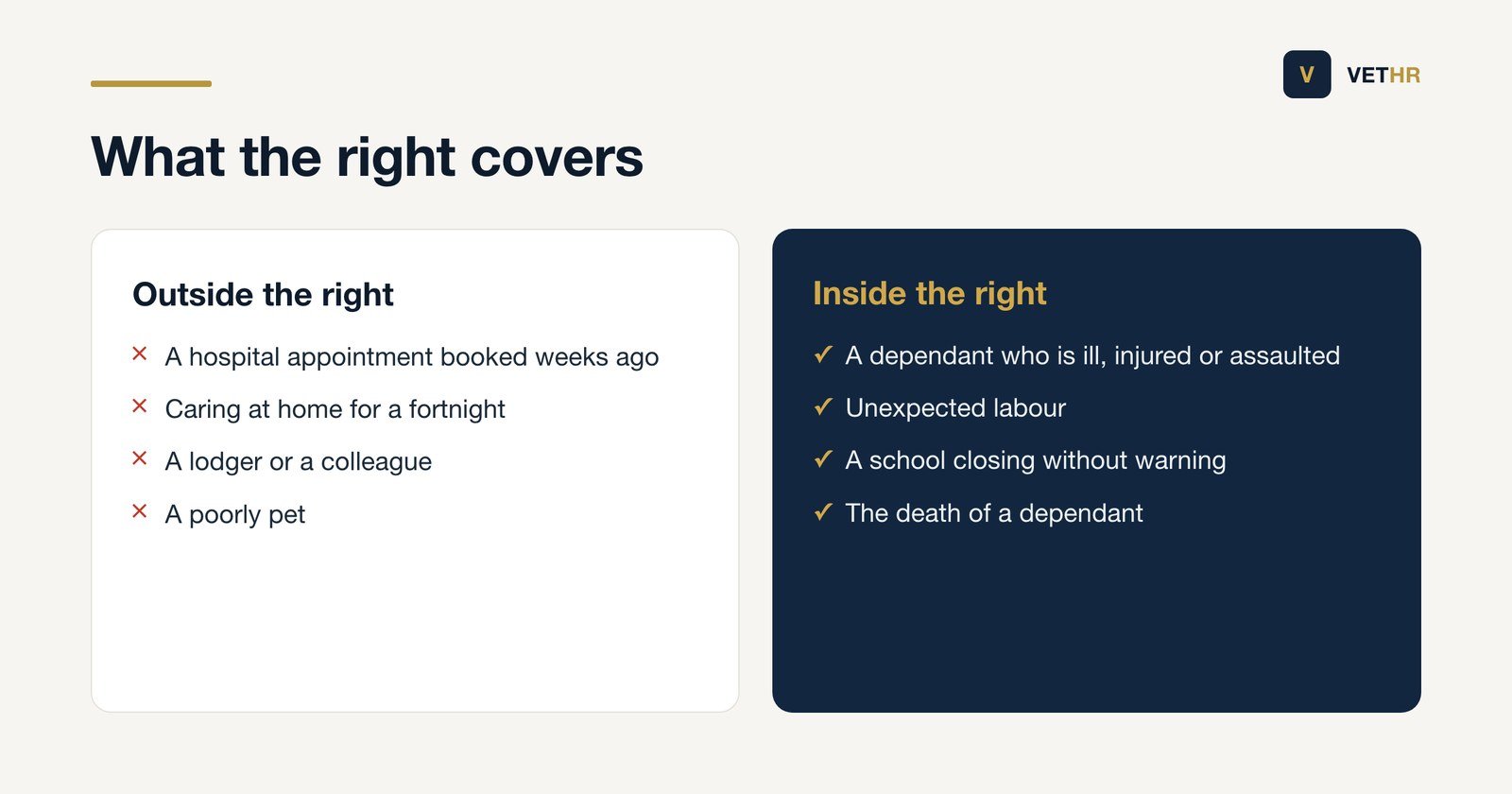
A dependant is a close family member or someone who relies on the employee. Acas lists a husband, wife, civil partner or partner, a child, a parent, a person who lives in their household, and a person who relies on them, such as an elderly neighbour. Tenants, lodgers and employees in the household do not count.
The GOV.UK guidance on time off for dependants also names a grandchild, and anyone who depends on the employee for care. The practical test is reliance: who would be left without help if your employee did not go?
That covers more of your team’s lives than the obvious cases. A receptionist who is the only local relative of a frail grandmother, or a vet whose partner has been in an accident, both fall within it.
Time off for dependants covers the unexpected. Acas gives examples: helping a dependant who is ill, injured or assaulted, taking a dependant to hospital when they go into labour unexpectedly, a child’s school closing unexpectedly, and the death of a dependant. Section 57A of the Employment Rights Act 1996 also covers the unexpected disruption or ending of care arrangements, such as a childminder cancelling.
What it does not cover is the planned. GOV.UK is clear that the right does not apply to a situation the employee knew about beforehand, and gives a hospital appointment as the example. Planned time is better handled through carer’s leave, parental leave or annual leave.
There is no set amount. The law says the time should be reasonable, and GOV.UK says it depends on the situation. Usually that means enough time to deal with the emergency itself and put other arrangements in place, which is often a day or two rather than a week, though a serious illness or a death can need longer.
GOV.UK’s own example is a child falling ill: the employee could take time off to go to the doctor and make care arrangements, and the employer may then ask them to use annual leave or parental leave if they want to look after the child for longer.
Acas adds that the employer should be as flexible as it can be, depending on the employee’s circumstances. In practice terms, the question to ask on the phone is simple: how long do you think you will need, and what would help?
The employee should tell you as soon as possible, explain the reason and say how long they expect to be away. In a genuine emergency that call may come after the shift has started, and that is still within the rules.
No. Time off for dependants is unpaid unless the contract or the practice’s policy says otherwise. GOV.UK confirms employers may pay for it but do not have to. What matters more is consistency: pay one nurse and not another for the same situation, and you have a fairness problem even if the law allows either.
Some practices offer paid compassionate leave or special leave alongside the statutory right. Acas notes these can be a better option for the employee, for example where the practice pays compassionate leave but not time off for dependants, or where the person needing help does not count as a dependant.
Write the position down. A single line in the staff handbook saying whether this leave is paid, and for how long, saves an awkward conversation at the worst possible moment.
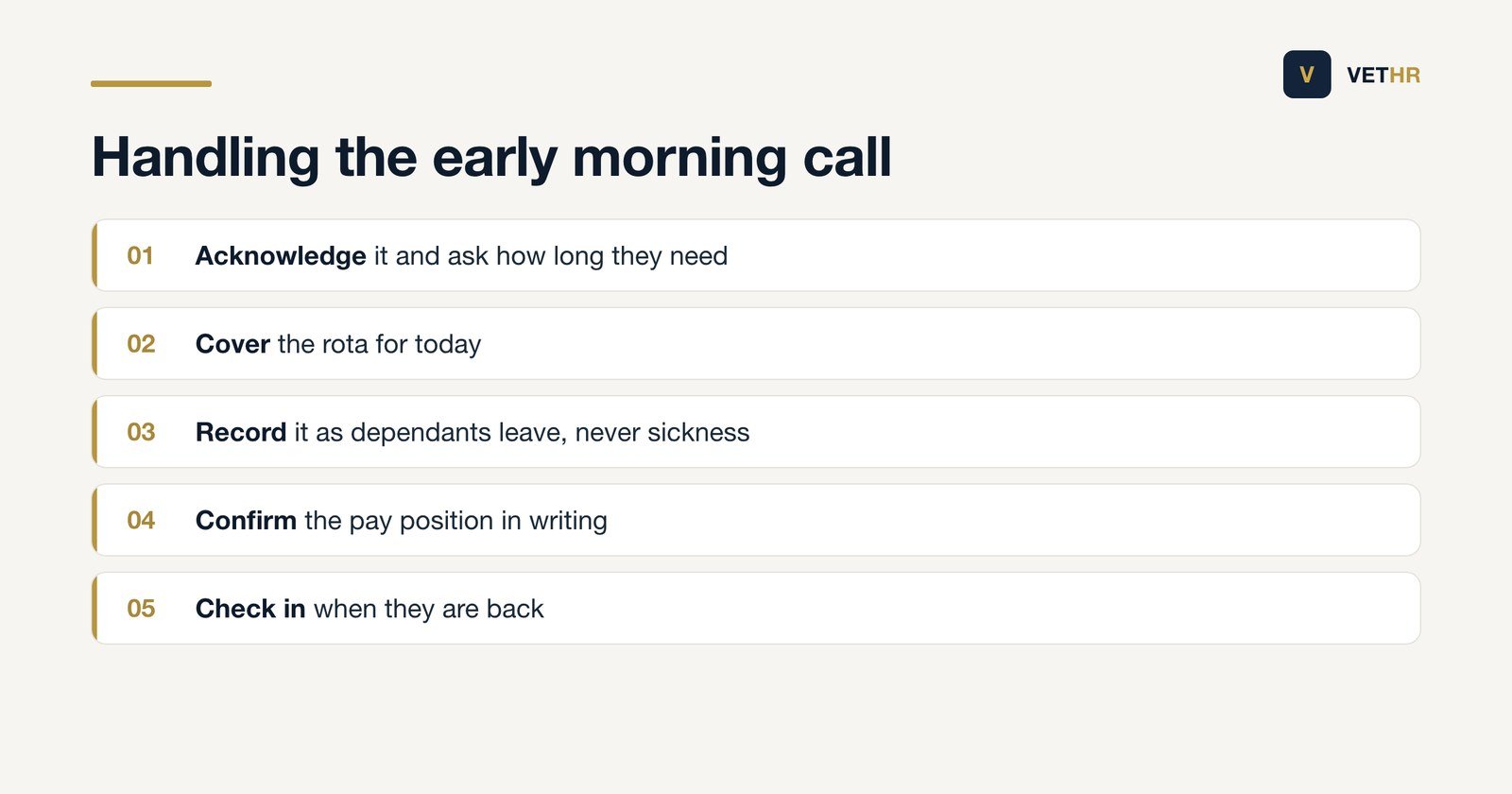
Listen first, then solve the rota. The person on the phone needs to hear that they can go, and to be asked how long they expect to need. Everything else, including cover, pay and recording, can be sorted by the practice once the call has ended.
Step three matters more than it looks. Logging an emergency as sickness can push someone towards an absence review they should never face, which is exactly the kind of worse treatment the law protects against. Our guide to absence trigger points explains why the categories need to stay separate.
Not sure how your practice records different types of leave? A free 30-minute HR health check will show you. Book your HR health check.
There is no limit on how many times someone can take time off for dependants, but GOV.UK says an employer may want to talk to the employee if the time off is affecting their work. That conversation should be about support and alternatives. It must never become a warning for using a legal right.
The protection is strong. Acas says an employee can bring a tribunal claim if they are unreasonably refused the time, treated worse for taking it, or dismissed or selected for redundancy because of it. Dismissal for taking or asking for this leave is automatically unfair, and no minimum length of service is needed to claim.
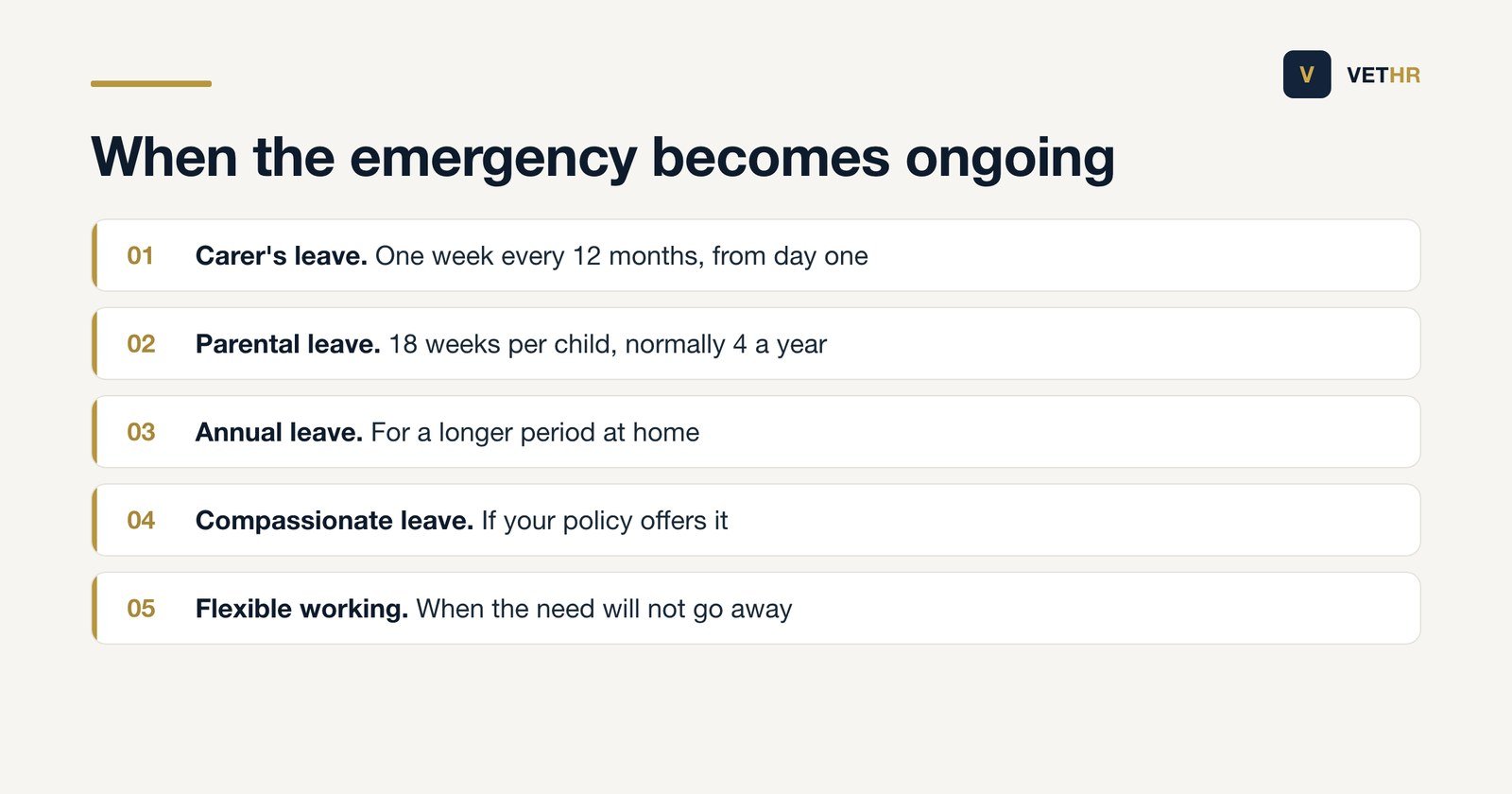
Repeated time off for dependants usually means the underlying care arrangement has changed. The better answer is often a different type of leave or a change to the working pattern:
A time off for dependants policy only needs to answer the questions people ask in the moment. Keep it to one page, put it where the whole team can find it, and make sure every shift lead can apply it at 7am without ringing the owner.
Only where the request is not reasonable or falls outside the right, for example a planned appointment. Unreasonably refusing genuine emergency time off can lead to a tribunal claim, so where there is doubt, let the person go and discuss the detail afterwards.
No. The statutory right is about people: partners, children, parents, household members and others who rely on the employee. A practice can still choose to offer compassionate leave, special leave or annual leave for a pet emergency, which many veterinary teams will understand better than most employers.
No set limit. GOV.UK says there are no limits on how many times someone can take it, although an employer may want to talk to the employee if it is affecting their work. Use that conversation to explore carer’s leave, parental leave or flexible working.
No. Record it separately. Counting emergency time off for a dependant towards a sickness review risks treating the employee worse for using a legal right, which Acas lists among the grounds for a tribunal claim.
The statutory right applies to employees. Whether bank staff are employees or workers depends on the real working relationship, so check their status. Many practices choose to handle emergencies the same way for everyone, which is simpler and fairer.
The 6.50am call is a test of culture as much as of policy. Say go, cover the rota, record the absence properly, and talk about longer-term support if the emergencies keep coming. That approach costs little and is remembered for years.
Our holiday and absence tools keep each type of leave in its own category, and a free HR health check will confirm your policy says what it needs to.
The Vet HR Team provides HR consultancy and white-labelled staff systems exclusively to UK veterinary practices. This guide is general information, not legal advice.
Contracts, rotas, holiday, a difficult conversation. Tell us what you are dealing with and we will come back within one working day. Nothing to sign up to.
Got it. We will come back to you within one working day. If you do not see a reply, please check your spam folder.
