Last updated: 5 September 2026
TL;DR: Work related stress is a health and safety risk, and employers have to assess significant risks to health. Most veterinary practices have a written assessment for cytotoxic drugs, radiation and manual handling, and nothing at all for workload. The HSE’s six Management Standards give you a structure you can work through in an afternoon without needing a psychologist. What makes it real is picking two actions and finishing them.
This article is about the employer’s duty and the process. It is not clinical advice. If somebody in your team needs support now, Vetlife Helpline is free, confidential and open 24 hours a day, 365 days a year, on 0303 040 2551.
Yes, in the sense that matters. Employers must assess the risks to the health and safety of their employees, and the Health and Safety Executive treats work related stress as one of those risks rather than as a separate wellbeing topic. There is no regulation that names a document called a stress risk assessment, in the same way there is no regulation naming a document called a manual handling assessment. The duty is to assess and to act on what you find.
The practical test is simple. If somebody asked to see your stress risk assessment, could you show them anything? For most practices the honest answer is a wellbeing poster and a hope.
The HSE publishes the Management Standards approach precisely so that an ordinary employer can do this without specialist help. It sets out six areas. Work through them honestly and you have a stress risk assessment.
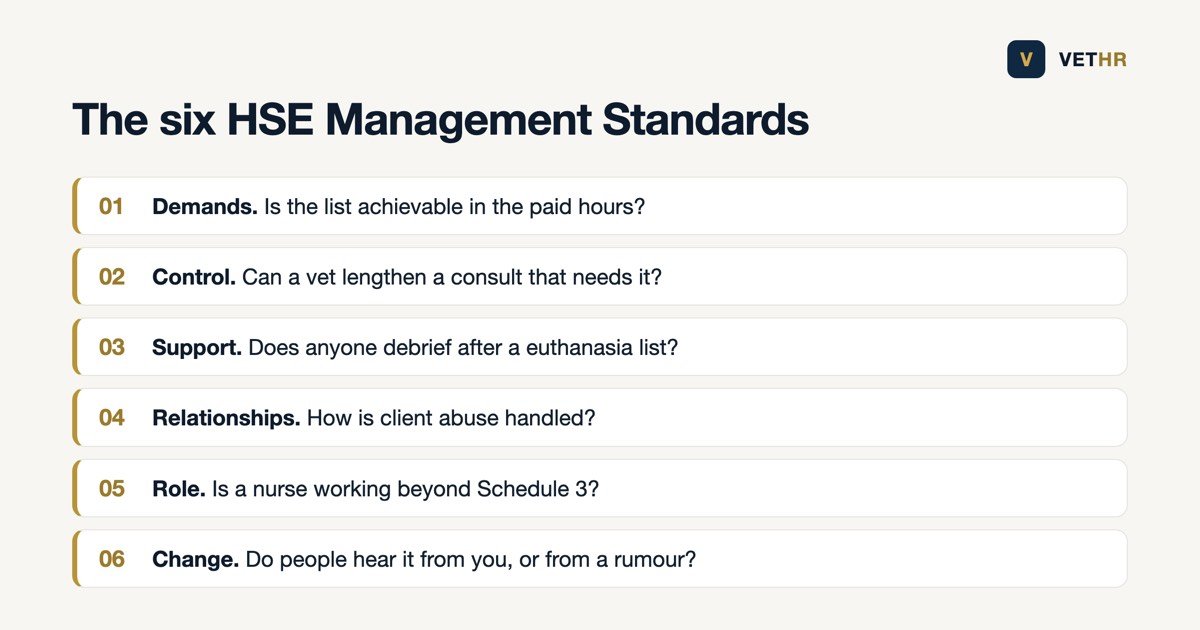
The standards were written for workplaces generally, and as the frame for a stress risk assessment they fit a veterinary practice almost exactly. Here is what each one is actually asking about.
Six areas, four or five questions each. That is the whole stress risk assessment, and it is why an afternoon is enough.
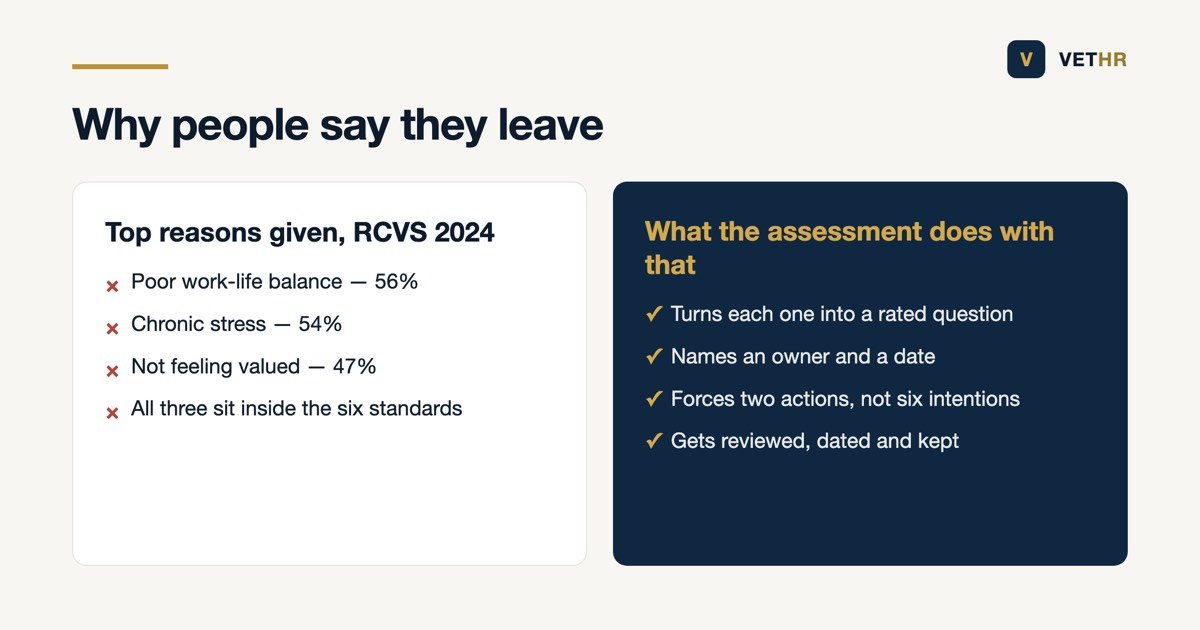
It is worth being direct about why a stress risk assessment matters more here than in an accountancy office. In the RCVS 2024 Surveys of the Professions, the reasons given by respondents who intended to leave were poor work-life balance (56 percent), chronic stress (54 percent) and not feeling rewarded or valued in a non-financial sense (47 percent). Every one of those three sits inside the six standards. The work also combines high emotional load, frequent client conflict, clinical responsibility carried very young, unsocial hours, and ready access to means. Elevated suicide risk in the profession has been documented for decades and is the reason Vetlife exists at all.
That combination is not present in most workplaces. It is the reason a stress risk assessment in a practice needs to ask about the euthanasia list and the abusive phone call, not about open plan noise levels.
You cannot complete a stress risk assessment from behind a desk and rate demands as low risk. The input to a stress risk assessment is what the team says, which is why the survey and the assessment are one exercise rather than two.
Ten questions on one page, anonymous, five minutes. A long survey does not get more honesty, it gets fewer responses. Ask whether people can finish their work in the hours they are paid for, whether they get a proper break, whether they get support after a difficult case, whether they are backed up when a client is abusive, and whether they would recommend working here to a friend in the profession.
Then report the results back, including the uncomfortable ones, and carry them straight into the stress risk assessment. A survey with no visible consequence is worse than no survey at all, because it teaches the team that saying so changes nothing. The next one gets half the responses and all of them polite.
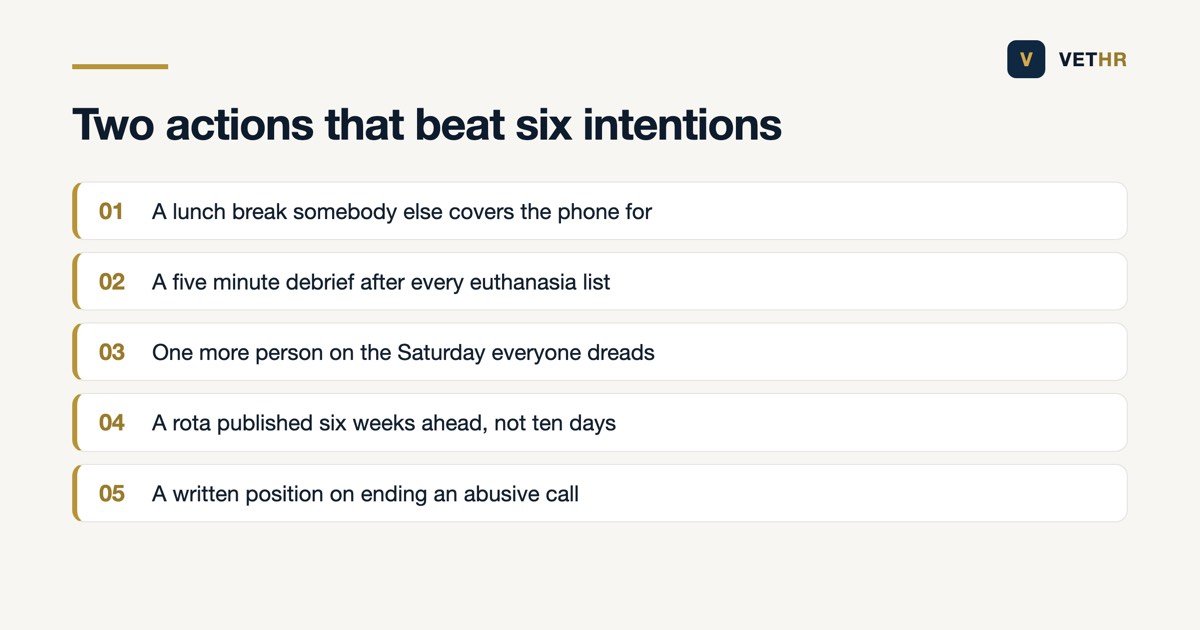
The failure mode of a stress risk assessment is a completed form with an action column full of words like “monitor” and “encourage”. Nothing changes, and the next assessment says the same thing a year later.
Pick the two highest risks and finish them before the review date. In practice the actions that move the needle in a veterinary practice are unglamorous:
Two of those, finished, will change the next survey more than a full page of intentions.
Sometimes a stress risk assessment stops being about the practice and starts being about one person. The conversation that follows is a supportive one, not a performance meeting, and it should not be minuted as one.
Open with what you noticed rather than what you concluded. “You have seemed stretched the last few weeks and I would rather ask than assume.” Then listen more than you talk, ask what would help before you suggest anything, and be honest about what you can and cannot change. Promising a rota change you cannot deliver does more damage than saying no.
Do not try to be the clinician. Encourage them to see their GP and offer to help them find the time. Give them the Vetlife number and say plainly that it is confidential and does not come back to the practice. If you believe somebody is at immediate risk, stay with them and get medical help now.
Anything you write down that records a health condition is special category data under UK GDPR. A note saying “off with anxiety, phased return agreed” is health data, and it needs a lawful basis, restricted access and a stated retention period.
Keep it separate from the general personnel file, limit who can open it, and make sure your staff privacy notice actually says you hold it. The ICO’s employment guidance is the reference point if you want to check your position.
Review the stress risk assessment annually as a minimum, and again after anything that changes the picture: an acquisition, a departure that reshapes the rota, a serious incident, a complaint that shook somebody, or a run of short term absence that looks like a pattern rather than a coincidence.
Date it, sign it, and keep the previous version. A stress risk assessment that has visibly changed year on year is evidence that the practice is managing the risk. One that has never been touched is evidence of the opposite.
Once a year as a baseline for the stress risk assessment, and again whenever something significant changes: an acquisition, a restructure, a serious incident, or a departure that changes the rota for everybody left. If nothing has changed and the last one produced completed actions, an annual review is enough.
The duty to assess risk does not have a headcount threshold. Employers with fewer than five employees do not have to write their risk assessment down, but writing it down is the only way to show you did it, and in a five person practice one person under sustained pressure is twenty percent of your team.
That is the assessment working. Report the results honestly, name the two things you are changing, and give a date. A team that sees a bad result acknowledged and acted on trusts the process more than a team that never saw a result at all.
Stress itself usually is not, but a mental health condition that has a substantial and long term adverse effect on day to day activities can be a disability under the Equality Act, and depression and anxiety often qualify. Once you know or ought to know, the duty to make reasonable adjustments applies, so take advice before you treat it as a straightforward absence issue.
Whoever holds health and safety in the practice should own the stress risk assessment, usually the practice manager or a partner, working from what the team has said rather than from their own impression. What you cannot do is have the person the survey is partly about mark their own homework.
A stress risk assessment is not a wellbeing gesture. It is the same exercise you already do for sharps and cytotoxics, applied to the risk that actually drives people out of the profession. The stress risk assessment takes an afternoon. The two actions take a month. The alternative is another resignation letter that says the job was fine and the person was tired.
Read it with our guides to managing burnout and when to refer to occupational health.
Contracts, rotas, holiday, a difficult conversation. Tell us what you are dealing with and we will come back within one working day. Nothing to sign up to.
Got it. We will come back to you within one working day. If you do not see a reply, please check your spam folder.
