Last updated: 5 September 2026
TL;DR: Workplace mediation is a facilitated conversation between two people who have to work together tomorrow. It resolves the kind of conflict a grievance process cannot, because a grievance produces a winner and a loser and a small practice cannot afford either. It is voluntary, confidential, and it does not work where there is a power imbalance or an allegation that needs investigating.
A structured, confidential conversation between people in conflict, facilitated by somebody neutral who does not decide anything. The mediator’s job is to get both people talking about what actually needs to change, not to judge who was right.
That last part is what makes it different from everything else in the HR toolkit. A grievance produces a finding. A disciplinary produces an outcome. Workplace mediation produces an agreement that both people had a hand in writing, which is why it tends to hold.
Because of the size and the intimacy of the work. Two nurses who cannot get on will still be sharing a prep room on Thursday. There is no other department to move somebody to, no floor to put between them, and often no way to avoid a shared out of hours shift.
A formal grievance in that setting produces a written finding that one of them was wrong, and then both of them anaesthetise a patient together the following week. The process technically concluded and the practice is worse off.
Workplace mediation is designed exactly for that situation: an ongoing working relationship that has to survive the resolution.
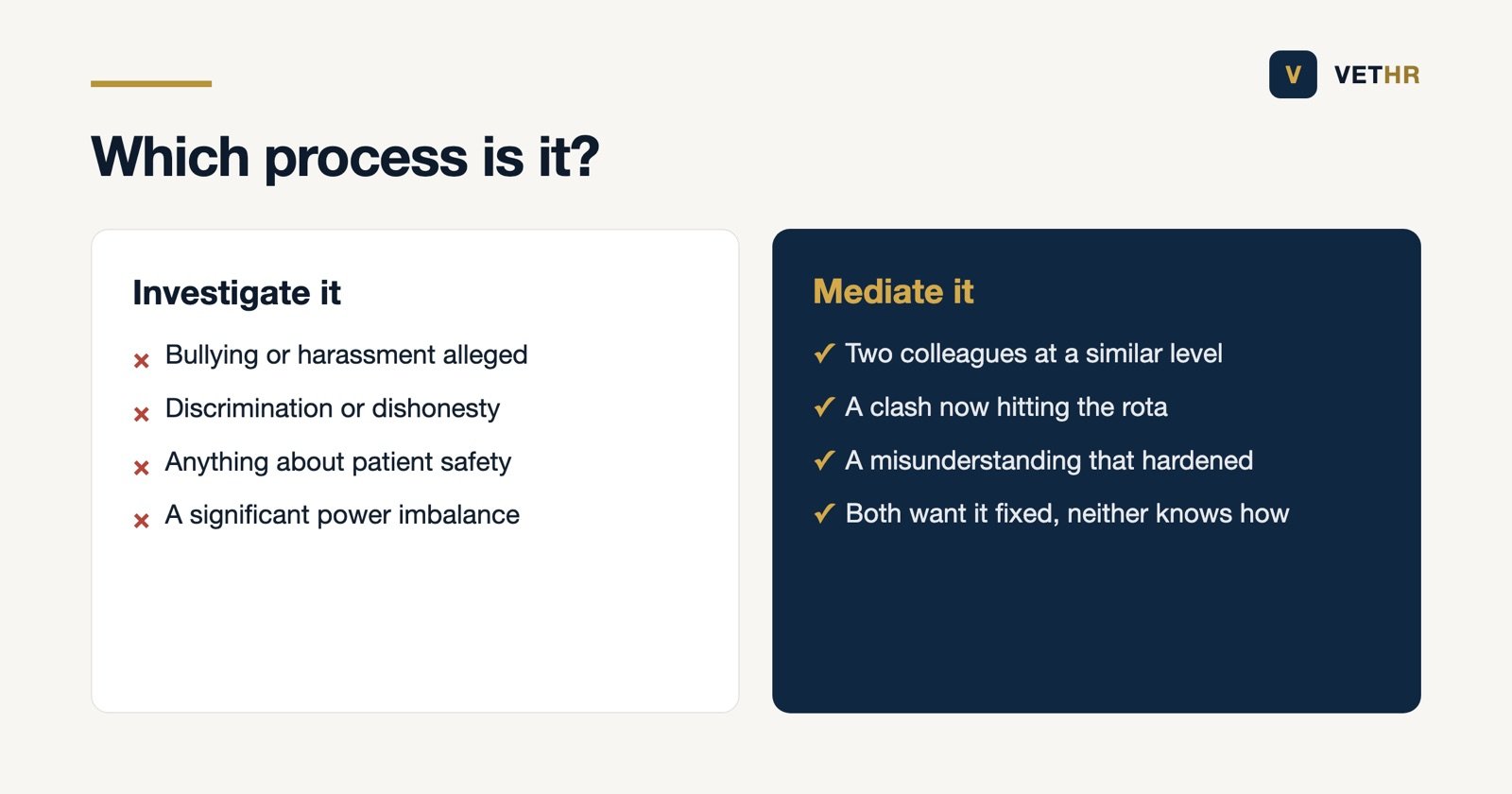
The common thread is that both people have something to gain from resolution and neither needs a finding of fact.
This matters more than the list above, because offering mediation in the wrong situation causes real harm.
The test is simple. If the question is “did this happen”, it is an investigation. If the question is “how do these two work together from here”, it is workplace mediation.
Somebody neutral, trusted by both, and with no stake in the outcome. In a small practice that is often nobody internal, and pretending otherwise is how workplace mediation fails on the first attempt.
The practice manager is rarely the right choice if they line manage either person. A partner is rarely right if the dispute touches a rota or a pay decision they made. Realistic options are a manager from another site, an external mediator, or your HR adviser.
Whoever it is must not be the person who would later hear a grievance about the same matter, for the same reason an investigator should not chair a hearing.
Half a day of workplace mediation is usually enough. Where it is not, that is often a sign the matter needed a different process.
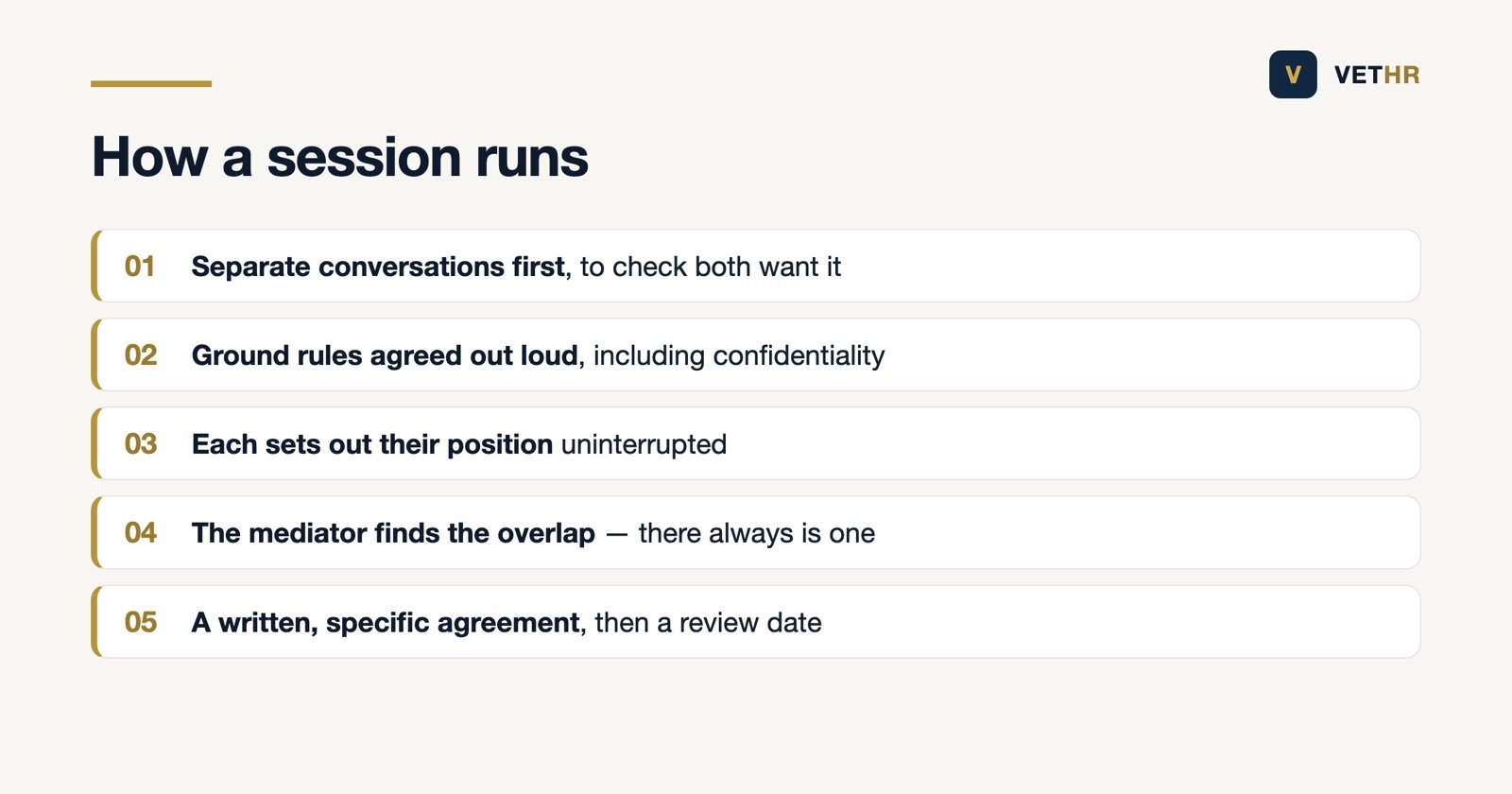
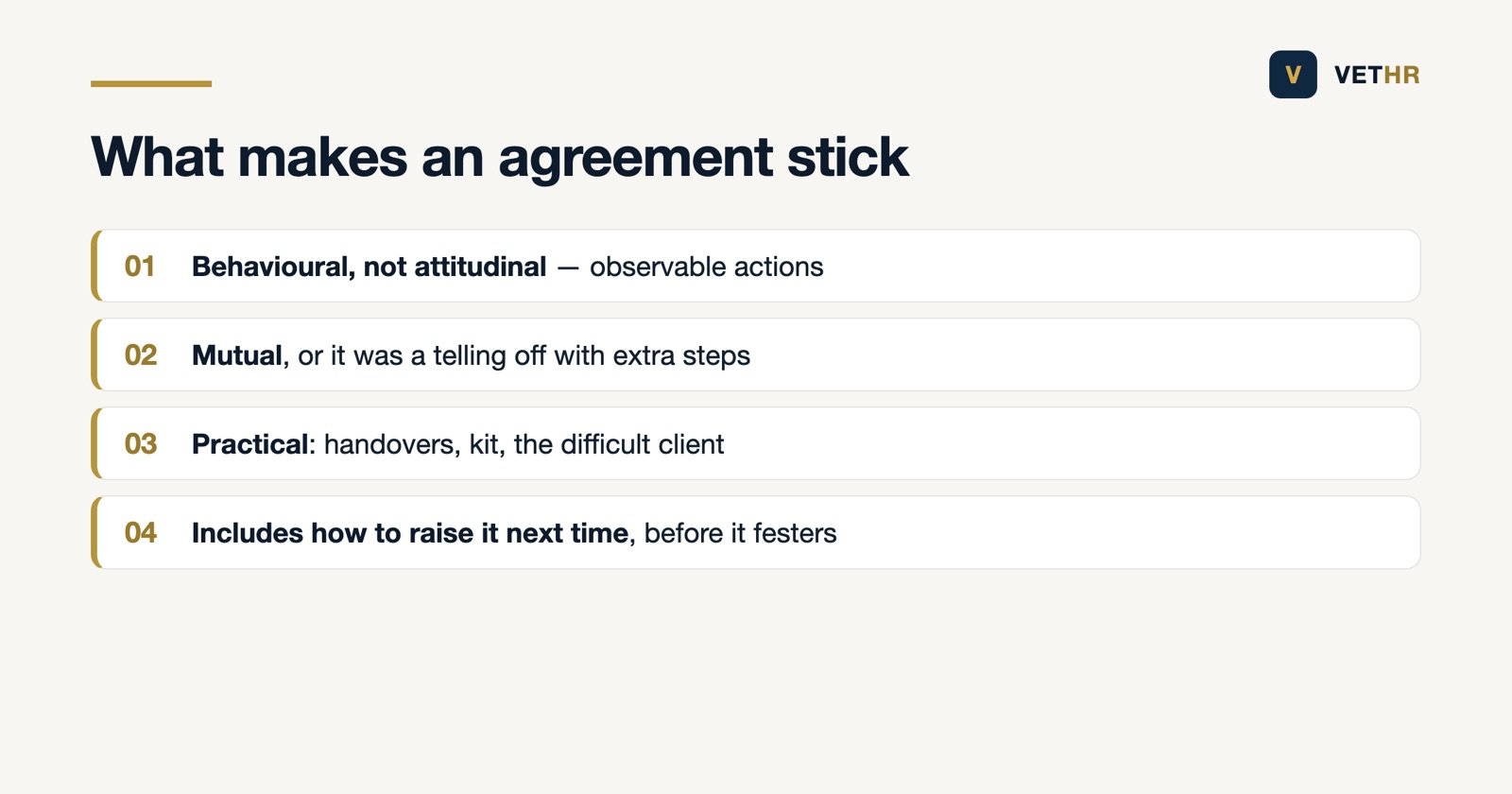
The agreement is where workplace mediation either sticks or quietly unravels, and the difference is specificity.
Vague agreements fail because nobody can tell whether they are being kept. “We will communicate better” cannot be observed, so within a fortnight both people privately believe the other one has broken it.
Write it down, both keep a copy, and diarise the review before anybody leaves the room.
What is said in workplace mediation stays there. The agreement can be shared with whoever needs to implement it, and the fact that mediation happened is usually recorded, but the content is not.
Two limits to state at the start rather than discover later. If something emerges that concerns patient safety, animal welfare or a safeguarding issue, it has to be acted on. And if an allegation of harassment or discrimination surfaces, the mediation stops and the proper process starts.
Say both of those before anybody speaks, not afterwards.
Workplace mediation sits before a grievance, usually. The draft Acas Code published for consultation in 2026 puts noticeably more weight on informal resolution than the current one, so a practice that tried workplace mediation and recorded that it tried is in a stronger position than one that went straight to a formal hearing.
Offering it does not remove anybody’s right to raise a grievance, and it must never be presented as though it does. The right form of words is that mediation is available, it is voluntary, and the formal route remains open either way. Acas publishes guidance on mediation at work.
If the formal route is where you end up, our free grievance pack has the forms and letters.
No. It only works where both people choose it, and compelling attendance removes the voluntary basis the whole thing rests on. You can explain what it is and encourage it. You cannot instruct it.
No. It can resolve a matter so that nobody wants to raise one, which is different. The right to raise a grievance stays open throughout and must be stated clearly when mediation is offered.
That is what the review date is for. Sometimes one more session fixes it. Sometimes it shows the matter was never suitable for workplace mediation, in which case move to the formal process without treating the attempt as a failure.
Generally not as a performance record. Keep a note that workplace mediation took place and a copy of any practical agreement that affects working arrangements. The detail of what was said should not be filed.
In a practice, a two person disagreement is never confined to two people. It shows up in the rota, in who volunteers for what, and in how the team feels on a bad day. Half a day of workplace mediation is cheap against that.
Practices tend to have two settings for conflict: ignore it, or start a formal process. The first lets it grow and the second frequently costs somebody’s employment over something that was never that serious.
Workplace mediation is the missing middle, and it is far cheaper than either. Just be honest about which situations it suits, because using it as a way to avoid hearing a real complaint does more damage than never offering it. If you are not sure which you have, our free HR health check covers it, and see also our guide to managing conflict.
Contracts, rotas, holiday, a difficult conversation. Tell us what you are dealing with and we will come back within one working day. Nothing to sign up to.
Got it. We will come back to you within one working day. If you do not see a reply, please check your spam folder.
