Last updated: 5 September 2026
TL;DR: Student veterinary nurses leave practices over unprotected coaching time far more often than over pay. The clinical coach role only works if the hours are on the rota like a consult block, if there is a named alternative for when the coach is away, and if progress is reviewed on dates that were booked in advance. Everything else is detail.
A clinical coach supervises, teaches and assesses a student veterinary nurse in practice, and signs off the practical evidence that their training requires. It is the bridge between what the student learns at college and what they can actually do on a Tuesday with a real patient. The RCVS sets the framework for veterinary nurse training, and your training provider will tell you what it requires of the role in your case.
Put plainly, the clinical coach is the reason the qualification happens. A student can pass every written assessment and still fail to progress if nobody in practice is teaching, watching and signing.
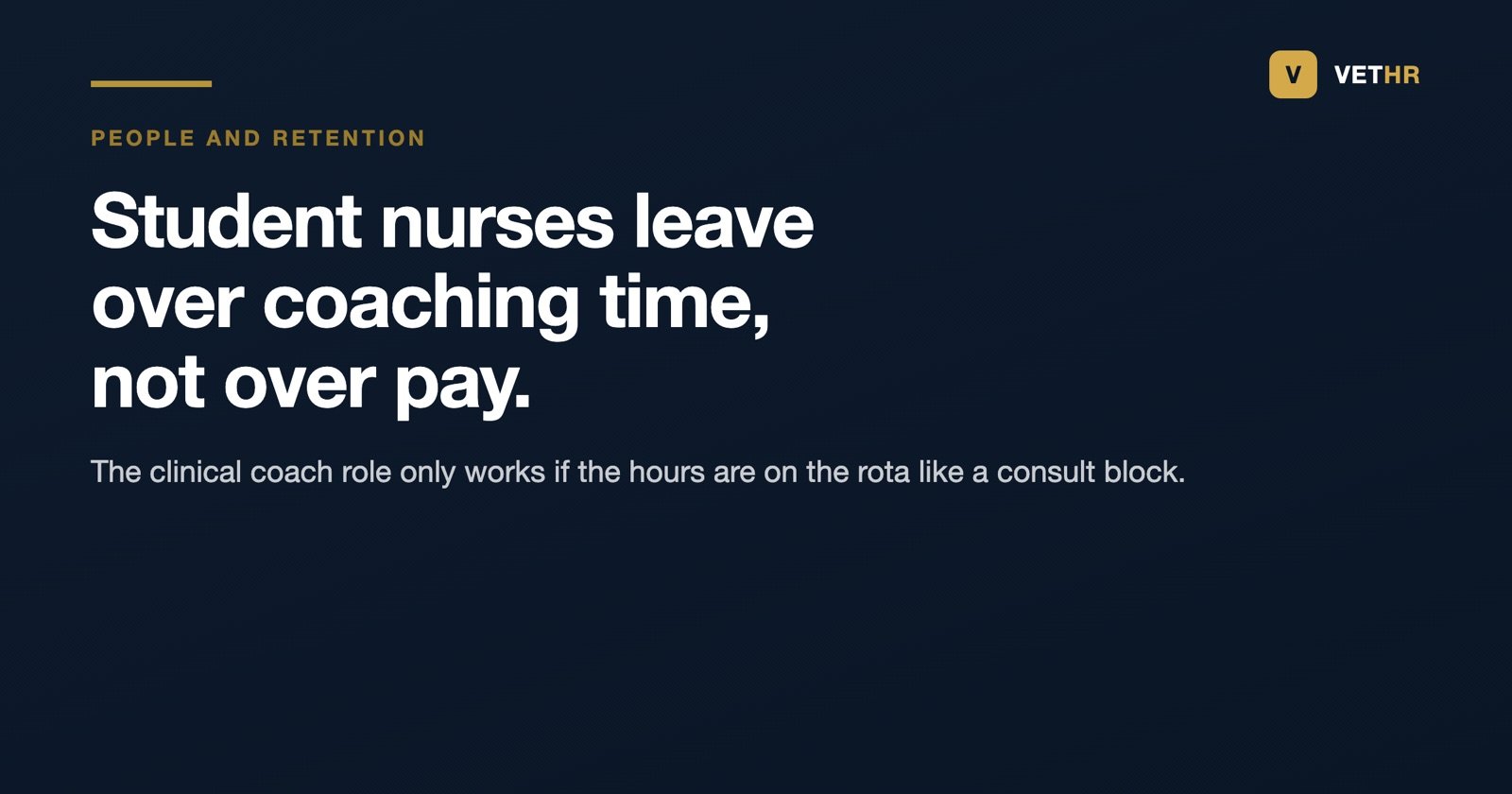
Rarely for the reason the exit conversation gives. The stated reason is usually pay or hours. The real reason, over and over, is that the training stopped happening and nobody noticed until they were already applying elsewhere.
Three patterns cause most of it:
The third is the most insidious, because everything looks fine. The student is busy, the team likes them, nobody is unhappy, and at the end of the year the portfolio is thin and the conversation is awkward.
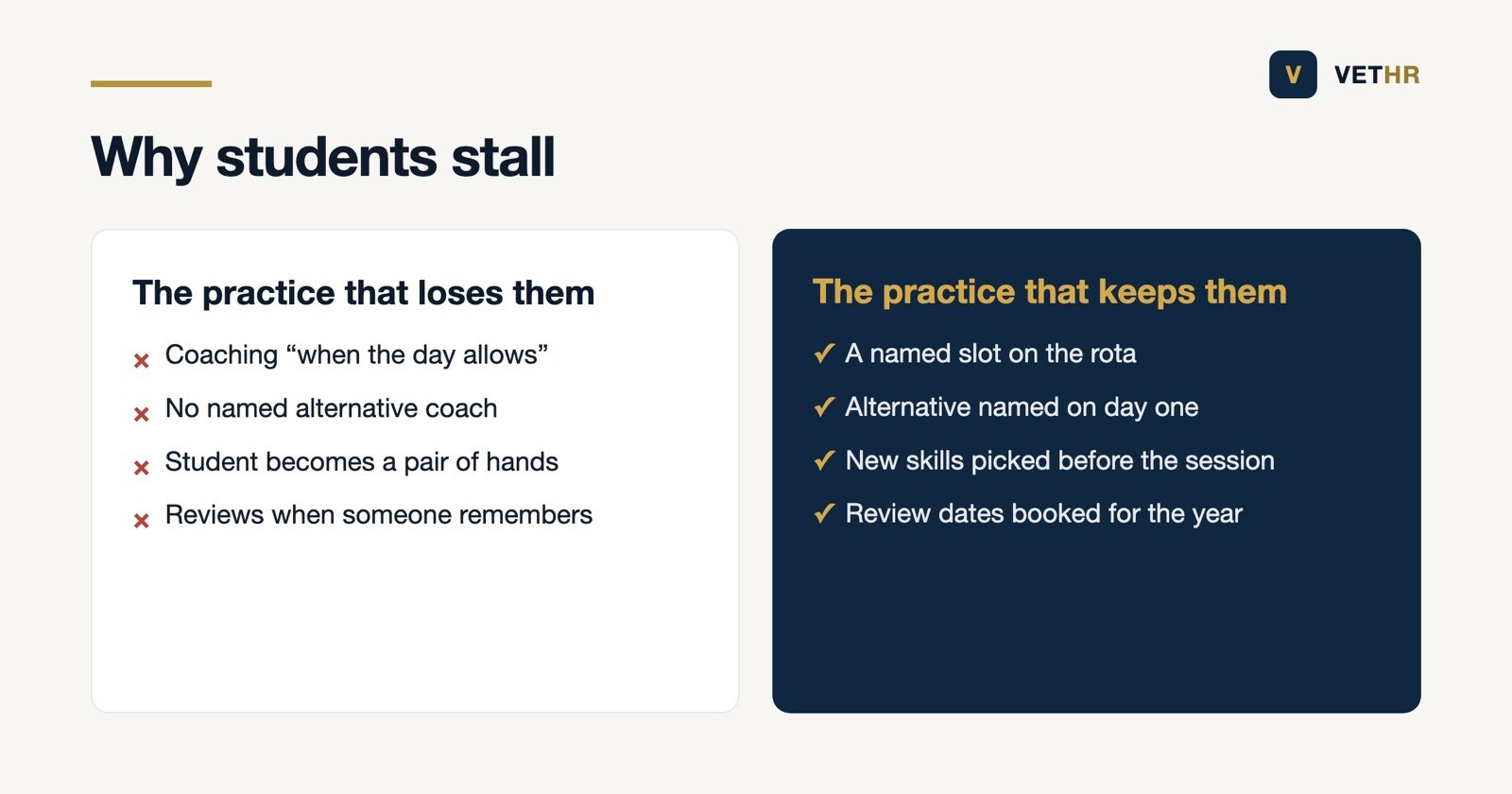
If you change one thing after reading this, change this one. Put the clinical coach hours on the rota with a name against them, in exactly the way an operating list or a consult block goes on the rota.
Not “we try to find time each week”. A slot, on the rota, that the practice defends. When the day goes wrong and something has to give, the rule is that the coaching session moves rather than evaporates, and it moves to a specific new time before the end of that day.
This costs staffing capacity and that is the honest trade. A practice that cannot rota protected coaching time does not have a coaching problem, it has a staffing levels problem, and taking on a student nurse without solving it first is unfair to everyone including the student.
Practices often appoint a clinical coach and never define the session, so it becomes a chat about how things are going. Useful, but not training.
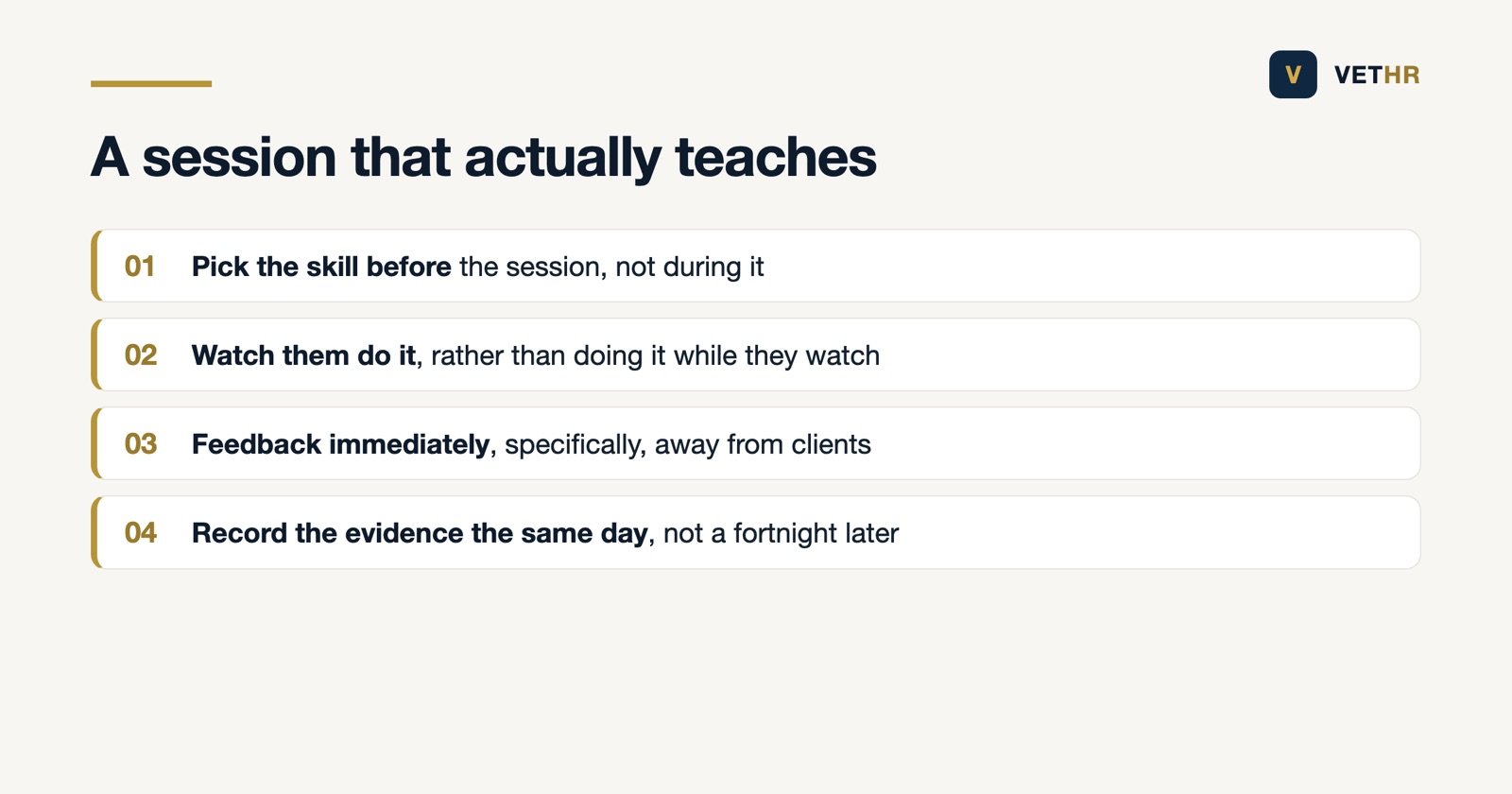
A working session has a shape. Pick one skill from the outstanding list before the session starts, not during it. Watch the student do it rather than doing it while they watch. Give feedback immediately, specifically, and out of earshot of clients. Record the evidence the same day, because a sign off written from memory a fortnight later is worth very little to anyone.
Twenty minutes done that way beats an afternoon of shadowing. The most common thing a clinical coach gets wrong is doing the task themselves because it is quicker, which it always is, and which teaches nothing.
It is worth being blunt about this, because protected coaching time is always competing with something that feels more urgent.
A student who leaves part way through takes with them everything the practice has already invested: the coaching hours already given, the training costs already paid, the recruitment round that found them, and the year or two of a nearly qualified pair of hands you were about to get back. Then you either recruit a qualified RVN in a market where that is slow and expensive, or you start another student and begin the investment again.
Set against that, an hour a week of protected clinical coach time is not a cost. It is the cheapest retention spend in the building, and the same logic that runs through our guide to the cost of a bad rota.
The best clinician is not automatically the best coach, and appointing on seniority alone is a common error. The qualities that matter are different.
Give the role to one person, name an alternative, and put both in the student’s induction paperwork. Our free new starter pack has an SVN section that covers exactly this.
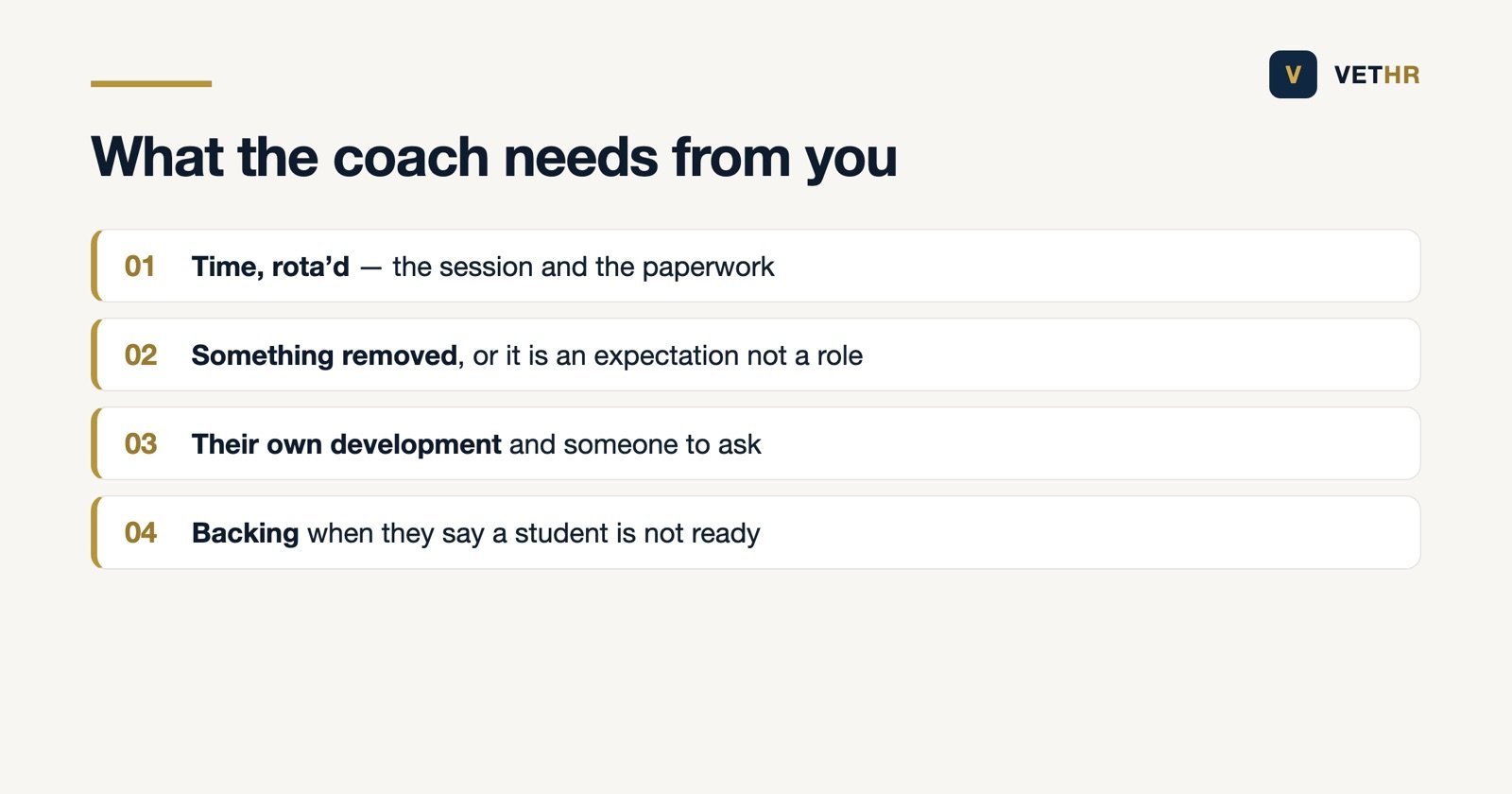
The clinical coach role is usually added to a full job with no time removed from it, and then the practice wonders why it does not happen. The role needs support in four concrete ways.
Book progress reviews for the whole year on the day the student starts. Monthly for the first three months, then at least quarterly. Twenty minutes each, written up briefly, with three questions.
What have you done since we last met that was new? What is on the list that you have had no opportunity to practise? What is getting in the way? The second question is the one that surfaces drift, because the honest answer after a busy quarter is often a long list.
Where progress has stalled, fix it as a rota problem rather than treating it as a performance issue. It is almost never the student’s fault.
A student veterinary nurse is an employee as well as a trainee, and the two relationships need to stay distinct.
The last point matters most. A clinical coach who also runs the disciplinary process is a coach the student will manage rather than confide in.
Agree a figure with your training provider and then rota it. What matters far more than the exact number is that it is a fixed, named slot rather than an intention, and that it survives a busy week.
Sometimes, but only if the time is doubled rather than shared. Two students on one clinical coach with the same rota’d hours means both get half a coach, and both notice.
Change the clinical coach, early and without blame. A poor coaching relationship does not improve with time and it costs a qualification. This is exactly why a named alternative should exist from day one.
Recognise the clinical coach role somehow, whether through pay, protected time, CPD or title. A role that carries real responsibility and no recognition gets done badly by tired people, and coaching is the first thing to slide.
Then do not take a student this year. That is a genuinely responsible decision, and far better than enrolling someone into a training place your rota cannot support.
Training your own nurses is the most reliable recruitment strategy available in this profession, because you end up with someone who knows your practice, your clients and your protocols, and who chose to stay. It only works if the coaching is real.
Put the hours on the rota this month and name the alternative coach. If you want help structuring the role and the reviews, our free HR health check covers it, and you keep the written summary either way. Acas has useful general guidance on training and development at work.
Contracts, rotas, holiday, a difficult conversation. Tell us what you are dealing with and we will come back within one working day. Nothing to sign up to.
Got it. We will come back to you within one working day. If you do not see a reply, please check your spam folder.
