Last updated: 4 September 2026
TL;DR: From 30 October 2026 employers must give workers a written trade union statement telling them they have the right to join a union. It goes out with the written statement of particulars, so in practice it becomes part of onboarding. There is no small employer exemption. The under 21 threshold you may have read about applies to union access rights, which are a different duty entirely.
The trade union statement is a short written notice telling a worker that they have the right to join a trade union. Nothing more dramatic than that.
Section 58 of the Employment Rights Act 2025 inserts a new section 136A into the Trade Union and Labour Relations (Consolidation) Act 1992, requiring employers to give workers a written statement that they have the right to join a trade union. It must be given at the same time as the section 1 written statement of employment particulars, and at other times to be prescribed in regulations.
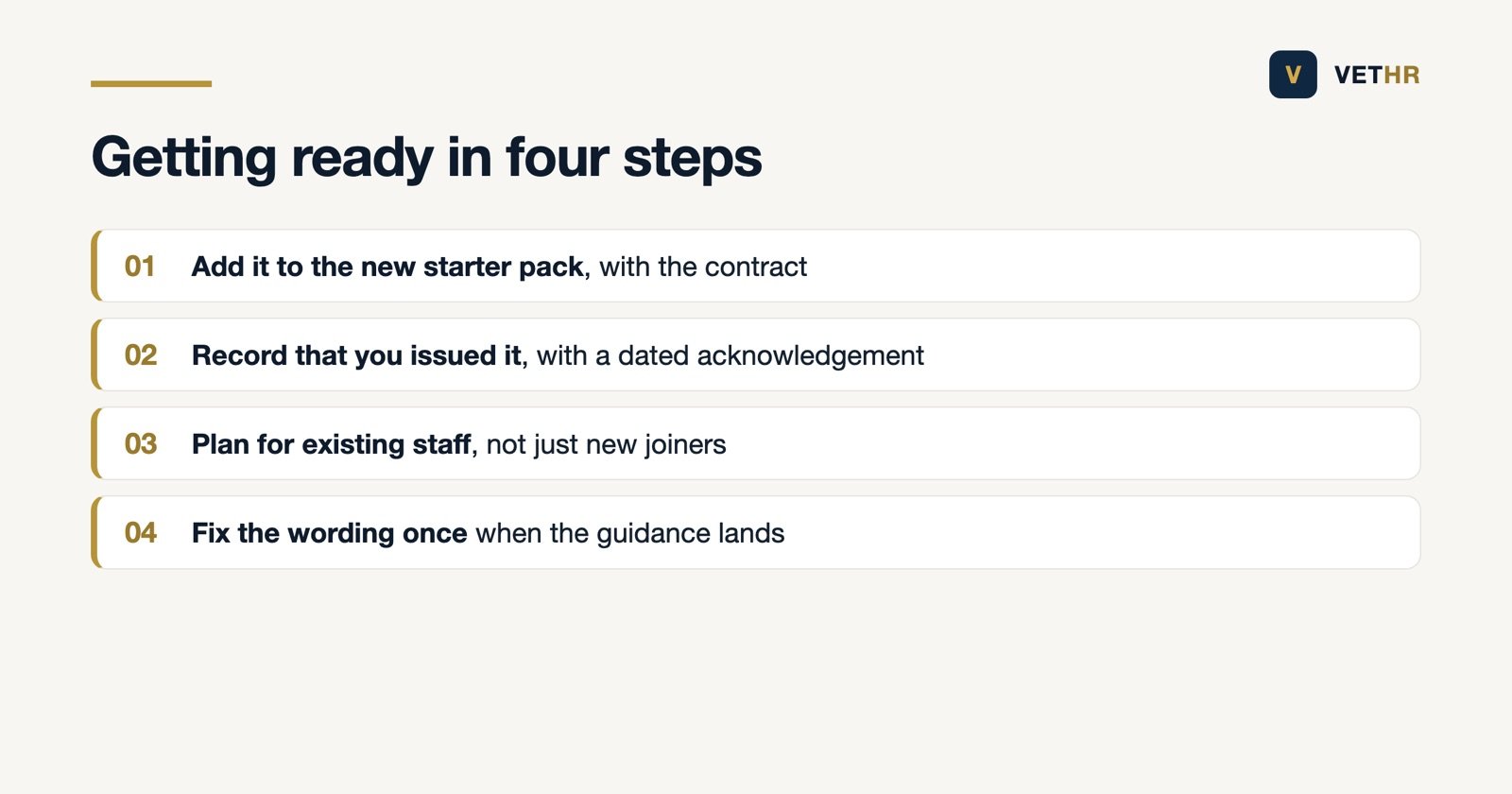
Because the section 1 statement is a day one right, the trade union statement effectively becomes part of your new starter pack from 30 October 2026.
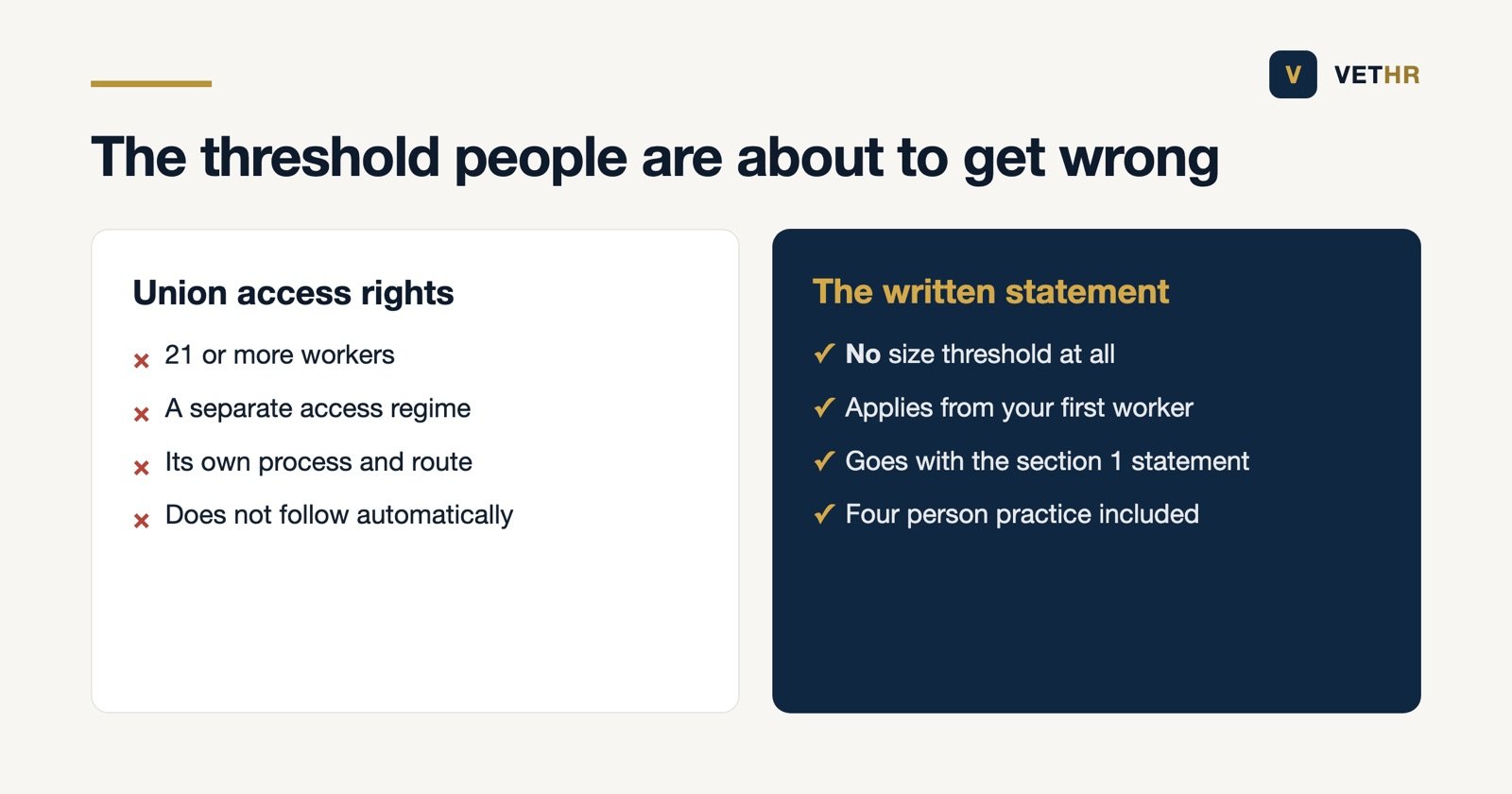
No. The trade union statement duty has no size threshold, and this is the point most likely to be got wrong.
A 21 worker threshold does appear in the trade union reforms, and it has been widely reported. It attaches to the new right of access, under which a union can seek an agreement to enter a workplace or communicate with workers. That access regime is where the size threshold sits.
The trade union statement duty in section 136A carries no such threshold. It applies to employers regardless of headcount. A four person branch surgery owes it exactly as a fifteen site group does.
If you take one thing from this article, take that distinction. Two different duties arrive on the same day, only one of them has a size exemption, and it is not the one that affects every practice.
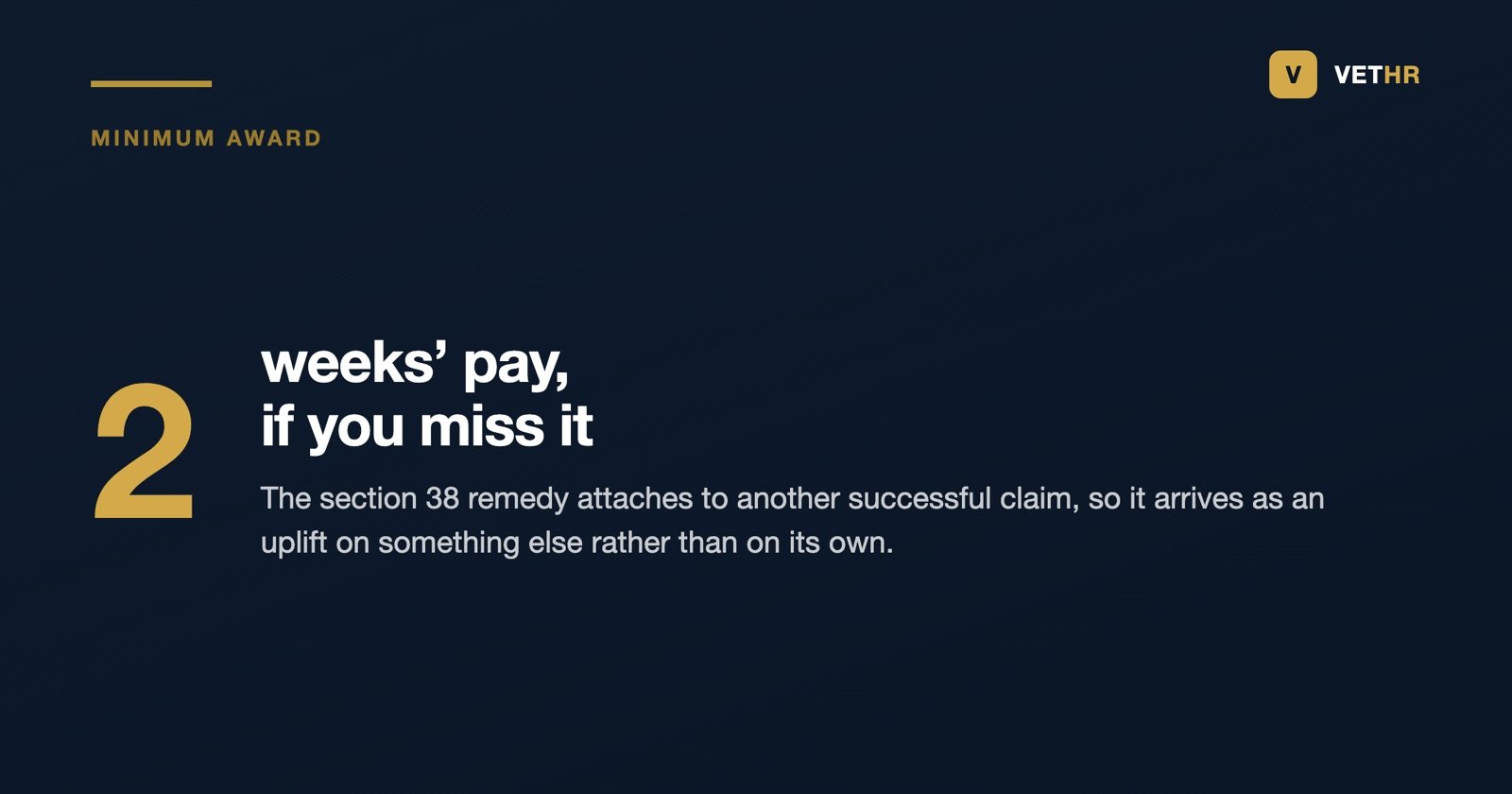
Failure to comply attracts a remedy under section 38 of the Employment Act 2002. That is the mechanism that already applies where an employer has not given a proper written statement of particulars, and it carries a minimum award of two weeks’ pay.
The important structural detail is how that remedy works. It is not usually a free standing claim. It attaches to another successful claim, so the failure to issue a trade union statement becomes an uplift on whatever brought the person to a tribunal in the first place. You are unlikely to be taken to a tribunal solely for missing it. You are quite likely to have it added on top of something else.
That makes it exactly the sort of small administrative failure worth closing, because it costs almost nothing to comply and only ever appears at the worst possible moment.
The precise content will be set by secondary legislation, and further guidance was expected during September 2026. That means the sensible position today is to prepare the process rather than finalise the wording.
What is already clear is the shape. A trade union statement needs to tell the worker plainly that they have the right to join a trade union, and it needs to be in writing and given to them rather than merely available somewhere. Keep it factual and neutral. This is a statement of a right, not a position on whether anyone should exercise it.
Do not draft anything that could read as discouragement. Detriment or dismissal connected to trade union membership or activities is unlawful and carries protection from day one, so a statement with editorial commentary attached is a risk you have created for no benefit.
Union density is low across veterinary work, which is precisely why practices are likely to miss this. The instinct will be that it does not apply here. It does, because the duty attaches to being an employer rather than to having any union presence.
It is worth separating two things that often get conflated in a practice. Whether anyone joins a union is not your decision and not your business. Whether you issued the trade union statement is entirely your responsibility and entirely within your control.
Treat it the way you treat the privacy notice: a document you issue as a matter of routine, with a record that you did.
The trade union statement does not arrive alone, and the other change that day is considerably bigger for a veterinary practice.
Handle them together in one sitting. The trade union statement is a template job; the harassment duties need a risk assessment and a conversation with your team. Acas maintains a running summary of the Employment Rights Act 2025 as each tranche commences.
If you are building a compliance calendar for the year, put the trade union statement alongside the harassment work in October, then the unfair dismissal changes in January.
If you host your policies and issue documents with acknowledgements, this is a ten minute job. Our policies system does exactly that, and our employment contract template covers the section 1 particulars the trade union statement now travels with.
The duty is framed around workers, which is broader than employees. If you engage bank or casual staff on worker terms, plan on the basis that they are included.
Wait for the regulations before deciding. It must be given at the same time as the section 1 statement, but whether it can sit inside the same document or must be standalone is the kind of detail the secondary legislation will settle. A separate page is the safer default.
Answer factually and neutrally, and do not treat the question as a problem. Any detriment connected to union membership or activities is unlawful, and the conversation itself is protected territory.
That is the separate access regime, which is where the 21 worker threshold applies. It is a different process with its own route and does not follow automatically from issuing a trade union statement.
The statute requires it at the point of the section 1 statement and at other prescribed times. Periodic reissue is expected but the exact frequency comes from regulations, so build a process that can repeat rather than assuming a one off.
This is one of the smallest obligations in the whole Employment Rights Act 2025 and one of the easiest to miss, because every instinct in a veterinary practice says it is about somebody else. It is not. It applies to you at any size, it lands on 30 October, and it costs a page and a tick box.
Put a placeholder in your onboarding pack now and fill in the final wording when the guidance lands. If you would rather someone else tracked this and the rest of the 2026 changes, our free HR health check is a good place to start, and you keep the written summary either way. See also our guide to the 2026 employment law changes.
Contracts, rotas, holiday, a difficult conversation. Tell us what you are dealing with and we will come back within one working day. Nothing to sign up to.
Got it. We will come back to you within one working day. If you do not see a reply, please check your spam folder.
