Last updated: 4 September 2026
TL;DR: There is no universal ratio. The RCVS Practice Standards Scheme sets floors rather than formulas, and the honest way to set veterinary practice staffing levels is to work backwards from the hours you must cover, then add headroom for holiday, sickness and CPD. Most practices are not short of staff on a normal week. They are short of cover on an abnormal one.
No. There is no statutory or regulatory ratio of veterinary surgeons to registered veterinary nurses, and anyone quoting you one is quoting a rule of thumb rather than a requirement.
What exists instead are minimum standards tied to what the practice actually does. The RCVS Practice Standards Scheme sets requirements by accreditation level, and those are floors. Meeting the floor is not the same as being adequately staffed, which is the distinction that catches practices out.
The requirements scale with accreditation level and with whether you hold in-patients. In broad terms:
The scheme’s five yearly review placed noticeably more weight on nursing presence and staffing sufficiency. If you were last accredited some time ago, check the current requirements against your veterinary practice staffing levels rather than assuming continuity.
Always work from the current published standards for your accreditation level. This article is an HR guide, not a substitute for the scheme documentation.
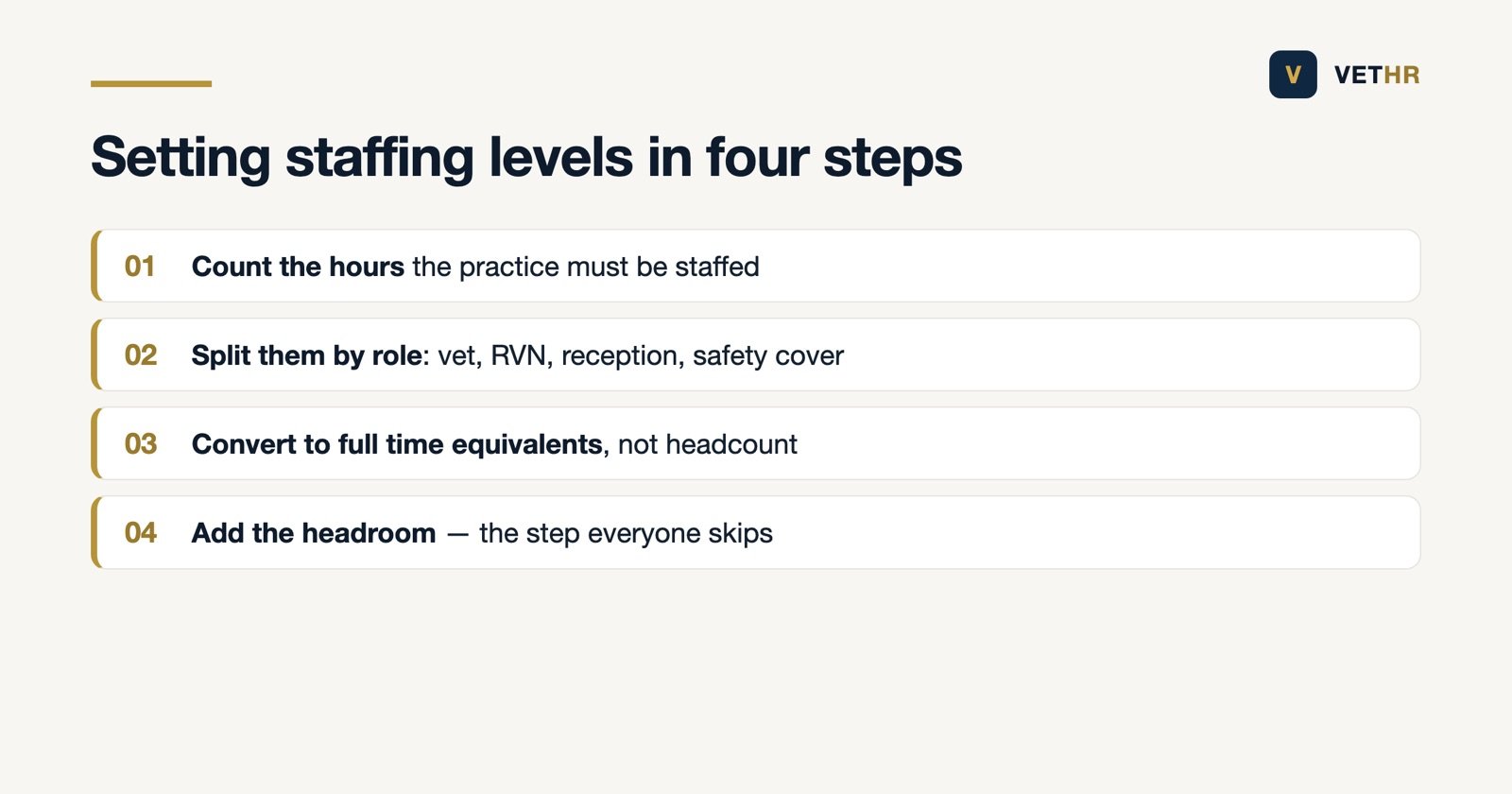
Set staffing levels by working backwards from hours that must be covered, not forwards from how many people you have. Four steps, and a spreadsheet afternoon.
Staffing levels set to exactly the hours you need break the first time anyone is unavailable, and people are unavailable far more of the year than practices plan for.
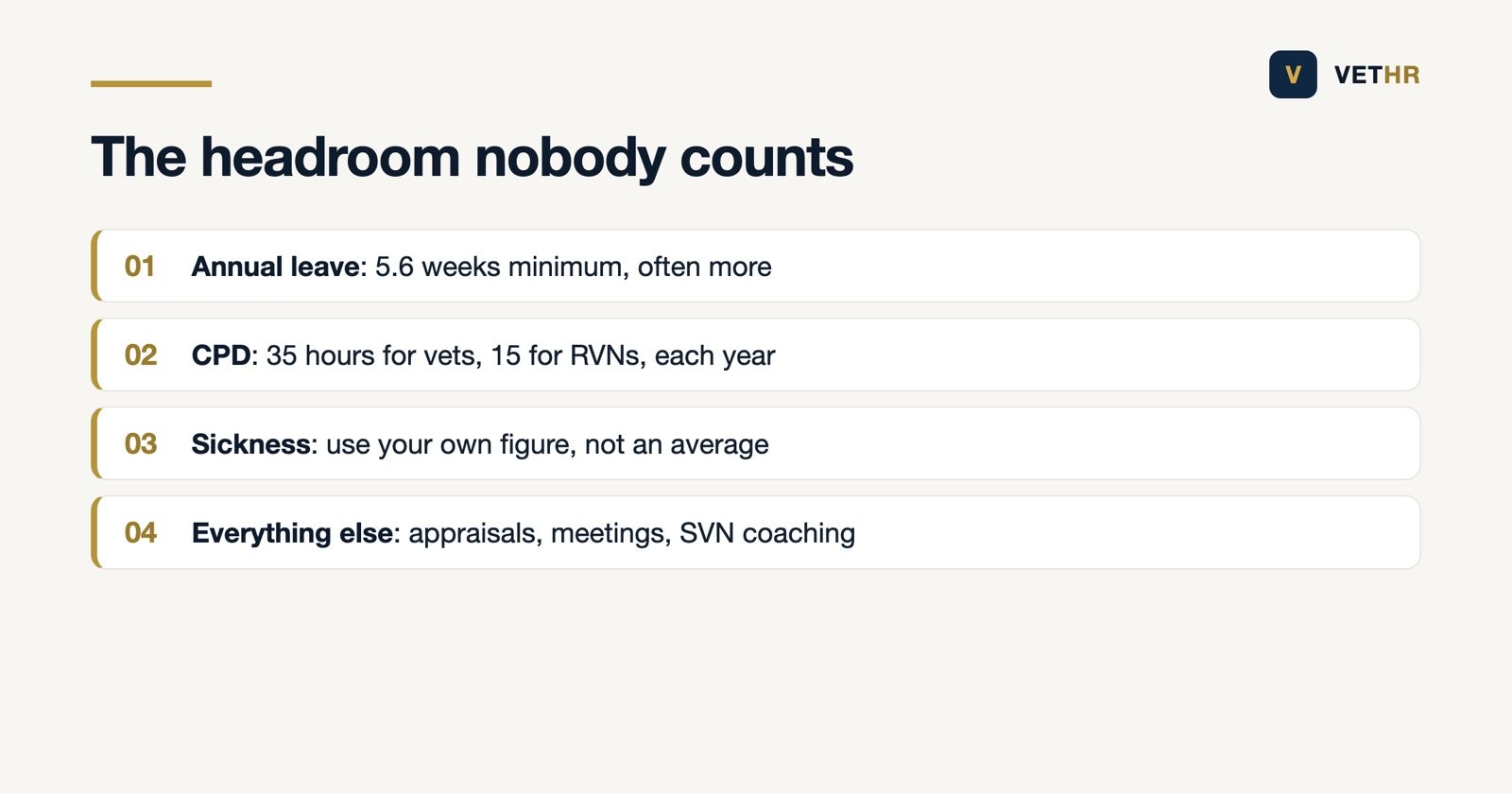
Count it honestly for one full time person:
Add those together and a full time employee is available for materially fewer weeks than the fifty two you rota against. Staffing levels built on fifty two weeks are built on a number that does not exist. Any staffing model that ignores this produces a practice that runs beautifully in March and falls apart in August.
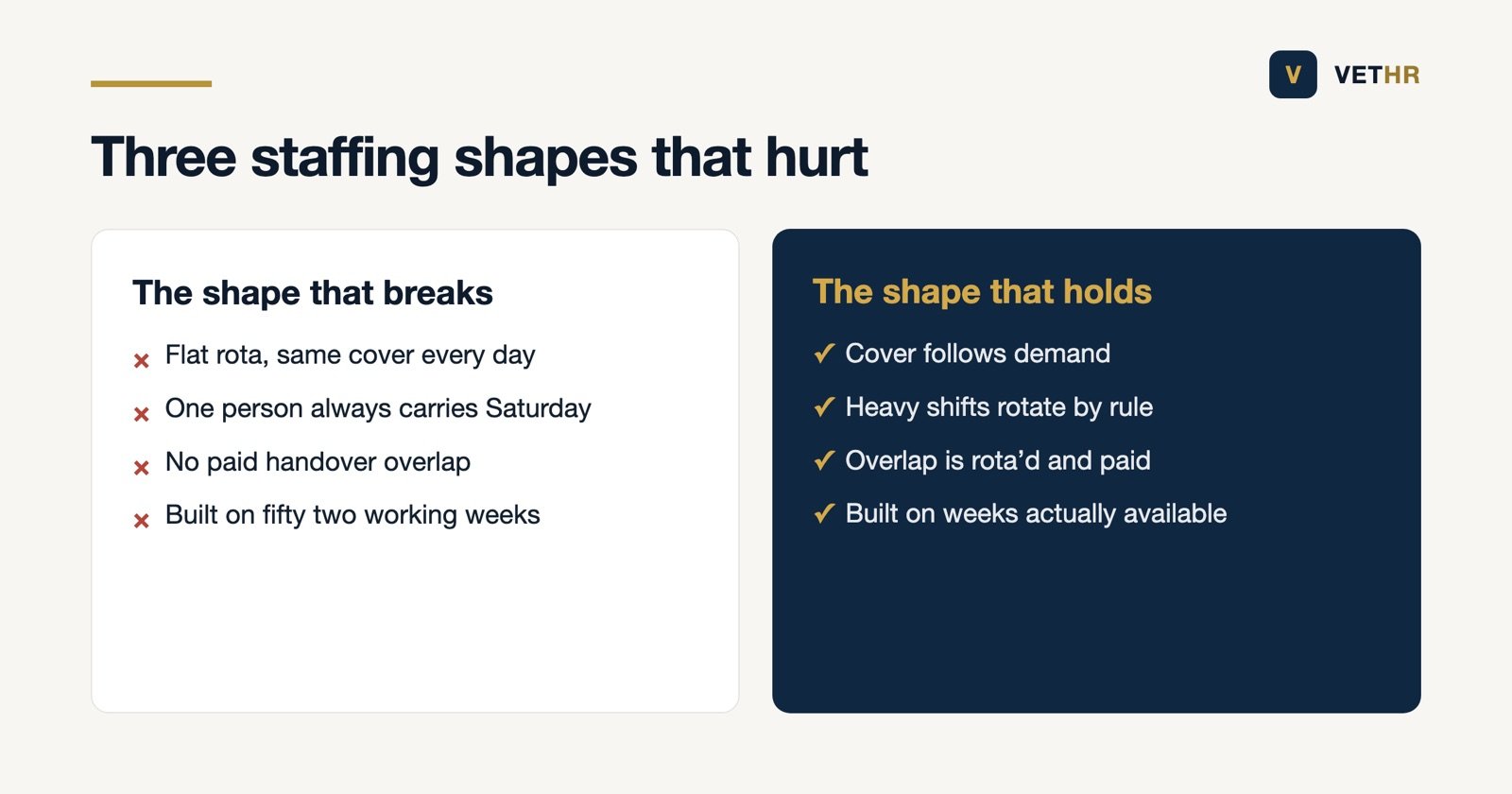
Staffing levels are usually described as a headcount when they are really a shape. Two practices with identical headcount can feel completely different depending on where the hours sit.
Three shapes cause most of the pain:
Fixing shape is usually cheaper than fixing headcount, and it is the first thing to look at before writing a job advert.
Here is the fastest diagnostic for veterinary practice staffing levels, and it takes about a minute.
Take next week’s rota. Remove one RVN. Then remove one vet. Ask what actually happens.
If the answer is that consults get shortened, a list moves, and someone stays late, you are staffed tightly but functioning. If the answer is that you cannot open a branch, or that a single person is left in sole charge with in-patients, you are not understaffed by one person. You were already running with no margin and had not noticed, because the margin was being provided by people quietly absorbing it.
That absorption is the thing that shows up eighteen months later as a resignation. Our guide to the cost of a bad rota puts numbers on it.
There is a compliance dimension to this that is new in 2026. Working out staffing levels properly means knowing hours actually worked, and hours actually worked is now something you are required to be able to evidence.
Since 6 April 2026 employers must keep records adequate to show they have met annual leave obligations, and keep them for six years, as we cover in our guide to the annual leave records duty. Separately, the minimum wage test divides pay by hours worked, so unrecorded early starts and overruns create exposure whatever your headline rates are.
The useful consequence is that the data you need to fix your staffing levels is the same data you are now required to hold. Practices that capture hours properly get a compliance answer and a staffing answer from one piece of work. Acas sets out the basics of working hours if you want the underlying rules.
Often. Recruitment is slow and expensive, and in a market where vets and RVNs are hard to find it is not always available at any price. Before adding a post, check three things.
That third one is worth measuring before you recruit. If the answer is a day a week, systems are cheaper than a person.
Employment law does not set one. Requirements come from the RCVS Practice Standards Scheme where you are accredited, and from health and safety duties, which is a different route to the same answer: enough people to work safely.
Lone working is not prohibited, but it must be risk assessed and controlled. Where in-patients are held, the Practice Standards Scheme requirements on nursing presence apply regardless of what the risk assessment says.
They count as people on the rota but not as registered nurses, and their protected coaching time has to be rota’d rather than assumed. Counting an SVN as an RVN is one of the more common staffing model errors.
Budget for it as a planned line rather than an emergency, because a practice with no headroom will always need some. Then treat a rising freelance spend as the signal it is: your veterinary practice staffing levels are structurally short, not temporarily unlucky.
Per hour, usually not. In overhead, slightly, because handovers, meetings and training are per person rather than per hour. That overhead is normally worth paying, because part time roles are how practices retain experienced people who would otherwise leave.
Most practices asking whether their staffing levels are too low are really asking why the rota feels impossible. Sometimes the answer is another vet. Often it is that the headroom was never built in, registered staff are doing unregistered work, and nobody has counted the admin.
Do the one person off test this week, then do the headroom sum. Our free veterinary rota template has the four week grid and the hours summary set up for exactly that. If you want a second opinion before committing to a salary, our free HR health check covers rota, hours and cover, and you keep the written summary either way.
Read next: Annualised Hours in a Veterinary Practice.
Contracts, rotas, holiday, a difficult conversation. Tell us what you are dealing with and we will come back within one working day. Nothing to sign up to.
Got it. We will come back to you within one working day. If you do not see a reply, please check your spam folder.
