Last updated: 4 September 2026
TL;DR: Most practices run a rota without a veterinary rota policy, which means every decision is a negotiation and every refusal looks personal. A one page policy covering notice, swaps, out of hours, holiday clashes and who decides removes almost all of that. It is not bureaucracy, it is the thing that lets you say no once and be believed.
A veterinary rota policy is the short written statement of how your rota is built, published, changed and disputed. It is not the rota itself and it is not the contract. It sits between them and answers the questions the contract is too general to cover and the rota is too busy to explain.
Practices usually have all of this already. It just lives in the practice manager’s head, which is why it changes depending on who asks and how tired everyone is.
Because an unwritten rule cannot be applied consistently, and rota resentment is the quietest driver of resignations in veterinary practice. Almost every rota argument is really an argument about fairness, and fairness is impossible to demonstrate without a rule that existed before the decision.
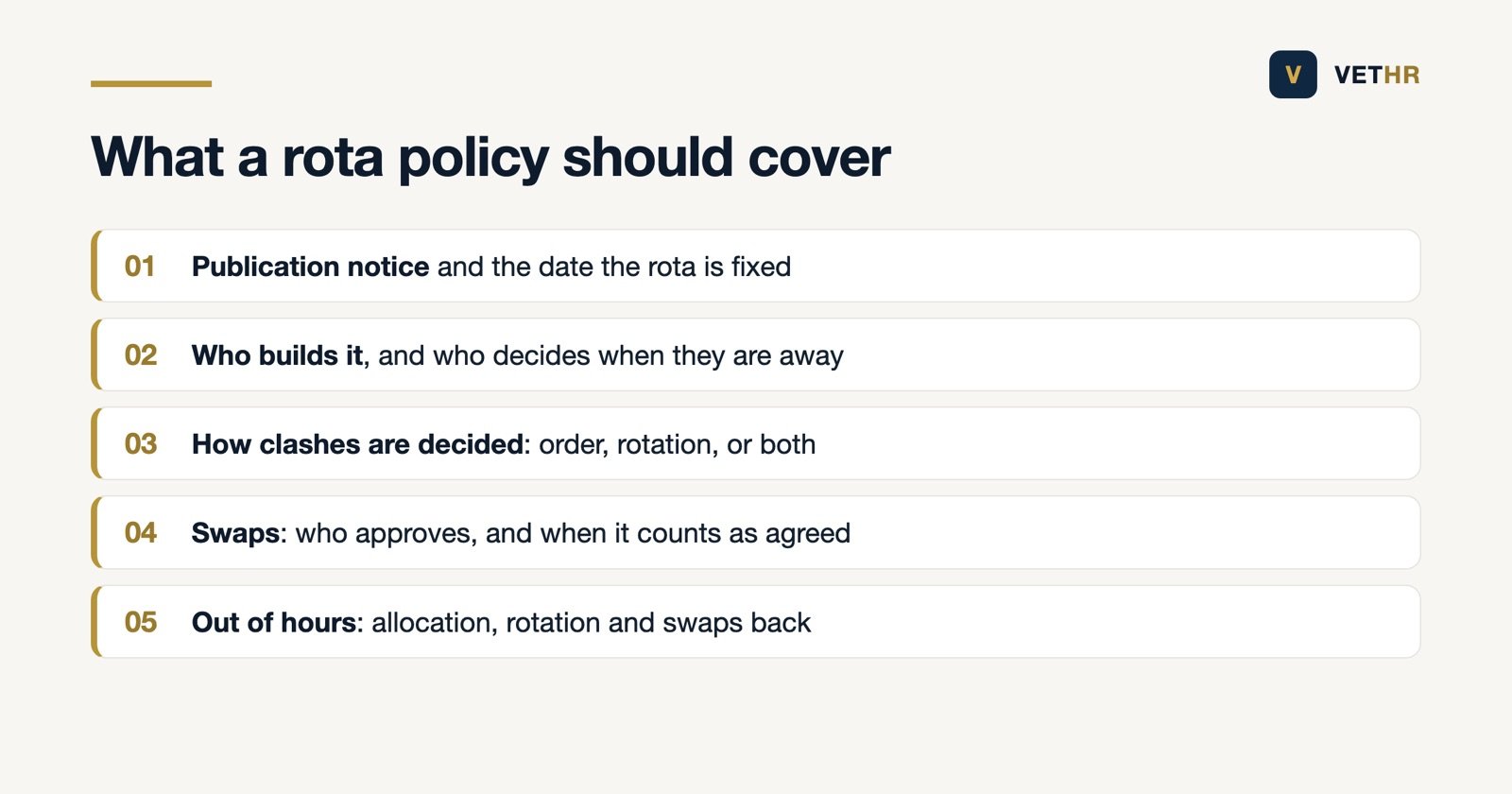
Three things change the day you write a veterinary rota policy down:
Eight sections is plenty for a veterinary rota policy, and one page is the target. If it runs to five pages nobody will read it and you have written a procedure manual instead.
Notice that most of these are decisions rather than rules. The work is not writing the veterinary rota policy, it is agreeing what it says.
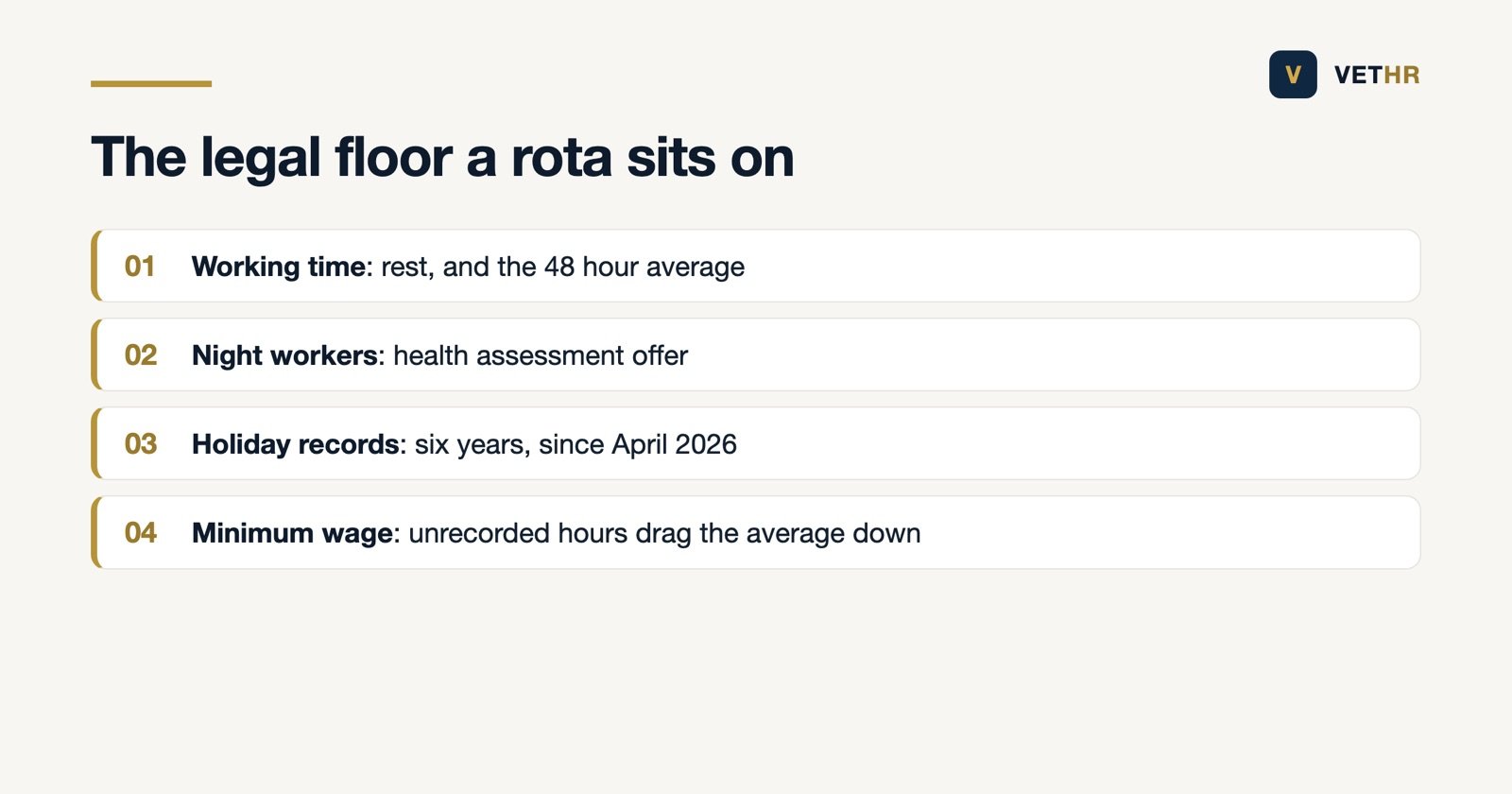
A veterinary rota policy is not a legal document, but it operates on top of several rules that are. Getting these wrong in the policy is how a practice ends up systematically non compliant.
Gov.uk sets out the basic position on maximum weekly working hours, which is the one most practices assume they understand and then apply to the wrong average.
By counting it, publishing the count, and rotating it by a rule rather than by memory. This is the part of a veterinary rota policy that earns its keep. Out of hours resentment almost never comes from doing out of hours. It comes from believing you do more of it than someone else and not being able to prove it.
Three lines in the veterinary rota policy fix most of it. State how many out of hours periods each person is expected to cover over a defined cycle. State how the cycle rotates, including weekends and bank holidays. State what happens when someone genuinely cannot do their turn, and whether they owe it back.
Then publish the running total. A visible count ends the argument faster than any conversation, because it either shows the load is even or it shows you were right to complain.
A swap is not agreed until it is recorded. Everything else about swaps is preference; that one rule is the difference between a functioning rota and a Tuesday morning with nobody on reception.
The failure pattern is always the same. Two people agree something in a WhatsApp group, one of them forgets, and the practice discovers it when a client arrives. Nobody was dishonest. There was simply no record and no approval step.
Your veterinary rota policy should say who may approve a swap, that skill mix must still work afterwards, and that the swap only counts once the rota itself has been changed. If your rota lives in a system with an audit trail, as our rota system does, that last step happens automatically.
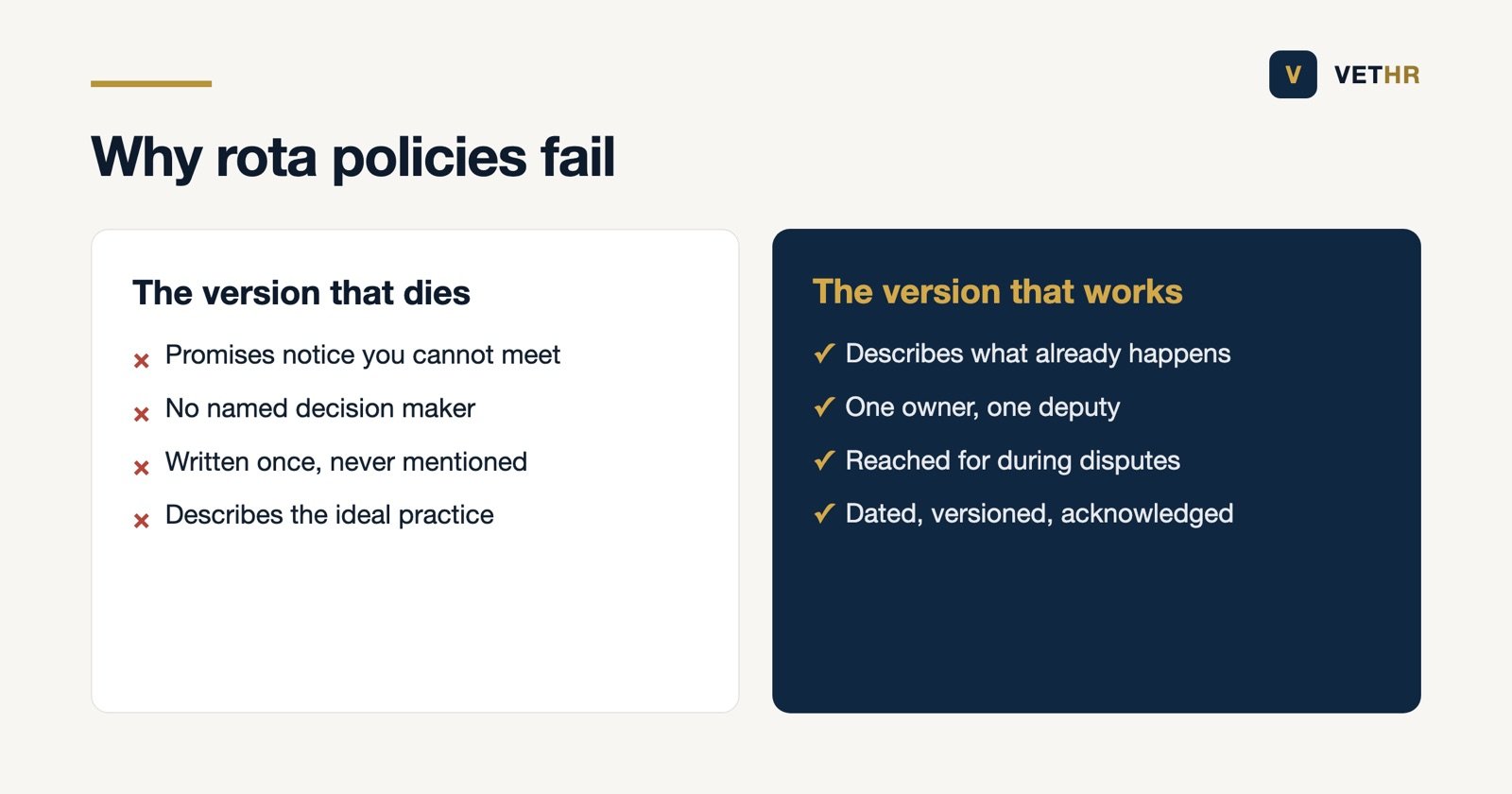
Most practices that have tried this before have a document nobody uses. It usually failed in one of three ways, and all three are avoidable.
The test of a veterinary rota policy is not whether it is comprehensive. It is whether the practice manager reaches for it during a disagreement. If they do not, it is decoration.
Flexible working is a statutory right to request from day one, and a request has to be handled in a reasonable manner within the statutory timeframe. A veterinary rota policy does not override that and should not try to.
What it can usefully do is set out what the practice needs the rota to achieve, so that when a request cannot be accommodated the reason is a stated operational constraint rather than an improvised one. Acas guidance on flexible working sets out the process, and a practice that can point to its minimum cover levels is in a far better position when it has to say no.
Do not announce the veterinary rota policy. Draft it, then ask the team to break it.
Usually not. Keep it as a non contractual policy the contract refers to. That way you can change how the rota works without needing every member of staff to agree a contract variation.
There is no statutory minimum for publishing a rota. Four weeks is a widely used standard and is long enough for people to plan a life. The number matters less than whether you meet the one you promised.
It depends on what the contract allows. Many veterinary contracts include a flexibility clause, but relying on it constantly damages trust faster than almost anything else. Write down what the practice may change and with how much notice, then stay inside it.
Small practices need it most. With four people, one unfair looking weekend is a quarter of the team, and there is nowhere for the resentment to dissipate.
Say so explicitly. State which parts apply to everyone working the rota and which apply only to employees, so nobody assumes a term applies to them that does not.
A veterinary rota policy is a boring document that prevents a large amount of expensive trouble. It will not make the rota easier to build. It will make it possible to defend, which is a different and more useful thing when someone is upset at 7am.
If you would rather start from something, our free veterinary rota template has the cover check, the out of hours count and the leave record already built in. Write the first draft this month, while nothing is on fire. If you want a hand agreeing the difficult clauses, our free HR health check covers rota and policy, and you keep the written summary either way.
Read next: Shift Patterns for a Veterinary Practice.
Contracts, rotas, holiday, a difficult conversation. Tell us what you are dealing with and we will come back within one working day. Nothing to sign up to.
Got it. We will come back to you within one working day. If you do not see a reply, please check your spam folder.
