Last updated: 4 September 2026
TL;DR: Since 6 April 2026 every UK employer must keep annual leave records adequate to show it has met its holiday obligations, and keep them for six years. They must cover entitlement, leave taken, carry over, how holiday pay was calculated and any payment in lieu on leaving, with irregular hours and part year staff included. Failing to keep annual leave records is a criminal offence, and the Fair Work Agency can inspect.
A new regulation 16B was inserted into the Working Time Regulations 1998 by section 35 of the Employment Rights Act 2025. It requires every employer to keep records adequate to show that it has complied with its annual leave obligations. There is no small employer exemption. A two vet branch surgery carries the same duty as a fifteen site group.
This is a genuinely new obligation rather than a restatement of an old one. Employers already had to keep working time records, but nothing previously required a practice to be able to prove, years later, how a particular RVN’s holiday pay was worked out. That is what changed.
The change arrived quietly in a month full of louder ones. Day one statutory sick pay and day one paternity leave took most of the attention, which is covered in our guide to the 2026 employment law changes for veterinary practices. The record keeping duty is the one that is easiest to fail without noticing.
Your annual leave records must be adequate to show you gave each worker the right amount of leave, paid it correctly, and settled anything outstanding when they left. In practice that means five things per person, per leave year.
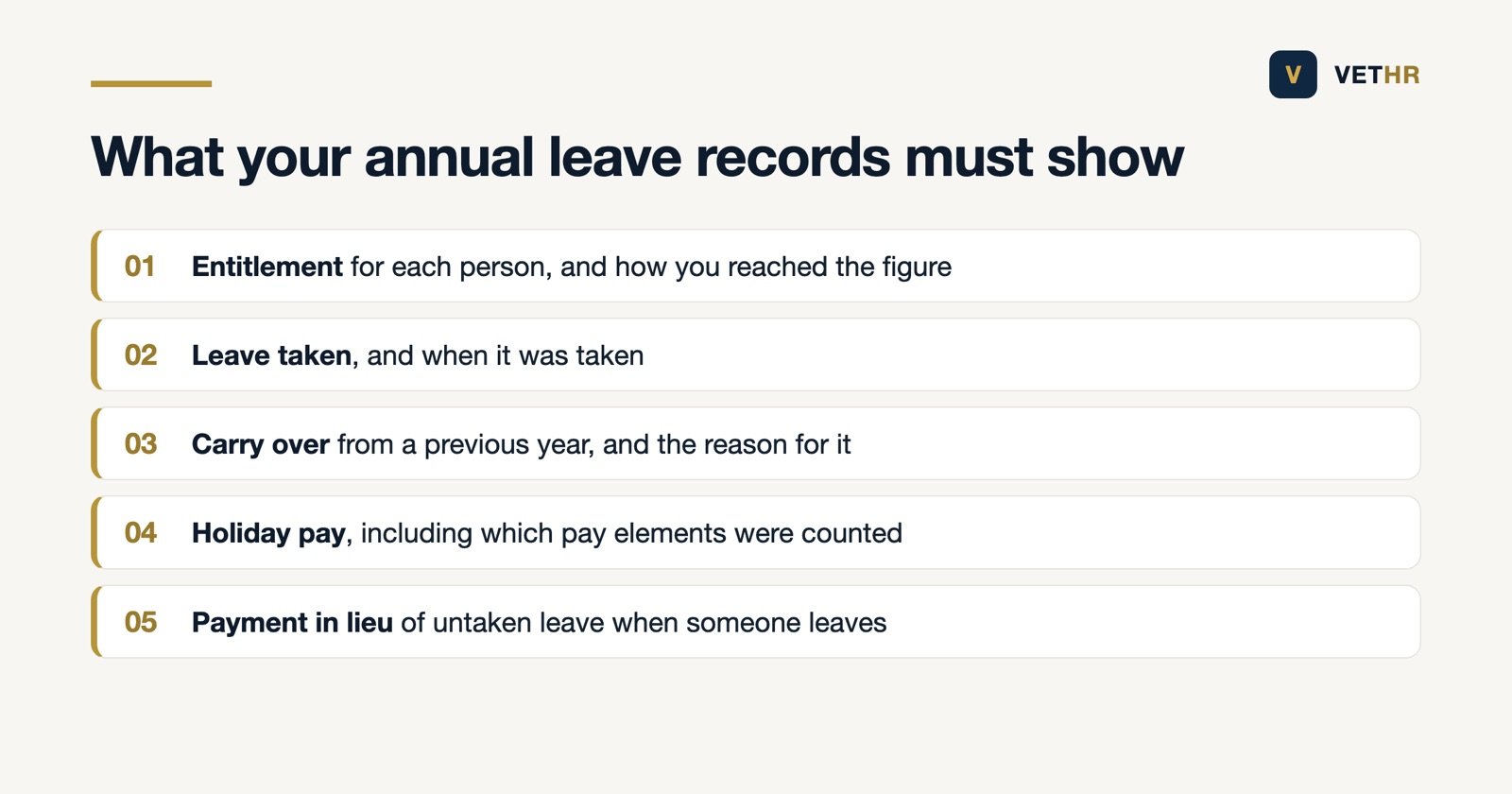
Point four is the one practices consistently miss. Recording that someone took ten days in August is easy. Being able to show, in 2031, which overtime, on call payments and freelance vet cover shifts fed into the average that paid for those ten days is a different discipline entirely.
Acas confirms in its guidance on keeping holiday records that the format is up to you. There is no prescribed form. A spreadsheet is acceptable if it holds the right things and survives.
Because a rota answers a different question. A rota says who is working on Thursday. Annual leave records say what someone was entitled to, what they took, what they were paid for it and how that figure was reached. Most practice rotas are rebuilt every few weeks and overwrite themselves as they go, so the evidence disappears in the ordinary course of use.
Three failure patterns come up again and again in veterinary practices:
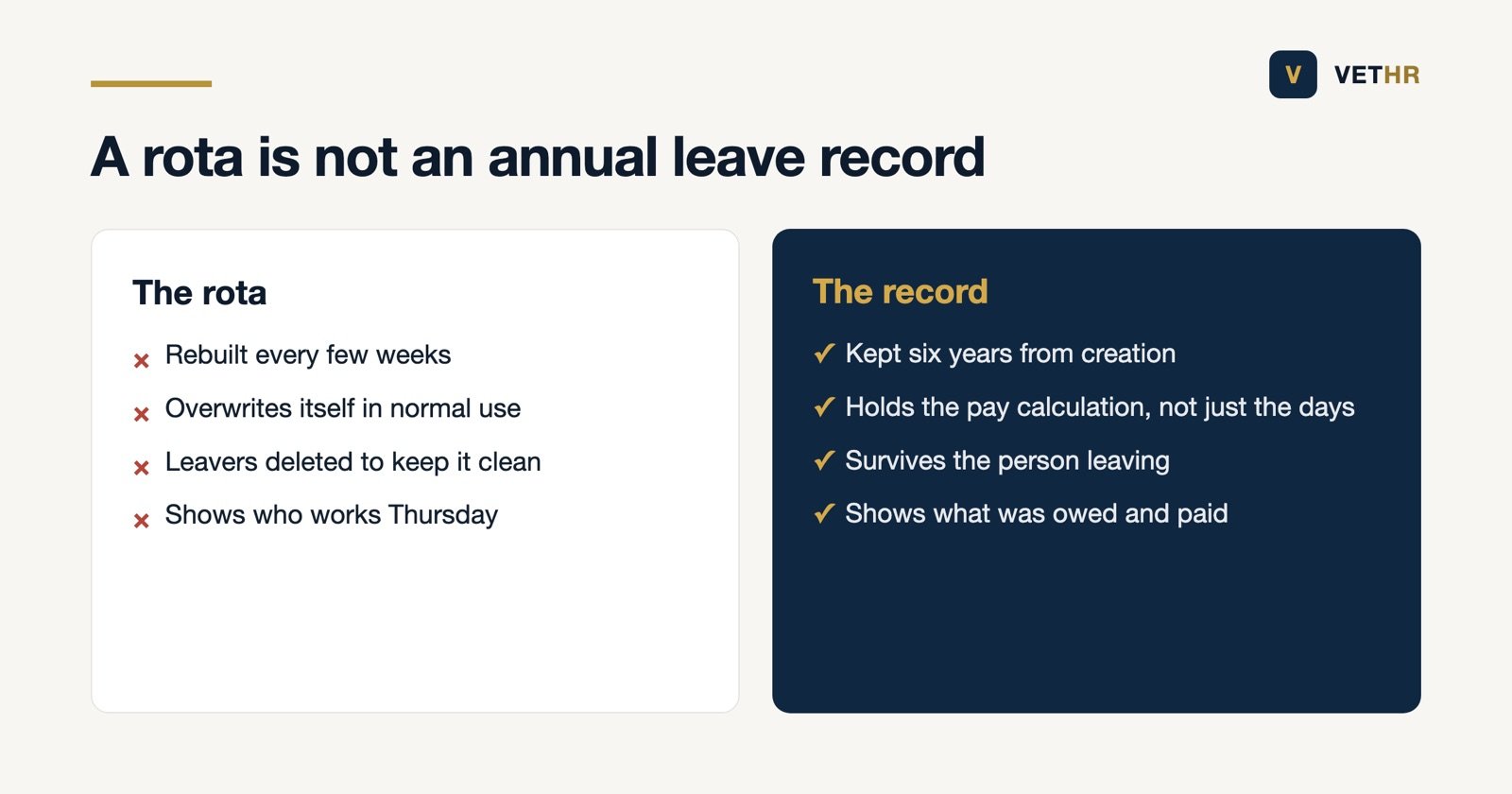
None of these are signs of a badly run practice. They are what happens when a tool built for scheduling is quietly asked to serve as a legal record.
They do not change the duty, but they raise the stakes, because the regulation calls out irregular hours and part year workers specifically. These are exactly the people a veterinary practice employs most: the part time RVN on three variable days, the weekend receptionist, the bank animal care assistant, the vet who picks up out of hours.
For those staff, entitlement accrues in proportion to hours actually worked in each pay period rather than sitting at a fixed number of days. That means your annual leave records have to show a running calculation, not a single figure typed in at the start of the year. If you want to sanity check your own numbers, our holiday entitlement calculator does the arithmetic for both regular and irregular patterns.
The practical test is simple. Pick one part time member of your team. Can you produce, today, the entitlement they accrued last leave year, what they took, and how their holiday pay was worked out? If that takes more than a few minutes, it is not a record.
There is a second wrinkle worth flagging. Holiday pay for variable hours staff is normally averaged over a reference period, which means the figure depends on data from weeks that have nothing to do with the holiday itself. Your annual leave records therefore need to capture the inputs, not just the output, because the input weeks will otherwise be overwritten long before anyone asks.
The regulation asks for records adequate to show compliance, and deliberately does not define the word. That is not unhelpful vagueness. It means the standard is functional: could you, if asked, demonstrate that this person got the leave and the pay they were owed?
A useful working test is the handover test. If your practice manager left tomorrow and someone new sat down at the same desk, could they answer a holiday query about a part time nurse from two years ago using only what is written down? If the answer depends on a conversation with the person who left, the annual leave records are not adequate yet.
Adequate does not mean elaborate. A single well structured sheet per person, holding entitlement, leave taken, carry over and the pay calculation, satisfies the duty comfortably. What fails is not a lack of sophistication, it is a lack of durability: annual leave records that only exist inside a file being edited by four people at once.
Six years from the date the record was made. The clock runs from 6 April 2026 onwards, so nothing created before that date falls under the new duty, and the first records you made under it must survive until 2032.
Six years is longer than most practice software retains annual leave records by default, and considerably longer than the average life of a shared spreadsheet. It is also longer than many people stay. Build the retention decision in now, including what happens to a leaver’s record, because retrofitting it later is not possible.
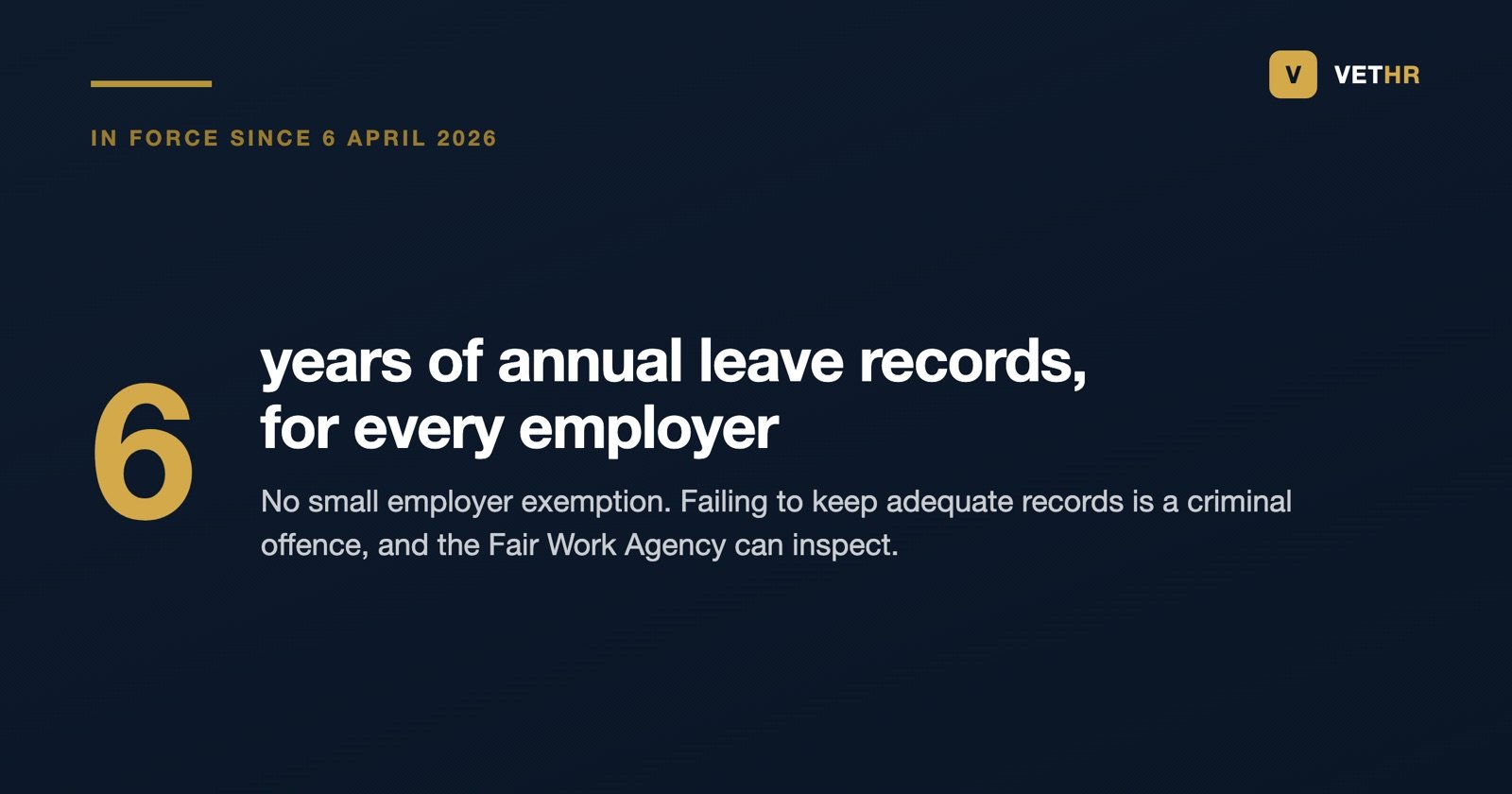
Failing to keep adequate annual leave records is a criminal offence, punishable by a fine up to the statutory maximum. That is a meaningful shift. Most holiday disputes used to end at an employment tribunal as a civil matter between employer and worker; this duty sits in a different category.
Enforcement sits with the Fair Work Agency, which became operational on 7 April 2026 and can inspect business premises and documentation. Its powers are being phased in: statutory sick pay and parts of the enforcement remit moved across in April 2026, while national minimum wage enforcement transfers from HMRC and holiday pay enforcement begins in April 2027. The record keeping duty itself bites now, so the year before that is the window to get the record straight.
There is a second, quieter risk. Where a worker claims underpaid holiday, the absence of records makes the claim considerably harder to defend. The practice that can show its working usually resolves these in a fortnight. The practice that cannot is arguing from memory.
Five steps, in order, and none of them require new software on day one.
Steps one, two and four cost nothing but a decision. If the arithmetic itself is the problem, our holiday calculations system keeps entitlement, accrual and the pay calculation in one place per person, which is the shape the record has to take anyway.
No. The regulation lets you keep records in whatever manner and format you reasonably think fit. Paper is legally acceptable. The practical question is whether it will still be findable and legible in six years, which is where paper usually loses.
Yes. There is no small employer exemption in regulation 16B. Every employer carries the same duty regardless of headcount, unlike the health and safety rule that only requires written risk assessments at five or more employees.
You need them for anyone with statutory annual leave entitlement, which includes workers as well as employees. Genuinely self employed freelance vet cover engaged through their own business is a different analysis, and worth checking rather than assuming.
Six years from when each record was made, and the duty only bites on records created from 6 April 2026. You are not required to reconstruct history, but you are required to start now and keep going.
Usually not. Payroll shows what was paid, rarely the entitlement it was drawn against or the carry over position. Most practices need the payroll output plus a leave record that reconciles to it.
Nobody went into veterinary work to maintain annual leave records for six years. But this duty is unusually cheap to satisfy if you start now and unusually expensive to fix later, because the evidence you need is being overwritten this week.
Decide where your annual leave records live, who owns them, and how the holiday pay calculation gets captured. That is most of the job. If you want a second pair of eyes, our free HR health check covers holiday, contracts and policies, and you keep the written summary either way. You can also start with the veterinary employment contract template, which now carries the record keeping clause as standard.
Read next: Carrying Over Holiday in a Veterinary Practice.
Contracts, rotas, holiday, a difficult conversation. Tell us what you are dealing with and we will come back within one working day. Nothing to sign up to.
Got it. We will come back to you within one working day. If you do not see a reply, please check your spam folder.
